Databricks Course: Master Spark, PySpark, Delta Lake, Unity Catalog & Lakehouse
Data is growing rapidly across every industry, and organizations need modern platforms to store, process, transform, and analyze massive volumes of data efficiently.
Databricks is a modern Data + AI platform built around the Lakehouse architecture, bringing data engineering, analytics, machine learning, and AI workloads together on a unified platform.
For professionals looking to build a career in Data Engineering, Big Data, Cloud Data Engineering, and Analytics, learning Databricks along with SQL, Python, PySpark, Spark, and Delta Lake can provide a strong technical foundation.
What is Databricks?
Databricks is a cloud-based platform designed for building, managing, and scaling modern data, analytics, and AI solutions.
It provides an integrated environment where data engineers can work with:
- SQL
- Python
- Apache Spark
- PySpark
- Spark SQL
- Delta Lake
- Unity Catalog
- Data pipelines
- Cloud storage
- Data analytics
- Machine learning and AI
Databricks combines data lake and data warehouse capabilities through the Lakehouse architecture, helping organizations work with different types of workloads on a common data platform.
Why Learn Databricks?
Traditional data platforms often require separate systems for data lakes, data warehouses, data processing, and analytics.
Databricks provides a unified environment for modern data engineering and analytics.
Some important reasons to learn Databricks include:
- Growing demand for Cloud Data Engineers
- Big Data processing with Apache Spark
- Python and PySpark-based ETL development
- Modern Lakehouse architecture
- Delta Lake-based data management
- Centralized governance with Unity Catalog
- Batch and streaming data processing
- Cloud data engineering
- Real-time analytics
- Data engineering for AI and machine learning
Databricks documentation describes the platform as a unified foundation for ETL, machine learning/AI, and data warehouse/BI workloads.
What Does a Databricks Professional Do?
A Databricks professional generally works on designing, developing, maintaining, and optimizing modern data pipelines.
A Databricks Data Engineer may be responsible for:
- Extracting data from different sources
- Building ETL and ELT pipelines
- Transforming large datasets
- Developing Spark and PySpark applications
- Creating Delta Lake tables
- Implementing Lakehouse architecture
- Building batch and streaming pipelines
- Loading incremental data using Auto Loader
- Managing data using Unity Catalog
- Implementing data quality and governance
- Optimizing data processing workloads
- Preparing curated datasets for analytics and AI
Databricks provides data engineering capabilities for ingestion, transformation, and orchestration through its modern data engineering platform.
Key Components of Databricks
A Databricks professional should understand several important technologies and concepts.
Apache Spark
Apache Spark is a distributed processing engine used to process large volumes of data efficiently.
Databricks provides a managed environment for working with Spark and related data engineering workloads.
Python & PySpark
Python is widely used in data engineering, while PySpark allows developers to work with Apache Spark using Python.
PySpark can be used for:
- Data transformation
- ETL pipelines
- Data cleansing
- Data aggregation
- Large-scale data processing
- Analytics
Spark SQL
Spark SQL allows professionals to query and transform data using SQL.
This is particularly useful for SQL developers who want to transition into modern data engineering.
Delta Lake
Delta Lake is a storage layer used by Databricks to provide reliable data management capabilities.
It supports capabilities such as:
- ACID transactions
- Reliable data pipelines
- Table versioning
- Time travel
- Data updates
- Data deletes
- Schema management
Databricks documentation describes Delta Lake as the optimized storage layer that provides the foundation for Databricks tables.
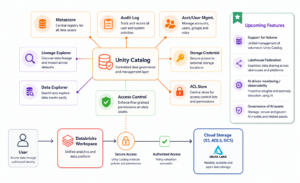
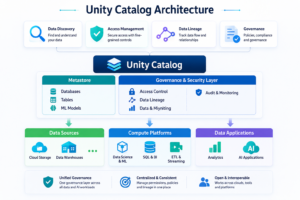
Unity Catalog
Unity Catalog provides centralized governance for data and AI assets.
It supports capabilities including:
- Access control
- Data discovery
- Data lineage
- Auditing
- Centralized governance
Unity Catalog organizes data using a catalog → schema → table structure and provides governance across Databricks workspaces.
Auto Loader
Auto Loader is used for incremental data ingestion from cloud storage.
It can detect and process new files as they arrive, making it useful for scalable ingestion pipelines and real-time or near-real-time workloads.
Lakehouse Architecture
The Lakehouse architecture combines important capabilities of data lakes and data warehouses.
It can provide a common environment for:
- Data Engineering
- Business Intelligence
- Analytics
- Machine Learning
- AI workloads
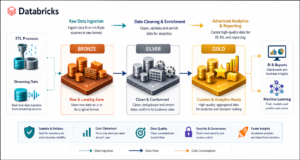
A common Lakehouse implementation uses layers such as Bronze, Silver, and Gold, commonly known as the Medallion Architecture.
Tools Used in Databricks
Professionals working with Databricks commonly work with a combination of technologies and tools.
Core Technologies
- SQL Server / MSSQL
- T-SQL
- SQL
- Python
- Apache Spark
- PySpark
- Spark SQL
- Delta Lake
- Unity Catalog
- Auto Loader
- Lakehouse
- Cloud Storage
- ETL / ELT
Databricks Environment
Professionals can work with:
- Databricks Workspace
- Databricks Notebooks
- Compute
- SQL Warehouses
- Jobs and Workflows
- Delta Tables
- Unity Catalog
- Data Pipelines
Databricks’ own learning materials identify the workspace, notebooks, Unity Catalog, Delta Lake, and data engineering workflows as foundational areas for data engineers.
Databricks Course – Complete Training Modules
The SQL School Databricks Course is structured to build skills progressively, starting with SQL Server and moving toward modern Databricks Data Engineering.
Module 1: SQL Server (MSSQL) & T-SQL
The course begins with a strong SQL foundation.
Topics include:
- SQL Server fundamentals
- Database concepts
- Tables and relationships
- SELECT queries
- Joins
- Subqueries
- Functions
- Stored Procedures
- Views
- Transactions
- CTEs
- Window Functions
- T-SQL programming
- Real-world SQL scenarios
A strong SQL foundation helps learners understand data transformation before moving into Spark SQL and PySpark.
Module 2: Databricks Data Engineering – Spark, Python & PySpark
This module focuses on modern Databricks Data Engineering.
Phase 1: Databricks Fundamentals, Architecture & Unity Catalog
Learn:
- Databricks fundamentals
- Databricks workspace
- Lakehouse architecture
- Databricks architecture
- Compute concepts
- Notebooks
- Unity Catalog
- Catalogs
- Schemas
- Tables
- Data governance
- Access control
- Data lineage
Unity Catalog provides centralized governance, lineage, auditing, and data discovery capabilities within Databricks.
Phase 2: Spark SQL
Learn how to use SQL with Apache Spark.
Topics include:
- Spark SQL fundamentals
- DataFrames
- SQL queries
- Filtering
- Joins
- Aggregations
- Window functions
- Data transformation
- Querying large datasets
This phase helps SQL professionals transition their existing SQL knowledge into distributed data processing.
Phase 3: Python ETL & Analytics
Learn Python for data engineering and analytics.
Topics include:
- Python fundamentals
- Variables and data types
- Collections
- Functions
- Exception handling
- File processing
- Data transformation
- ETL development
- Data analysis
The objective is to build practical Python skills required for modern data engineering.
Phase 4: PySpark, Medallion Architecture, Delta Lake, Auto Loader & Lakehouse
This phase focuses on core Databricks Data Engineering skills.
PySpark
Learn how to process large datasets using Python and Spark.
Medallion Architecture
Understand:
Bronze → Silver → Gold
- Bronze – Raw data
- Silver – Cleaned and transformed data
- Gold – Business-ready data
Delta Lake
Learn how to create and manage reliable Delta tables and perform data operations.
Auto Loader
Learn incremental data ingestion from cloud storage.
Lakehouse
Understand how data lakes and data warehouses can work together within a modern Lakehouse architecture.
Databricks tutorials demonstrate ETL workflows using Spark, Auto Loader, Delta Lake, notebooks, and jobs.
Module 3: Databricks Real-Time Retail Project for Resume
Learning concepts alone is not enough for a Data Engineering career.
This module focuses on a Real-Time Retail Data Engineering Project designed to provide practical project experience.
A retail project can include data such as:
- Customers
- Products
- Orders
- Transactions
- Stores
- Sales
- Inventory
- Customer activity
The project can demonstrate an end-to-end data engineering workflow:
Source Data → Ingestion → Bronze → Silver → Gold → Analytics
Learners can work with SQL, Python, PySpark, Delta Lake, Auto Loader, and Lakehouse concepts to develop a project that demonstrates practical data engineering skills.
Module 4: Databricks Certification, Interview & Career Preparation
The final module focuses on preparing learners for the next stage of their career.
Topics include:
- Databricks certification preparation
- Important technical concepts
- SQL interview questions
- PySpark interview questions
- Spark interview questions
- Delta Lake interview questions
- Databricks scenario-based questions
- Data Engineering interview preparation
- Resume preparation
- Project explanation
- Career guidance
Certification preparation should be combined with hands-on practice because real-world Data Engineering roles require the ability to design and implement data workflows, not just remember concepts.
Databricks Career Opportunities
Databricks skills can be applied across modern data and analytics teams.
Possible career paths include:
Databricks Data Engineer
Designs and develops data pipelines using technologies such as Spark, Python, PySpark, SQL, Delta Lake, and Databricks.
Cloud Data Engineer
Builds scalable data solutions using cloud platforms and modern data engineering technologies.
Big Data Engineer
Works with large-scale datasets using distributed processing technologies such as Apache Spark.
PySpark Developer
Develops data transformation and processing solutions using Python and PySpark.
Data Platform Engineer
Works on the infrastructure, pipelines, governance, and platforms required to support enterprise data workloads.
ETL Developer
Builds pipelines to extract, transform, and load data from multiple sources.
Data Analytics Engineer
Transforms raw data into reliable, analytics-ready datasets for reporting and business intelligence.
Databricks Career Roadmap
A learner can gradually build a career path such as:
SQL → T-SQL → Python → Spark → PySpark → Spark SQL → Delta Lake → Unity Catalog → Auto Loader → Lakehouse → Real-Time Projects → Certification → Data Engineering Career
This approach allows SQL professionals to build upon their existing database knowledge while moving toward modern cloud data engineering.
Who Should Learn Databricks?
Databricks training can be useful for:
- SQL Developers
- SQL DBAs
- Data Engineers
- ETL Developers
- BI Developers
- Data Analysts
- Python Developers
- Cloud Professionals
- Big Data Professionals
- Professionals transitioning into Data Engineering
- Freshers interested in modern data technologies
Learners with SQL experience can particularly benefit from the combination of SQL + Python + PySpark + Databricks.
Skills You Can Build Through Databricks Training
After completing the course, learners can build skills in:
✔ SQL & T-SQL
✔ Python
✔ Apache Spark
✔ PySpark
✔ Spark SQL
✔ ETL & ELT
✔ Delta Lake
✔ Auto Loader
✔ Unity Catalog
✔ Medallion Architecture
✔ Lakehouse Architecture
✔ Data Pipeline Development
✔ Cloud Data Engineering
✔ Real-Time Data Processing
✔ Data Engineering Projects
Why Choose Practical Databricks Training?
Databricks is best learned by combining concepts with hands-on implementation.
A practical learning approach helps learners understand how data moves through a real pipeline rather than learning individual tools separately.
The training path combines:
SQL Foundation + Python + Spark + PySpark + Databricks + Delta Lake + Auto Loader + Lakehouse + Real-Time Project + Interview Preparation
Databricks’ current learning resources also emphasize hands-on workflows involving notebooks, Unity Catalog, Delta Lake, and data engineering tasks.
Frequently Asked Questions – Databricks Course
1. What is Databricks?
Databricks is a cloud-based platform for data engineering, analytics, machine learning, and AI.
2. What is Databricks Data Engineering?
It involves building scalable data pipelines using SQL, Python, Spark, PySpark, and Databricks.
3. Why should I learn Databricks?
Databricks helps build modern cloud data engineering skills using Spark, Lakehouse, Delta Lake, and related technologies.
4. Is Databricks suitable for beginners?
Yes, beginners can learn Databricks with a structured foundation in SQL, Python, and data engineering concepts.
5. Do I need SQL knowledge to learn Databricks?
Basic SQL knowledge is highly beneficial for learning Databricks and Spark SQL.
Conclusion
Databricks has become an important technology in modern data engineering because it brings together data processing, analytics, governance, and AI capabilities around a Lakehouse-based platform.
For professionals planning a career in Databricks, learning SQL, Python, Apache Spark, PySpark, Spark SQL, Delta Lake, Unity Catalog, Auto Loader, and Lakehouse architecture provides a strong technical foundation.
The SQL School Databricks Course follows a structured path from MSSQL & T-SQL → Spark & Python → PySpark → Delta Lake → Auto Loader → Lakehouse → Real-Time Retail Project → Certification & Career Preparation.
Start Your Databricks Journey
🚀 Learn Databricks. Build Real-Time Projects. Prepare for Interviews. Advance Your Data Engineering Career.
Join SQL School’s Databricks Course and take the next step toward becoming a job-ready Data Engineer.
📞 Call / WhatsApp: +91 9666440801 | +91 9951440801
🌐 Website: sqlschool.com
Trainer: Mr. Sai Phanindra
Book Your FREE Demo Session Today!
#Databricks #DatabricksTraining #DatabricksCourse #DataEngineering #DataEngineer #PySpark #ApacheSpark #SparkSQL #DeltaLake #UnityCatalog #Lakehouse #Python #SQL #TSQL #CloudDataEngineering #BigData #ETL #DataEngineeringCareer #DatabricksCertification