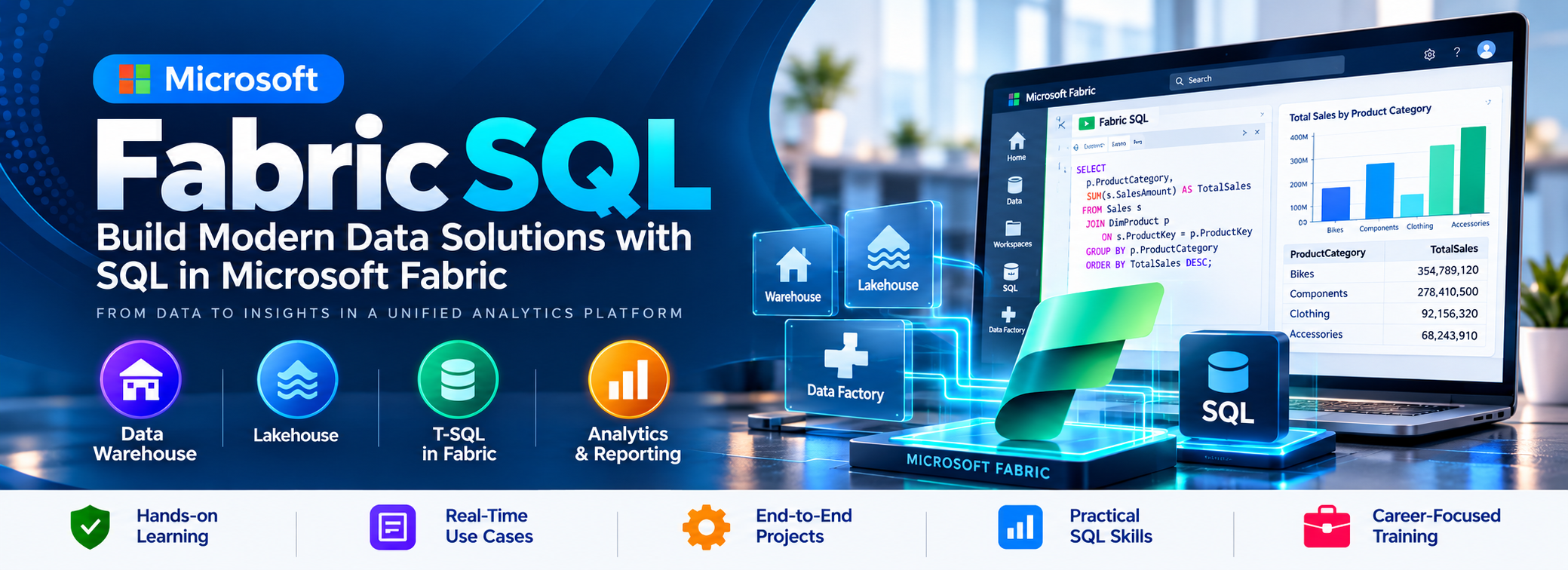
#Fabric Data Engineer With SQL

Master Fabric SQL with Microsoft T-SQL through practical, project-based training. Learn advanced T-SQL, query tuning, Azure SQL, Microsoft Fabric, AI/Copilot and GitHub while working on two real-time projects. Includes DP-800 guidance, interview preparation and career support.

Training Highlights

✅ 400+ SQL Queries for practical learning
✅ MSSQL & Advanced T-SQL Programming
✅ SQL Query Tuning & Execution Plans
✅ Azure SQL & Cloud Migrations
✅ Microsoft Fabric SQL + AI/Copilot
✅ Git & GitHub for SQL Projects
✅ 2 Real-Time Projects – Healthcare & Banking
✅ DP-800 Exam Guidance

Modules We Learn

✅ Module 1: MSSQL & TSQL
✅ Module 2: TSQL Programming
✅ Module 3: Query Tuning
✅ Module 4: SQL Server in Cloud (Azure, Fabric)
✅ Module 5: Real-Time Projects
✅ Module 6: Interview & Career Preparation

Course Duration: 9 Weeks
Fabric With SQL Course Contents:

Module 1: MSSQL & TSQL

Ch 1: SQL Database Job Roles

  • Database Intro
  • OLTP, DWH, OLAP
  • DBMS Basics
  • SQL Database Job Roles

Ch 2: Database Intro & Installations

  • SQL Server Installations
  • Instance & Collations
  • SSMS Tool Installation
  • Connections, Authentications

Ch 3: SQL Basics V1 (Commands)

  • SQL Basics (DDL, DML, etc..)
  • Creating Databases, Tables
  • Data Inserts (GUI, SQL)
  • Basic SELECT Queries

Ch 4: SQL Basics V2 (Commands, Operators)

  • DDL: Create, Alter, Drop
  • DML: Insert, Update, Delete
  • DQL: Select, Fetch
  • Add, Truncate Statements
  • SQL Operators

Ch 5: Data Types & Variables

  • Integer Data Types
  • Character, MAX Data Types
  • Decimal & Boolean Data Types
  • Date and Time Data Types
  • SQL_Variant Type

Ch 6: Data Imports

  • Data Imports with Excel
  • Data Imports with CSV
  • Data Types Detection
  • OLE-DB Connections
  • ORDER BY, TOP, OFFSET

Ch 7: Schemas & Batches

  • Schemas & Table Grouping
  • Real-world Banking Database
  • 2 Part, 3 Part & 4 Part Naming
  • Batch Concept & “Go” Command

Ch 8: Constraints, Keys & RDBMS

  • Null, Not Null Constraints
  • Unique Key & Check
  • Primary Key Constraint
  • Foreign Keys, Default
  • DB Diagrams & ER Models

Ch 9: Normal Forms & RDBMS

  • Normal Forms: 1 NF, 2 NF
  • 3 NF, BCNF and 4 NF
  • 1:1, 1:M, M:1 Cardinality
  • Cascading Keys, Self Referencing Keys

Ch 10: Joins & Queries

  • Joins: Table Comparisons
  • Inner Joins & Matching Data
  • Outer Joins: LEFT, RIGHT
  • Full Outer Joins & Aliases
  • Self Joins & Aliases

Ch 11: Sub Queries

  • Basic Sub Queries
  • Aggregations
  • Combining Queries
  • Correlated Sub Queries
  • UNION, UNION ALL

Ch 12: Group By Queries

  • Group By, Distinct
  • GROUP BY, HAVING
  • Cube( ) and Rollup( )
  • Sub Totals & Grand Totals
  • Grouping( ) & Usage
  • ISNULL, COALESCE

Ch 13: Joins with Group By, Sub Queries

  • 3 Table, 4 Table Joins
  • Join Queries & WHERE
  • Join & Group By, Sub Queries
  • IIF(), CASE Statement
  • EXISTS, NOT EXISTS
  • Query Execution Order

Ch 14: Views & RLS

  • Views: Realtime Usage
  • DML, SELECT with Views
  • WITH CHECK OPTION
  • Row Level Security (RLS)
  • Important System Views

Ch 15: Functions & Queries

  • User Defined Functions
  • Scalar, Table Value Functions
  • Variables & Parameters
  • Date & Time Functions
  • String Functions
  • Aggregated Functions
  • Data Conversion Functions

Ch 16: Advanced SQL & Window Functions

  • Window Functions (Rank)
  • Row_Number, DenseRank
  • Partition By & Order By
  • Lag & Lead Functions
  • Pivot, UnPivot
  • Running Totals
  • Moving Average

Ch 17: Stored Procedures – 1

  • Stored Procedures: Realtime Use
  • Parameters Concept with SPs
  • Procedures with SELECT
  • System Stored Procedures
  • Stored Procedures, Tuning

Ch 18: Stored Procedures – 2

  • Merge Statement (Upsert)
  • Merge with OLTP & DWH
  • Matched and Not Matched
  • Merge & SP Recompilations

Ch 19: Triggers & Automations

  • Need for Triggers in Real-world
  • DDL & DML Triggers
  • For / After Triggers
  • Instead Of Triggers
  • Disabling DMLs Triggers

Ch 20: Transactions & ACID

  • Auto Commit Transaction
  • Explicit Transactions
  • COMMIT, ROLLBACK
  • Checkpoint & Query Blocking
  • READPAST, LOCKHINT
  • TRY…CATCH & Error Handling

Ch 21: SQL Query Performance & Indexing

  • Clustered vs Nonclustered Indexes
  • Index Seek vs Scan
  • Execution Plans
  • SARGable Queries
  • Tuning Queries
  • Avoiding SELECT *
  • Indexing JOIN/WHERE columns
  • Statistics Basics
  • Query Optimization Examples

Ch 22: CTEs & Tuning

  • Common Table Expression
  • CTEs for Data Retrieval
  • CTEs for DML Operations
  • Data Cleansing Techniques
  • Duplicate Detection/Removal

Ch 23: Temp Tables & Advanced Query Techniques

  • Local & Global Temp Tables
  • SELECT..INTO Statement
  • Cursor Basics – When to Use & Avoid
  • NULLIF
  • Basic Execution-Plan Reading

Ch 24: Bonus / Advanced Module: SQL Server Internals

  • Database Engine Components
  • Parser, Compiler & Optimizer
  • Parsing and Compilation
  • Memory Manager & IO Managers

Module 2: TSQL Programming

Ch 25: Variables & Try..Catch

  • Variables: Declaration & Usage
  • Assigning Values to Variables
  • SELECT & SET Operations
  • Try.. Catch Block with Variables
  • THROW Statement, Error Handling

Ch 26: Updatable Views

  • Using Triggers with Views
  • Updatable Views, DML
  • Views & Stored Procedures
  • Data Distributions in Tables
  • Rollback Options in Realtime

Ch 27: Stored Procedures & TVPs

  • Using TVP with Procedures
  • Creating User Defined Types
  • Big Data Copy & Transactions
  • Transactional Integrity with SPs
  • Conditional Commits, Rollbacks
  • Procedure Recompilations

Ch 28: Stored Procedures, Cursors

  • Cursors Types: Local, Global
  • FETCH and Iterations
  • Procedures with Cursors
  • Formatting Queries, Nvarchar
  • WHILE Loop: @Fetch Status
  • sp_executesql Extended SP
  • Dynamic SQL Programming

Ch 29: SPs & Recursive CTEs

  • CTEs: Common Table Expression
  • CTEs For DML Operations
  • Defining Recursive CTEs
  • Anchor Element: Realtime Use
  • Termination Checks and Loops
  • Cautions with Recursive CTEs

Ch 30: Functions & Loops

  • Inline, Table Line Functions
  • Multi Line Table Functions
  • Using LOOPs in Functions
  • Table Generation Logic
  • Date & Time Data Types
  • Calendar Data Generations

Ch 31: Open Fuzzy Logic, Debugging

  • EDIT_DISTANCE_SIMILARITY
  • JARO_WINKLER_DISTANCE
  • MATCH Operator, OPENROWSET
  • JSON_OBJECT
  • JSON_ARRAY
  • JSON_ARRAYAGG
  • JSON_CONTAINS

Ch 32: PIVOT, UNPIVOT

  • Reading Denormalized Data
  • PIVOT Operation with TSQL
  • PIVOT with Aggregates
  • UNPIVOT with TSQL
  • PIVOT with Functions, SPs

Ch 33: Change Data Capture

  • CDC Concept
  • Database Level CDC
  • Table Level CDC
  • CT Tables (Change Tracking)
  •  __$operation fields
  •  DDL & DML Tracking

Module 3: Query Tuning

Ch 34: Performance Tuning Fundamentals

  • Query Monitoring
  • Server Dashboards
  • Server Logs
  • Identify CPU/IO Queries
  • Identify Long Running Queries
  • DMVs, DMFs For Query Audits

Ch 35: Query Store

  • Query Store Concept
  • Configure Query Store
  • History Retention
  • Query Store Settings

Ch 36: Tuning: Indexes

  • Indexes: Sort Locations
  • Clustered & Online Indexes
  • Non Clustered, Column Store
  • Included Indexes in Realtime
  • Filtered Indexes & Usage
  • Indexed Views (Materialized)

Ch 37: Tuning: Partitions

  • Partitions: Performance Tuning
  • Partition Functions & Schemes
  • Compressions: ROW, PAGE
  • Partitions Limitations in OLTP
  • Partitions with DWH

Ch 38: Statistics & Tuning

  • Statistics: Realtime Usage
  • Index & Column Statistics
  • Statistics & Key Purpose
  • Statistics Versus Indexes
  • Stats Updates

Ch 39: Index Management

  • Index Management Options
  • Index Rebuilds, Re-Organize
  • Database Maintenance Plans
  • Page Count and Index Conditions
  • Resumable & Online Indexes

Ch 40: Tuning Tools

  • Tuning Tools: Workload Files
  • Profiler Tuning, Events
  • DTA, Profiler Options
  • Physical Design Structures
  • PDS Recommendations
  • Query Execution Cache
  • Tuning Tools: Precautions

Ch 41: Execution Plans – 1

  • Execution Plan Analysis
  • IO Cost and CPU Cost
  • SubTree & Operator Cost
  • Table & Index Scan, Index Seek
  • Index Selectivity & Tuning

Ch 42: Execution Plans – 2

  • Extended Events
  • wait statistics
  • sys.dm_exec_query_stats
  • sys.dm_exec_requests
  • sys.dm_exec_sessions
  • Cache Plans

Ch 43: Server Management & Tuning

  • Extended Events
  • NUMA Nodes, Processor Affinity
  • Thread Count, DOP
  • MAXDOP
  • Memory Grants
  • Tempdb Contention/Spills
  • Memory Pressure

Ch 44: Lock Management

  • Open Transactions in Realtime
  • Open Transaction, Blocking
  • LOCKS: Types & Audits
  • S, X, IX, U and MD Locks
  • Sch-M and Sch-S Locks
  • SP_WHO2, SP_LOCK
  • sysprocesses & Lock Waits

Ch 45: Isolation Levels

  • Lock Hints and Isolation Levels
  • Read Committed, Uncommitted
  • Serializable, Repeatable Read
  • Snapshot Isolation, Versioning
  • Read Committed Snapshot
  • sysprocesses & sp_who2
  • Choosing Correct Isolation Level

Ch 46: Deadlocks, LIVE Locks

  • Deadlocks in Real-world
  • Profiler Tool & Deadlocks
  • Lock Management: Deadlocks
  • Deadlock Graphs & Events
  • Deadlock Avoidance, Prevention
  • Deadlock Prevention
  • sysprocesses & sp_who2

Ch 47: Deadlocks, LIVE Locks

  • CPU and I/O waits
  • locking waits
  • memory-related waits
  • parallelism waits
  • symptom & root cause

Ch 48: AI Enabled SQL, Tuning

  • Installing AI Components
  • Using AI in SQL
  • SQL Queries with Prompts
  • SQL Query Analysis
  • Plan Regression
  • Parameter Sniffing

Module 4: SQL Server in Cloud (Azure, Fabric)

Ch 49: Cloud Basics, Azure Funda

  • Cloud Fundamentals
  • Cloud Concepts, Benefits
  • IaaS, PaaS, SaaS Cloud Types
  • Azure Resources & Usage
  • Azure Services & Purpose
  • Azure Account & Subscription

Ch 50: Azure SQL Deployments

  • Azure SQL Services
  • Azure SQL Server Creation
  • Azure SQL Databases
  • Azure Firewall: Rules
  • SSMS Tool: Test Connections

Ch 51: Azure Storage Accounts

  • Azure Storage Account
  • Azure Data Lake Storage (ADLS)
  • Azure BLOB Data
  • Containers
  • Folder & File Uploads
  • Access Keys

Ch 52: Azure SQL DB Migrations

  • SQL DB Migration Options
  • Data Migration Assistant: DMA
  • DMA Tool, Migration Options
  • On-Premises DB Export
  • Azure SQL Database Import
  • Azure Storage Account

Ch 53: Azure SQL DB Metrics

  • Azure SQL DB Metrics
  • CPU, Memory, Log Metrics
  • Data File Metrics, Alerts
  • Azure Action Groups
  • Azure Notifications

Ch 54: Azure SQL DB Tuning – 1

  • Automated Tuning Options
  • Server Level Tuning
  • Database Level Tuning
  • Index Creation
  • Index Drop, Index Seek

Ch 55: Azure SQL DB Tuning – 2 (AI)

  • Azure AI Search
  • Watermark Columns
  • Filterable, Searchable
  • Indexer & Data Refresh

Ch 56: Regular Expressions

  • REGEXP_LIKE
  • REGEXP_REPLACE
  • REGEXP_SUBSTR
  • REGEXP_INSTR
  • REGEXP_COUNT
  • REGEXP_MATCHES

Ch 57: TSQL in Microsoft Fabric

  • Microsoft Fabric Concepts
  • Fabric Account & Workspace
  • Fabric Warehouse Creation
  • TSQL in Fabric Warehouse
  • TSQL Events in Fabric

Ch 58: TSQL with AI, Co-Pilot

  • CoPilot Concepts
  • CoPilot Architecture
  • CoPilot with TSQL
  • CoPilot in Fabric
  • Model Context Protocol (MCP)
  • MCP End Points

Ch 59: GITHUB with SQL

  • Git fundamentals
  • Creating repositories
  • Version controlling .sql scripts
  • Branches and commits
  • SQL project folder structure
  • README documentation
  • Publishing project code
  • Building a professional SQL GitHub portfolio

Ch 60: DP-800 Exam Guidance

  • DP-800 Certification Overview
  • Exam Objectives & Latest Syllabus
  • AI & GitHub Copilot for SQL Development
  • Exam Scenario-Based Questions
  • Exam Mocks
  • Exam Preparation Guidance

Module 5: Real-Time Projects

Real-Time Project 1
Project Requirement:

Solve 20+ Real-World Healthcare Business Requirements.

Project Workflow:

Database Design → SQL Development → Data Analysis → Performance Optimization

Project Operational Flow:

Healthcare DB → Patients → Doctors → Appointments → Treatments → Billing → Insurance → SQL
Analysis → Stored Procedures → Performance Tuning → Business Reports

Business Requirements:

Monthly Hospital Revenue, Top Doctors By Patients Treated, Repeat Patients, Department
Performance, Average Treatment Cost, Unpaid Bills, Insurance Claim Analysis, Patient Trends,
Month-Over-Month Revenue And Top Procedures…

Project Implementations:

  • HealthCare Database
  • DB & Table Design
  • Data Validations
  • Query Design
  • Query Tuning
  • Stored Procedures
  • Functions
  • Excel Analytics

Real-Time Project 2
Banking Transaction Management System using SQL Server & T-SQL

  • Customer Account Management
  • Savings / Current Account Tables
  • Account Opening & KYC Data
  • Deposit and Withdrawal Transactions
  • Fund Transfer Between Accounts
  • Transaction History Report
  • Daily, Monthly, Yearly Statements
  • Stored Procedures for Banking Operations
  • Views for Customer & Account Reports
  • Functions for EMI, Interest & Balance Calculation
  • Triggers for Audit Tracking
  • Cloud Deployments
  • Cloud Migrations
  • Azure SQL
  • Fabric SQL
  • CDC (Change Data Capture)
  • GIT Configurations
  • Version Control Concepts
  • Realtime Project Implementations

Module 6: Interview & Career Preparation

  • 100 SQL Interview Questions
  • 30 Query-Based Interview Problems
  • 10 Scenario-Based SQL Questions
  • Capstone Project Interview Explanation
  • SQL Skills for Resume
  • Mock Interviews
  • Job Assistance
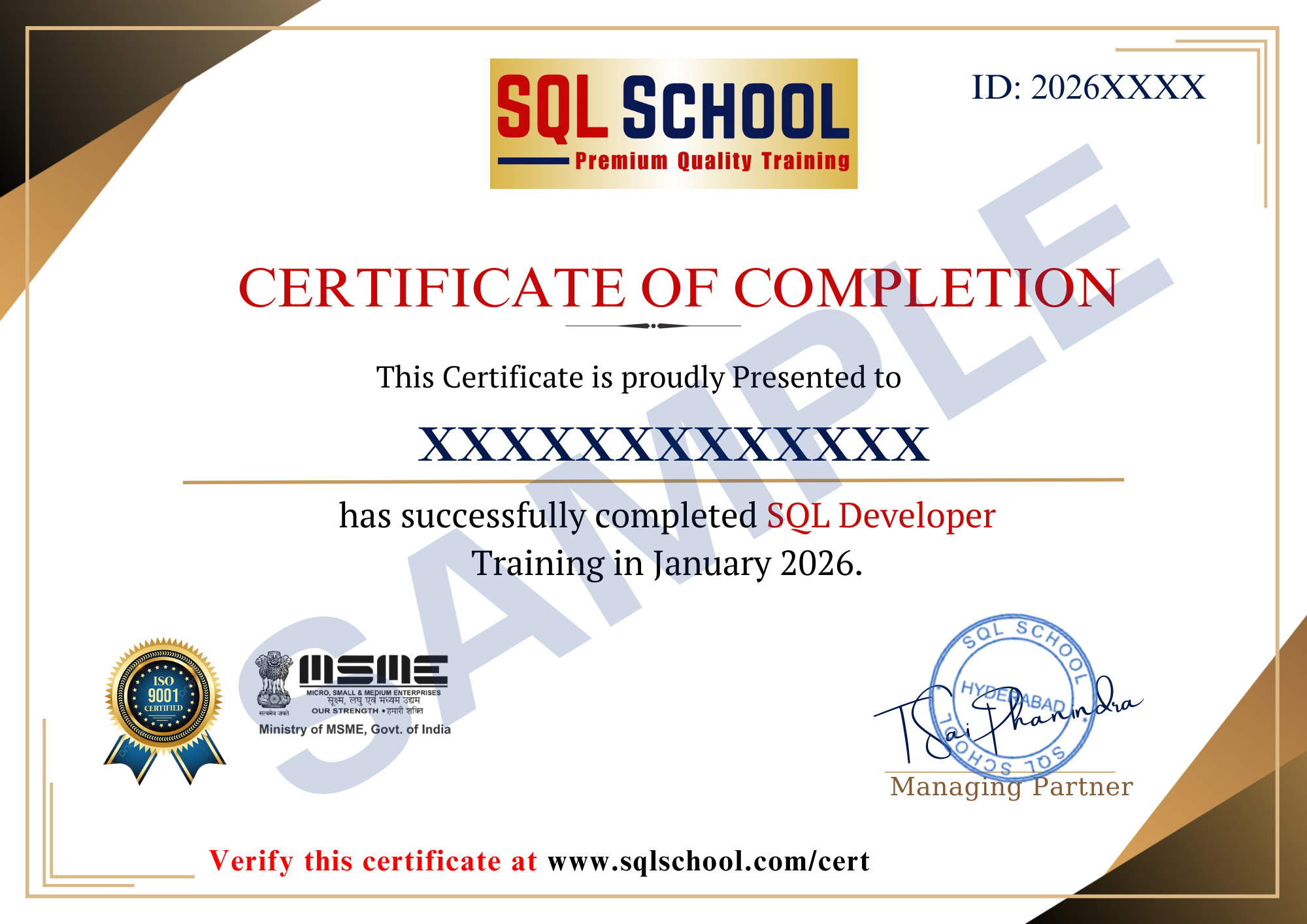
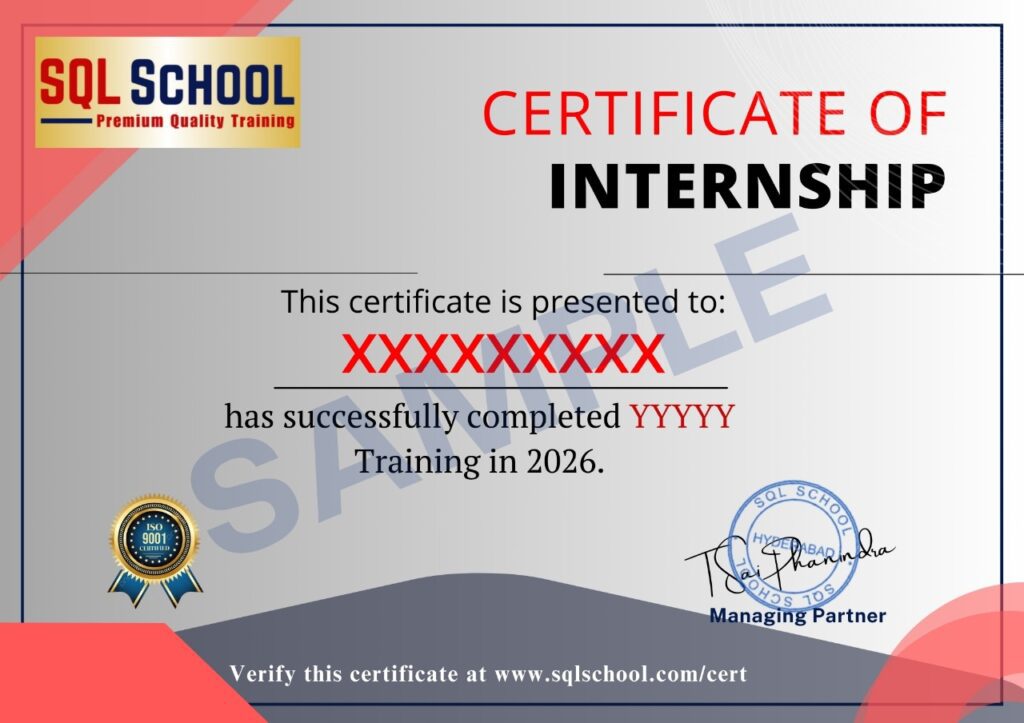
  • Course Completion Certificate

What is Fabric SQL Training?

Fabric SQL Training is a practical, job-oriented program covering MSSQL, T-SQL Programming, Query Performance Tuning, Azure SQL, Microsoft Fabric SQL, AI/Copilot, GitHub, and real-time projects.

Who can join this course?

The course is suitable for freshers, SQL developers, data analysts, ETL/Data Engineering aspirants, existing SQL professionals, and professionals preparing for Azure/Fabric SQL roles.

Do I need prior SQL experience?

No. Previous SQL experience is not required. The training starts with database and SQL fundamentals before progressing to advanced T-SQL, performance tuning, cloud SQL, and Fabric SQL. Fabric SQL Training


Is this course practical or theory-based?

The training is designed to be hands-on, with real-time examples, daily assignments, practice databases/scripts, 400+ SQL queries, and real-time projects. Fabric SQL Training

Does the course cover Microsoft Fabric and AI?

Yes. It includes T-SQL in Microsoft Fabric Warehouse, Copilot with T-SQL, Copilot in Fabric, AI-enabled SQL development, MCP concepts, and GitHub for SQL projects.

Are real-time projects included?

Yes. The course includes two real-time projects: a Healthcare project covering database design, SQL development, analysis and performance optimization, and a Banking Transaction Management System using SQL Server and T-SQL. Fabric SQL Training

Does the training include DP-800 certification guidance?

Yes. The course provides DP-800 exam guidance, including certification overview, exam objectives, AI & GitHub Copilot for SQL development, scenario-based questions, mock exams, and preparation guidance.

What career and interview support is included?

The program includes 100 SQL interview questions, 30 query-based problems, 10 scenario-based questions, capstone project interview explanation, resume guidance, mock interviews, job assistance, and a course completion certificate.

Demo Videos

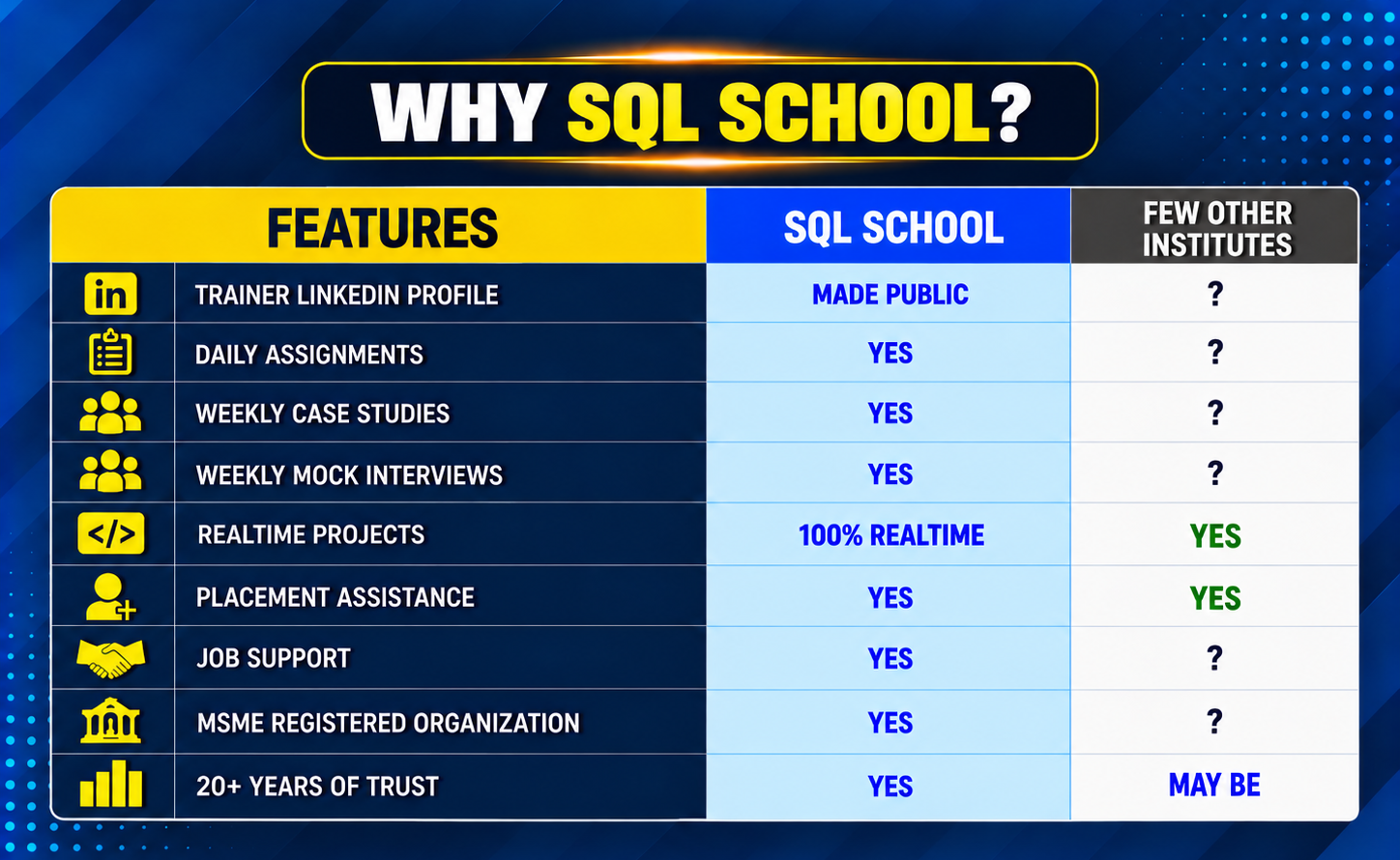
SQL SCHOOL vs Other Institutes

Training Modes

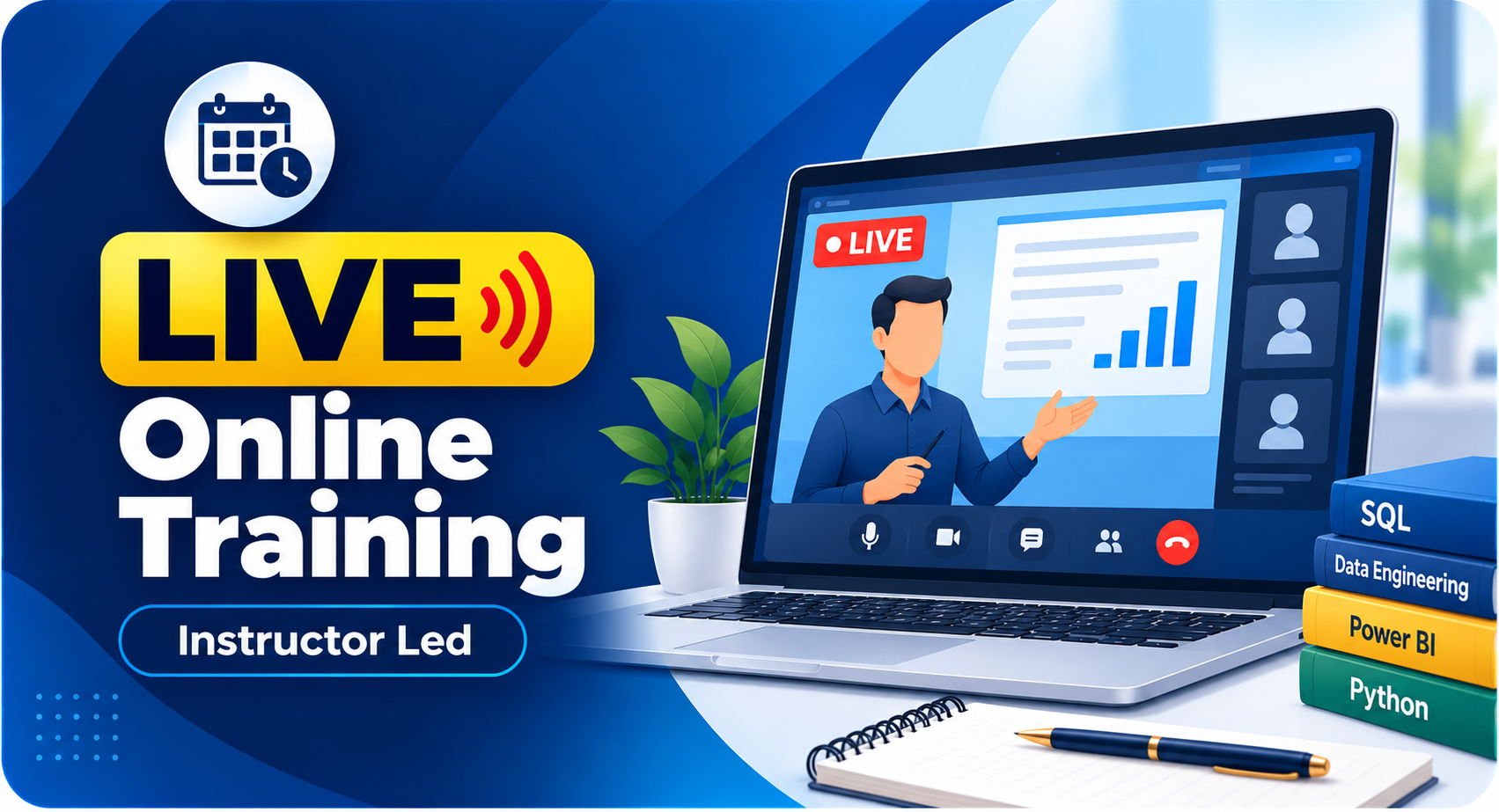
LIVE Online Training

Instructor Led

Self Paced Videos

 On-Demand

Verified by MonsterInsights