Windows OS, 6 GB RAM, any processor. SQL School provides installation guidance and complete lab support.
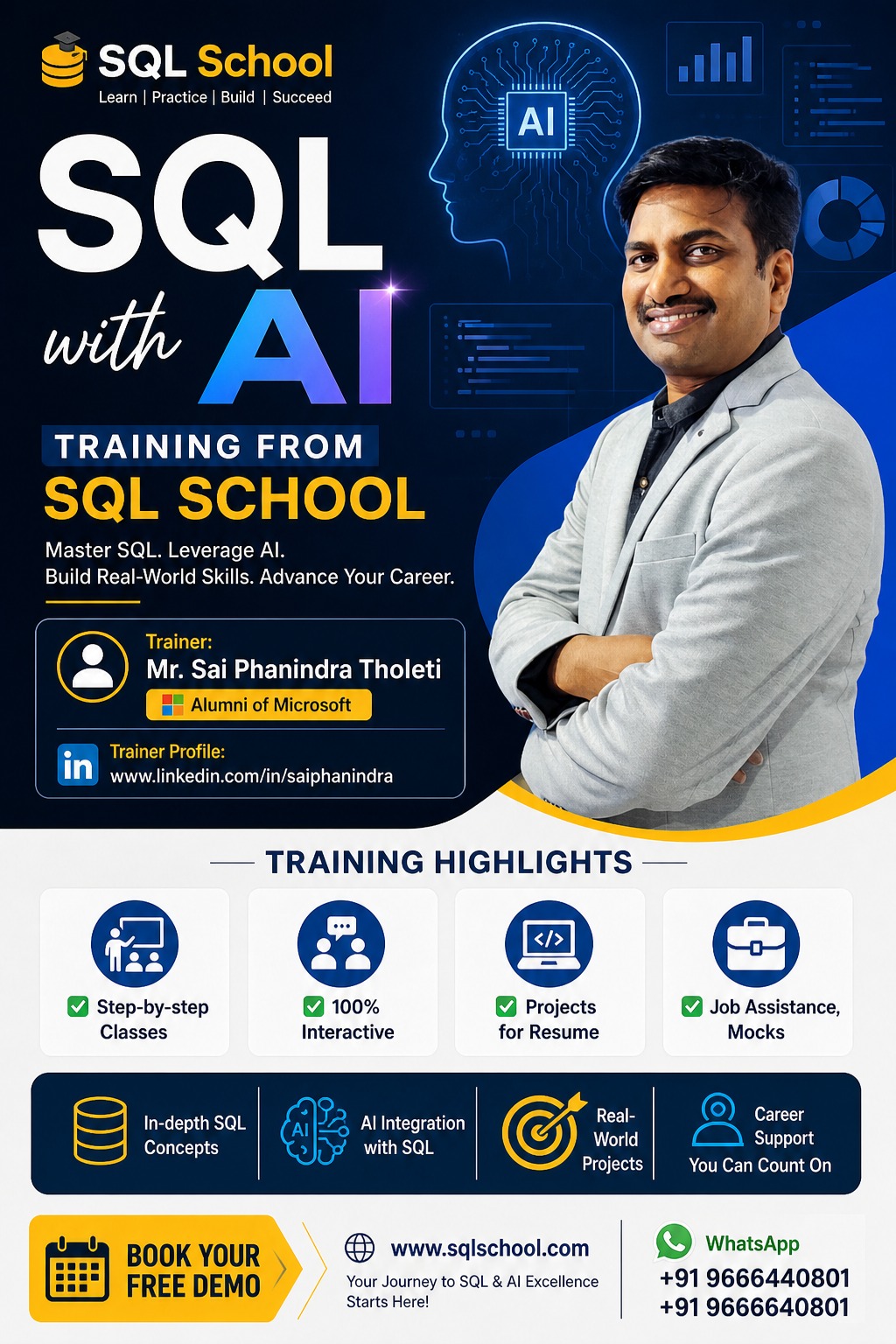
This Job Oriented Course is 100% practical, step by step. Carefully planned to make you understand the concepts with Basic to Advanced Level of Microsoft SQL with AI, use case scenarios and realtime project. This SQL with AI Course will make you Job Ready, help you to secure your job with ease.
Modules We Learn
✅ Module 1: Database Concepts, MSSQL & TSQL Queries
✅ Module 2: TSQL Programming
✅ Module 3: TSQL Query Tuning
✅ Module 4: Azure SQL (TSQL) with AI
✅ Module 5: Logic Apps, Azure Functions with TSQL
✅ Module 6: Fabric SQL (TSQL) with AI
✅ Module 7: CoPilot & Git Hub
✅ Module 8: DP 800 Exam Guidance
Module 1: Database Concepts, MSSQL & TSQL Queries
Ch 1: SQL Database Job Roles
- Introduction to Data
- Database Job Roles
- Database Intro, Types (OLTP, DWH, OLAP..)
- DBMS Concepts
- SQL & MSSQL Introduction
Ch 2: Database Intro & Installations
- SQL Server 2025 Installations
- SSMS Tool Installation
- AI Components
- AI Workloads
- Instance Concept
- Authentications, Collations
- Server Connections
- Version Checks
Ch 3: SQL Basics V1 (Commands)
- Creating Databases (GUI)
- Creating Tables, Columns (GUI)
- SQL Basics (DDL, DML, etc..)
- Creating Databases, Tables
- Data Inserts (GUI, SQL)
- Basic SELECT Queries
Ch 4: SQL Basics V2 (Commands, Operators)
- DDL: Create, Alter, Drop, Add, modify, etc..
- DML: Insert, Update, Delete, select into, etc..
- DQL: Fetch, Insert… Select, etc..
- SQL Operations: LIKE, BETWEEN, IN, etc..
- Special Operators
Ch 5: Excel Data Imports
- Data Imports with Excel
- Order By: Asc, Desc
- Order By with WHERE
- TOP & OFFSET
- UNION, UNION ALL
Ch 6: Data Types
- Integer Data Types
- Character, MAX Data Types
- Decimal & Money Data Types
- Boolean & Binary Data Types
- Date and Time Data Types
- SQL_Variant Type
Ch 7: Schemas & Batches
- Schemas: Creation, Usage
- Schemas & Table Grouping
- Real-world Banking Database
- 2 Part, 3 Part & 4 Part Naming
- Batch Concept & “Go” Command
Ch 8: Constraints, Keys & RDBMS
- Null, Not Null Constraints
- Unique Key Constraint
- Primary Key Constraint
- Foreign Key & References
- Default Constraint & Usage
- DB Diagrams & ER Models
Ch 9: Normal Forms & Modeling
- Normal Forms: 1 NF, 2 NF
- 3 NF, BCNF and 4 NF
- Self Referencing Keys
- Cascading Keys
- Adding PK to Tables
- Adding FK to Tables
Ch 10: Joins & Queries
- Joins: Table Comparisons
- Inner Joins & Matching Data
- Outer Joins: LEFT, RIGHT
- Full Outer Joins & Aliases
- Cross Join & Table Combination
- Joining more than 2 tables
Ch 11: Group By & Join Queries
- Group By, Distinct Keywords
- GROUP BY, HAVING
- Cube( ) and Rollup( )
- Sub Totals & Grand Totals
- Grouping( ) & Usage
- Group By with Joins
Ch 12: Sub Queries & Joins
- Sub Queries Concept
- Sub Queries & Aggregations
- Joins with Sub Queries
- Sub Queries with Aliases
- Sub Queries, Joins, Where
- Correlated Queries
- Joins with Sub Queries
- Query Execution Order
Ch 13: Views & Data Analytics
- Views: Realtime Usage
- Storing SELECT in Views
- DML, SELECT with Views
- Using Views with Excel
- Excel Pivot Tables
- Excel Pivot Charts
- Important System Views
Ch 14: Stored Procedures – 1
- Stored Procedures: Realtime Use
- Parameters Concept with SPs
- Procedures with SELECT
- System Stored Procedures
- Metadata Access with SPs
- SP Recompilations
- Stored Procedures, Tuning
Ch 15: Stored Procedures – 2
- Merge Statement
- Upsert Operations with Merge
- Merge with OLTP & DWH
- Matched and Not Matched
- Merge Statement inside SPs
Ch 16: User Defined Functions
- Using Functions in MSSQL
- Scalar Functions in Real-world
- Inline & Multiline Functions
- Parameterized Queries
- Date & Time Functions
- String Functions & Queries
- Aggregated Functions & Usage
Ch 17: Window Functions, CASE
- IIF Function and Usage
- CASE Statement Usage
- Window Functions (Rank)
- Row_Number( )
- Rank( ), DenseRank( )
- Partition By & Order By
Ch 18: Triggers & Automations
- Need for Triggers in Real-world
- DDL & DML Triggers
- For / After Triggers
- Instead Of Triggers
- Memory Tables with Triggers
- Disabling DMLs & Triggers
Ch 19: Transactions & ACID
- Transaction Concepts in OLTP
- Auto Commit Transaction
- Explicit Transactions
- COMMIT, ROLLBACK
- Checkpoint & Logging
- Lock Hints & Query Blocking
- READPAST, LOCKHINT
Ch 20: Indexes Basics, Tuning
- Indexes & Tuning
- Clustered Index, Primary Key
- Non Clustered Index & Unique
- Creating Indexes Manually
- Composite Keys, Query Optimizer
- Composite Indexes & Usage
Ch 21: CTEs & Tuning
- Common Table Expression
- Creating and Using CTEs
- CTEs, In-Memory Processing
- Using CTEs for DML Operations
- Using CTEs for Tuning
- CTEs: Duplicate Row Deletion
Ch 22: Cursors & Fetch
- Cursors: Realtime Usage
- Local & Global Cursors
- Scroll & Forward Only Cursors
- Static & Dynamic Cursors
- Fetch, Absolute Cursors
Ch 23: Temporary Tables
- TempDB: Realtime Use
- Local Temporary Tables
- Global Temporary Tables
- Testing & Using Temp Tables
- Temp Tables across Sessions
- Auto Create Tables using Select
- SELECT .. INTO & Bulk Loads
Ch 24: Linked Servers
- Creating Linked Servers
- Testing Linked Servers
- Remote Joins
- Correlated Queries
- Remote DB Access
- 4 Part Naming Conventions
Ch 25: Server Architecture
- Database Engine Components
- Parser, Compiler & Optimizer
- Protocols and Query Processing
- MDAC, CLR & Memory
- Parsing and Compilation
- SQL OS Components
Ch 26: Realtime Case Study: Healthcare Scenario (Design)
Ch 27: Realtime Case Study: Healthcare Scenario (Queries)
Module 2: TSQL Programming
Ch 1: Variables & Try..Catch
- Variables: Declaration & Usage
- Assigning Values to Variables
- SELECT & SET Operations
- Using Variables in SPs
- Variables Versus Parameters
- Try.. Catch Block with Variables
- THROW Statement, Error Handling
Ch 2: Updatable Views
- Using Triggers with Views
- Updatable Views, DML
- Views & Stored Procedures
- Data Distributions in Tables
- Transactions with Procedures
- Conditional Commits in SPs
- Rollback Options in Realtime
Ch 3: Stored Procedures & TVPs
- Using TVP with Procedures
- Creating User Defined Types
- Big Data Copy & Transactions
- Using SPs & Table Variables
- Transactional Integrity with SPs
- Conditional Commits, Rollbacks
- Procedure Recompilations
Ch 4: Stored Procedures, Cursors
- Cursors Types: Local, Global
- Using Procedues with Cursors
- Formatting Queries, Nvarchar
- WHILE Loop: @Fetch Status
- Variables with Dynamic SQL
- sp_executesql Extended SP
- Dynamic SQL Programming
Ch 5: SPs & Recursive CTEs
- CTEs: Common Table Expression
- CTEs For DML Operations
- Defining Recursive CTEs
- Anchor Element: Realtime Use
- Termination Checks and Loops
- Defining SPs with CTEs
- Cautions with Recursive CTEs
Ch 6: Functions & Loops
- Inline, Table Line Functions
- Multi Line Table Functions
- Using LOOPs in Functions
- Variables & Return Values
- Table Generation Logic
- Date & Time Data Types
- Calendar Data Generations
Ch 7: OpenRowSet, Debugging
- Reading JSON Data
- Using OPENROWSET( )
- OpenRowSet with Variables
- Debugging Stored Procedures
- Debugging Types in TSQL
- Debugging Techniques with SSMS
- Debug Options with Variables
Ch 8: PIVOT, UNPIVOT
- Reading Denormalized Data
- Normalizing Table Data
- PIVOT Operation with TSQL
- PIVOT with Aggregates
- FOR and IN Operators
- UNPIVOT with TSQL
- PIVOT with Functions, SPs
Ch 9: Temporary Tables
- TempDB: Realtime Use
- Local Temporary Tables
- Global Temporary Tables
- Testing & Using Temp Tables
- Temp Tables across Sessions
- Auto CreateTables using Select
- SELECT .. INTO & Bulk Loads
Ch 10: Change Data Capture
- CDC Concept
- Database Level CDC
- Table Level CDC
- CT Tables (Change Tracking)
- $operation fields
- DDL & DML Tracking
Ch 12: DB Architecture (VLDB)
- Planning Large Databases
- Primary, Secondary Data Files
- Filegroups, Spacing and Sizing
- Log File: Usage and Precautions
- Creating Tables with Filegroups
- Pages and Extents for Storage
- VLF, MiniLSN & Checkpoint
Module 3: TSQL Query Tuning
Ch 1: Tuning: Audits, AM Tool
- Activity Monitor Tool
- Perfmon Tool & Counters
- Query Audits: DMVs, DMFs
- Plan Handle, Execution Time
- Long Running Queries
- Query Store & Buffer Cache
- Data Flush, Stats Collection
Ch 2: Tuning : Indexes
- Indexes : Sort Locations
- Clustered & Online Indexes
- Non Clustered, Column Store
- Included Indexes in Realtime
- Filtered Indexes & Usage
- Covering Index & Selectivity
- Indexed Views (Materialized)
Ch 3: Tuning: Partitions
- Partitions: Performance Tuning
- Partition Functions & Schemes
- Partition Un-partitioned Tables
- Compressions: ROW, PAGE
- Auditing Partitions
- Partitions Limitations in OLTP
- Partitions with DWH
Ch 4: Statistics & Tuning
- Statistics: Realtime Usage
- Index & Column Statistics
- Statistics & Key Purpose
- Verifying, Using Stats
- Statistics Versus Indexes
- Stats Updates on Tables
- Stats Updates on Views
Ch 5: Index Management
- Index Management Options
- Index Rebuilds, Re-Organize
- Database Maintenance Plans
- Page Count and Index Conditions
- Degree Of Parallelism Settings
- Resumable & Online Indexes
- PAUSE, RESUME in Rebuilds
Ch 6: Tuning Tools
- Tuning Tools: Workload Files
- Profiler Tuning, Events
- DTA, Profiler Options
- Physical Design Structures
- PDS Recommendations
- Query Execution Cache
- Tuning Tools: Precautions
Ch 7: Execution Plans
- Execution Plan Analysis
- IO Cost and CPU Cost
- SubTree & Operator Cost
- NUMA Nodes, Processor Affinity
- Thread Count, DOP
- Table & Index Scan, Index Seek
- Index Selectivity & Tuning
Ch 8: Lock Management
- Open Transactions in Realtime
- Open Transaction, Blocking
- LOCKS: Types & Audits
- S, X, IX, U and MD Locks
- Sch-M and Sch-S Locks
- SP_WHO2, SP_LOCK
- sysprocesses & Lock Waits
Ch 9: Isolation Levels
- Lock Hints and Isolation Levels
- Read Committed, Uncommitted
- Serializable, Repeatable Read
- Snapshot Isolation, Versioning
- Read Committed Snapshot
- sysprocesses & sp_who2
- Choosing Correct Isolation Level
Ch 10: Deadlocks, LIVE Locks
- Deadlocks in Real-world
- Profiler Tool & Deadlocks
- Lock Management: Deadlocks
- Deadlock Graphs & Events
- Deadlock Avoidance, Prevention
- Deadlock Prevention
- sysprocesses & sp_who2
Module 4: Azure SQL (TSQL) with AI
Ch 1: Cloud Basics, Azure Funda
- Cloud Fundamentals
- Cloud Concepts, Benefits
- IaaS, PaaS, SaaS Cloud Types
- Azure Cloud Concepts
- Azure Resources & Usage
- Azure Services & Purpose
- Azure Account & Subscription
Ch 2: Azure SQL Deployments
- Azure SQL Services
- Azure SQL Server Creation
- Azure SQL Databases
- Azure Firewall : Rules
- Test Connections from SSMS
- SSMS Tool : Test Connections
- ADS Tool : Installation, use
Ch 3: Azure SQL DB Operations
- Azure SQL : DDL Statements
- Azure SQL: DML Statements
- Azure SQL: DQL Statements
- TCL & DCL Commands
- Differences with OnPrem
- Azure SQL DB Advantages
Ch 4: Azure SQL DB Migrations
- SQL DB Migration Options
- Data Migration Assistant: DMA
- DMA Tool, Migration Options
- On-Premises DB Export
- Azure SQL Database Import
- Azure Storage Account
- Linking SSMS with Azure
Ch 5: Azure SQL DB Licensing
- Azure SQL DB Licensing
- Per Database Licensing
- DTUs: Basic, Standard Types
- VPU and Plan Types
- DTU Versus VPU Licensing
- Elastic DTUs (eDTU) Usage
- Elastic Query Processing
Ch 6: Azure SQL DB Metrics
- Azure SQL DB Metrics
- CPU, Memory, Log Metrics
- Data File Metrics, Alerts
- Action Groups & Emails
- Query Performance Insight
- Automated Tuning Options
- Query Recommendations
Ch 7: Azure SQL DB Tuning, AI
- Automated Tuning Options
- Manual Tuning Options
- Server Level Tuning
- Database Level Tuning
- Create Index Option
- Drop Index, Seek Options
- Built-In Intelligence
Ch 8: Azure AI Search
- AI Search Service, Tuning
- AI Indexes, Practical Use
- Watermark Columns
- Triggers & Timestamp
- Filterable, Searchable
- Sortable, FaceTables
- Indexer & Data Refresh
Module 5: Logic Apps, Azure Functions with TSQL
Ch 1: Azure Storage Account Concepts
- Azure Storage Accounts
- Standard & ADLS Accounts
- Containers & File Uploads
- File Operations
- Access Tiers
Ch 2: Azure Tables & ADF
- Azure Tables
- Entities and Properties
- Storage Service Operations
- OData Queries & Filters
- Data Loads with ADF
Ch 3: Azure Key Vaults
- Azure Encryptions at REST
- SMK & CMK Encryptions
- Azure Key Vaults & Keys
- Key Access Policies
- Rest, Transit Encryptions
- Realtime Considerations
Ch 4: Azure Logic Apps
- Azure Logic Apps
- Consumption Logic
- Standard Logic
- Logic App Connectors
- Triggers & Parallel Branches
- Schedules & Automations
- Data Governance
Ch 5: Azure Functions
- Azure Functions
- Creating, Using Functions
- Azure Functions with TSQL
- TSQL Debugging
- Testing Azure Functions
Module 6: Fabric SQL (TSQL) with AI
Ch 1: Fabric Introduction
- Need for Fabric, Big Data
- Fabric Data Engineering Model
- Fabric Components (Items)
- Microsoft Fabric: Advantages
- Cloud Warehouse & AI
- AI with CoPilot
- Azure Versus Fabric DWH
Ch 2: Fabric Account, Workspace
- Need for Fabric Workspace
- Workspace Creation Process
- Pins and New Items
- Item Categorization
- ETL, Storage, Analytical
- Streaming, Monitoring
- Compute & Separation
Ch 3: Fabric Architecture
- Intelligent Data Foundation
- Polaris Distributed Engine
- Stateless & Stateful
- Cache, Metadata, Xact & Data
- Fabric Tasks, Inputs & DAG
- State Machine & Statistics
- Hot Spot Recovery
Ch 4: Fabric Warehouse
- Fabric Warehouse Creation
- Fabric Warehouse Features
- Fabric Warehouse Properties
- Fabric Warehouse Limitations
- DWH Internal Operations
- Default Schemas & Objects
Ch 5: Fabric Data Types
- Realtime use of Fabric Houses
- Exact, Approximate Numbers
- Date and Time Data Types
- Fixed & Variable Length
- Binary & String Data Types
- Fabric Type Limitations
Ch 6: SSMS Connections
- Warehouse SQL Connection
- Database Engine Server
- Multi Factor Authentication
- Warehouse Artifacts
- Executing .SQL Scripts
- Testing Fabric Artifacts
Ch 7: Fabric Caching
- Fabric Caching Process
- In-memory Cache, Disk Cache
- Cache Types: LRU /MRU
- Cold Cache / Cold Run
- Realtime use of Caching
- Performance Advantages
- Warehouse Optimizations
Ch 8: Fabric Statistics
- Query Engine Options
- Statistics Types
- Leverage Statistics
- Auto, Manual Statistics
- Update Statistics
- Statistics Consistency
- Statistics Lists & Reports
Ch 9: Time Travel
- Continuous Data Protection
- Data Storage, Retention
- FOR TIMESTAMP AS OF
- Time Travel Scenarios
- Time Travel Implementation
- Time Travel on Queries
- Time Travel Limitations
Ch 10: Aggregated Data Store
- Options for Data Aggregations
- Save As table, Save As View
- Single Table Aggregations
- Multi Table Aggregations
- Dynamic Conditions
- Parameterized Aggregations
Ch 11: Zero Copy Cloning
- User Layer, Storage Layer
- Cloning & Parquet Files
- Synapse Data Warehouse
- Data History Retention
- Point In Time , Schema Level
- Zero Copy Cloning Limitations
Ch 12: Fabric Security
- Workspace Security
- Warehouse Security
- Item Security & Roles
- Adding AD Users
- Item Security Limitations
- MFA & Client Security
Ch 13: Regular Expressions
- REGEXP_LIKE
- REGEXP_REPLACE
- REGEXP_SUBSTR
- REGEXP_INSTR
- REGEXP_COUNT
- REGEXP_MATCHES
- REGEXP_SPLIT_TO_TABLE
Ch 14: Fuzzy Logic & JSON
- EDIT_DISTANCE
- EDIT_DISTANCE_SIMILARITY
- JARO_WINKLER_DISTANCE
- MATCH Operator
- JSON_OBJECT
- JSON_ARRAY
- JSON_ARRAYAGG
- JSON_CONTAINS
- OPENJSON
- JSON_VALUE
Module 7: CoPilot & Git Hub
Ch 1: AI Concepts
- AI Introduction
- AI Concepts
- AI in SQL Server
- AI Workloads
- CoPilot Concepts
Ch 2: CoPilot Concepts
- CoPilot Architecture
- CoPilot with TSQL
- CoPilot in Fabric
- Model Context Protocol (MCP)
- GitHub Copilot
- MCP End Points
Ch 3: Security Concepts
- CoPilot & Security
- Always Encrypted
- Column Level Encryption
- Keys & Certificates
- Row Level Security
- GraphQL, REST, MCP endpoints
Ch 4: Data Events
- Event Management
- Change Event Stream (CES)
- Change Data Capture (CDC)
- Change Tracking
- Azure Functions
- Fabric Integrations
Module 8: DP 800 Exam Guidance
- DP 800 Exam Guidance
- DP 800 Exam Samples
- DP 800 Exam Mocks

What is the SQL Server T-SQL Training?
This course teaches complete SQL Server T-SQL from basics to advanced: SQL queries, T-SQL programming, query tuning, and Azure SQL development with real-time practical training.
Who can join this SQL course?
Anyone — freshers, non-IT students, Data Analysts, BI Developers, Data Engineers, and SQL Developers. No prerequisites. All topics start from basics.
What are the training plans available?
Plan A: MSSQL + TSQL Queries
Plan B: MSSQL + TSQL Programming + Query Tuning
Plan C: MSSQL + Programming + Tuning + Azure SQL Dev with AI
Each plan includes increasing depth and duration.
What are the core SQL basics covered?
Database creation, tables, DDL, DML, DQL, SELECT queries, operators, schema usage, Excel imports, and SQL Server installation.
Do you teach constraints and keys?
Yes. NULL, NOT NULL, UNIQUE, PRIMARY KEY, FOREIGN KEY, DEFAULT, ER diagrams, and relational modelling are covered.
What indexing topics will I learn?
Clustered, non-clustered, unique indexes, composite indexes, index tuning, index usage verification, and query optimizer basics.
Are joins taught in detail?
Yes. Inner, left, right, full outer, cross joins, multi-table joins, aliasing, join audits, and real-time comparison queries.
Do you teach Views, RLS, and metadata?
Yes. Creating & using views, DML with views, Row Level Security, CHECK OPTION, system metadata queries, and audits.
Will I learn Stored Procedures?
Yes. Writing stored procedures, input/output parameters, tuning SPs, metadata SPs, recompilation, and transaction-based procedures.
Are Functions taught in this SQL course?
Yes. Scalar, inline table-valued, multi-statement functions, date/time functions, string functions, and aggregated queries.
Do you cover Triggers and Automations?
Yes. DML triggers, DDL triggers, Instead Of triggers, replication logic, audit triggers, and automation concepts.
Will I learn transactions and ACID concepts?
Yes. Transaction control, commit/rollback, checkpoints, locks, blocking, lock hints, and real-time OLTP usage.
Do you teach SQL tuning and performance optimization?
Yes. CTEs for tuning, statistics, indexing strategies, partitions, query store, execution plans, DMVs/DMFs, and workload analysis.
What advanced T-SQL programming topics are included?
Variables, try-catch, table types, TVPs, dynamic SQL, recursive CTEs, loops, PIVOT/UNPIVOT, temp tables, synonyms, and debugging.
Is SQL Server architecture included in this course?
Yes. Database engine architecture, compiler, optimizer, SQL OS, storage, log files, filegroups, pages, extents, VLFs, and large database planning.
Do you cover locking, deadlocks, and isolation levels?
Yes. Lock types, blocking scenarios, deadlock analysis, SP_LOCK, SP_WHO2, profiler deadlock graphs, and all isolation levels including snapshot.
Is Azure SQL included in the training?
Yes, in Plan C. Azure SQL fundamentals, DB creation, networking, firewall, migrations, metrics, tuning, AI search, backups, and restores.
Are real-time projects part of the course?
Yes. The training includes mini projects, enterprise case studies, tuning assignments, and 3 real-time projects for resume placement.
What training modes are available?
Live Online Training, Self-Paced Videos, Corporate Training, Resume Support, Mock Interviews, and Free Demo Sessions.
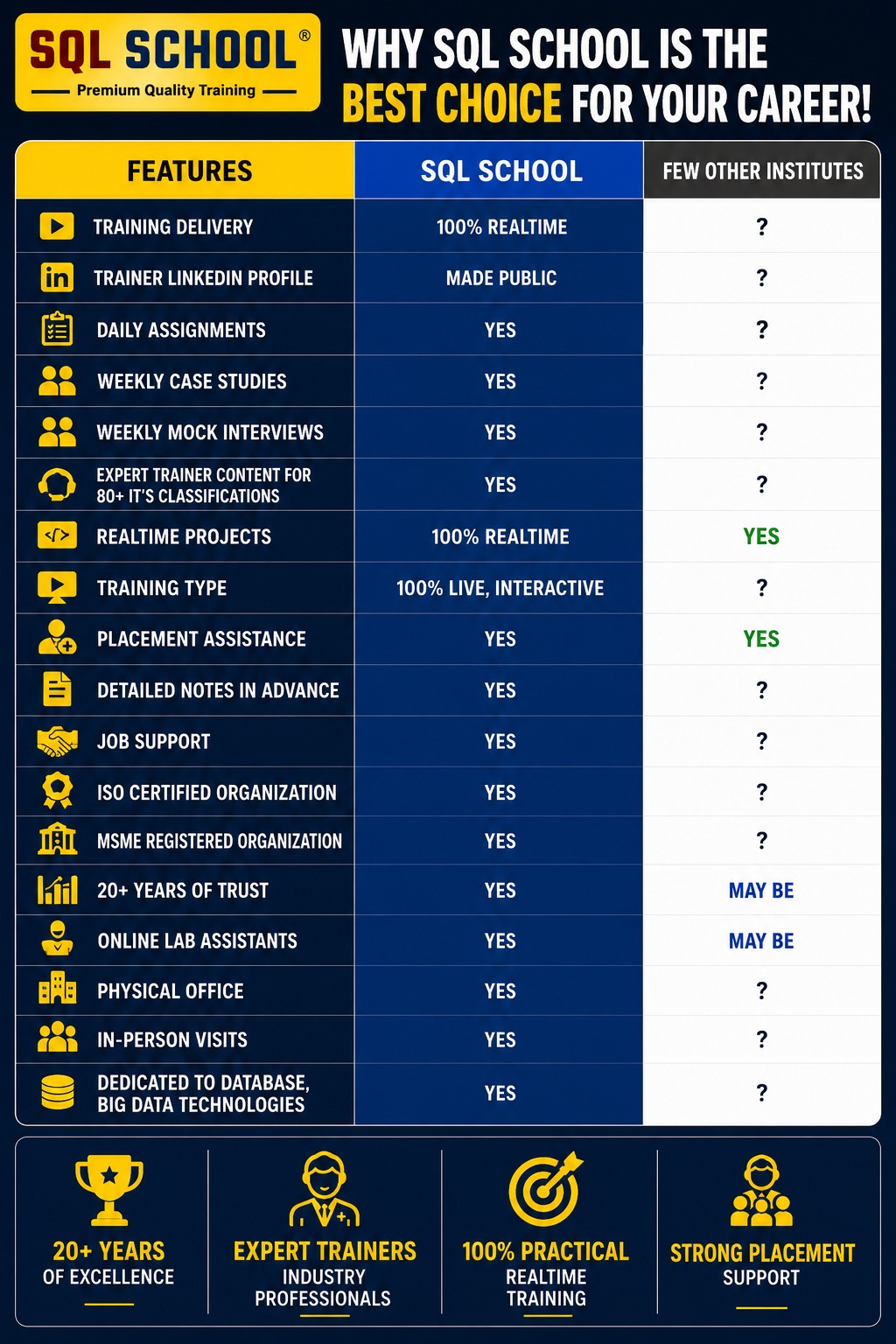
SQL SCHOOL vs Other Institutes
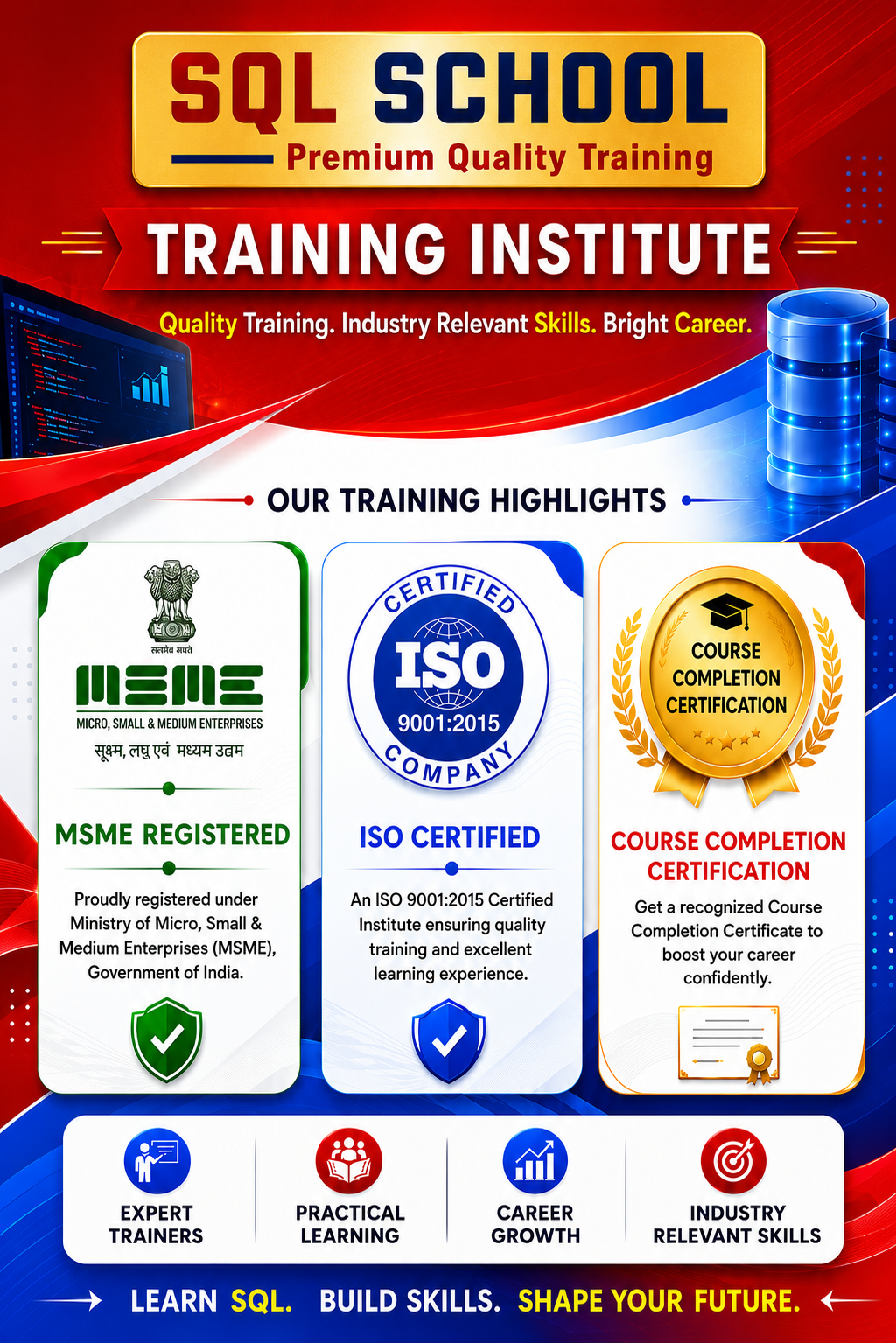
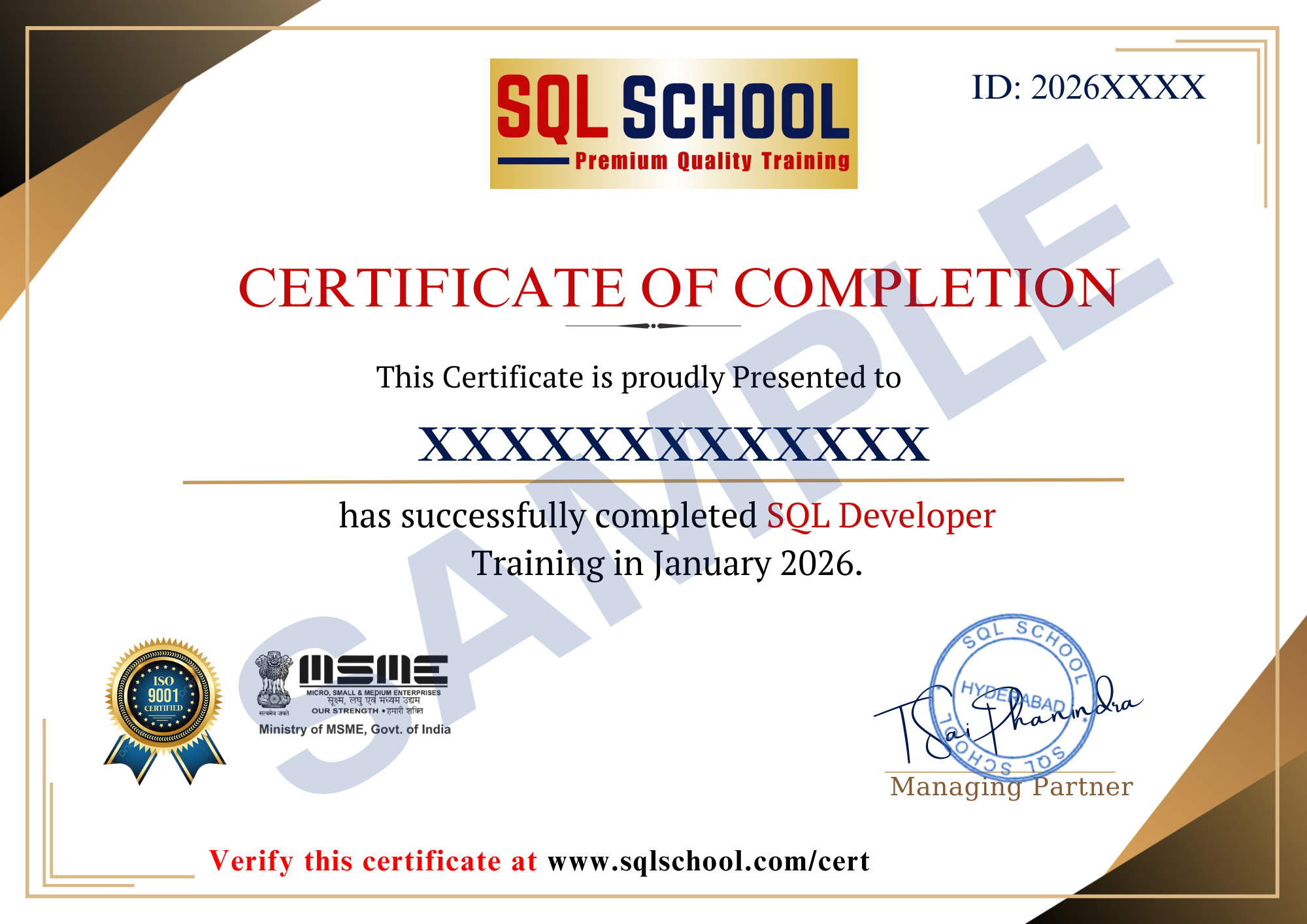




















SQL SCHOOL
24x7 LIVE Online Server (Lab) with Real-time Databases.
Course includes ONE Real-time Project.
Why Choose SQL School
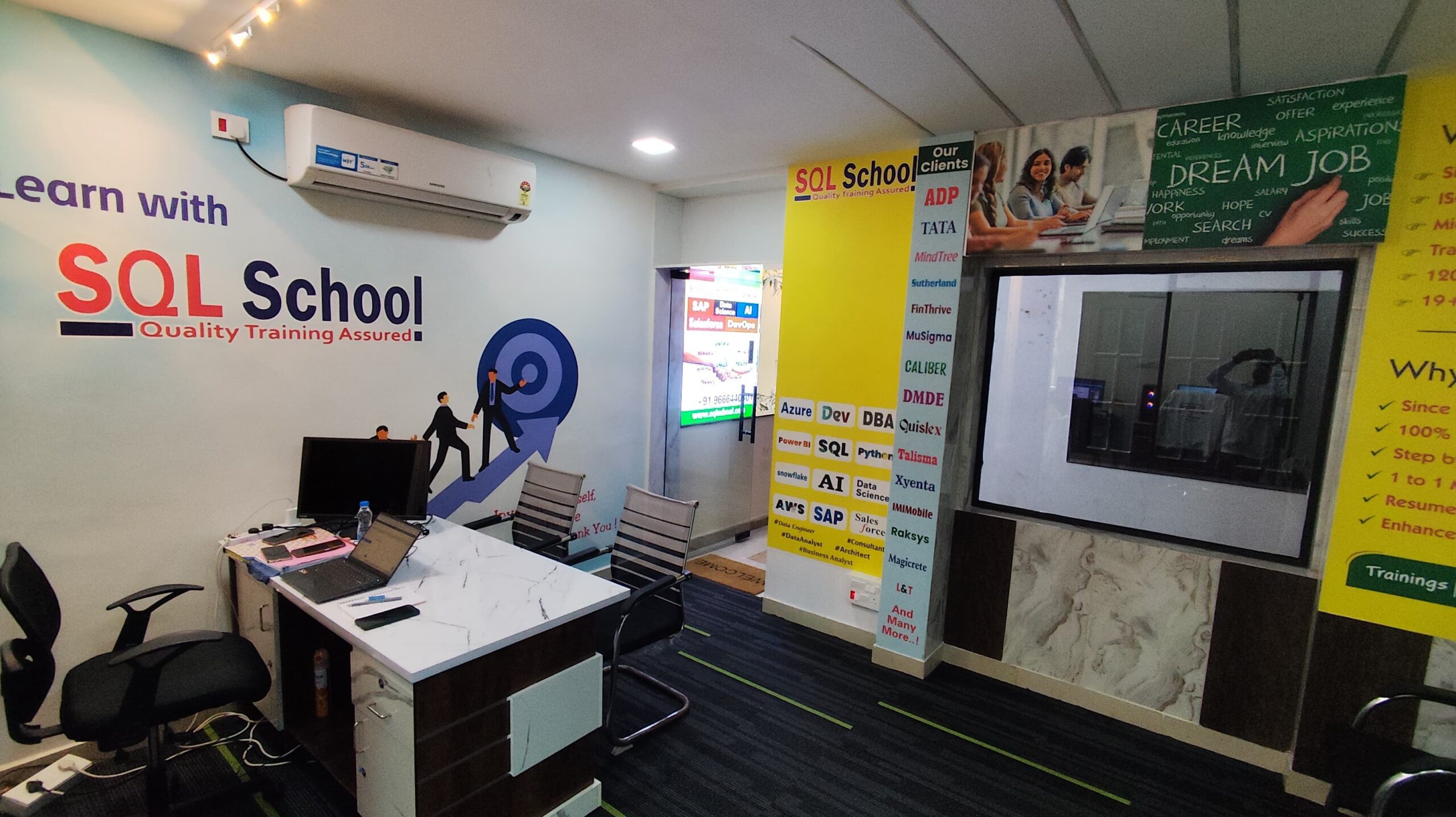
- 100% Real-Time and Practical
- ISO 9001:2008 Certified
- Weekly Mock Interviews
- 24/7 LIVE Server Access
- Realtime Project FAQs
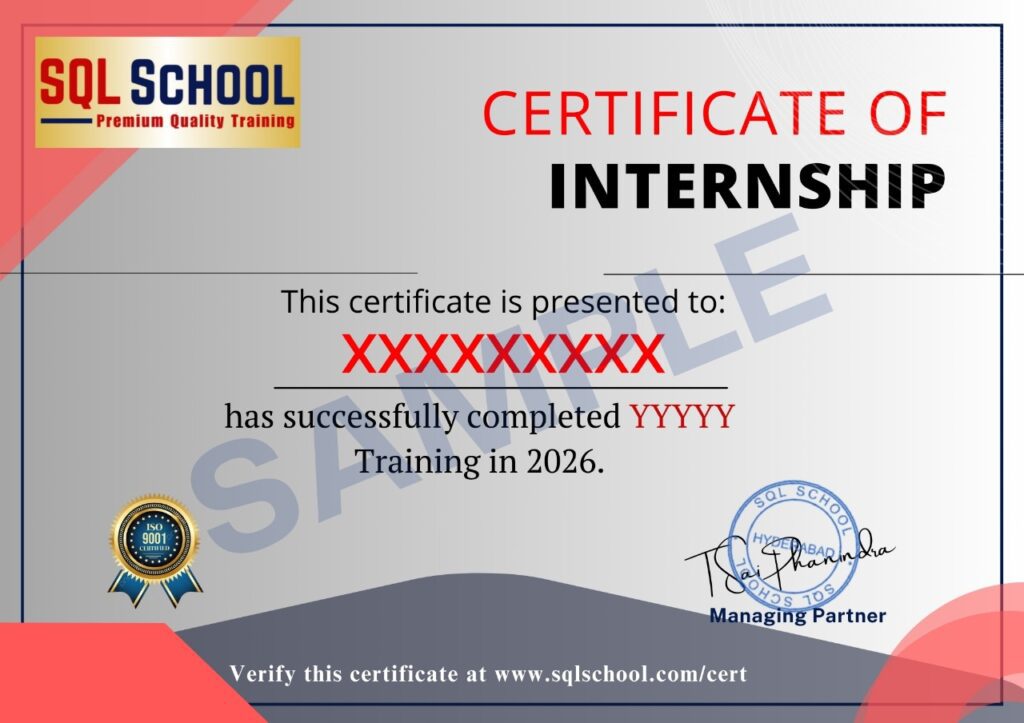
- Course Completion Certificate
- Placement Assistance
- Job Support