#SQL With Python

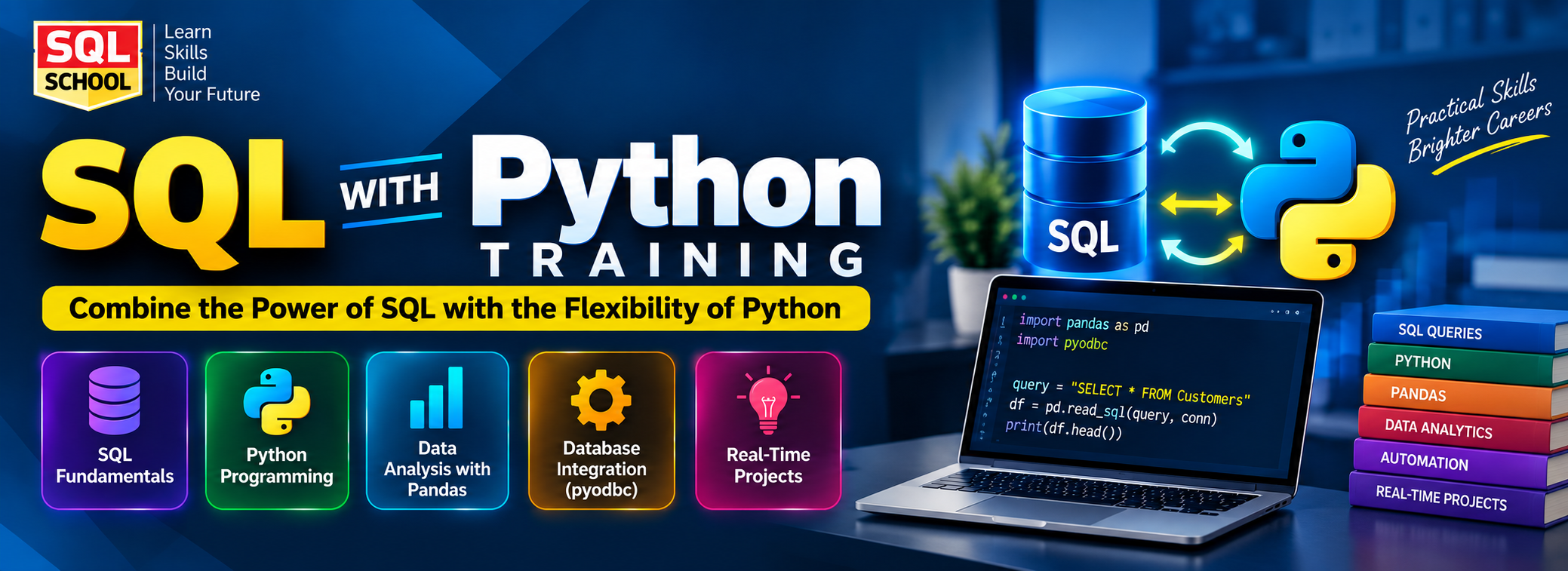
Master SQL Server, T-SQL, Python, Pandas, and NumPy to build practical skills in data analytics and automation. Learn to query, clean, transform, analyze, and process real-world data while integrating Python with SQL Server for efficient data workflows. Gain hands-on experience with DataFrames, data processing, automation, and advanced SQL queries, and complete an end-to-end Banking Analytics project to develop practical, job-oriented and interview-ready skills.

Training Highlights

✅ SQL Server & Advanced T-SQL
✅ SQL Query Performance & Indexing
✅ Python Programming from Basics
✅ Pandas & NumPy for Data Analytics
✅ Data Cleaning & Transformation
✅ Python + SQL Server Integration
✅ Hands-On Practice & Daily Assignments
✅ End-to-End Banking Analytics Project

Modules We Learn

✅ Module 1: SQL Server TSQL (MSSQL) Queries
✅ Module 2: Python Concepts & Analytics
✅ Module 3: Python Programming
✅ Module 4: Real-Time Project (Banking)

Course Duration: 2 Months
SQL With Python
Course Contents:

Module 1: SQL Server TSQL (MSSQL) Queries

Ch 1: SQL Database Job Roles

  • Introduction to Data
  • Database Job Roles
  • SQL Job Roles
  • SQL Developer Jobs
  • Data Engineer Jobs
  • Data Analyst Jobs

Ch 2: Database Intro & Installations

  • Database Intro & Types (OLTP, DWH, ..)
  • DBMS Concepts
  • SQL Server 2025 Installations
  • SSMS Tool Installation
  • Server Connections, Authentications

Ch 3: SQL Basics V1 (Commands)

  • Creating Databases (GUI)
  • Creating Tables, Columns (GUI)
  • SQL Basics (DDL, DML, etc..)
  • Creating Databases, Tables
  • Data Inserts (GUI, SQL)
  • Basic SELECT Queries

Ch 4: SQL Basics V2 (Commands, Operators)

  • DDL: Create, Alter, Drop, Add, modify, etc..
  • DML: Insert, Update, Delete, select into, etc..
  • DQL: Fetch, Insert… Select, etc..
  • SQL Operations: LIKE, BETWEEN, IN, etc..
  • Special Operators

Ch 5: Data Types

  • Integer Data Types
  • Character, MAX Data Types
  • Decimal & Money Data Types
  • Boolean & Binary Data Types
  • Date and Time Data Types
  • SQL_Variant Type, Variables

Ch 6: Excel Data Imports

  • Data Imports with Excel
  • SQL Native Client
  • Order By: Asc, Desc
  • Order By with WHERE
  • TOP & OFFSET
  • UNION, UNION ALL

Ch 7: Schemas & Batches

  • Schemas: Creation, Usage
  • Schemas & Table Grouping
  • Real-world Banking Database
  • 2 Part, 3 Part & 4 Part Naming
  • Batch Concept & “Go” Command

Ch 8: Constraints, Keys & RDBMS – Level 1

  • Null, Not Null Constraints
  • Unique Key Constraint
  • Primary Key Constraint
  • Foreign Key & References
  • Default Constraint & Usage
  • DB Diagrams & ER Models

Ch 9: Normal Forms & RDBMS – Level 2

  • Normal Forms: 1 NF, 2 NF
  • 3 NF, BCNF and 4 NF
  • Adding PK to Tables
  • Adding FK to Tables
  • Cascading Keys
  • Self Referencing Keys
  • Database Diagrams

Ch 10: Joins & Queries

  • Joins: Table Comparisons
  • Inner Joins & Matching Data
  • Outer Joins: LEFT, RIGHT
  • Full Outer Joins & Aliases
  • Cross Join & Table Combination
  • Joining more than 2 tables

Ch 11: Views & RLS

  • Views: Realtime Usage
  • Storing SELECT in Views
  • DML, SELECT with Views
  • RLS: Row Level Security
  • WITH CHECK OPTION
  • Important System Views

Ch 12: Stored Procedures

  • Stored Procedures: Realtime Use
  • Parameters Concept with SPs
  • Procedures with SELECT
  • System Stored Procedures
  • Metadata Access with SPs
  • SP Recompilations
  • Stored Procedures, Tuning

Ch 13: User Defined Functions

  • Using Functions in MSSQL
  • Scalar Functions in Real-world
  • Inline & Multiline Functions
  • Parameterized Queries
  • Date & Time Functions
  • String Functions & Queries
  • Aggregated Functions & Usage

Ch 14: Triggers & Automations

  • Need for Triggers in Real-world
  • DDL & DML Triggers
  • For / After Triggers
  • Instead Of Triggers
  • Memory Tables with Triggers
  • Disabling DMLs & Triggers

Ch 15: Transactions & ACID

  • Transaction Concepts in OLTP
  • Auto Commit Transaction
  • Explicit Transactions
  • COMMIT, ROLLBACK
  • Checkpoint & Logging
  • Lock Hints & Query Blocking
  • READPAST, LOCKHINT

Ch 16: CTEs & Tuning

  • Common Table Expression
  • Creating and Using CTEs
  • CTEs, In-Memory Processing
  • Using CTEs for DML Operations
  • Using CTEs for Tuning
  • CTEs: Duplicate Row Deletion

Ch 17: Indexes Basics, Tuning

  • Indexes & Tuning
  • Clustered Index, Primary Key
  • Non Clustered Index & Unique
  • Creating Indexes Manually
  • Composite Keys, Query Optimizer
  • Composite Indexes & Usage

Ch 18: Group By Queries

  • Group By, Distinct Keywords
  • GROUP BY, HAVING
  • Cube( ) and Rollup( )
  • Sub Totals & Grand Totals
  • Grouping( ) & Usage
  • Group By with UNION
  • Group By with UNION ALL

Ch 19: Joins with Group By

  • Joins with Group By
  • 3 Table, 4 Table Joins
  • Join Queries with Aliases
  • Join Queries & WHERE
  • Join Queries & Group By
  • Joins with Sub Queries
  • Query Execution Order

Ch 20: Sub Queries

  • Sub Queries Concept
  • Sub Queries & Aggregations
  • Joins with Sub Queries
  • Sub Queries with Aliases
  • Sub Queries, Joins, Where
  • Correlated Queries

Ch 21: Cursors & Fetch

  • Cursors: Realtime Usage
  • Local & Global Cursors
  • Scroll & Forward Only Cursors
  • Static & Dynamic Cursors
  • Fetch, Absolute Cursors

Ch 22: Window Functions, CASE

  • IIF Function and Usage
  • CASE Statement Usage
  • Window Functions (Rank)
  • Row_Number( )
  • Rank( ), DenseRank( )
  • Partition By & Order By

Ch 23: Merge(Upsert) & CASE, IIF

  • Merge Statement
  • Upsert Operations with Merge
  • Matched and Not Matched
  • IIF & CASE Statements
  • Merge Statement inside SPs
  • Merge with OLTP & DWH

Module 2: Python Concepts & Analytics

Ch 1: Python Introduction

  • Python Introduction
  • Python Versions
  • Python Job Roles

Ch 2: Python Architecture

  • Python Architecture
  • PVM: Python Virtual Machine
  • Compiler
  • Byte Code
  • Execution Process
  • Resource Allocations
  • Python Implementations

Ch 3: Python Installations

  • Python Introduction
  • Python Installations
  • Anaconda Installation
  • Python IDE & Usage
  • Jupyter Notebooks

Ch 4: Python Print Statement

  • Python Print Statement
  • print(), print()
  •  Testing Case Sensitivity
  • Single Line print()
  • Multi Line print()
  • print() with single quotations
  • Debug with AI (AI Assistants)

Ch 5: Python Variables

  • Python Variables
  • Assigning values
  • Purpose & Rules
  • Variable Value Reads
  • Multiple Variables & Print()

Ch 6: Python Operators

  • Arthematic *& Multiplier Operators
  • Python String Literals
  • Single, Double Quotes
  • Format Strings (f string)
  • Comparison, Indexing Operators

Ch 7: Python Data Types

  • Python Data Types
  • Integer, Float, String Data Types
  • Type Casting
  • Type Identification
  • Multi Value Assignments
  • Python Built-In Classes (data types)

Ch 7: Python Lists

  • Creating Python Lists
  • Printing List Items
  • Print List Slices
  • Length & Type
  • list() method
  • Empty Lists, Append
  • Loops, List Updates

Ch 8: Python Dictionaries

  • Python Dictionary
  • Creating, Indexing Dictionaries
  • Edit / Overwrite Key Values
  • Lists inside Dictionaries
  • Delete & Clear

Ch 9: Python Tuples

  • Python Tuples
  • Defining, Indexing
  • Length(), Type()
  • Mixed Values in Tuples
  • Overwriting Tuples
  • Tuple Class, (( ))

Ch 10: Python IF..ELSE Condition

  • If..Else conditions
  • if..elif..else & Shorthand if
  • composite conditions
  • Indent, pass statement
  • in & negation operators
  • range conditions

Ch 11: Python Loops (For)

  • Python For Loop
  • For Loop @ Range
  • For Loop @ Sequence Values
  • Nested Loops
  • Loop Control Statements
  • Break, Continue, Paas

Ch 12: Python Loops (While)

  • While Loop
  • Termination Checks (Expressions)
  • Variables, Logical Conditions
  • Loop Conditions, Operators
  • Exit Conditions
  • iter() and Looping Options

Ch 13: Python Dataframes

  • Dataframes: Creation
  • Pandas Dataframes
  • Dataframes From Single List
  • Dataframes from Dictionary
  • Display Dataframes, List Items
  • Identify, Replace Nulls, NumPy

Ch 14: Python SQL DB Access

  • SQL DB Access with Python
  • import pandas.DataFrame
  • pyodbc module, sql functions
  • SQL DB Cursor Connections
  • SQL Query Executions: DDL, DML
  • Filters, Aggregations with SQL
  • Dataframe Usage with SQL

Ch 15: Dataframe Transformations – 1

  • Dataframe Transformations
  • Concat & Append
  • Merge Function
  • Join with Multiple Dataframes
  • Indexing Operations
  • Data Type Checks, Conversions
  • Loops with Dataframes

Ch 16: Dataframe Transformations – 2

  • Pandas – Cleaning Data
  • Replace, Transform Columns
  • Data Discovery & Column Fill
  • Identify & Remove Duplicates
  • dropna(), fillna() Functions
  • Data Plotting & matlib Lib

Ch 17: Python Functions & Lambda

  • Python Functions & Usage
  • Function Parameters
  • Default & List Parameters
  • Python Lambda Functions
  • Recursive Functions, Usage
  • Return & Print @ Lamdba

Ch 18: Python File Handling

  • File Handling, Activities
  • Loop, Write, Close Files
  • Appending, Overwriting
  • import os, path.exists
  • f.open, f.write
  • f.read, f.close

Module 3: Python Programming

Ch 19: Python Modules

  • Import Python Modules
  • Built In Modules & dir
  • datetime module in Python
  • Date Objections Creation
  • strftime Method & Usage
  • imports & datetime.now()

Ch 20: Python User Inputs & TRY

  • Try Except, Exception Handling
  • Raise an exception method
  • TypeError, Scripting in Python
  • Python User Inputs
  • Python Index Numbers
  • input() & raw_input()

Ch 21: Python Dictionary

  • Dictionary Creation, Use
  • Hashing, Copy, Update
  • Deletion, Sorting
  • Len(), Inbuilt Functions
  • Variable Types – python List
  • Cmp() List Method
  • Python Dictionary Str(dict)
  • Programming Concepts
  • Loops and Sets
  • Realtime Usage

Ch 22: Python Packages

  • Package in Python
  • Creating a package
  • Package Imports, Modules
  • Sub Packages Creation
  • Sub Package Imports
  • Popular Packages in Python
  • NumPy & SciPy
  • Libraries in Python
  • Python Seaborn
  • Python framework

Ch 23: Exception Handling

  • Shell Script Commands
  • OS operations in Python
  • File System Shell Methods
  • os – math – cmd -csv – random
  • Numpy (numerical python)
  • Pandas – sys – Matplotlib
  • Common RunTime Errors
  • Python Custom Exception
  • Exception Handling
  • Try…Except…else, Try…finally

Ch 24: Python Class & Objects

  • Class variables, Instances
  • Built in Class Attributes
  • Objects – Constructors
  • Modifiers – Self Variable
  • Python Garbage Collections
  • Hierarchical Inheritance
  • Multilevel, Multiple, Hybrid
  • Overloading & OverRiding
  •  Polymorphism– Abstraction

Ch 25: Regular Expressions

  • Regular Expression
  • Regular Expression Patterns
  • Literals – Repetition Cases
  • Groups andGrouping
  • w+ and ^ , \s Expressions
  • re.split function
  • Regular expression methods
  • re.match() in Regular Expr
  • re.search(), re.findall for Text
  • read_csv(), read_excel(), read_sql()

Ch 26: Multi-Threading

  • Python Multi-Threading
  • Thread Synchronization
  • Python Gil & Programming
  • Thread Control Block (TCB)
  • Stack Pointers & App Usage
  • Program Counters in Realtime
  • Thread State Concept
  • Python Exception Handling

Ch 27: Python TKinter

  • Tkinter GUI Program
  • Components & Events
  • Adding Controls in Tkinter
  • Radio & Check Buttons
  • Tkinter Forms in Realtime
  • List Boxes, Menu, ComboBox
  • Mainloop () & Functions

Ch 28: Python Web & IoT Intro

  • Python Web Frameworks
  • Django: Advantages
  • Web Framework
  • MVC and MVT – Django
  • Web Pages using python
  • HTML5, CSS3 usage
  • PYTHON Bottle & Pyramid
  • Falcon; smart_open in python
  • filtering and sorting
  • groupby()
  • merge() / join()
    pivot tables
  • missing-value treatment
  • duplicate handling
  • datetime transformations

Module 4: Real-Time Project (Banking)

Project Overview
Build an end-to-end Banking Data Processing & Analytics solution by combining SQL Server and
Python. Participants work with realistic banking datasets such as customers, accounts,
transactions, loans and branches, using SQL for database operations and Python for data
ingestion, transformation, automation and analytics.

Project Objective
The project demonstrates how SQL and Python work together in a real-world data environment—from
storing transactional data in SQL Server to extracting, cleaning, analysing and automating data workflows
using Python.

Business Scenario
A banking organization wants to consolidate and analyse customer and transaction data to better
understand account activity, transaction patterns, customer behaviour, loan portfolios and
branch performance.

End-to-End Project Flow
Banking Source Data → Python Data Ingestion → Data Validation & Cleaning → SQL Server
Database → SQL Queries → Python/Pandas Analysis → Business Rules → Reports & Insights

Practical Skills Covered
SQL Server + T-SQL | Python | Pandas | NumPy | pyodbc | Data Cleaning | Data
Transformation | SQL–Python Integration | Data Validation | Exception Handling |
Automation | Banking Analytics

Project Outcome
By completing this project, participants gain practical experience in building a SQL + Python
data solution from source to business-ready output. The project is designed to strengthen
hands-on implementation skills and provide a practical project scenario that can be discussed
during SQL/Python technical interview

Who can join the SQL with Python course?

The course starts from fundamentals, so it is suitable for freshers as well as SQL Developers, Data Analysts, MIS professionals, support engineers, database professionals, Business Analysts and ETL Developers.

Do I need prior Python knowledge?

No. The curriculum starts with Python fundamentals, including installation, architecture, variables, operators, data types, lists, dictionaries, conditions and loops.

Do I need prior SQL knowledge?

No. SQL is covered from database basics and SQL Server installation before progressing into advanced T-SQL concepts.

Will I learn both SQL and Python in this course?

Yes. The course combines SQL Server/T-SQL with Python programming and analytics, followed by an integrated real-time project.

Does the course cover Pandas and DataFrames?

Yes. It covers Pandas DataFrames, NumPy, transformations, joins, indexing, null handling, duplicate removal and data cleaning.

Will I learn how to connect Python with SQL Server?

Yes. You will work with SQL database connections, pyodbc, SQL cursors, DDL/DML queries, aggregations and DataFrames using SQL data.

Is there a real-time project included?

Yes. The course includes an end-to-end Banking Data Processing & Analytics project using customer, account, transaction, loan and branch datasets.

What career opportunities can this training support?

The PDF identifies roles including SQL Developer, Python Data Analyst, Junior Data Analyst, Data Analyst, Reporting Analyst, Database Developer, ETL Developer and Data Automation Developer.

Demo Videos

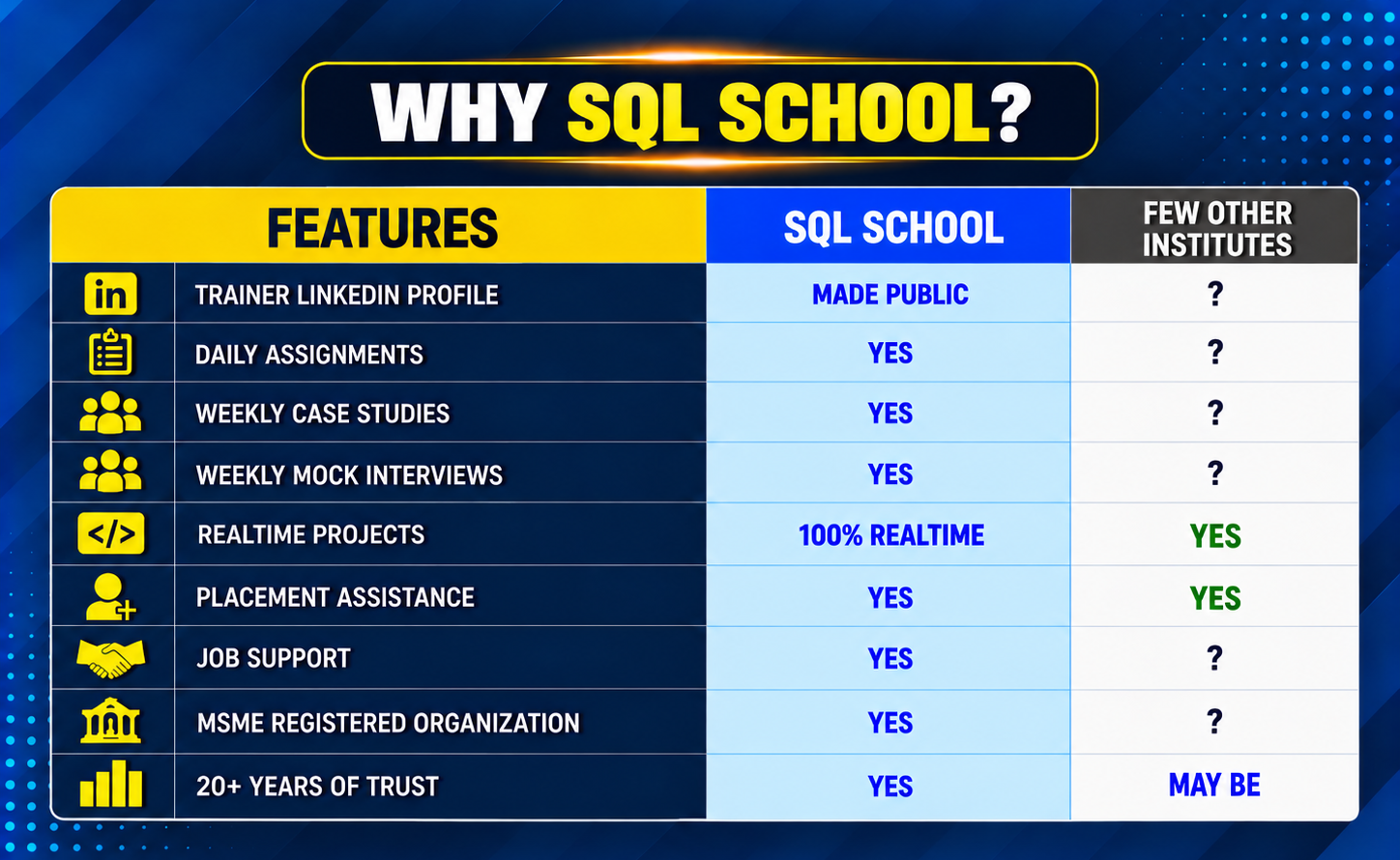
Why SQL SCHOOL?

Training Modes

Why Choose SQL School

  • 100% Real-Time and Practical
  • ISO 9001:2008 Certified
  • Concept wise FAQs
  • TWO Real-time Case Studies, One Project
  • Weekly Mock Interviews
  • 24/7 LIVE Server Access
A man smiling and giving a thumbs up while holding a notebook.
  • Realtime Project FAQs
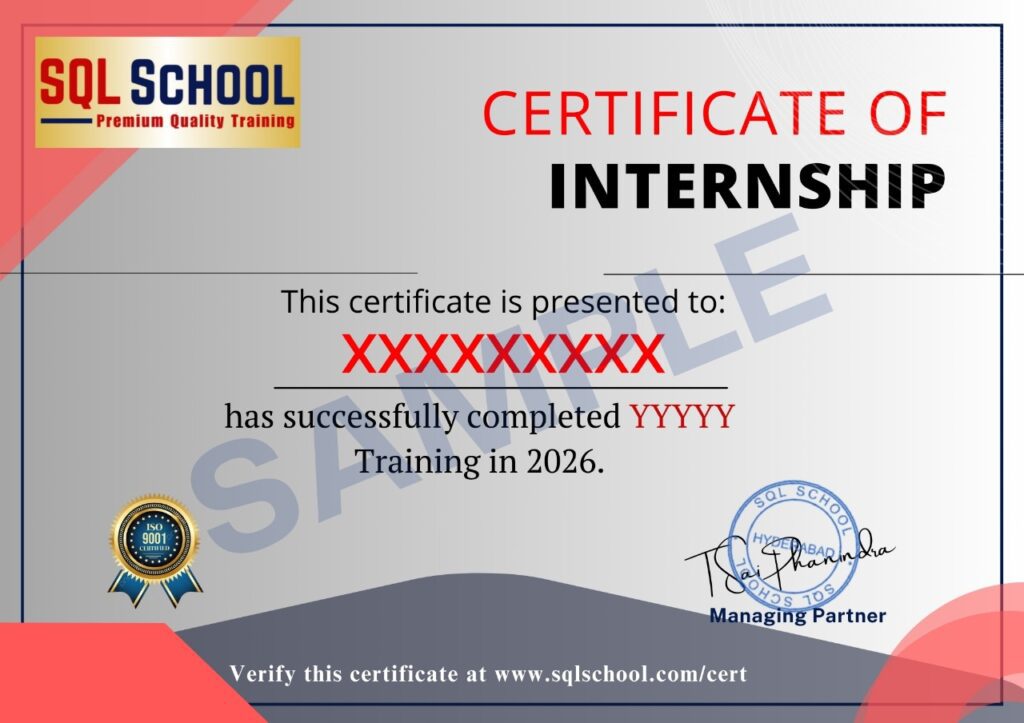
  • Course Completion Certificate
  • Placement Assistance
  • Job Support
  • Realtime Project Solution
  • MS Certification Guidance

SQL School Azure Data Engineer training certificate of completion issued in January 2026 with verification ID
Verified by MonsterInsights