


Cloud ETL Admin job roles are very prominent, high demand unique profile that involves End to End Database Management From OLTP to DWH Databases. This ETL Admin jobs are very much mandatory for Big Data, Data Science and AI Projects ! Practically speaking, we need DATA and every DATA Storage platform needs ADMIN.
Training Highlights
✅ ETL Architecture & Data Flows
✅ SSIS, Informatica, Talend, ADF
✅ Scheduling & Job Monitoring
✅ Error Handling & Logging
✅ Performance Optimization
✅ Validation & Quality Checks
✅ Incremental Loads & CDC
✅ Cloud ETL Integrations
✅ Real Time Project
Modules We Learn:
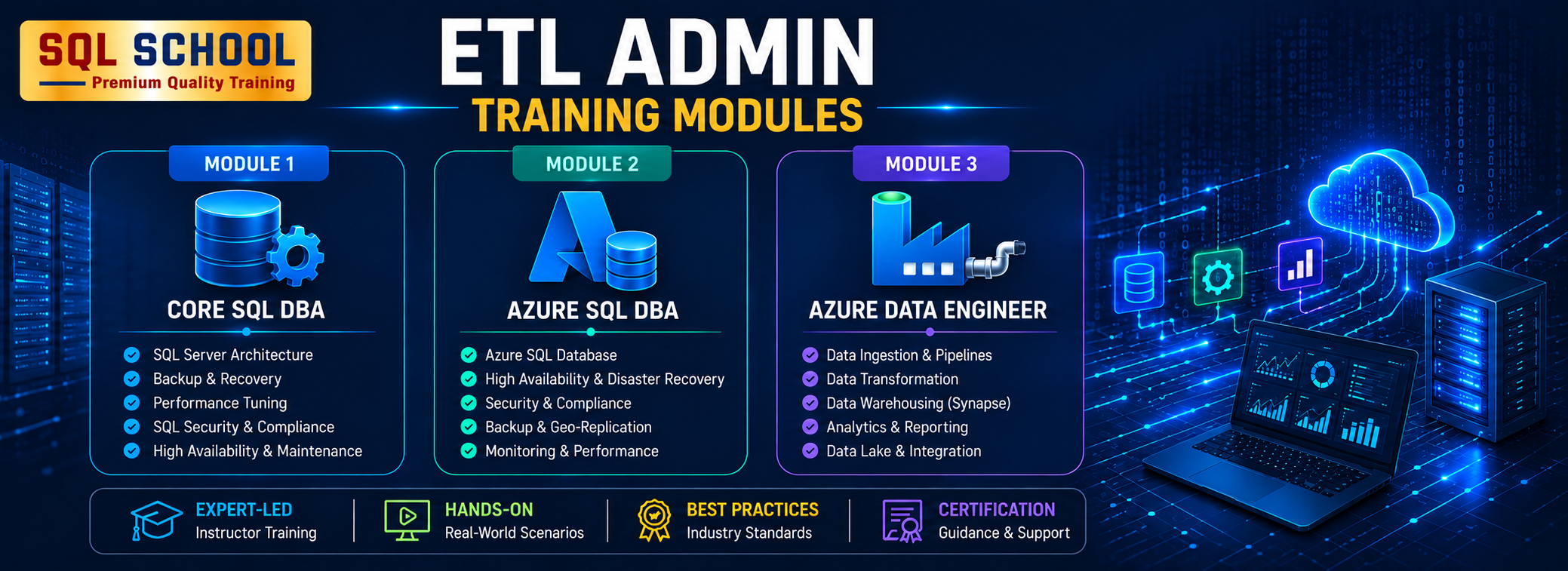
✅ Module 1: Database Concepts & Core SQL DBA
✅ Module 2: Azure SQL DBA
✅ Module 3: Azure ETL & DWH
✅ Module 4: Real-Time Project
Course Duration 3.5 Months
ETL Admin
Course Contents:
Module 1: Database Concepts & Core SQL DBA
Ch 1: SQL Database Job Roles
- Introduction to Databases
- DBA Job Roles
- Routine DBA Activities
- Emergency DBA Activities
- ETL Admin Job Scope, Job Growth
Ch 2: Database Intro & Installations
- SQL Server Installations
- Instance & Collations
- SSMS Tool Installation
- Connections, Authentications
Ch 3: SQL Basics V1 (Commands)
- SQL Basics (DDL, DML, etc..)
- Creating Databases, Tables
- Data Inserts (GUI, SQL)
- Basic SELECT Queries
Ch 4: SQL Basics V2 (Commands, Operators)
- DDL: Create, Alter, Drop
- DML: Insert, Update, Delete
- DQL: Select, Fetch
- Add, Truncate Statements
- SQL Operators
Ch 5: Data Types
- Integer Data Types
- Character, MAX Data Types
- Decimal & Boolean Data Types
- Date and Time Data Types
- SQL_Variant Type
Ch 6: Data Imports
- Data Imports with Excel
- Data Imports with CSV
- Auto Detection of Data Types
- OLE-DB Connections
- Order By, TOP, OFFSET
Ch 7: Schemas & Batches
- Schemas & Table Grouping
- Real-world Banking Database
- 2 Part, 3 Part & 4 Part Naming
- Batch Concept & “Go” Command
Ch 8: Constraints, Keys & RDBMS
- Null, Not Null Constraints
- Unique Key & Check
- Primary Key Constraint
- Foreign Keys, Default
- DB Diagrams & ER Models
Ch 9: Joins & Queries
- Joins: Table Comparisons
- Inner Joins & Matching Data
- Outer Joins: LEFT, RIGHT
- Full Outer Joins & Aliases
- Self Joins & Aliases
Ch 10: Views & RLS
- Views: Realtime Usage
- DML, SELECT with Views
- WITH CHECK OPTION
- Row Level Security (RLS)
- Important System Views
Ch 11: Stored Procedures (Practical Overview)
- Stored Procedures: Realtime Use
- Parameters Concept with SPs
- Procedures with SELECT
- System Stored Procedures
- Stored Procedures, Tuning
Ch 12: User Defined Functions (Practical Overview)
- Functions in Real-world
- Scalar & Table Value Functions
- Parameterized Queries
- Variables & Parameters
- Function Executions
Ch 13: Triggers & Automations
- Need for Triggers in Real-world
- DDL & DML Triggers
- For / After Triggers
- Instead Of Triggers
- Disabling DMLs Triggers
Ch 14: Transactions & ACID
- Auto Commit Transaction
- Explicit Transactions
- COMMIT, ROLLBACK
- Checkpoint & Query Blocking
- READPAST, LOCKHINT
Ch 15: CTEs & Tuning
- Common Table Expression
- CTEs for Data Retrieval
- CTEs for DML Operations
- CTEs for Data Cleansing
- CTEs with Row Number
Ch 16: Linked Servers
- SQL Server Instances
- Linked Server: Creation
- Linked Server: Testing
- Scripting Linked Servers
- Realtime Usage
- Remote DB Access
Ch 17: Server Architecture
- Database Engine Components
- Parser, Compiler & Optimizer
- Protocols and Query Processing
- MDAC and CLR Components
- Parsing and Compilation
- Memory Manager & IO Managers
- SQL OS Components, MDAC
Ch 18: DB Architecture (VLDB)
- Planning Large Databases
- Primary, Secondary Data Files
- Filegroups, Spacing and Sizing
- Log File: Usage and Precautions
- Creating Tables with Filegroups
- Pages and Extents for Storage
- VLF, MiniLSN & Checkpoint
Ch 19: Backups
- Database Backups & Types
- DB, Filegroup, File Backups
- Copy Only Backups, Usage
- Partial Backups, Split Backups
- Mirror Backups, Verifications
- Checksum, ContinueOnError
Ch 20: Restores
- DB, Filegroups, File Restores
- GUI Restores: Limitations
- Restoring & Online States
- FILELISTONLY
- MOVE Options with Restores
- Standby Mode Restores
- Point-In-Time (PITR) Restores
Ch 21: Jobs, Maintenance & DB Mail
- SQL Server Agent Service
- Job Steps & Schedules
- DB Maintenance Plans
- Backup Maintenance
- Common Errors, Solutions
- SMTP, Email Profile
- Alert System : Agent Settings
- Operators, Job Notifications j
Ch 22: Security Management
- Security Objects, Logins
- Users, Roles & Principals
- Schema Level Security
- Object, Column Level Security
- Security Audit, Logon Failures
- Keys & Certificates
- Encryptions & Data Security
Ch 23: DB Migrations
- Creating Credentials
- Creating SSIS Proxies
- Creating CDW Packages
- Database Detach – Attach
- SMO Migration Method
- DB Migration Schedules
- Detect, Fix Orphan Users
Ch 24: Tuning: Audits, AM Tool
- Activity Monitor Tool
- Perfmon Tool & Counters
- Query Audits: DMVs, DMFs
- Plan Handle, Execution Time
- Long Running Queries
- Query Store & Data Flush
Ch 25: Tuning: Indexes
- Indexes: Sort Locations
- Clustered & Online Indexes
- Non Clustered, Column Store
- Included Indexes in Realtime
- Covering Index & Selectivity
- Indexed Views (Materialized)
Ch 26: Tuning: Partitions
- Partitions: Performance Tuning
- Partition Functions & Schemes
- Partition Un-partitioned Tables
- Compressions: ROW, PAGE
- Partitions Limitations in OLTP
- Partitions with DWH
Ch 27: Statistics & Tuning
- Statistics: Realtime Usage
- Index & Column Statistics
- Statistics & Key Purpose
- Statistics Versus Indexes
- Stats Updates on Tables
- Stats Updates on Views
Ch 28: Index Management
- Index Management Options
- Index Rebuilds, Re-Organize
- Database Maintenance Plans
- Page Count and DOP
- Resumable & Online Indexes
- PAUSE, RESUME in Rebuilds
Ch 29: Tuning Tools
- Tuning Tools: Workload Files
- Profiler Tuning, Events
- DTA, Profiler Options
- Physical Design Structures
- PDS Recommendations
- Query Execution Cache
- Tuning Tools: Precautions
Ch 30: Execution Plans
- Execution Plan Analysis
- IO Cost and CPU Cost
- SubTree & Operator Cost
- NUMA Nodes, Processor Affinity
- Thread Count, DOP
- CTEs & Tuning
Ch 31: Lock Management
- Open Transactions in Realtime
- Open Transaction, Blocking
- LOCKS: Types & Audits
- S, X, IX, U and MD Locks
- Sch-M and Sch-S Locks
- SP_WHO2, SP_LOCK
- sysprocesses & Lock Waits
Ch 32: Isolation Levels
- Lock Hints and Isolation Levels
- Read Committed, Uncommitted
- Serializable, Repeatable Read
- Snapshot Isolation, Versioning
- Read Committed Snapshot
- sysprocesses & sp_who2
- Choosing Correct Isolation Level
Ch 33: Deadlocks, LIVE Locks
- Deadlocks in Real-world
- Profiler Tool & Deadlocks
- Lock Management: Deadlocks
- Deadlock Graphs & Events
- Deadlock Avoidance, Prevention
- Deadlock Prevention
- sysprocesses & sp_who2
Ch 34: Recovery Models
- Recovery Models
- Database Properties
- Full Recovery Model
- Simple & Bulk Logged
- Realtime Uses
- Backups Versus Recovery Models
Ch 35: HA DR @ Replication – 1
- Replication : Realtime Usage
- Distributor Configurations
- Publisher and Subscriber
- Replication Types: Snapshot
- Transactional Replication
- Log Reader Agent & Usage
- Replication Monitor, Alerts
Ch 36: HA DR @ Replication – 2
- Merge Replication & Usage
- Peer – Peer Replication
- Push & Pull Subscriptions
- Conflict Detection, Avoidance
- Scripting Replication Agents
- Limitations with Replication
- Common Errors, Solutions
Ch 37: HA DR @ Log Shipping
- Log Shipping Configurations
- Primary, Secondary Servers
- Working with Network Shares
- Jobs: Backup, Copy, Restore
- NORECOVERY, STANDBY
- Manual Failover Process
- Common Errors, Solutions
Ch 38: HA DR @ DB Mirroring
- Database Mirroring Concepts
- Configuring Principal, Mirror
- Configure Witness, EndPoint
- Synchronous, Asynchronous
- Automated Failover Process
- Manual Failover, Monitoring
- Common Errors, Solutions
Ch 39: DB Health Checks, Repairs
- DBCC Commands in Realtime
- DBCC for Audits, Repairs
- MSDB Suspect Pages
- User Database Repairs
- Single User Mode
- Emergency Mode
- Recovery & Restoring Modes
Ch 40: Issues & Solutions
- Log Space Issues, Solutions
- TempDB Issues, Solutions
- Memory Issues, Solutions
- Health Check Strategies
- Healthy Backups
- Maintenance Plans
- Database States
Ch 41: Updates & Upgrades
- Updates Process
- RTM, SP, CU (Cumulative Updates)
- Upgrades Process (In-Place)
- Cautions & Maintenance
- Rollbacks
Ch 42: System DB Rebuilds, DAC
- Command Line Installations
- System DB Rebuilds
- Server Down Issues
- Service Startup Issues
- DAC: Dedicated Admin Console
- Login Failure Issues
- SQL CMD : Secondary Logins
Ch 43: AI for SQL DBA, SLA & OLA Process
- AI Extensions
- AI Optimizations
- SLA – OLA Process
- Ticketing Tools
- 3rd Party Tools
- Common Errors & Solutions
Ch 44: SQL DBA Project – Phase 1 (Enterprise SQL Server Database Administration)
- Routine DBA Activities
- Emergency DBA Activities
- Maintenance DBA Activities
- Auditing Techniques
- RCA (Root Cause Analysis)
Ch 45: SQL DBA Project – Phase 2 (Enterprise SQL Server Database Administration)
- Login Failure Errors
- Slow Database Issues
- Network Errors
- Security Strategies
- HA DR Strategies
- Common Error Codes
- Need for Azure Cloud
Module 2: Azure SQL DBA
Ch 46: Cloud Basics, Azure Funda
- Cloud Fundamentals
- Cloud Concepts, Benefits
- IaaS, PaaS, SaaS Cloud Types
- Azure Cloud Concepts
- Azure Resources & Usage
- Azure Services & Purpose
- Azure Account & Subscription
Ch 47: Azure SQL Deployments
- Azure SQL Services
- Azure SQL Server Creation
- Azure SQL Databases
- Azure Firewall : Rules
- Test Connections from SSMS
- SSMS Tool : Test Connections
- ADS Tool : Installation, use
Ch 48: Azure SQL DB Licensing
- Azure SQL DB Licensing
- Per Database Licensing
- DTUs: Basic, Standard Types
- VPU and Plan Types
- DTU Versus VPU Licensing
Ch 49: Elastic Pools
- Creating Elastic Pools
- Elastic DTUs (eDTU) Usage
- Elastic Query Processing
- Per Database Allocations
- Realtime Use
- Cost Optimizations
Ch 50: Azure Storage Account
- Azure Storage Account
- Azure Data Lake Storage Account
- Hierarchical Name Space (HNS)
- Storage Containers
- File Uploads
Ch 51: Azure SQL DB Migrations
- SQL DB Migration Options
- Data Migration Assistant: DMA
- DMA Tool, Migration Options
- On-Premises DB Export
- Azure SQL Database Import
Ch 52: Azure SQL DB Tuning – 1
- Server Level Tuning
- Database Level Tuning
- Built-In Intelligence
- Index Options
- Index Hints
Ch 53: Azure SQL DB Tuning – 2
- Using Azure AI
- AI Search Service
- AI Indexes, Practical Use
- Watermark Columns
- Index Refresh Options
Ch 54: Azure SQL DB Metrics
- Azure SQL DB Metrics
- CPU, Memory, Log Metrics
- Data File Metrics, Alerts
- Action Groups & Emails
- Query Recommendations
Ch 55: Azure SQL DB Backups
- Azure SQL DB Backups
- Backup Retention Options
- LTR Backups, Log Backups
- Automated Backups
- Backup Configurations
- Backup History
Ch 56: Azure SQL DB Restores
- Azure SQL DB Restores
- LTR Restores
- PITR Restores
- Server Level Restores
- Database Level Restores
Ch 57: HA DR @ Replication
- Azure HA DR Mechanisms
- Geo Replication
- Primary & Secondary
- Manual Failover
- Automated Failover
- DMVs For Replication
- Testing Read Only Databases
Ch 58: HA DR @ Server Failover
- Multi Database Replication
- Configure Server HADR
- Adding Replica Databases
- Replica DB: Capacity
- Replica DB: Status
- Automated Failover
Ch 59: Azure Security – 1
- Azure SQL Server Security
- Creating Logins & Users
- Grant, With Grant
- Database Roles & Security
- Schema Level Security
Ch 60: Azure Security – 2
- Row Level Security (RLS)
- Predicate Function
- Dynamic RLS
- Security Functions
- Dynamic Data Masking
- Email and Phone Number Masking
Ch 61: Azure Security – 3
- Azure AD Users
- AD Principals
- Creating AD Users
- IAM Concepts
- Implementing RBAC
- MFA Authentication
Ch 62: Azure Virtual Machines
- Azure IaaS Implementation
- Configure Disk, Network
- Configure SQL Security
- CPU, Processor & IO
- IP & RDP Connections
- Testing SSMS Connections
- Migrating SQL 2025 to VM
Ch 63: Azure VM Clusters
- Azure Active Directory
- Azure AD DS Services
- Azure Networking Options
- Availability Groups, Usage
- Listeners and Realtime Use
- FSW: File Share Witness
Ch 64: SQL Server Clusters
- Creating SQL Clusters
- Cluster Nodes
- Master Node
- Cluster Components
- Testing SQL Clusters
Ch 65: Always-On
- Configure Always-On
- Testing, Using Always-On
- AOAG Implementation
- AOAG Monitoring
- Comparing Paas & IaaS
Ch 66: PowerShell
- Azure PowerShell
- Az and get Commands
- Creating Resources
- Lists & Validations
- Password Resets
- Firewall Config
- Resource Cleanups
Ch 67: Azure Managed Instance
- Azure MI Implementation
- Network Entities for MI
- Cloud Azure MI Access
- Azure MI Implementation
- Azure MI Migrations
Ch 68: Real-Time Project (Enterprise SQL Server DBA in Cloud) – Phase 1
- Azure Cloud Migrations
- Azure Cloud Management
- Troubleshooting
- Routine SQL DBA Activities
Ch 69: Real-Time Project (Enterprise SQL Server DBA in Cloud) – Phase 2
- Maintenance DBA Activities
- Performance Tuning
- Azure Cloud (IaaS) Clusters
- Always-On
Ch 70: BONUS MODULE
- DP 300 Exam Guidance
- Resume & Mock Interviews
Module 3: Azure ETL & DWH
Part 1: Azure Fundamentals, ADLS & IAM
Ch 1: Azure Fundamentals
- Cloud Introduction, Azure
- Cloud Implementations
- Azure Account, Subscription
- Azure ETL & DWH Resources
- Azure Storage, IoT Resources
Ch 2: Azure Storage & ADLS
- Azure Storage Account
- Azure Data Lake Storage
- Azure BLOB Containers
- Blob File Uploads
- Azure Tables
Ch 3: Azure Storage Security
- Microsoft Entra ID
- RBAC, IAM
- Access Keys, SAS Keys
- ACL (Access Control List)
- Connection Strings
Ch 4: Azure Stream Analytics
- Azure IoT Hubs
- Azure Stream Analytics
- LIVE Data Ingestions
- SAQL Queries
- Stream Analytics Jobs
- Handling JSON Data
Ch 5: Azure Key Vaults
- Azure Key Vaults
- Azure Keys & Secrets
- Access Policies
- Secret Management
- Managed Identity
Ch 6: Azure Logic Apps
- Azure Logic Apps
- Logic Apps & Automations
- Azure Events
- Azure Triggers & Signals
- ADLS with Logic Apps
Part 2: Azure Data Factory & Synapse
Ch 1: Azure Fundamentals
- Cloud Introduction, Azure
- Cloud Implementations
- Azure Account, Subscription
- Azure ETL & DWH Resources
- Azure Storage, IoT Resources
Ch 2: Azure Deployments, Azure SQL
- Azure SQL Server Deployment
- Azure SQL DB Deployment
- Azure SQL Database (OLTP)
- Azure Firewall Rules
- Connections from SSMS Tool
Ch 3: Azure SQL DB Migrations
- Azure Storage Account
- On-Premise SQL DB, bacpac
- Azure SQL DB Migration
- SQL Server Imports from BLOB
- Migration Verifications
Ch 4: Azure Synapse (DWH)
- Synapse Pool Architecture
- Control Node, Compute Node
- DMS (Data Movement Service)
- Azure DWH Tables: Partitions
- Distributions & MAXDOP
Ch 5: Azure Data Factory (ADF)
- Need for ADF & Pipelines
- Data Orchestration with IR
- Integration Runtime Engine
- Linked Services, Datasets
- Pipelines: Copy Data Activity
- Data Flow Activity with IR
Ch 6: Azure SQL DB Loads
- ADF: Author, Azure SQL DB Reads
- Azure SQL Pool Writes
- Synapse Analytics with IR
- Pipeline Design, Validation
- Pipeline Runs, Monitoring
Ch 7: Azure Blob Data Loads
- ADF Author & Pipeline Runs
- Azure BLOB Storage Access
- Storage Containers in ADF
- Pipeline Validation, Schedules
Ch 8: File Incremental Loads
- File Incremental Loads
- Storage Account, Data Lake
- Binary Copy, Schema Drift
- Staging Concept in ADF
- Initial, Incremental Loads
- Schema & Data Changes
Ch 9: Table Incremental Loads
- Implement SCD with ADF
- Self Hosted IR: Realtime Use
- On-premise Data: Incr Loads
- Copy Method: Upsert, Keys
- Staging & ADF Optimizations
- Pipeline Logging
Ch 10: ADF Data Flow – 1
- Creating Data Flow Items
- Using Multiple Sinks
- Conditional Split Transformation
- Select, Sort, Union, Loops
- ADF Debug Options
Ch 11: ADF Data Flow – 2
- Working with Multiple Tables
- Join Transform, Broadcast
- Surrogate Keys, Derived Cols
- ETL Loads Dates, Sink Options
- Aggregated Data Loads
Ch 12: ADF Data Flow – 3
- Pivot Transformation
- Group By & Pivot Keys
- Column Pattern, Deduplicate
- Lookup, Cached Lookup
- Tuning Transformations
- Tuning Data Flow, Spark
Ch 13: ADF Data Flow – 4
- Get Metadata
- IF & Lookup Transformation
- Cache Lookup
- Data Validations
- Lookup Versus Joins
Ch 14: ADF Optimizations
- Synapse SQL Pool Partitions
- ADF Partitions
- Broadcast Options
- Staging, Logging
- DIU, DOCP
Ch 15: ADF Parameters, Security
- Linked Service Parameters
- Creating Logins & Users
- Schemas, ETL Permissions
- Logins Parameters in ADF
- Dynamic Linked Services
Ch 16: SCD & ETL with Control Tables
- Incremental Loads (SCD)
- Control Tables, Watermarks
- Lookup Activity, Delta Queries
- SP Activity & Parameters
- Pipeline Parameters, SPs
Ch 17: ADF Metrics, Alerts
- Azure Insights
- Azure Metrics for ADF
- Azure Metrics for Synapse
- Alerts and Notifications
- Action Groups, Tuning Options
Ch 18: Synapse Analytics
- Azure Synapse Analytics
- Synapse Deployments
- Synapse Configurations
- ADLS Containers
- Workspace Server Setup
- Synapse Studio (GUI)
Ch 19: Synapse: Dedicated SQL Pools
- Creating Dedicated SQL Pools
- BLOB Data Imports
- TSQL Queries, Data Imports
- Big Data Analytics
Ch 20: Synapse: Serverless Pools
- Serverless Pools, TSQL
- Serverless Architecture
- OPENROWSET Operations
- BULK Copy Scripts
- Big Data Analytics
Ch 21: ADF with DevOps & CI/CD
- Git repositories and branching
- ADF Git integration
- Development / Test / Production environments
- Parameterized deployments
- Production release workflow
Ch 22: Azure Databricks
- Azure Databricks Deployments
- Azure Databricks Regions
- Classic Deployments
- Access connector for Databricks
Ch 23: Azure Databricks with ADLS
- Creating IAM Users
- ADLS Security for Databricks
- Creating Service Principals
- Enterprise Applications
- Client ID, Secret ID
- External Tables (Delta)
Ch 24: Azure Databricks with ADF
- Azure Databricks Connections in ADF
- Calling Notebooks in ADF
- ADF Versus Databricks
- ADF With Databricks
- End to End ETL Strategies
Ch 25: Fabric Concepts
- Fabric Architecture
- OneLake
- Lakehouse
- Warehouse
- Data Factory
- Fabric Pipelines
- Dataflow Gen2
Ch 26: Fabric Migrations
- Azure → Fabric migration scenarios
- ADF → Fabric Data Factory
- Synapse → Fabric
- ADLS → OneLake
Part 3: Azure ETL & DWH Admin
Ch 1: Azure DWH Backups
- Azure DWH Backups
- Backup Policies
- Backup Retention
- Backup Configurations
- Azure OLTP Versus DWH Backups
Ch 2: Azure DWH Restores
- Azure DWH Restores
- Point In Time Restores (PITR)
- Azure OLTP Versus DWH Restores
Ch 3: Azure DWH Replication
- Azure DWH Replication Options
- Replication Settings & Process
- Testing Replication in Azure DWH
Ch 4: Azure DWH Security – 1
- Azure SQL Server Logins
- Azure SQL Pool Users
- Logins, Permissions
- Users, Permissions
- Roles & Schemas
- GRANT, WITH GRANT
Ch 5: Azure DWH Security – 2
- Azure AD (Microsoft Entra)
- IAM and RBAC
- Azure Defender
- TDE & Data Encryptions
Ch 6: Azure DWH Management
- Azure Synapse Partitions
- Distributions
- Performance Tuning
- Big Data Issues, Solutions
Ch 7: Data Governance
- Azure Data Governance Concepts
- Data Governance Rules
- Data Governance Scenarios
- Data Security & Management
Module 4: Real-Time Project
Environment: Online Travel Data Engineering Platform
Project Objective:
Build an end-to-end Azure ETL Solution to process, transform, and analyze Online Travel business data
from multiple sources.
Skills Gained:
- Data Ingestion & ETL Development
- Azure Data Factory Pipelines
- Data Lake Architecture, RBAC
- Azure IoT, Stream Analytics
- Azure ETL Admin
- Azure ETL Backups, Restores
- Azure ETL Security
Components For Project
- ADF Pipelines
- Pipeline Logging
- Pipeline Management
- Synapse Analytics
- Apache Spark Schemas
- Monitoring & Alerts
- End to End Integrations
- IAM & Managed Identity
- Key Vaults & Security
Resume Highlights
After completing this module, you can confidently showcase experience in:
- Azure OLTP Management
- Azure DWH Management
- Azure ETL Management
- Azure to Fabric Migrations
- Data Quality & Validation
- Performance Optimizations
What is the ETL Admin Training?
This course trains you on complete ETL Administration including SQL, SQL DBA, Azure SQL DBA, Azure ETL, Data Warehouse Admin, ADF, Synapse, Streaming, and Real-Time Project Implementation.
What are the objectives of this ETL Admin course?
Objectives By the end of this course, you’ll be able to:
* List the four key product lines available from Databricks.
* Describe how each product line serves its respective audience.
* Navigate the Databricks Workspace UI to locate key features and functionalities.
* Describe the primary responsibilities and core skills of a data engineer
* Explain the stages of a traditional data engineering architecture, from data ingestion to processing, storage, and consumption
* Define the core components of the Databricks Lakeflow offering and describe how it benefits data engineering practitioners
* Describe the Medallion Architecture for data transformation in Databricks.
* Describe how Lakeflow Declarative Pipelines and Lakeflow Jobs facilitate unified orchestration in Databricks.
Prerequisites
A basic understanding of data engineering principles and topics such as data collection, extraction, ingestion, and transformation.
Who should join the ETL Admin course?
DBAs, System Engineers, Data Engineers, Database Consultants, Project Managers, and professionals who want to add strong technical expertise to their resume. Anyone can join.
What is the duration of the ETL Admin training?
The course duration is 3 months, including two real-time projects and job-oriented hands-on labs.
What modules are included in the ETL Admin program?
Module 1: SQL & MSSQL
Module 2: Core SQL DBA
Module 3: Azure SQL DBA + CoPilot
Module 4: Azure ETL & DWH (ADF, Synapse)
Module 5: Real-Time Projects
Is this course suitable for beginners?
Yes. The training starts from Database Basics, SQL Basics, and Installation concepts before moving into advanced SQL DBA, Azure, ETL and DWH operations.
What SQL topics are included for ETL Admin?
Database creation, SQL commands, tables, constraints, joins, views, stored procedures, functions, transactions, CTEs, tuning, linked servers, schemas, and ER models.
Will I learn full SQL DBA administration?
Yes. SQL Server Architecture, Backups, Restores, Jobs, Maintenance Plans, Alerts, Security, Migrations, Tuning, Indexing, Partitions, Statistics, Execution Plans, Locks & Deadlocks.
Do you teach High Availability & Disaster Recovery?
Yes. Replication (Snapshot, Transactional, Merge, Peer-to-Peer), Log Shipping, Database Mirroring, Failover processes, monitoring, and troubleshooting.
Will I learn Azure SQL DBA as part of this program?
Yes. Cloud fundamentals, Azure SQL Servers, Databases, Firewall, Licensing (DTU vs VCore), Migration tools, Metrics, Automated Tuning, Backups & PITR Restores, Geo-Replication, Failover Groups, Azure VM, Managed Instance.
Does this course include Azure Data Factory (ADF)?
Yes. Pipelines, Linked Services, Datasets, Integration Runtime, Copy Activity, Data Flows, Incremental Loads, Schema Drift, SCD, Parameters, Validations, Monitoring, Alerts.
Will I learn Azure Synapse Analytics?
Yes. Synapse architecture, control/compute nodes, T-SQL tables, distributed tables (Hash, Round Robin, Replicated), big data loads, DMVs, and performance tuning.
Do you cover Azure Storage and BLOB handling?
Yes. Storage Accounts, Containers, Data Lake, BLOB ingestion, pipeline transformations, staging concepts, compression, binary copy, and security using RBAC/ACLs.
Will I learn Incremental Loads and SCD in ADF?
Yes. Table Incremental Loads, File Loads, Control Tables, Watermarks, Upsert keys, SCD implementation, and pipeline tuning options.
Do you teach LIVE Streaming & IoT pipelines?
Yes. Azure IoT Hubs, Stream Analytics Jobs, live JSON/AVRO ingestion, SAQL queries, watermarking, and real-time streaming pipelines.
Are Security & Identity Management covered?
Yes. Logins, Users, Permissions, IAM, AD Users, MFA, RBAC, Data Masking, Dynamic RLS, Key Vaults, Encryptions at REST & in Transit.
Do you cover CI/CD and GitHub integrations?
Yes. Git repositories, branch management, publishing changes, builds, deployments, and full CI/CD workflows for ADF and Synapse.
Is there a complete real-time ETL & DWH project?
Yes. End-to-end project including Requirements, Design, ETL Development, ADF Pipelines, Synapse Loads, Incremental Logic, Scheduling, Alerts, and Resume-Level Details.
Will I get support for DP-203 or DP-300?
Yes. The course includes DP-203 (Azure Data Engineer) and DP-300 (Azure DBA) guidance with FAQs, mock interviews, and resume support.
What job roles can I apply for after this course?
ETL Admin, Data Engineer, Azure Data Engineer, SQL DBA, Azure SQL DBA, DWH Engineer, ADF Developer, Synapse Engineer, and Cloud Data Operations roles.
What training modes are available?
Live Online Training, Self-Paced Video Training, 1-on-1 Doubt Sessions, Real-Time Projects, Resume Preparation, and Mock Interviews.
Demo Videos
Training Modes






Why Choose SQL School
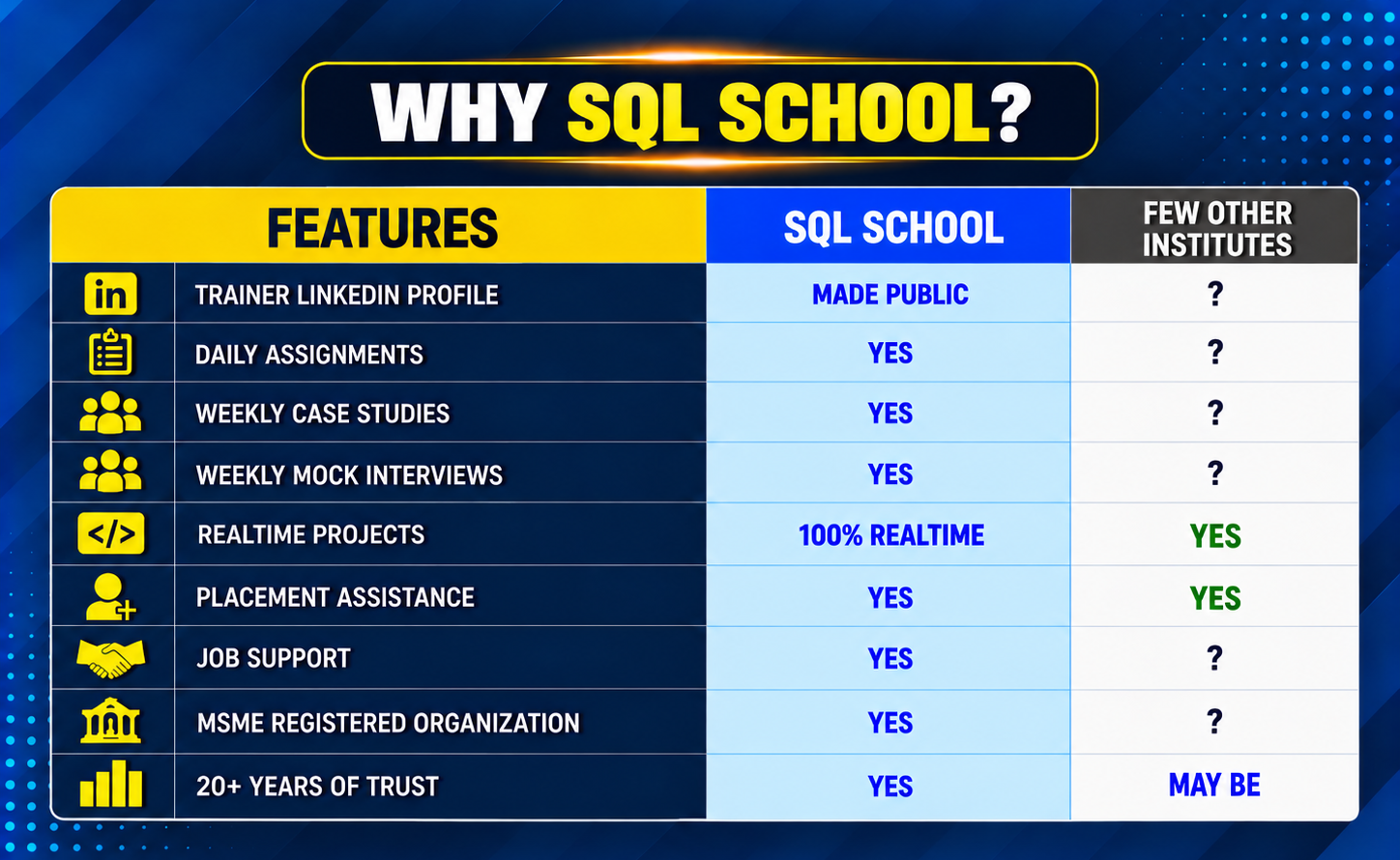
- 100% Real-Time and Practical
- ISO 9001:2008 Certified
- Concept wise FAQs
- TWO Real-time Case Studies, One Project
- Weekly Mock Interviews
- 24/7 LIVE Server Access

- Realtime Project FAQs
- Course Completion Certificate
- Placement Assistance
- Job Support
- Realtime Project Solution
- MS Certification Guidance