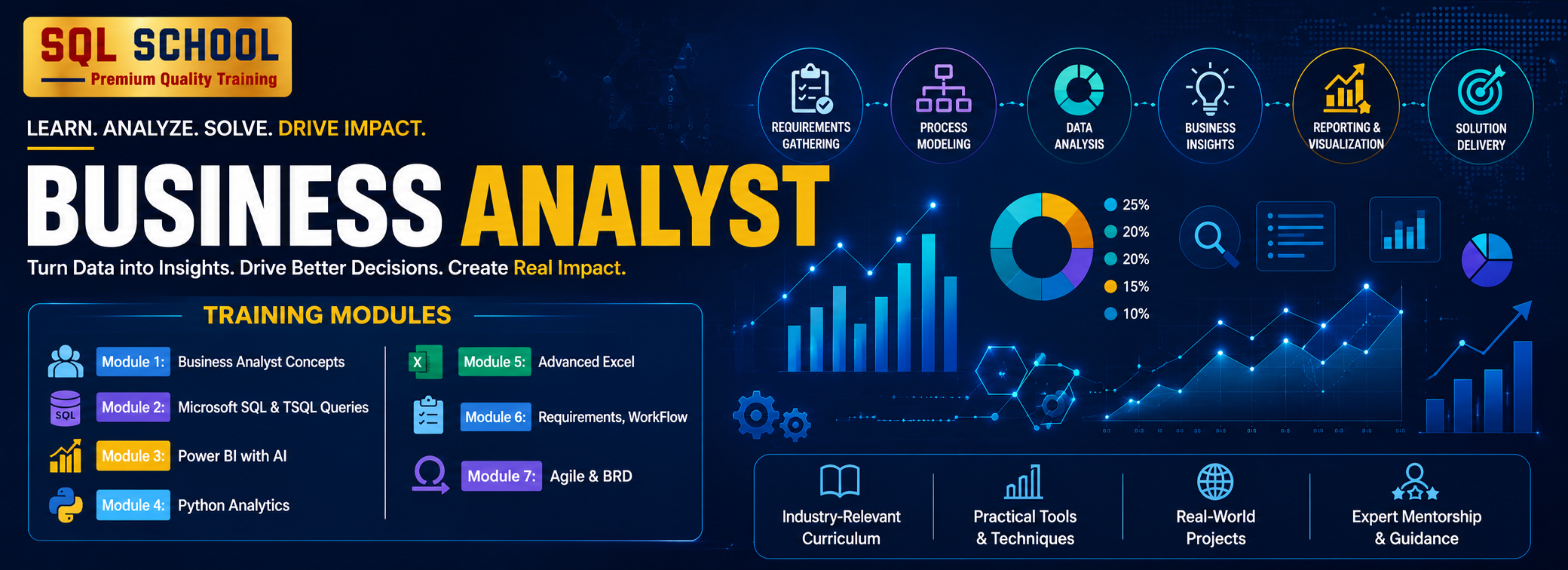
Module 1: SQL Server TSQL
Module 2: Power BI
Module 3: Python Analytics
Module 4: Advanced Excel
Module 5: Requirements & Workflow
Module 6: Agile & BRD


Business Analyst is a promising job role that deals with Business Operations, Business Life Cycle, Data and Analysis driven over a specific process drive the customers with rich Infographics of entire enterprise content as well as provide life cycle implementation plan.
Training Highlights
✅ SQL & Excel for Business Analysis
✅ Real-time On-Job Challenges
✅ Power BI & Tableau Dashboards
✅ BRD/FRD Documentation
✅ Agile & Scrum Methodologies
✅ Process Modeling: UML, BPMN
✅ Data Visualization & Storytelling
✅ Python Basics for Data-Driven Insights
✅ Use Case Scenarios For Job Work
Modules We Learn:
✅ Module 1: SQL Server (MSSQL), TSQL
✅ Module 2: Power BI
✅ Module 3: Python (For Business Analysts)
✅ Module 4: Advanced Excel, Macros
✅ Module 5: Project Requirements & Work Flow
✅ Module 6: Agile & BRD
✅ Module 7: End to End Project Work
Course Duration 3.5 Months
Business Analyst
Course Contents:
Module 1: Business Analyst Concepts & SQL Basics
Ch 1: Business Analyst Introduction
- Business Analysis
- Data & Importance
- Database Intro
- Business Analyst Job Roles
Ch 2: Database Intro & Installations
- SQL Server Installations
- Instance & Collations
- SSMS Tool Installation
- Connections, Authentications
Ch 3: SQL Basics V1 (Commands)
- SQL Basics (DDL, DML, etc..)
- Creating Databases, Tables
- Data Inserts (GUI, SQL)
- Basic SELECT Queries
Ch 4: SQL Basics V2 (Commands, Operators)
- DDL: Create, Alter, Drop
- DML: Insert, Update, Delete
- DQL: Select, Fetch
- Add, Truncate Statements
- SQL Operators
Ch 5: Data Types & Variables
- Integer Data Types
- Character, MAX Data Types
- Decimal & Boolean Data Types
- Date and Time Data Types
- SQL_Variant Type
Ch 6: Data Imports
- Data Imports with Excel
- Data Imports with CSV
- Auto Detection of Data Types
- OLE-DB Connections
- Order By, TOP, OFFSET
Ch 7: Schemas & Batches
- Schemas & Table Grouping
- Real-world Banking Database
- 2 Part, 3 Part & 4 Part Naming
- Batch Concept & “Go” Command
Ch 8: Constraints, Keys & RDBMS
- Null, Not Null Constraints
- Unique Key & Check
- Primary Key Constraint
- Foreign Keys, Default
- DB Diagrams & ER Models
Ch 9: Normal Forms & RDBMS
- Normal Forms: 1 NF, 2 NF
- 3 NF, BCNF and 4 NF
- 1:1, 1:M, M:1 Cardinality
- Cascading Keys, Self Referencing Keys
Ch 10: Joins & Queries
- Joins: Table Comparisons
- Inner Joins & Matching Data
- Outer Joins: LEFT, RIGHT
- Full Outer Joins & Aliases
- Self Joins & Aliases
Ch 11: Views & RLS
- Views: Realtime Usage
- DML, SELECT with Views
- WITH CHECK OPTION
- Row Level Security (RLS)
- Important System Views
Ch 12: Stored Procedures – 1
- Stored Procedures: Realtime Use
- Parameters Concept with SPs
- Procedures with SELECT
- System Stored Procedures
- Stored Procedures, Tuning
Ch 13: Stored Procedures – 2
- Merge Statement (Upsert)
- Merge with OLTP & DWH
- Matched and Not Matched
- Merge & SP Recompilations
Ch 14: User Defined Functions – 1
- Functions in Real-world
- Scalar & Table Value Functions
- Parameterized Queries
- Variables & Parameters
- Function Executions
Ch 15: User Defined Functions – 2
- Date & Time Functions
- String Functions & Queries
- Aggregated Functions & Usage
- Window Functions (Rank)
- Row_Number, DenseRank
- Partition By & Order By
Ch 16: Triggers & Automations
- Need for Triggers in Real-world
- DDL & DML Triggers
- For / After Triggers
- Instead Of Triggers
- Disabling DMLs Triggers
Ch 17: Transactions & ACID
- Auto Commit Transaction
- Explicit Transactions
- COMMIT, ROLLBACK
- Checkpoint & Query Blocking
- READPAST, LOCKHINT
Ch 18: Indexes Basics, Tuning
- Clustered Index, Primary Key
- Non Clustered Index
- Query Optimizer
- Tuning Queries
Ch 19: CTEs & Tuning
- Common Table Expression
- CTEs for Data Retrieval
- CTEs for DML Operations
- CTEs for Data Cleansing
- CTEs with Row Number
Ch 20: Cursors & Temp Tables
- Cursors & Fetch
- Scroll, Absolute Types
- Local & Global Temp Tables
- SELECT..INTO Statement
Ch 21: Sub Queries
- Basic Sub Queries
- Aggregations
- Combining Queries
- UNION, UNION ALL
Ch 22: Group By Queries
- Group By, Distinct
- GROUP BY, HAVING
- Cube( ) and Rollup( )
- Sub Totals & Grand Totals
- Grouping( ) & Usage
Ch 23: Joins with Group By, Sub Queries
- 3 Table, 4 Table Joins
- Join Queries & WHERE
- Join & Group By, Sub Queries
- IIF(), CASE Statement
- Query Execution Order
Ch 24: Capstone Project (HealthCare Domain)
- HealthCare Database
- DB & Table Design
- Data Validations
- Query Design
- Query Tuning
- Excel Analytics
Module 2 : Power BI
Ch 1: Power BI Intro, Installation
- Power BI & Data Analysis
- Power BI Eco System
- Power BI Design Tools
- Power BI Installation
Ch 2: Report Design Concepts
- Basic Report Design (PBIX)
- Data Points, Spotlight
- Visual Interactions & Edits
- Focus Mode, PDF Exports
Ch 3: Grouping, Hierarchies
- Creating Groups: Lists
- Creating Groups: Bins
- Hierarchies & Drill-Downs
- Drill Up, Conditional Drill Down
Ch 4: Slicer & Visual Sync
- Slicer Visual in Power BI
- Slicer: Format Options
- Single Select, Multi Select
- Slicer: Select All On / Off
- Visual Sync with Slicers
Ch 5: Filters & Drill Thru
- Power BI Filters
- Basic, Top & Advanced
- Visual Filters, Page Filters
- Report Level Filters, Clear Filter
- Drill Thru Filters & Usage
Ch 6: Bookmarks, Buttons
- Power BI Bookmarks
- Images: Actions, Bookmarks
- Buttons: Actions, Bookmarks
- Page to Page Navigations
- Score Cards, Master Pages
Ch 7: SQL DB Access & Big Data
- SQL DB Access, Queries
- Storage Modes: Direct Query
- Formatting & Date Time
- Storage Modes in Power BI
- Data Modeling & Formatting
Ch 8: Power BI Visualizations
- Charts, Bars, Lines, Area
- Tree Maps & Axis Items
- Funnel, Card, Mult-Row Card
- Pie Charts & Waterfall
- Scatter Chart, Play Axis
- Infographics, Classifications
Ch 9: Power Query Transformations – 1
- Power Query (Mashup)
- ETL Transformations in PBI
- Table Combine Options
- Merge, Union All Options
- Missing Values, Duplicate Records
- Wrong Data Types, Outliers
- Close, Apply & Visualize
Ch 10: Power Query Transformations – 2
- Group By Transformation
- Aggregate, Pivot Operation
- Reverse Rows, Count Rows
- Data Cleaning, Null Handling
- Data Type Detection, Change
- Rename, Replace, Move
- Fill Up, Fil Down
Ch 11: Power Query Transformations – 3
- String / Text Transformations
- Split, Merge, Extract, Format
- Numeric and Date Time
- Add Column & Expressions
- Column From Examples
Ch 12: Power Query Transformations – 4
- Parameters in Power Query
- Static Parameters, Defaults
- Dynamic Dropdowns, Lists
- Linking with Table Queries
- Step Edits, Type Conversions
Ch 13: Power BI Cloud & Fabric
- Power BI Cloud, Microsoft Fabric
- Microsoft Fabric Concepts
- Fabric One Lake (DWH, LH, etc.)
- Microsoft Fabric Workspace
- Power BI Desktop Connections
- Report Uploads (PBIX)
- Report Edits, Semantic Models
Ch 14: Power BI Cloud Dashboards
- Power BI Dashboards
- Dashboard Creation, Usage
- Pin Visuals, Pin LIVE Pages
- Add Image, Video Tiles
- Q&A & Pin Tiles
Ch 15: Power BI Cloud Operations
- Report Shares, Alerts
- Subscriptions, Exploration
- Downloads & Edits
- Report Cloning in Cloud
- QR Codes, Web Publish
- Lineage & Metrics
Ch 16: Power BI Cloud Gateways
- Data Gateways, Data Refresh
- Install, Configure Gateways
- Data Refresh & Scheduling
- Gateway Optimizations
- Incremental Refresh
- Large Dataset Optimization
Ch 17: Power BI Cloud Apps
- Power BI Apps: Creation
- App Sections & Content
- Audience & App Security
- App Updates, Favorites
- App URL, End User Access
Ch 18: Power BI Report Server, RDL
- Power BI Report Server
- RS Config Tool Options
- Report Database, TempDB
- Web Service & Server URL
- Report Builder Tool
- Paginated Report (RDL)
- RDL Report Publish
Ch 19: DAX Concepts & Calculations
- DAX Concepts: Intro & Realtime Need
- DAX Columns: Creation, Use
- DAX Measures: Creation, Use
- DAX Functions: IIF, ISBLANK
- SUM, CALCULATE Functions
Ch 20: DAX Quick Measures
- Quick Measures in Power BI
- Running Totals
- Star Rating Calculations
- DAX Measures in Data View
- DAX in Cloud Reports
Ch 21: Data Modelling
- Dimensions Tables
- Fact Tables & DAX Measures
- Data Models & DDAX Joins
- Star & Snowflake Schemas
- Many-to-Many Relationships
- Calculation Groups
Ch 22: DAX Joins, Variables
- CALCULATEX & Variables
- COUNT, COUNTA, etc..
- SUM, SUMX, etc..
- SELECTED MEMEBER
- Filter Context, RETURN
Ch 23: DAX Models & Calculations
- VAR, SWITCH, SUMMARIZE
- TREATAS, USERELATIONSHIP
- CROSSFILTER, GENERATE
- RANKX, TOPN, WINDOW
- OFFSET, INDEX
Ch 24: DAX Time Intelligence
- Need for Time Intelligence
- Date Table Generation
- Time Intelligence with DAX
- PARALLELPERIOD, DATE
- CALENDAR, Total Functions
- YTD, QTD, MTD with DAX
Ch 25: DAX – Row Level Security
- RLS: Row Level Security
- Data Modelling & Roles
- Add Cloud Users & KPIs
- CoPilot with DAX
Ch 26: DAX – Analytical Reports
- DAX with Excel
- Analytical Reports
- Virtual Cube Concepts
- Cross Filter Reporting
- Alerts, Data Activator
Ch 27: PL 300 Exam Guidance
- PL 300 Exam Guidance
- Exam Samples
- Exam Scenarios
Realtime Project: Enterprise Healthcare Data & Analytics Platform
Project Objective
Design and implement a modern Healthcare Data Platform using Power BI Analytics and Reporting services
to process patient, hospital, clinical, and operational data for reporting, analytics, and decision-making.
Technologies Used
- SQL Server
- MS Excel
- Parquet
- CSV
- Azure
Learning Outcomes
After completing this project, you can confidently showcase experience in:
- Power BI Reporting
- Power BI Data Analytics
- Business Process Understanding
- Performance Optimization
- End-to-End Power BI Implementation in Cloud
Module 3: Python (For Business Analysts)
Ch 1: Python Introduction
- Python Introduction
- Python Versions
- Python for Data Analysts
- Python Architecture
Ch 2: Python Installations
- Python Introduction
- Python Installations
- Anaconda Installation
- Python IDE & Usage
- Jupyter Notebooks
Ch 3: Python Print Statement
- Python Print Statement
- print(), print()
- Testing Case Sensitivity
- Single Line, Multi Line prints
- print() with single quotations
- Debug with AI (AI Assistants)
Ch 4: Python Variables
- Python Variables
- Assigning values
- Variable Value Reads
- Multiple Variables & Print()
Ch 5: Python Operators
- Athematic Operators
- Python String Literals
- Single, Double Quotes
- Format Strings (f string)
- Comparison, Indexing Operators
Ch 6: Python Data Types
- Python Data Types
- Integer, Float, String Data Types
- Type Casting
- Multi Value Assignments
Ch 7: Python Lists
- Creating Python Lists
- Printing List Items
- Print List Slices
- Empty Lists, Append
- Loops, List Updates
Ch 8: Python Dictionaries
- Python Dictionary
- Indexing Dictionaries
- Edit Key Values
- Lists inside Dictionaries
- Delete & Clear
Ch 9: Python Tuples
- Python Tuples
- Defining, Indexing
- Length(), Type()
- Mixed Values in Tuples
- Overwriting Tuples
Ch 10: Python IF..ELSE Condition
- If..Else conditions
- if..elif..else & Shorthand if
- composite conditions
- Indent, pass statement
- in & negation operators
- range conditions
Ch 11: Python Dataframes
- Dataframes: Creation
- Pandas Dataframes
- Dataframes From Single List
- Dataframes from Dictionary
- Display Dataframes, List Items
- Identify, Replace Nulls, NumPy
Ch 12: Python SQL DB Access
- SQL DB Access with Python
- import pandas.DataFrame
- pyodbc module, sql functions
- SQL Query Executions: DDL, DML
- Filters, Aggregations with SQL
- Dataframe Usage with SQL
Ch 13: Dataframe Transformations – 1
- Dataframe Transformations
- Concat & Append
- Merge Function
- Join with Multiple Dataframes
- Data Type Checks, Conversions
- Loops with Dataframes
Ch 14: Dataframe Transformations – 2
- Pandas – Cleaning Data
- Replace, Transform Columns
- Data Discovery & Column Fill
- Identify & Remove Duplicates
- dropna(), fillna() Functions
Module 4: Advanced Excel, Macros
Ch 1: Basic Functions
- SUM, AVERAGE, MAX, MIN, COUNT, COUNTA
- Absolute, Mixed
- Relative Referencing
Ch 2: Formatting and Proofing
- Currency Format
- Format Painter
- Formatting Dates
- Custom and Special Formats
- Formatting Cells
Ch 3: Functions
- SUMIF, SUMIFS, COUNTIF
- COUNTIFS, AVERAGEIF
- AVERAGEIFS, NESTED IF
- IFERROR STATEMENT
- AND, OR, NOT
Ch 4: Protecting Excel
- File Level Protection
- Workbook
- Worksheet Protection
- Security Concepts
- Realtime Issues, Solutions
Ch 5:Text Functions
- Upper, Lower, Proper
- Left, Mid, Right
- Trim, Len, Exact
- Concatenate
- Find, Substitute
Ch 6:Date & Time Functions
- Today, Now
- Day, Month, Year
- Date, Date if, Date Add
- EOMONTH
- Weekday Functions
Ch 7: Adv. Techniques
- Paste Formulas
- Paste Formats
- Paste Validations
- Transpose Tables
Ch 8: New in Excel & 365
- Charts – Tree map & Waterfall
- Sunburst, Box and whisker Charts
- Combo Charts – Secondary Axis
- Adding Slicers Tool in Pivot & Tables
- Using Power Map and Power View
- Forecast Sheet, park lines
Ch 9: New in Excel & 365
- Using 3-D Map
- New Controls in Pivot Table
- Various Time Lines
- Auto complete a data range
- Quick Analysis Tool
- Smart Lookup manage Store
Ch 10: Printing Workbooks
- Setting Up Print Area
- Customizing Headers
- Templates
- Print Titles –Repeat Rows
Ch 11: Sorting and Filtering
- Filtering on Text
- Numbers & Colors
- Sorting Options
- Advanced Filters
- Filter Criteria
Ch 12: What If Analysis
- Goal Seek
- Scenario Analysis
- Data Tables (PMT Function)
- Solver Tool
Ch 13: Logical Functions
- If Function
- How to Fix Errors – if error
- Nested If
- Complex if and or functions
Ch 14: Data Validation
- Number, Date & Time
- Text and List Validation
- Custom validations formulas
- Dynamic Dropdowns
Ch 15: Lookup Functions
- V lookup / H Lookup
- Index and Match
- Smooth User Interface
- Nested V Lookup
- Reverse Lookup
- Worksheet linking
- V lookup with Helper Column
Ch 16: Pivot Tables – 1
- Creating Simple Pivot Tables
- Classic Pivot table
- Choosing Field
- Filtering PivotTables
- Modifying PivotTable Data
- Grouping
- Calculated Fields
Ch 17: Pivot Tables – 2
- Array with IF, LEN
- MID function formulas.
- Array with Lookup functions.
- Various Charts
- SLICERS, Filter data
- Manage Primary Axis
- Manage Secondary Axis
Ch 18: Excel Dashboard
- Planning a Dashboard
- Adding Tables and Charts to Dashboard
- Adding Dynamic Contents to Dashboard
Ch 19: VBA Macros
- Using Outlook Namespace
- Outlook Configurations, MAPI
- Worksheet Operations
- Workbook Operations
- Merge Worksheets using Macro
- Merge multiple excel files into one sheet
Module 5: Project Requirements & WorkFlow
Ch 1: Project Concepts
- What is a Project
- What is a Product
- SMART Analysis
- Business Analyst In the project Team
- Business Analyst In the Product Team
Ch 2: Project Life Cycles
- Systems Development Life Cycles
- Project Life Cycles
- Product Life Cycles
- Requirement Life Cycles
- Seventh Morning’s Requirements Development Life Cycle
Ch 3: Forming Requirements
- Overview of Requirements
- Attributes of Good Requirements
- Types of Requirements
- Requirement Sources
- Gathering Requirements from Stakeholders
- Common Requirements Documents
Ch 4: Transforming Requirements
- Stakeholder Needs Analysis
- Decomposition Analysis
- Additive/Subtractive Analysis
- Gap Analysis
- Notations (UML & BPMN)
- Flowcharts
- Swim Lane Flowcharts
- Entity-Relationship Diagrams
- State-Transition Diagrams
- Data Flow Diagrams
- Use Case Modelling
- Business Process Modelling
Ch 5: Finalizing Requirements
- Presenting – 10 Tips
- Presenting Requirements
- Socializing Requirements and Gaining Acceptance
- Prioritizing Requirements
Ch 6: Managing Requirements Assets
- Change Control
- Requirements Tools
Ch 7: Project Management Life Cycle
- Traditional Project Management
- Tack your Initiation
- Plan your Task
- Start your Execution Phase
- Monitor and Control
- Get the Signoff
Ch 8: Product Management Life Cycle
- Idea without fail
- Research More
- Do the Analysis
- Implement the solution
- Test the Results
Ch 9: Product Growth Management
- Introduction to the Market
- Define the Growth
- Identify the Maturity
- Decline the product
Module 6: Agile & BRD
Ch 1: Data Storytelling
- Data storytelling
- Chart Types
- Trend Visualisation
- BRD Documentations
- BRD Analysis
- Insights Generation and Dashboard Building
Ch 2: Business Thinking
- Systems thinking
- Understanding Business Models
- KPI trees
- OKRs
Ch 3: Experimentation & A/B testing
- Experiment Design
- Hypothesis Building
- Control groups, sample size
- Interpreting test results: significance vs business impact
Ch 4: Opportunity Sizing & Market Research
- User Segmentation
- Opportunity sizing: TAM, TOM, SOM
- Hypotheses building
- Market research and analysis
Ch 5: Metrics & Analysis
- How to define metrics
- KPIs and KFIs
- Analysis techniques
- Data instrumentation
Ch 6: Descriptive and Inferential statistics
- Z-score
- Central Limit Theorem, p-value
- Hypothesis testing
- Power Analysis
Ch 7: Experimentation & A/B testing
- Experiment Design
- Hypothesis Building
- Control groups, sample size
- Interpreting test results: significance vs business impact
Module 7: End to End Project Work
👉🏻Realtime Project
👉🏻Resume Guidance
👉🏻1:1 mentorship
What is the Business Analyst Training?
This training teaches end-to-end Business Analysis including SQL, Power BI, Python Analytics, Advanced Excel, Requirements Gathering, UML, Agile, BRD, Workflows, and two real-time projects.
Who can join this Business Analyst course?
Anyone — freshers, non-IT learners, working professionals, job seekers, career switchers. The course starts from basics of data, processes, workflows, and analysis.
What is the duration of the Business Analyst Training?
The complete course duration is 3.5 months, including 2 real-time projects, assignments, and weekly mock interviews.
Do I need any technical background to join?
No. The course begins from scratch with fundamentals of data, business processes, SQL basics, analysis, and dashboards.
What SQL topics will I learn as a Business Analyst?
SQL basics, joins, constraints, keys, ER models, views, stored procedures, functions, triggers, transactions, indexing, CTEs, tuning, window functions, merge, subqueries, and real-time banking datasets.
Does the course include Power BI?
Yes. Report design, visualizations, slicers, filters, hierarchies, bookmarks, cloud publishing, dashboards, data modelling, DAX basics, RLS, gateways, apps, and PL-300 exam guidance.
Will I learn Python for Business Analytics?
Yes. Python basics, lists, dictionaries, loops, DataFrames, Pandas cleaning, transformations, SQL access, merges, joins, plotting, and a real-time analysis project are included.
Does the course include Advanced Excel?
Yes. Functions, formatting, lookups, pivot tables, dashboards, macros, slicers, charts, what-if analysis, forecast tools, data validation, and Excel 365 features.
Do we learn Requirements Gathering in this training?
Yes. Requirement types, stakeholders, sources, attributes of good requirements, requirement lifecycle, decomposition, gap analysis, UML, BPMN, flowcharts, ER diagrams, and swimlane diagrams.
Does this course teach UML and Workflow Modelling?
Yes. UML, BPMN, flowcharts, DFDs, state-transition diagrams, entity-relationship diagrams, and use case modelling are included in Module 5.
Do you cover Agile Methodology and BRD?
Yes. Agile basics, data storytelling, BRD documentation, KPIs, OKRs, experimentation, AB testing, opportunity sizing, and metrics analysis are taught.
Are real-time projects included in the training?
Yes. Two full real-time projects covering SQL, Power BI, Python, Excel, Requirements, Workflows, Agile & BRD are included.
What kind of Business Analyst activities will I learn?
Requirement analysis, gap analysis, stakeholder interactions, work item processing, change control, presenting requirements, prioritizing tasks, and documentation standards.
Will I learn KPIs, OKRs and metrics design?
Yes. You will learn defining KPIs, business KPIs vs process KPIs, metric instrumentation, analysis techniques, and KPI trees.
Does this course include A/B Testing and Experimentation?
Yes. Experiment design, hypothesis building, sample size, control groups, significance testing, and interpreting results are included.
Is the course suitable for complete beginners?
Yes. The course starts from basic concepts of data and business understanding and gradually moves to real-time analytics and BA workflows.
What tools will I become proficient in?
SQL Server, SSMS, Excel, Power BI Desktop, Power BI Cloud, Python Pandas, Jupyter, UML tools, BRD/FRD templates, and Flowcharting tools.
What job roles can I apply for after the training?
Business Analyst, Data Analyst, Reporting Analyst, Power BI Analyst, SQL Analyst, Requirements Analyst, Product Analyst, and MIS Analyst.
What training modes are available?
Live Online Training, Self-Paced Videos, Resume Preparation, Weekly Mock Interviews, Real-Time Project Mentorship, and 1-on-1 Support.
Demo Videos
Training Modes






Why Choose SQL School
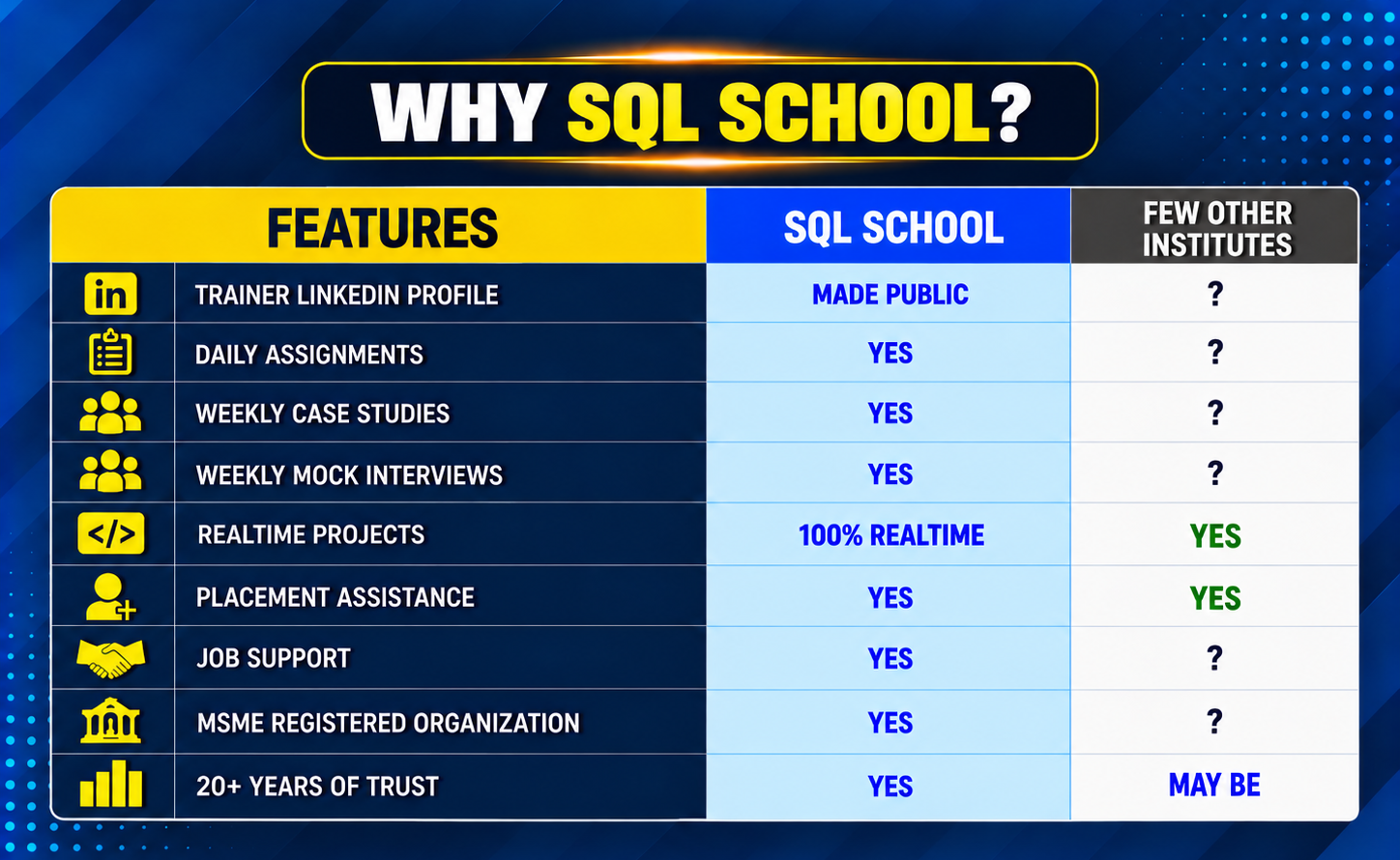
- 100% Real-Time and Practical
- ISO 9001:2008 Certified
- Concept wise FAQs
- TWO Real-time Case Studies, One Project
- Weekly Mock Interviews
- 24/7 LIVE Server Access

- Realtime Project FAQs
- Course Completion Certificate
- Placement Assistance
- Job Support
- Realtime Project Solution
- MS Certification Guidance