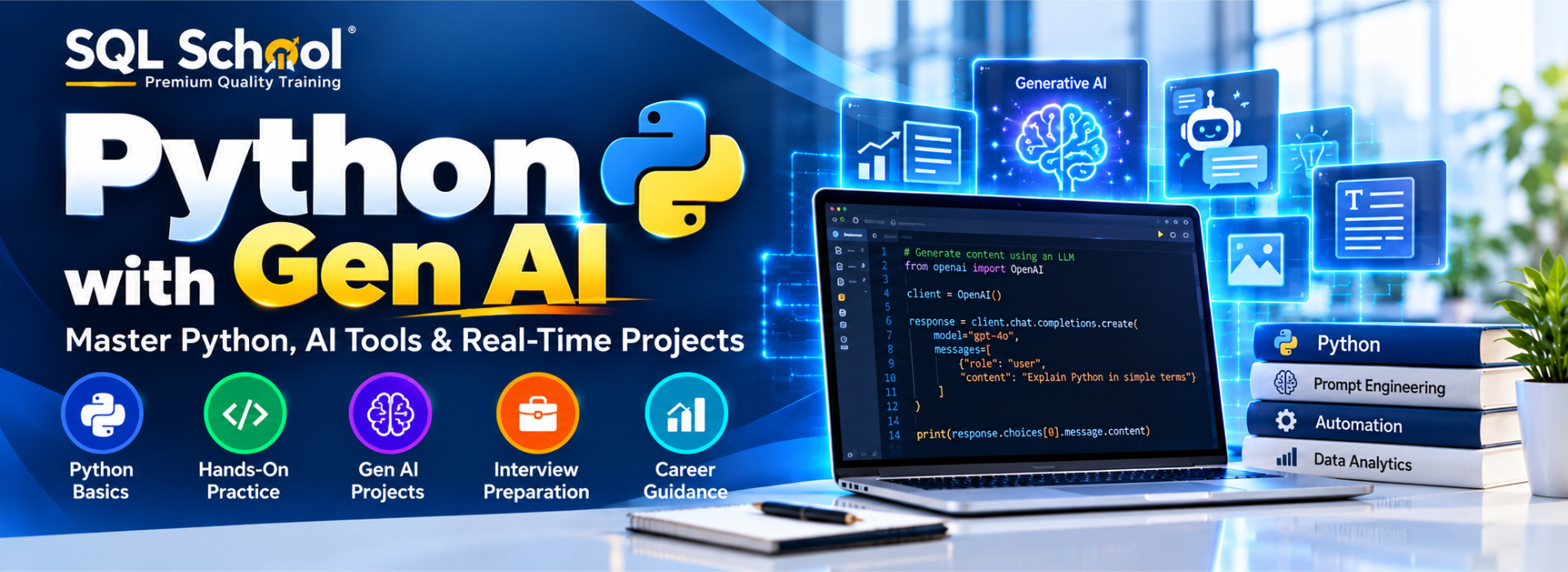
Python with Generative AI combines Python programming with modern AI technologies to develop intelligent applications, automate tasks, analyze data, and build AI-powered solutions.

At SQL School, you’ll master Python Fundamentals, Advanced Python, OOP, Data Analytics, NumPy, Pandas, Prompt Engineering, Large Language Models (LLMs), LangChain, Vector Databases, Retrieval-Augmented Generation (RAG), AI Agents, and Gen AI Application Deployment through hands-on practical training, real-time projects, expert-led sessions, certification guidance, and interview preparation to build job-ready skills in Python, AI, and Generative AI Developmen
Who Should Join?

✅ Freshers & Graduates
✅ Python Beginners & Developers
✅ SQL Developers
✅ Data Analysts & BI Developers
✅ Data Engineers & ETL Developers
✅ Software Engineers
✅ Database Administrators
✅ AI & Machine Learning Enthusiasts
✅ IT Professionals & Career Switchers
✅ Professionals Interested in Gen AI & AI Agents

Training Highlights

✅ Python Programming – Basics to Advanced
✅ NumPy, Pandas & Data Analytics
✅ Python for AI & Machine Learning
✅ Generative AI, LLMs & Prompt Engineering
✅ LangChain, Vector Databases & RAG Applications
✅ AI Agents, Automation & Deployment

Modules We Learn 

✅ Module 1: Python Concepts & Programming
✅ Module 2: Python For AI & Data
✅ Module 3: Gen AI Development
✅ Module 4: AI Agents Deployment
✅ Module 5: Realtime Projects

Course Duration: 3 Months

Python with Gen AI Course Contents:

Module 1: Python Concepts & Programming

Ch 1: Python Introduction

  • Python Introduction.
  • Python Versions
  • Python Job Role
  • Python with AI

Ch 2: Python Architecture

  • Python Architecture
  • PVM: Python Virtual Machine
  • Compiler, Byte Code
  • Execution Process
  • Python Implementations

Ch 3: Python Installations

  • Python Installations
  • Anaconda Installation
  • Python IDE & Usage
  • Jupyter & PyCharm

Ch 4: Python Print Statement

  • print(), display()
  • Single Line print()
  • Multi Line print()
  • Print with Separators

Ch 5: Python Variables

  • Python Variables
  • Assigning values
  • Purpose & Rules
  • Variable Value Reads
  • Multiple Variables & Print()

Ch 6: Python Operators

  • Athematic Operators
  • Python String Literals
  • Single, Double Quotes
  • Format Strings (f string)
  • Comparison, Indexing Operators

Ch 7: Python Data Types

  • Python Data Types
  • Integer, Float, String Data Types
  • Type Casting
  • Type Identification
  • Multi Value Assignments

Ch 8: Python Lists

  • Creating Python Lists
  • Printing List Items
  • Print List Slices
  • Length& Type
  • Empty Lists, Append
  • Loops, List Updates

Ch 9: Python Dictionaries

  • Python Dictionary
  • Indexing Dictionaries
  • Edit Key Values
  • Listsinside Dictionaries
  • Delete& Clear

Ch 10: Python Tuples

  • Python Tuples
  • Length(), Type()
  • Mixed Values in Tuples
  • Overwriting Tuples

Ch 11: Python IF..ELSE Condition

  • If..Else conditions
  • if..elif..else & Shorthand if
  • Indent, passstatement
  • in & negation operators
  • range conditions

Ch 12: Python Loops

  • For Loop @ Range
  • For Loop @ Sequence Values
  • While Loop, Exit Conditions
  • Nested Loops. Break, Continue, Paas

Ch 13: Python File Handling

  • File Handling, Activities
  • Loop, Write, Close Files
  • Appending, Overwriting
  • import os, path.exists
  • f.open, f.write, f.read, f.close

Ch 14: Python Dataframes

  • Dataframes: Creation. Pandas Dataframes
  • Dataframes From Single List. Dataframes @ Dict, Lists

Ch 15: Python SQL DB Access

  • SQL DB Access with Python. import pandas.DataFrame
  • Pyodbc module,sql functions. SQL DB Cursor Connections
  • SQLQuery Executions: DDL, DML

Ch 16: Dataframe Transformations- 1

  • Dataframe Transformations. Concat & Append
  • Merge Function. Join with Multiple Dataframes
  • Loops with Dataframes

Ch 17: Dataframe Transformations – 2

  • Pandas- Cleaning Data. Replace, Transform Columns
  • Data Discovery &Column Fill. Identify & Remove Duplicates
  • dropna(), fillna() Functions

Ch 18: Dataframe Transformations – 3

  • Python Functionsfor date, time. Now() Function in Python
  • date, time Functions. Calendar Data Generation

Ch 19: Python Functions & Lambda

  • Python Functions & Usage. Default & List Parameters
  • Python Lambda Functions. Recursive Functions, Usage
  • Return & Print @ Lamdba

Ch 20: Python Modules

  • Import Python Modules, Built In Modules & dir
  • datetime module in Python. Date Objections Creation
  • strftime Method & Usage. imports & datetime.now()

Ch 21: Python User Inputs & TRY

  • Try Except, Exception Handling. Raise an exception method
  • TypeError, Scripting in Python. User Inputs, Index Numbers
  • input() & raw_input()

Ch 22: Python Dictionary

  • Dictionary Creation, Use, Hashing, Copy, Update
  • Deletion, Sorting. Len(), Inbuilt Functions
  • Variable Types – python List, Cmp() List Method
  • Python Dictionary Str(dict)

Ch 23: Python Packages

  • Creating a package, Package Imports, Modules
  • Sub Packages & Imports Popular Packages in Python
  • NumPy & SciPy. Python Seaborn, Python framework

Ch 24: Exception Handling

  • Shell Script Commands, OS operations in Python
  • os- math – cmd -csv – random, Numpy (numerical python)
  • Pandas -sys – Matplotlib, Common RunTime Errors
  • Exception Handling, Try…Except…else, Try…finally

Ch 25: Python Class & Objects

  • Class variables, Instances. Built in Class Attributes
  • Objects – Constructors, Modifiers- Self Variable
  • Python Garbage Collections, Multilevel, Multiple, Hybrid
  • Overloading & OverRiding, Polymorphism– Abstraction

Ch 26: Regular Expressions

  • Regular Expression, Regular Expression Patterns
  • Literals – Repetition Cases, w+ and ^ ,\s Expressions
  • re.split function, Regular expression methods

Ch 27: Multi-Threading

  • Python Multi-Threading, Thread Synchronization
  • Python Gil & Programming, Thread Control Block (TCB)
  • Stack Pointers & App Usage, Program Counters in Realtime
  • Python Exception Handling

Ch 28: Python TKinter

  • Tkinter GUI Program, Components & Events, Adding Controlsin Tkinter
  • Radio & Check Buttons, Tkinter Forms in Realtime, List Boxes, Menu, ComboBox
  • Mainloop () & Function

Ch 29: Python Web & IoT Intro

  • Python Web Frameworks
  • Django: Advantages
  • Web Framework
  • MVC and MVT – Django
  • Web Pages using python
  • HTML5, CSS3 usage
  • PYTHON Bottle & Pyramid
  • Falcon; smart_open in python

Module 2: Python for AI & Data

Ch 1: Introduction to Python for AI & Data Analytics

  • Role of Python in Artificial Intelligence, Data Analytics & Automation
  • Setting Up Python, Jupyter Notebook, VS Code & Google Colab
  • Working with Python Libraries, Packages & Virtual Environments
  • Reading and Processing Structured & Unstructured Data
  • Introduction to Python-Based Data Processing Workflows

Ch 2: NumPy – Arrays, Operations & Numerical Computing

  • Introduction to NumPy and Multidimensional Arrays
  • Creating, Indexing, Slicing & Reshaping NumPy Arrays
  • Mathematical, Statistical & Aggregate Operations
  • Broadcasting, Vectorization & Array Manipulation
  • Practical Numerical Data Processing for AI Applications

Ch 3: Pandas – DataFrames, Data Cleaning & Transformation

  • Introduction to Pandas Series and DataFrames
  • Importing Data from CSV, Excel, JSON & SQL Databases
  • Data Filtering, Sorting, Grouping & Aggregations
  • Handling Missing Values, Duplicates & Data Type Conversions
  • Data Merging, Joining, Transformation & Exporting

Ch 4: Data Visualization with Matplotlib & Seaborn

  • Introduction to Data Visualization Using Python
  • Creating Line, Bar, Pie, Histogram & Scatter Charts
  • Customizing Graphs, Labels, Legends & Subplots
  • Statistical Visualization Using Seaborn
  • Exploratory Data Analysis (EDA) with Practical Datasets

Ch 5: Python with SQL, REST APIs & JSON Data

  • Connecting Python with SQL Server and Other Databases
  • Executing SQL Queries and Performing CRUD Operations
  • Introduction to REST APIs and HTTP Methods
  • Consuming REST APIs Using Python Requests
  • Reading, Parsing, Processing & Generating JSON Data
  • Building Automated API-to-Database Data Pipelines

Ch 6: AI Fundamentals – ML, NLP, Transformers & LLM Basics

  • Introduction to Artificial Intelligence, Machine Learning & Generative AI
  • Understanding Supervised, Unsupervised & Deep Learning
  • Natural Language Processing (NLP) Concepts and Applications
  • Introduction to Neural Networks and Transformer Architecture
  • Understanding Large Language Models (LLMs), Tokens & Context Windows
  • Introduction to Embeddings and Semantic Similarity

Module 3: Generative AI Development

Ch 1: Introduction to Generative AI & Large Language Models (LLMs)

  • Introduction to Generative AI and Its Real-World Applications
  • Differences Between Traditional AI, Machine Learning & Generative AI
  • Understanding Large Language Models and Transformer-Based Architecture
  • Overview of GPT, Llama, Gemini & Other LLM Families
  • Understanding Tokens, Context Windows, Temperature & Model Parameters
  • Introduction to LLM Limitations, Hallucinations & Responsible AI

Ch 2: Prompt Engineering – Techniques, Templates & Best Practices

  • Introduction to Prompt Engineering and Prompt Structure
  • Zero-Shot, One-Shot & Few-Shot Prompting Techniques
  • Role-Based Instructions, Context Setting & Prompt Templates
  • Structured Output Generation Using JSON and Schemas
  • Prompt Evaluation, Optimization & Reusable Prompt Design
  • Handling Prompt Injection, Hallucinations & Unsafe Outputs

Ch 3: OpenAI API Integration with Python

  • Introduction to OpenAI APIs, Models & API Authentication
  • Setting Up the OpenAI Python SDK and Managing API Keys
  • Generating Text and Conversations Using the Responses API
  • Implementing Structured Outputs and Function Calling
  • Processing AI Responses, Exceptions, Token Usage & API Costs
  • Building a Python-Based AI Chatbot Using OpenAI APIs

Ch 4: Hugging Face Models, Transformers & Embeddings

  • Introduction to Hugging Face Hub and Open-Source AI Models
  • Exploring Pretrained Models, Tokenizers & Transformers
  • Loading and Using Hugging Face Models with Python
  • Understanding Text Embeddings and Vector Representations
  • Implementing Semantic Similarity and Text Classification
  • Comparing Hosted LLM APIs with Locally Executed Models

Ch 5: LangChain Framework – Chains, Prompts & Tools

  • Introduction to LangChain Architecture and Core Components
  • Configuring Language Models and Prompt Templates
  • Working with Chat Models, Message Objects & Structured Outputs
  • Building Reusable LLM Pipelines and Processing Workflows
  • Integrating External APIs, Python Functions & Tools
  • Building a LangChain-Based AI Assistant

Ch 6: Retrieval-Augmented Generation (RAG) & Vector Databases

  • Introduction to RAG Architecture and Knowledge-Based AI Applications
  • Loading Documents from PDF, TXT, CSV & Web Sources
  • Document Chunking, Embedding Generation & Indexing
  • Introduction to Vector Databases – FAISS & Chroma
  • Implementing Semantic Search, Retrievers & Context Grounding
  • Building a Document Question-Answering Chatbot Using RAG

Module 4: AI Agents & Deployment

Ch 1: Introduction to AI Agents & Agentic AI

  • Introduction to AI Agents and Agentic AI Concepts
  • Differences Between AI Chatbots, AI Assistants & AI Agents
  • Understanding Agent Components – LLM, Tools, State & Memory
  • Agent Workflows, Planning, Reasoning & Decision-Making
  • Single-Agent vs Multi-Agent Architecture
  • Real-World Applications of AI Agents in Business Automation

Ch 2: Building AI Agents with Python, LangChain & LangGraph

  • Introduction to LangChain Agents and LangGraph
  • Creating AI Agents Using Python and LLM APIs
  • Building Stateful Agent Workflows with LangGraph
  • Understanding Nodes, Edges, State & Conditional Routing
  • Implementing Agent Execution, Persistence & Human Approval
  • Developing a Practical AI Research or Data Assistant

Ch 3: AI Tool Calling, Workflow Automation & Memory

  • Introduction to Function Calling and Tool Integration
  • Connecting AI Agents with REST APIs and Python Functions
  • Integrating AI Agents with SQL Databases and External Systems
  • Implementing Conversation History and Persistent Memory
  • Building Automated Multi-Step AI Workflows
  • Handling Tool Errors, Access Permissions & Human-in-the-Loop Approvals

Ch 4: Building Gen AI Applications with Streamlit & FastAPI

  • Introduction to AI Application Architecture and Web Interfaces
  • Creating Interactive AI Applications Using Streamlit
  • Building REST APIs Using FastAPI
  • Integrating LLMs, RAG Pipelines & Agents with Web Applications
  • Managing User Sessions, File Uploads & Chat History
  • Building an End-to-End AI Chatbot Web Application

Ch 5: AI Application Deployment, Monitoring & Security

  • Introduction to AI Application Deployment and Hosting Options
  • Managing Python Dependencies, Environments & Docker Containers
  • Deploying Streamlit and FastAPI Applications
  • Secure API Key Management, Authentication & Access Control
  • Monitoring API Usage, Logs, Latency, Errors & Costs
  • Implementing AI Guardrails, Evaluation, Testing & Production Best Practices

What is the Python with AI & Gen AI course, and who should join this program?

This course is designed for Freshers, Python Beginners, SQL Developers, Data Analysts, Software Engineers, IT Professionals, and Career Switchers. It covers Python Programming, AI, Machine Learning, Generative AI, LLMs, Prompt Engineering, RAG, LangChain, and AI Agents.

What are the prerequisites to learn Python with AI & Generative AI?

No prior Python, AI, or Machine Learning experience is required. Basic computer knowledge is sufficient. SQL or programming knowledge is helpful but not mandatory. Training starts from Python fundamentals and progresses step by step.

What modules are included in the Python with AI & Gen AI training?

The course covers Python Fundamentals, Advanced Python, OOP, Data Structures, NumPy, Pandas, Data Analytics, AI & Machine Learning Basics, Prompt Engineering, LLMs, LangChain, Vector Databases, RAG Applications, AI Agents, and Deployment.

Is the Python with AI & Gen AI course fully practical and project-oriented?

Yes. SQL School focuses on LIVE instructor-led classes, hands-on coding, practical assignments, AI application development, and real-world scenarios. Students learn to build Python applications, automate tasks, integrate LLMs, and develop AI-powered solutions.

What real-time projects will I work on in this course?

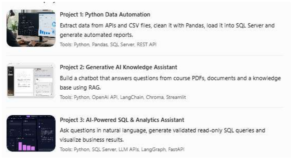
Practical project examples include Python Data Analytics, Task Automation, AI-Powered Chatbots, Document Question-Answering using RAG, Knowledge-Based AI Assistants, and AI Agents for business workflow automation.

What career opportunities are available after completing Python with AI & Gen AI training?

Depending on your existing skills and project experience, this training can support career paths such as Python Developer, Python Automation Developer, AI Application Developer, Junior Gen AI Developer, Data Analyst, and AI Solutions Developer. SQL School also provides interview preparation and career guidance.

Why SQL SCHOOL?

Training Modes

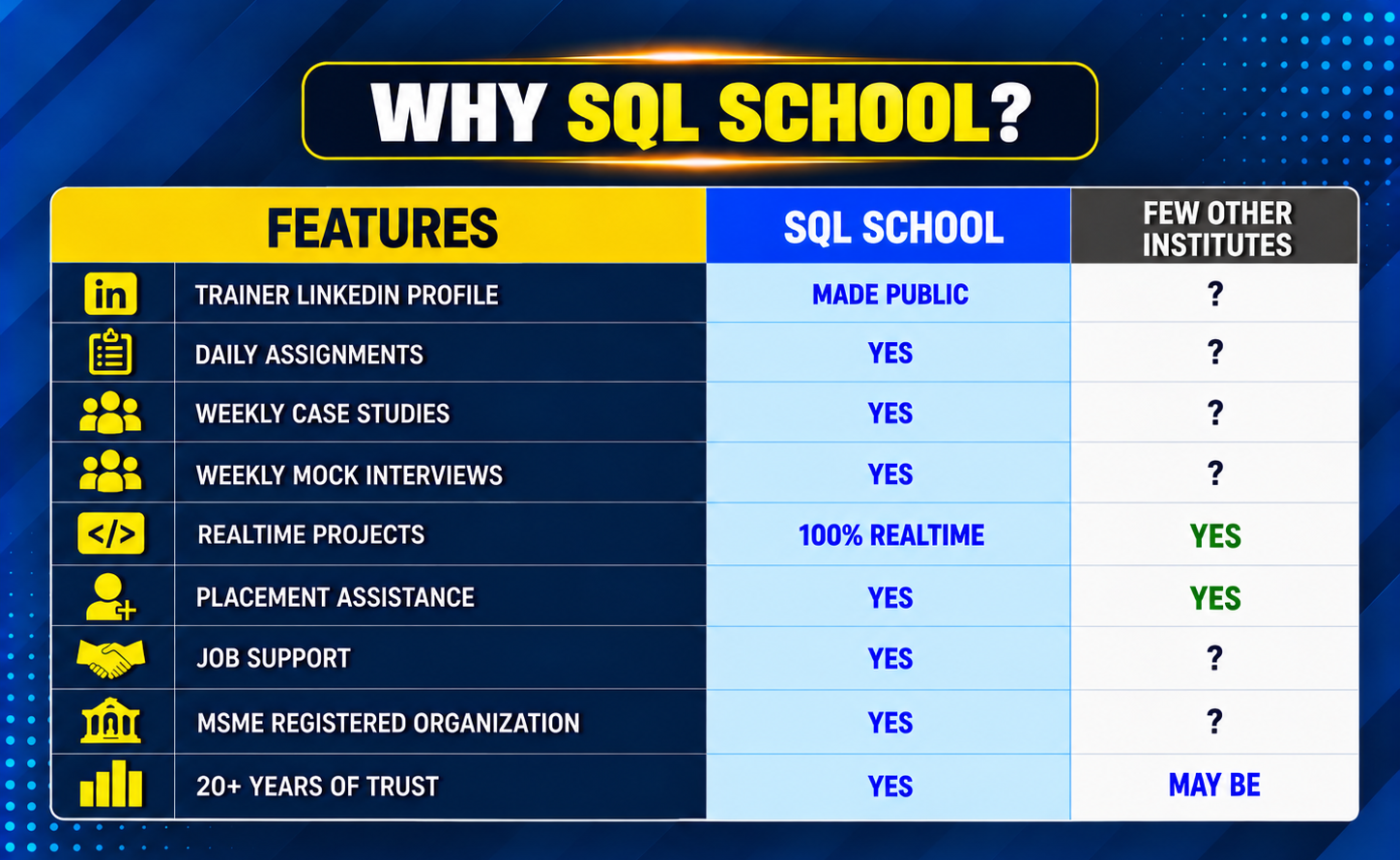
Why Choose SQL School

  • 100% Real-Time and Practical
  • ISO 9001:2008 Certified
  • Concept wise FAQs
  • TWO Real-time Case Studies, One Project
  • Weekly Mock Interviews
  • 24/7 LIVE Server Access
A man smiling and giving a thumbs up while holding a notebook.
  • Realtime Project FAQs
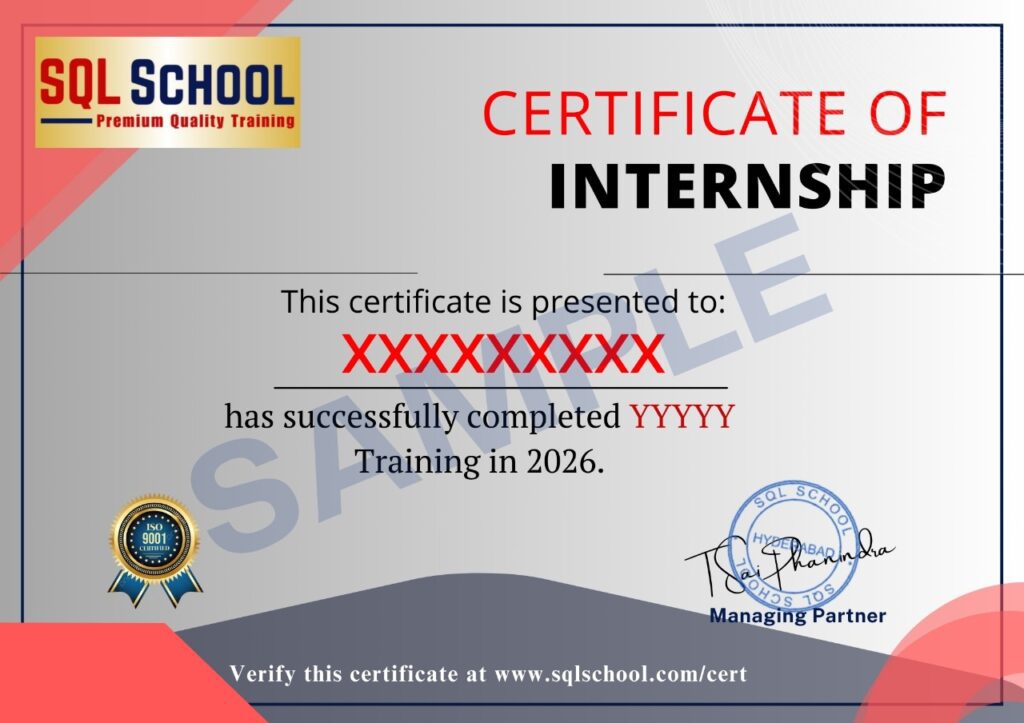
  • Course Completion Certificate
  • Placement Assistance
  • Job Support
  • Realtime Project Solution
  • MS Certification Guidance

SQL School Azure Data Engineer training certificate of completion issued in January 2026 with verification ID