MySQL Course 2026: Complete Training Guide for Beginners and IT Professionals
Learn MySQL from basics to advanced SQL queries, database design, joins, stored procedures, performance tuning and real-time projects.
Discover what MySQL is, why companies use it, what you should learn, and how practical MySQL training can support your database career.
Introduction to MySQL
In today’s digital world, almost every organization depends on databases to store, retrieve and manage information. From e-commerce websites and banking applications to customer management systems, databases play a central role in modern software.
MySQL is one of the world’s most widely used open-source relational database management systems. It allows developers, database administrators and analysts to organize and retrieve structured information using Structured Query Language (SQL).
This MySQL course guide explains the core concepts, essential tools, SQL programming skills, practical applications and career pathways involved in learning MySQL.
What Is MySQL?
MySQL is a relational database management system (RDBMS) developed and maintained by Oracle. It stores data in tables consisting of rows and columns. Relationships between tables allow applications to organize large amounts of information efficiently.
MySQL supports transactions, indexing, stored procedures, views, triggers, user access controls, backup operations and several other database capabilities.
An online shopping website can use MySQL to maintain customer records, products, orders, payments and delivery information. SQL queries help retrieve and update that data.
How Does MySQL Work?
Basic MySQL Application Architecture
Application Request → SQL Query → Database Processing → Results
Why Learn MySQL in 2026?
MySQL remains an important skill for developers, analysts and database professionals. It is widely used in web development and can also support internal business systems and data-driven applications.
Web Development
MySQL is commonly used with backend technologies such as PHP, Python, Java and Node.js.
Data Analysis
Analysts use SQL queries to filter, aggregate and examine transactional data before reporting or visualization.
Database Administration
DBAs manage security, backups, database performance, replication and availability.
Career Development
Understanding MySQL provides a foundation for developer, database and data-oriented roles.
MySQL Versions and Features in 2026
MySQL uses two main release tracks: Long-Term Support (LTS) and Innovation. The LTS track emphasizes stability, while Innovation releases introduce newer functionality more frequently.
MySQL 8.4 LTS and MySQL 9.7 LTS are important supported release series. Oracle also introduced calendar-based version numbering for Innovation releases in 2026.
For beginner training, use an appropriate supported MySQL Community Server version. Before upgrading production databases, check application compatibility and Oracle’s official release documentation.
MySQL Installation and Workbench Setup
The first practical activity in a MySQL training course is installing the database server and connecting to it through a client application.
Step 1: Download MySQL Community Server
Visit the official MySQL download portal. Select a supported version compatible with your operating system.
Step 2: Install the Database Server
- Download the appropriate installer or package.
- Install MySQL Community Server.
- Configure the database server.
- Set a secure administrator password.
- Configure database connectivity.
- Verify the MySQL service is running.
Step 3: Install MySQL Workbench
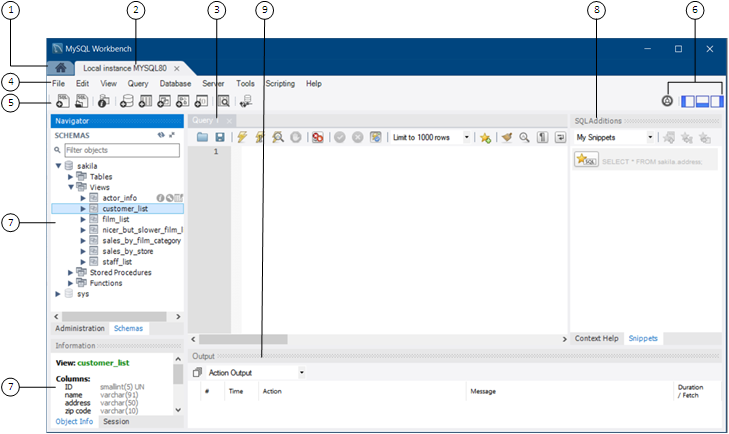
MySQL Workbench is a graphical application used for SQL development, database modeling and administration. It helps students write queries, explore schemas and manage database connections.
Step 4: Connect to MySQL
Open MySQL Workbench and configure a local connection. For a typical local installation, the connection settings are:
| Setting | Typical Value |
|---|---|
| Hostname | localhost |
| Port | 3306 |
| Username | root or a configured user |
| Password | Your configured password |
Step 5: Verify Installation
SELECT VERSION();

SHOW DATABASES;
If these commands execute successfully, your MySQL connection is ready for practice.
MySQL Course Syllabus: What Will You Learn?
A comprehensive MySQL training program should combine database fundamentals, SQL programming and practical database management skills.
Module 1: Database Fundamentals
- DBMS and RDBMS concepts
- Tables, rows and columns
- Primary and foreign keys
- Relational database design
Module 2: MySQL Setup
- MySQL installation
- MySQL Workbench
- Connections and authentication
- Database and user creation
Module 3: SQL Fundamentals
- DDL, DML, DCL and TCL
- CREATE, ALTER and DROP
- INSERT, UPDATE and DELETE
- SELECT and WHERE clauses
Module 4: SQL Queries
- Operators and filtering
- ORDER BY and GROUP BY
- Aggregate functions
- HAVING and DISTINCT
Module 5: Advanced SQL
- INNER and OUTER JOINs
- Subqueries and correlated queries
- Common Table Expressions
- Window functions
Module 6: SQL Programming
- Stored procedures
- Stored functions
- Views and triggers
- Cursors and control statements
Module 7: Performance
- Indexes and query optimization
- EXPLAIN query plans
- Transactions and locking
- Performance troubleshooting
Module 8: Practical Projects
- Database design exercises
- Business reporting queries
- Data validation scenarios
- Interview-oriented SQL problems
For the detailed SQL School MySQL course outline, see the official curriculum: MySQL Training Syllabus PDF.
Practical MySQL Tutorial with SQL Examples
Learning MySQL becomes easier when students execute queries rather than memorizing syntax alone. Try the following beginner-friendly exercise.
Example 1: Create a Database
CREATE DATABASE sqlschool_demo;

USE sqlschool_demo;
Example 2: Create an Employee Table
CREATE TABLE employees (
    employee_id INT PRIMARY KEY,
    employee_name VARCHAR(100),
    department VARCHAR(50),
    salary DECIMAL(10,2)
);
Example 3: Insert Sample Records
INSERT INTO employees
(employee_id, employee_name, department, salary)
VALUES
(1, 'Ravi', 'IT', 65000),
(2, 'Priya', 'HR', 45000),
(3, 'Arjun', 'IT', 78000),
(4, 'Meena', 'Finance', 55000);
Example 4: Retrieve Employee Data
SELECT *
FROM employees;
Example 5: Filter Employees
SELECT employee_name, salary
FROM employees
WHERE department = 'IT'
ORDER BY salary DESC;
Example 6: Department-Wise Average Salary
SELECT
    department,
    COUNT(*) AS employee_count,
    AVG(salary) AS average_salary
FROM employees
GROUP BY department;
Example 7: Find the Second-Highest Salary
SELECT DISTINCT salary
FROM employees
ORDER BY salary DESC
LIMIT 1 OFFSET 1;
These exercises introduce practical SQL operations used in data retrieval, reporting and database applications.
Write a query to find the employee with the highest salary in each department. Try solving it using GROUP BY and then using ROW_NUMBER() or DENSE_RANK().
Real-Time MySQL Project for Students
Project: E-Commerce Order Management Database
A useful MySQL practice project is an online retail order-management system. The objective is to design relational tables and generate meaningful reports from transactional data.
E-Commerce Database Workflow
Project Tasks
- Design normalized database tables.
- Create primary and foreign key relationships.
- Insert sample transactional records.
- Write SQL JOIN queries.
- Generate monthly sales reports.
- Find the top-selling products.
- Identify repeat customers.
- Optimize selected queries using indexes.
Example: Monthly Revenue Report
SELECT
    DATE_FORMAT(order_date, '%Y-%m') AS sales_month,
    SUM(total_amount) AS revenue
FROM orders
WHERE order_status = 'Completed'
GROUP BY DATE_FORMAT(order_date, '%Y-%m')
ORDER BY sales_month;
This query assumes the project includes an orders table with order_date, total_amount and order_status columns. It calculates monthly completed-order revenue from the sample dataset.
Projects like this strengthen database design, query writing and business problem-solving skills.
MySQL vs SQL Server vs PostgreSQL
MySQL, Microsoft SQL Server and PostgreSQL are relational database systems, but each has different strengths and ecosystems.
| Feature | MySQL | SQL Server | PostgreSQL |
|---|---|---|---|
| Developer | Oracle | Microsoft | Open-source community |
| Common Uses | Web applications | Enterprise applications | Advanced data applications |
| SQL Dialect | MySQL SQL | T-SQL | PostgreSQL SQL / PL/pgSQL |
| Popular GUI | MySQL Workbench | SSMS | pgAdmin |
| Licensing | Community and commercial | Free and commercial editions | Open source |
The best database depends on application requirements, performance expectations, existing infrastructure and team expertise. Learning core SQL concepts makes it easier to adapt to additional database platforms.
Career Opportunities After Learning MySQL
MySQL knowledge can support several technical career paths. Most roles require additional skills beyond database querying alone.
SQL / Database Developer
Develop database objects, write complex SQL queries, build stored routines and optimize data access.
MySQL Database Administrator
Manage databases, backups, access security, replication, monitoring and recovery.
Data Analyst
Extract and analyze data using SQL, Excel, Python and visualization tools.
Backend Developer
Integrate MySQL with backend applications, APIs and web services.
Additional experience with Git, APIs, Python, Java, cloud technologies or business intelligence tools may improve readiness for these roles.
Who Can Join a MySQL Training Course?
- Students and recent graduates
- Beginners learning databases
- Software and backend developers
- Data analysts and aspiring analysts
- Database support professionals
- IT professionals planning a career transition
- Working professionals improving SQL skills
Beginners can start with database fundamentals. Prior programming experience is useful for application development, but it is not essential for learning basic SQL.
MySQL Interview Preparation
Successful MySQL interview preparation requires understanding concepts and practicing queries using sample datasets.
Important MySQL Interview Topics
- What is the difference between SQL and MySQL?
- What is a primary key?
- What is a foreign key?
- What are INNER JOIN and LEFT JOIN?
- What is the difference between WHERE and HAVING?
- What is database normalization?
- What are indexes, and when are they useful?
- How do transactions and ROLLBACK work?
- What are stored procedures and triggers?
- How do you identify slow SQL queries?
Practice query-writing tasks involving joins, aggregation, duplicates, ranking functions and subqueries. Employers may assess both SQL syntax and your approach to solving problems.
Why Choose SQL School for MySQL Training?
SQL School Training Institute in Hyderabad offers practical database and SQL training designed for students, developers, analysts and working professionals.
- LIVE online instructor-led training
- Self-paced learning options
- Step-by-step explanations
- Hands-on SQL exercises
- Concept-wise assignments
- Real-world database examples
- Interview preparation guidance
- Job assistance and career support
The published MySQL curriculum includes database fundamentals, MySQL installation, SQL commands, joins, subqueries, performance concepts, stored programs and advanced database topics.
SQL School focuses on helping learners understand concepts through practical database exercises rather than relying only on theoretical instruction.
Frequently Asked Questions About MySQL
1. Is MySQL easy for beginners?
MySQL is suitable for beginners. Start with tables, SELECT statements, filtering and basic joins before progressing to advanced SQL.
2. Is MySQL free to learn?
MySQL Community Edition is freely available under its applicable open-source license. You can install it locally for educational practice.
3. Does MySQL require programming knowledge?
No programming language is required to begin learning SQL. Programming knowledge becomes useful when integrating databases with applications.
4. How long does it take to learn MySQL?
Basic querying can be learned within a few weeks of regular practice. Advanced database programming and administration require more experience. SQL School’s published MySQL syllabus lists a one-month training duration.
5. Is MySQL useful for Data Analysts?
Yes. Analysts use SQL to retrieve, filter, aggregate and prepare data for reports and analysis.
6. What is MySQL Workbench?
MySQL Workbench is a graphical tool for writing SQL queries, exploring database schemas, database modeling and selected administration tasks.
7. What is the difference between MySQL and SQL?
SQL is a language used to work with relational databases. MySQL is a database management system that supports SQL.
8. Can I learn MySQL through online classes?
Yes. Online classes can include live demonstrations, SQL exercises, project practice and instructor guidance.
9. Can learning MySQL help me get a job?
MySQL is a useful technical skill for database, development and data-related roles. Employment depends on your complete skill set, experience and interview performance.
10. Is MySQL still relevant in 2026?
Yes. MySQL continues to support modern applications and offers actively maintained release tracks. Learning MySQL remains valuable for many software and database careers.
Conclusion: Start Your MySQL Learning Journey
MySQL provides a strong foundation for working with relational databases, developing applications and analyzing structured information.
Begin with database fundamentals, practice SQL queries regularly, build relational database projects and gradually learn advanced topics such as stored procedures, indexing and performance optimization.
With structured learning and hands-on exercises, students and working professionals can develop practical MySQL skills applicable to real-world IT environments.
Start Learning MySQL with SQL School
Ready to strengthen your SQL and database skills?
Join SQL School’s practical training program and learn through guided exercises and real-world examples.
Training Modes: LIVE Online and Self-Paced
Contact: +91 96664 40801
Website: www.sqlschool.com

