Databricks Interview Questions Series 4: Advanced Scenarios & Expert Solutions
Welcome to Databricks Interview Questions Series 4, the latest installment of our popular interview-preparation series designed to help you crack advanced Databricks and Spark interviews with confidence. This series is brought to you by Mr. Sai Phanindra, Chief Mentor at SQL School, who brings 20+ years of industry experience to every session. Unlike basic Q&A dumps you find elsewhere, Databricks Interview Questions Series 4 focuses on real-world scenarios, advanced concepts, performance optimization, and interview excellence — the exact skills that separate candidates who get hired from those who don’t.
Each series installment takes you deeper, building on what you learned before. If you’ve already gone through Level 1, Level 2, and Level 3, this Level 4 edition takes things further into performance tuning, Delta Lake internals, CDC pipelines, and streaming fault tolerance — topics that senior Databricks and Data Engineering interviews love to probe. Below, we’ve broken down every question and answer from the video (Question 31 through Question 40) along with the actual on-screen visuals, so you can revise exactly what was taught.
31: How do you troubleshoot a Databricks job that suddenly becomes slow?
First, check the Spark UI to identify slow stages, large shuffles, data skew, spills, and executor utilization. Then compare the current run with previous successful runs and inspect query plans, input volume, file sizes, partitioning, and recent code changes.
This is one of the most commonly asked scenario-based questions in Databricks Interview Questions Series 4, because interviewers want to see a structured debugging approach rather than a guess. Always start with observability tools before jumping to conclusions.
32: What is Data Skew and how do you solve it?
Data skew occurs when some partitions contain much more data than others, causing a few tasks to run significantly longer. You would use techniques such as salting, repartitioning, broadcast joins where possible, and Adaptive Query Execution (AQE).
33: How can a large JOIN be optimized in Databricks?

Large joins can be optimized by filtering data before the join, selecting only required columns, using broadcast joins for sufficiently small datasets, addressing data skew, and reducing unnecessary shuffle operations.
34: What is a Broadcast Join?
A Broadcast Join distributes a small dataset to all executors so that the join can be performed locally. It helps avoid a large shuffle and can significantly improve join performance.
Notice how Questions 33 and 34 build on each other — this layered teaching style is what makes Databricks Interview Questions Series 4 so effective for interview prep. Instead of memorizing isolated facts, you learn how join optimization strategies connect to one another in real pipelines.
35: Why doesn’t increasing cluster size always improve performance?
Performance may be limited by data skew, shuffle, I/O, inefficient transformations, serialization, or a single long-running task. Adding more workers does not necessarily resolve these bottlenecks.
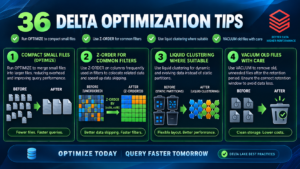
36: How can a large Delta table be optimized?
A large Delta table can be optimized by improving data layout, reducing small files, using appropriate clustering or partitioning strategies, minimizing unnecessary data scans, and optimizing frequently executed queries.
37: How is SCD Type 2 implemented in Databricks?
SCD Type 2 maintains historical versions of records using columns such as business key, effective start date, effective end date, and current-record indicator. When a change occurs, the existing record is expired and a new version is inserted.
SCD Type 2 questions show up in almost every senior data engineering interview, which is exactly why this topic gets special emphasis in Databricks Interview Questions Series 4. Interviewers often follow this up by asking you to write the actual MERGE INTO logic in Delta Lake, so make sure you can code this out, not just explain it conceptually.
38: How can a high-volume CDC pipeline be designed?
A high-volume CDC (Change Data Capture) pipeline processes changes incrementally instead of repeatedly scanning the complete source. Checkpoints or reliable processing boundaries, deduplication, change ordering, and efficient handling of inserts, updates, and deletes are important.
39: What happens when a Structured Streaming job fails?
Checkpointing stores processing progress and state information in durable storage. After a restart, the streaming job can use the checkpoint to recover its processing state and continue from the appropriate point.
40: How can an Out-of-Memory error be troubleshooted in Databricks?
Executor and driver memory, garbage collection, task sizes, shuffle, caching, data skew, and operations such as collect() should be analysed. The solution may involve optimizing transformations, reducing data movement, or adjusting resources.
Out-of-memory errors remain a top pain point for engineers running production Spark jobs, and this final question in Databricks Interview Questions Series 4 ties together everything covered earlier — skew, shuffle, joins, and cluster sizing — into one practical troubleshooting checklist.
Key Takeaways from This Session
Questions 34 and 37 were specifically flagged as high-priority in this part of the series, since Broadcast Joins and SCD Type 2 implementation are recurring themes across real Databricks interviews. If you master the reasoning behind each answer above — not just the words — you’ll be well prepared to handle follow-up and whiteboard-style questions in your actual interview.
That wraps up this edition of Databricks Interview Questions Series 4. Practice explaining each answer in your own words, try implementing the SCD Type 2 and CDC pipeline scenarios hands-on in a Databricks workspace, and stay tuned for the next part of the series where Mr. Sai Phanindra will cover even more advanced, real-world interview scenarios.
For structured, hands-on Databricks, Data Engineering, and Power BI training, visit SQL School.
Continue Your Databricks Interview Preparation
Don’t stop with Series 4. Strengthen your preparation using these resources:
Previous Interview Questions
Databricks Interview Questions – Series 3
Complete Interview Video Series
Watch the Databricks Interview Questions Playlist
Want Complete Databricks Training?
Go beyond interview questions with practical training covering Databricks, Spark, PySpark, Delta Lake, real-time projects, performance optimization, and interview preparation.
Explore Databricks Data Engineer Training at SQL School
Ready to Build Your Databricks Career?
Learn with Industry Experts • Work on Real-Time Projects • Get Interview Ready
Whether you’re preparing for your first Databricks role or an experienced Data Engineering position, consistent hands-on practice combined with scenario-based interview preparation can help you approach technical interviews with greater confidence.
Book Your FREE Demo Today!
📞 +91 99514 40801
Visit SQL School
Keep Learning. Keep Practicing. Get Databricks Interview Ready!
Author: Mr. Sai Phanindra
With 20+ Years of technical expertise
exclusively on SQL & Database Technologies, I assure you 100% Practical, Step by Step Classes.
Linkdin Profile: www.linkedin.com/in/saiphanindra/
Contact No: +91 9030040801 (or) +91 9666440801