Azure Data Engineer Course: Build the Skills to Engineer Modern Cloud Data
Data is no longer just something organizations store—it is one of their most valuable business assets. Every application, transaction, customer interaction, IoT device, and digital service generates data. But raw data has limited value until it is collected, organized, transformed, and made available for analytics.
This is where an Azure Data Engineer plays an important role.
Microsoft Azure provides a powerful ecosystem for building modern data platforms. An Azure Data Engineer works with technologies for data ingestion, data lakes, ETL/ELT, data transformation, cloud databases, distributed processing, analytics, and data integration.
An Azure Data Engineer Course provides a structured path for learning these technologies and understanding how they work together to create real-world data solutions.
What Does an Azure Data Engineer Actually Do?
An Azure Data Engineer is responsible for turning data from different sources into reliable and usable information.
Consider a retail company that receives data from:
- Online orders
- Mobile applications
- Customer databases
- Payment systems
- Website activity
- Inventory systems
- IoT devices
This information may exist in different formats and locations.
An Azure Data Engineer can design a solution that:
Collects → Stores → Cleans → Transforms → Integrates → Processes → Delivers
The final data can then be consumed by business analysts, data scientists, Power BI developers, applications, and AI systems.
This makes Data Engineering one of the fundamental layers of modern analytics and AI.
Why Choose Azure for Data Engineering?
Azure provides services covering almost every stage of the data lifecycle.
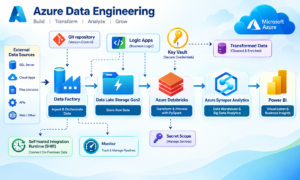
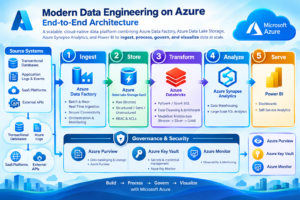
A modern Azure data platform may include:
SQL Server / APIs / Applications
↓
Azure Data Factory
↓
Azure Data Lake Storage Gen2
↓
Azure Databricks / PySpark
↓
Azure Synapse / Fabric
↓
Power BI / Analytics / AI
Instead of learning isolated technologies, an Azure Data Engineer learns how these services can work together as an integrated data platform.
Core Skills Covered in Azure Data Engineer Training
A quality Azure Data Engineer Training program should develop both technical fundamentals and cloud data engineering skills.
SQL and T-SQL
SQL remains a critical foundation for data engineering.
Important concepts include:
- Advanced SELECT queries
- Joins
- Subqueries
- CTEs
- Window functions
- Views
- Stored procedures
- Functions
- Temporary tables
- Data manipulation
- Query optimization
- Indexing
- Data validation
- ETL queries
Strong SQL knowledge makes it easier to understand databases, warehouses, transformations, and analytical workloads.
Azure Data Factory: Connecting the Data World
One of the most important technologies for an Azure Data Engineer is Azure Data Factory (ADF).
ADF can be used to create automated data integration and orchestration workflows.
For example:
SQL Server → ADF → ADLS Gen2 → Databricks → Analytics
Key concepts include:
- Pipelines
- Activities
- Datasets
- Linked Services
- Integration Runtime
- Copy Activity
- Parameters
- Variables
- Triggers
- Lookup
- ForEach
- Conditional activities
- Incremental data loading
- Data transformation
- Monitoring
- Error handling
ADF becomes particularly valuable when an organization needs to move and process data automatically on a scheduled or event-driven basis.
Azure Data Lake: The Foundation for Large-Scale Data
Traditional databases are not always the best place to keep every type of organizational data.
Modern organizations may need to store:
- CSV files
- JSON files
- Parquet files
- Application logs
- Images
- IoT data
- Transaction data
- Semi-structured data
- Historical datasets
Azure Data Lake Storage Gen2 (ADLS Gen2) provides scalable cloud storage designed for analytics and big-data workloads.
An Azure Data Engineer needs to understand how to organize, secure, access, and process data stored in a data lake.
Azure Databricks and PySpark
When datasets become large, traditional single-machine processing may not be sufficient.
This is where distributed processing technologies such as Apache Spark become important.
Azure Databricks provides a collaborative environment for data engineering and analytics workloads.
Training can include:
- Python
- PySpark
- Spark SQL
- DataFrames
- Transformations
- Aggregations
- Joins
- Spark jobs
- Notebooks
- Delta Lake
- Data pipelines
- Batch processing
- Streaming
Azure Synapse Analytics
Another important component of Azure’s data ecosystem is Azure Synapse Analytics.
Synapse brings together capabilities for:
- Data warehousing
- SQL analytics
- Big-data processing
- Apache Spark
- Data integration
- Data exploration
- Analytical workloads
Azure Data Engineers can use Synapse to work with enterprise-scale analytical data and integrate different data processing technologies.
Python: An Important Skill for Modern Data Engineers
SQL is essential, but modern Data Engineering frequently requires programming skills as well.
Python can be used for:
- Data transformation
- Automation
- File processing
- Data validation
- ETL development
- API integration
- PySpark processing
- Databricks development
Learning Python + PySpark + SQL provides a strong technical foundation for modern data engineering.
Real-Time Data Processing
Not every organization can wait for overnight processing.
Consider:
- Online transactions
- Fraud detection
- IoT monitoring
- Application logs
- Website activity
- Financial transactions
These scenarios may require data to be processed continuously.
Azure offers services and technologies such as:
- Azure Event Hubs
- Azure IoT Hub
- Azure Stream Analytics
- Azure Databricks
- Spark Structured Streaming
This allows organizations to build solutions capable of handling streaming and near-real-time workloads.
Why Is Azure Data Engineering Important?
The importance of Data Engineering comes from a simple fact:
Good analytics requires good data.
A Power BI dashboard is only as reliable as the data behind it.
AI models are only as useful as the quality of the data used to train and operate them.
Business decisions depend on accurate and timely information.
Azure Data Engineers help create the infrastructure that makes this possible.
They establish processes for:
- Reliable data ingestion
- Data quality
- Data transformation
- Data integration
- Data availability
- Data security
- Data scalability
- Data governance
- Data processing
Advantages of Learning Azure Data Engineering
1. Learn an End-to-End Data Platform
Instead of learning only one tool, students can understand how databases, pipelines, storage, processing, and analytics fit together.
2. Develop Practical Cloud Skills
Hands-on Azure projects provide experience with cloud-based data workflows.
3. Build Multiple Technical Skills
An Azure Data Engineer can develop expertise across:
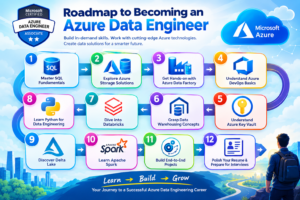
SQL + Azure + ADF + ADLS + Databricks + PySpark + Synapse + Data Warehousing
4. Prepare for Real-World Projects
Project-based learning helps bridge the gap between classroom concepts and workplace requirements.
5. Create Multiple Career Paths
Azure Data Engineering skills can support roles such as:
- Azure Data Engineer
- Cloud Data Engineer
- Data Engineer
- ETL Developer
- Azure ETL Developer
- Databricks Developer
- Data Platform Engineer
- BI Developer
- Analytics Engineer
Who Can Learn Azure Data Engineering?
Azure Data Engineering is not limited to experienced cloud professionals.
The course can be useful for:
- Freshers
- SQL Developers
- ETL Developers
- Database professionals
- BI Developers
- Data Analysts
- Software Developers
- Database Administrators
- Cloud professionals
- Professionals transitioning into Data Engineering
A learner does not necessarily need to master every Azure service before starting. A structured learning path can gradually build the required skills.
Azure Data Engineer Certification – What Learners Should Know
Certification plans should always be checked against Microsoft’s current certification portfolio because Microsoft periodically retires and replaces exams.
The previously popular DP-203: Data Engineering on Microsoft Azure exam was retired on March 31, 2025. Learners should therefore avoid outdated training material that presents DP-203 as a current exam and instead review Microsoft’s current Data Engineering certification options.
DP-750: Implementing Data Engineering Solutions Using Azure Databricks is the Microsoft exam for the Microsoft Certified: Azure Databricks Data Engineer Associate certification. It focuses on designing, building, securing, deploying, and maintaining data engineering solutions using Azure Databricks.
Frequently Asked Questions
What is an Azure Data Engineer?
An Azure Data Engineer designs and manages cloud-based data solutions, including data pipelines, storage, transformation, integration, and analytical data platforms.
What should I learn first for Azure Data Engineering?
Starting with SQL, database concepts, ETL, and data warehousing provides a strong foundation before moving into Azure services.
Is Python necessary for Azure Data Engineering?
Python is highly valuable for Databricks, PySpark, automation, data transformation, and large-scale data processing.
Is Azure Data Engineering suitable for beginners?
Yes. Beginners can start with SQL and cloud fundamentals and progressively learn Azure Data Factory, ADLS, Databricks, Synapse, Python, and PySpark.
What are the major Azure Data Engineering tools?
Some of the important technologies include Azure Data Factory, ADLS Gen2, Azure Databricks, Azure Synapse Analytics, Azure SQL, Python, PySpark, Spark and Delta Lake.
Can SQL Developers move into Azure Data Engineering?
Yes. Strong SQL knowledge provides an excellent foundation. The next step is to develop skills in cloud services, ETL, data lakes, distributed processing, and Azure data architecture.
Conclusion
The future of data is increasingly cloud-based, distributed, automated, and AI-driven. Organizations need professionals who can build the data foundation required for analytics, reporting, machine learning, and artificial intelligence.
An Azure Data Engineer Course can provide that foundation by bringing together SQL, ETL, Azure Data Factory, Data Lake Storage, Synapse, Databricks, Python, PySpark, Delta Lake, and real-world data engineering projects.
The goal should not simply be to learn Azure services individually. The real objective is to understand how to engineer reliable, scalable, secure, and analytics-ready data solutions.
For learners looking to move toward a career in cloud data engineering, Azure Data Engineering offers a strong and practical technology path.
Azure Data Engineer Training: https://sqlschool.com/azure-data-engineer-training/
Ready to build job-ready skills in Azure Data Engineering?
Join SQL School’s 100% Practical Azure Data Engineer Course and learn SQL, Azure Data Factory, ADLS, Azure Synapse, Databricks, Python, PySpark, and real-time projects through step-by-step, scenario-based training.
🚀 Build Real Skills. Work on Real Projects. Become a Confident Azure Data Engineer.
Trainer: Mr. Sai Phanindra 20+ Years of Exp
📞 Call / WhatsApp: +91 96664 40801 | +91 99514 40801
🌐 Visit: sqlschool.com
👉 Book Your Free Demo Today and Start Your Azure Data Engineering Journey!
#AzureDataEngineer #AzureDataEngineering #AzureDataEngineerCourse #AzureDataEngineerTraining #AzureTraining #MicrosoftAzure #AzureDataFactory #AzureDatabricks #AzureSynapse #AzureDataLake #ADLSGen2 #PySpark #PythonForDataEngineering #DataEngineering #CloudDataEngineering #DataEngineer #DataEngineeringCourse #DataEngineeringTraining #RealTimeProjects #SQLTraining #TSQL #DataEngineeringCareer #CloudComputing #MicrosoftFabric #SQLSchool