Python Training 2026 – Complete Guide to Python Programming, Data Analytics, AI & Real-Time Projects
Python is one of the most versatile programming languages used in today’s IT industry. From software development and data analysis to automation, Artificial Intelligence (AI), and Machine Learning (ML), Python helps professionals solve real-world problems with simple and efficient code.
If you are a student, fresher, SQL Developer, Data Analyst, Data Engineer, or working IT professional, learning Python can help you expand your technical skills and explore new career opportunities.
In this guide, we will understand what Python is, why it is important, how to install it, the essential programming concepts, real-world applications, and how to get started with Python Training at SQL School.
What is Python Programming?
Python is a high-level, general-purpose programming language known for its simple syntax, readability, and extensive collection of libraries.
Python is commonly used for:
- Software and application development
- Data Analytics and Data Science
- AI and Machine Learning
- Automation and scripting
- Database integration and SQL operations
- API development and integration
- Data Engineering and ETL pipelines
Unlike many programming languages that require lengthy code for simple operations, Python allows developers to build practical solutions with fewer lines of code.
Example: Your First Python Program
print("Welcome to SQL School")
print("Learn Python Programming")
Output:
Welcome to SQL School
Learn Python Programming
This simple example demonstrates how Python displays information using the print() function.
Why Learn Python in 2026?
Python is useful across multiple technology domains. Whether you want to become a Python Developer, automate daily tasks, work with business data, or build AI applications, Python provides a practical foundation.
1. Easy to Learn
Python uses readable syntax, making it suitable for beginners without prior programming experience.
2. Used in Multiple IT Job Roles
Python knowledge is relevant to Python Developers, Data Analysts, Data Engineers, Automation Engineers, and AI/ML professionals.
3. Powerful Data Analytics Libraries
Libraries such as Pandas, NumPy, Matplotlib, and Seaborn help professionals analyze, transform, and visualize data.
4. Supports Automation
Python scripts can automate repetitive tasks involving files, reports, APIs, and databases.
5. Important for AI and Machine Learning
Python supports libraries and frameworks used for Machine Learning, predictive analytics, and Generative AI development.
How to Install Python on Windows – Step-by-Step Guide
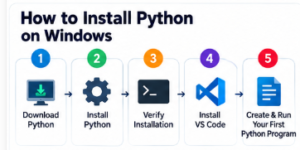
Before starting Python Programming Training, you need to install Python and configure a development environment.
Step 1: Download Python
Visit the official Python website:
https://www.python.org/downloads/
Download a current stable Python 3 release compatible with your operating system.
Step 2: Install Python
Open the downloaded installer and follow the installation instructions.
On Windows, if the installer offers the option to add Python to PATH, enable it. Alternatively, Python can be added to PATH later.
Step 3: Verify Python Installation
Open Command Prompt and execute:
python --versionIf the python command is not available, try:
py --versionThe output should display your installed Python version.
Step 4: Install Visual Studio Code
Download Visual Studio Code from:
https://code.visualstudio.com/
Install the Python extension to write, run, and debug Python programs.
Step 5: Create Your First Python File
Create a file named hello.py.
name = "SQL School"
print("Welcome to", name)
Save the file and execute:
python hello.pyYou have now created and executed your first Python program.
Important Python Programming Concepts for Beginners
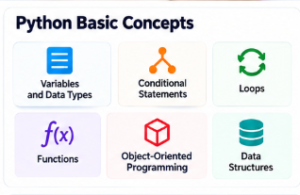
A structured Python course starts with programming fundamentals and gradually introduces advanced concepts.
1. Python Variables and Data Types
Variables store information such as names, numbers, dates, and other values.
student_name = "Rahul"
age = 25
course = "Python Training"

print(student_name)
print(age)
print(course)
Common Python data types include integers, floats, strings, booleans, lists, tuples, sets, and dictionaries.
2. Python Conditional Statements
Conditional statements execute code based on specified conditions.
marks = 85

if marks >= 60:
    print("Passed")
else:
    print("Needs Improvement")
3. Python Loops
Loops help automate repetitive operations.
for number in range(1, 6):
    print(number)
Output:
1
2
3
4
5
4. Python Functions
Functions organize reusable programming logic.
def calculate_total(price, quantity):
    return price * quantity

print(calculate_total(500, 3))
Output: 1500
5. Object-Oriented Programming (OOP)
Python supports Object-Oriented Programming concepts such as:
- Classes and objects
- Encapsulation
- Inheritance
- Polymorphism
- Abstraction
These concepts are useful when developing organized, reusable applications.
Python for Data Analytics – Pandas and NumPy
Python is widely used for analyzing structured and unstructured data.
Two important libraries are Pandas and NumPy.
What is Pandas?
Pandas is a Python library used for data manipulation and analysis. It provides DataFrames that help organize and process structured data.
Common Pandas operations include reading CSV and Excel files, cleaning data, filtering records, grouping data, and handling missing values.
Example: Sales Data Analysis
import pandas as pd

sales = {
    "Product": ["Laptop", "Mouse", "Keyboard"],
    "Amount": [50000, 1500, 2500]
}

df = pd.DataFrame(sales)

print(df)
print("Total Sales:", df["Amount"].sum())
Output:
Total Sales: 54000What is NumPy?
NumPy is a library used for numerical computing and efficient array operations.
import numpy as np

sales = np.array([1000, 2000, 3000, 4000])

print("Average Sales:", np.mean(sales))
Output:
Average Sales: 2500.0These libraries form an important foundation for Python Data Analytics and Data Science.
Python for Data Visualization
Data visualization helps businesses understand patterns, compare performance, and make informed decisions.
Python provides visualization libraries such as:
- Matplotlib
- Seaborn
- Plotly
Example: Create a Sales Chart Using Matplotlib
import matplotlib.pyplot as plt

months = ["Jan", "Feb", "Mar", "Apr"]
sales = [20000, 25000, 30000, 35000]

plt.plot(months, sales, marker="o")

plt.title("Monthly Sales Performance")
plt.xlabel("Month")
plt.ylabel("Sales")

plt.show()
This program displays a line chart showing monthly sales performance.
Python visualization skills are particularly useful for Data Analysts and Business Intelligence professionals.
Python with SQL Server Database Integration
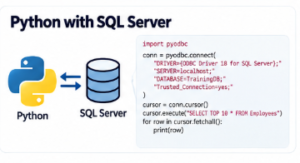
Python can connect to SQL Server databases to retrieve, analyze, and process business information.
Professionals can combine SQL queries with Python to create automated reports and data analysis workflows.
Example: Connect Python to SQL Server
import pyodbc

connection = pyodbc.connect(
    "DRIVER={ODBC Driver 18 for SQL Server};"
    "SERVER=localhost;"
    "DATABASE=TrainingDB;"
    "Trusted_Connection=yes;"
    "Encrypt=yes;"
    "TrustServerCertificate=yes;"
)

cursor = connection.cursor()

cursor.execute("SELECT TOP (10) * FROM Employees")

for row in cursor.fetchall():
    print(row)

connection.close()
Note: This is a local development example. It requires the Microsoft ODBC Driver 18, a running SQL Server instance, a database named TrainingDB, and appropriate database permissions. The local certificate setting shown here is for development only; production connections should use properly validated certificates.
Python with SQL is especially useful for SQL Developers, Data Analysts, Database Professionals, and Data Engineers.
Python for Automation and Real-World Applications
Python can automate routine tasks and reduce repetitive manual work.
Examples include:
- Reading and processing multiple Excel files.
- Cleaning CSV data before loading it into a database.
- Connecting to REST APIs and retrieving JSON data.
- Generating automated business reports.
- Processing log files and application data.
- Scheduling scripts and supporting ETL workflows.
For example, a Python script can read a daily sales file, validate the records, calculate totals, and prepare the data for reporting.
These are practical skills for professionals working in data-related IT roles.
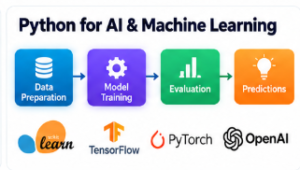
Python for Artificial Intelligence and Machine Learning
Python is a commonly used language for developing AI and Machine Learning applications.
Popular tools and frameworks include:
- Scikit-learn for classical Machine Learning
- TensorFlow and PyTorch for Deep Learning
- Pandas and NumPy for data preparation
- APIs and Python libraries for Generative AI applications
Python AI/ML projects may involve predicting sales, classifying customer feedback, detecting anomalies, or building AI-assisted business applications.
Beginners should first understand Python fundamentals, functions, data structures, and data handling before progressing to AI development.
Real-Time Python Projects for Practical Learning
Working on projects helps learners apply concepts instead of memorizing syntax.
Here are three useful project ideas.
Project 1: Banking Data Analytics
Objective: Analyze banking transaction data using Python.
Activities include:
- Import customer and transaction datasets
- Clean missing and duplicate records
- Analyze account transactions
- Calculate financial summaries
- Generate analytical reports
Project 2: E-Commerce Sales Analysis
Objective: Analyze online retail sales and customer purchase trends.
Activities include:
- Read CSV and Excel datasets
- Perform data cleaning using Pandas
- Calculate product-wise and region-wise sales
- Identify high-performing products
- Create visualizations using Matplotlib
Project 3: Python Automation with SQL Server
Objective: Automate data extraction and reporting.
Activities include:
- Connect Python to SQL Server
- Execute SQL queries
- Read results into Pandas DataFrames
- Generate reports
- Export processed results into CSV or Excel files
These examples demonstrate practical applications of Python programming, analytics, and automation.
Python Career Opportunities in 2026
Python can support several career paths depending on your experience and additional skills.
| Job Role | Important Skills |
|---|---|
| Python Developer | Python, OOP, APIs, debugging |
| Data Analyst | Python, Pandas, SQL, visualization |
| Data Engineer | Python, SQL, PySpark, ETL, cloud |
| Automation Engineer | Python scripting, APIs, testing |
| Data Scientist | Python, statistics, ML, analytics |
| AI/ML Engineer | Python, ML frameworks, model development |
Python alone does not guarantee a particular job. Employers also evaluate practical experience, problem-solving ability, projects, domain knowledge, and role-specific technologies.
Who Should Learn Python?
Python is suitable for:
- Students and Freshers: Learn programming fundamentals and develop practical coding skills.
- SQL Developers: Expand into Python automation and database integration.
- Data Analysts: Use Pandas, NumPy, and visualization libraries.
- Data Engineers: Build data processing and ETL solutions.
- Working IT Professionals: Automate tasks and learn new technical skills.
- Career Switchers: Start with Python fundamentals before selecting a specialization.
No prior programming experience is required to begin learning Python fundamentals.
Learn Python with SQL School – LIVE Online Training
At SQL School, our Python Training focuses on practical learning, hands-on coding, real-world applications, and career preparation.
Python Training Course Highlights
✅ Python Fundamentals and Advanced Programming
✅ Variables, Data Types, Functions and OOP
✅ Data Structures and File Handling
✅ Pandas, NumPy and Data Analytics
✅ Matplotlib and Data Visualization
✅ SQL Server and Python Integration
✅ APIs, Scripting and Automation
✅ Introduction to AI and Machine Learning
✅ Real-Time Projects and Practical Assignments
✅ Interview Preparation and Career Guidance
Training Options
LIVE Online Training: Learn through interactive instructor-led sessions.
Self-Paced Training: Study with recorded training materials.
Practical Projects: Apply course concepts to industry-oriented scenarios.
Career Preparation: Practice technical interview questions and strengthen project knowledge.
For complete modules, training plans, and current batch information, visit:
Python Course Details:
https://sqlschool.com/python-training/
Python with SQL Course:
https://sqlschool.com/python-sql/
Frequently Asked Questions About Python Training
1. Is Python easy for beginners?
Yes. Python has readable syntax and is commonly recommended as a starting language for programming beginners.
2. Can I learn Python without coding experience?
Yes. Start with variables, data types, operators, conditions, loops, and functions before proceeding to advanced topics.
3. Is Python useful for Data Analysts?
Yes. Python helps Data Analysts clean, process, analyze, and visualize business data using libraries such as Pandas, NumPy, and Matplotlib.
4. Is Python important for Data Engineers?
Python is widely used for data processing, ETL automation, API integration, and distributed data processing through technologies such as PySpark.
5. What is the difference between Python Programming and Python Data Analytics?
Python Programming focuses on writing applications, functions, classes, and automation scripts. Python Data Analytics focuses on cleaning, analyzing, transforming, and visualizing data.
6. Can I use Python with SQL Server?
Yes. Python can connect to SQL Server using database drivers and can process SQL query results using Pandas.
7. How long does Python training take?
The duration depends on the chosen learning plan. SQL School offers different Python training pathways, including programming, analytics, and AI/ML modules. Refer to the current course page for the applicable duration.
8. Does Python help with AI and Machine Learning?
Yes. Python supports a wide range of AI and ML libraries. However, building professional AI solutions also requires additional understanding of data, algorithms, statistics, and software engineering.
Conclusion: Start Your Python Learning Journey in 2026
Python is a valuable programming skill for students, freshers, and experienced IT professionals.
By learning Python fundamentals, Data Analytics, SQL integration, automation, and real-world project development, you can build a strong technical foundation for multiple IT career paths.
Start with the basics. Practice coding regularly. Build real projects. Develop job-relevant skills.
Ready to Learn Python with SQL School?
🚀 Join SQL School’s Python Training and Register for a FREE Demo!
🌐 Website: https://www.sqlschool.com
📚 Python Course: https://sqlschool.com/python-courses/
📞 Call / WhatsApp: +91 9951440801
📲 Join Our WhatsApp Channel for Python Tips, Technical Quizzes and Training Updates:
https://whatsapp.com/channel/0029VamSJLI35fLmVEvCPD3r
SQL School – Learn | Practice | Grow

