Microsoft Cloud Engineer Course 2026: Master SQL, Azure, Databricks, Fabric & AI
Introduction: Build Tomorrow’s Cloud Skills Today
The technology industry is rapidly evolving as organizations move their databases, applications, analytics platforms, and data pipelines to the cloud. At the same time, artificial intelligence is changing how businesses process information, automate workflows, and make decisions.
These developments have increased the importance of professionals who understand databases, cloud services, modern data engineering platforms, and AI-powered technologies.
The Microsoft Cloud Engineer Course 2026 provides a learning path for individuals who want to explore Microsoft SQL Server, Microsoft Azure, Azure Databricks, Microsoft Fabric, and Artificial Intelligence (AI).
At SQL School Training Institute, Hyderabad, learners can build their technical foundation through structured explanations, practical exercises, assignments, and scenario-based projects.
Whether you are starting your IT career or expanding your existing technical skills, learning how these technologies work together can help you prepare for modern cloud and data engineering responsibilities.
Beyond Traditional IT: Understanding the Microsoft Cloud Engineer Role
A Microsoft Cloud Engineer works with cloud-based technologies to implement, configure, maintain, secure, and optimize solutions that meet business requirements.
The exact responsibilities depend on the position. Some engineers focus on cloud infrastructure, while others specialize in databases, data integration, analytics platforms, or cloud-based data processing.
What Does a Cloud Engineer Work On?
- Deploying and managing cloud resources.
- Working with databases and cloud storage.
- Building automated data integration pipelines.
- Monitoring performance and troubleshooting technical issues.
- Implementing access controls and security practices.
- Supporting data processing and analytics workloads.
- Exploring automation and AI-assisted workflows.
A strong understanding of SQL, cloud fundamentals, Python, data pipelines, and modern data platforms can provide a useful foundation for cloud-related career paths.
The Five Technology Pillars of Modern Cloud Engineering
A modern cloud and data engineering learning path connects multiple technologies rather than focusing on a single tool.
Pillar 1: SQL Server — The Foundation of Enterprise Data
SQL Server is widely used to store, organize, query, and manage relational data. SQL skills are valuable for developers, database administrators, data engineers, and analysts.
Key topics to explore:
- SQL queries, joins, subqueries, and CTEs.
- Window functions and analytical calculations.
- Stored procedures, views, and functions.
- Transactions and data integrity.
- Indexing and query performance tuning.
- Database design and troubleshooting.
Hands-on example: Develop SQL queries that analyze customer purchases, calculate monthly revenue, and identify the highest-performing products.
Pillar 2: Microsoft Azure — Connecting Data to the Cloud
Microsoft Azure provides cloud services for computing, storage, databases, networking, security, and analytics.
Key topics to explore:
- Azure cloud fundamentals.
- Azure Data Factory and pipeline orchestration.
- Azure Data Lake Storage.
- Data ingestion and transformation.
- Azure Synapse Analytics concepts.
- Identity, access management, and monitoring.
Hands-on example: Design a data pipeline that transfers sales data from a source system to cloud storage for downstream processing.
Pillar 3: Azure Databricks — Processing Data at Scale
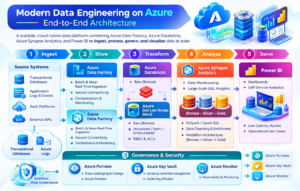
Azure Databricks supports large-scale data engineering and analytics using Apache Spark and related technologies.
Key topics to explore:
- Python for data engineering.
- PySpark DataFrames and Spark SQL.
- Batch processing and data transformations.
- Delta Lake and the Medallion Architecture.
- Incremental data loading.
- Data quality and performance optimization.
- Unity Catalog and data governance concepts.
Hands-on example: Transform raw retail transactions into validated, analytics-ready datasets using Bronze, Silver, and Gold data layers.
Pillar 4: Microsoft Fabric — Bringing Analytics Together
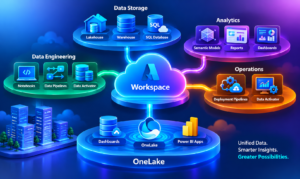
Microsoft Fabric is an integrated analytics platform that brings together data engineering, data integration, data warehousing, and business intelligence.
Key topics to explore:
- Fabric workspaces and OneLake.
- Lakehouse and Warehouse architecture.
- Data pipelines and Dataflows Gen2.
- Notebooks and Spark processing.
- Data transformation and orchestration.
- Power BI integration.
- Governance and analytical data management.
Hands-on example: Build a lakehouse workflow that transforms business data and prepares it for reporting through Power BI.
Pillar 5: Artificial Intelligence — Adding Intelligence to Data Workflows
AI tools can assist cloud and data professionals with development, documentation, data exploration, and selected automation tasks.
Key topics to explore:
- AI fundamentals and responsible AI.
- AI-assisted SQL and Python development.
- Large Language Models (LLMs).
- Retrieval-Augmented Generation (RAG).
- AI-powered document search.
- Data privacy and output validation.
Hands-on example: Develop a proof of concept that retrieves relevant information from approved company documents and answers questions using an appropriate AI service.
How the Technologies Connect: A Complete Cloud Data Journey
Learning individual technologies is useful, but understanding how they work together is what makes an end-to-end project meaningful.
Imagine a retail organization that wants to analyze customer behavior, product sales, inventory, and revenue across multiple stores.
A possible architecture could follow these stages:
- Data source: Collect transactional data from SQL Server and other business systems.
- Data ingestion: Use Azure Data Factory to orchestrate data movement.
- Cloud storage: Store incoming data in Azure Data Lake Storage or an appropriate OneLake environment.
- Data processing: Use Databricks or Fabric capabilities to clean, validate, and transform the data.
- Analytics preparation: Create curated datasets and reporting-ready tables.
- Business intelligence: Build Power BI reports to identify trends and performance metrics.
- AI capabilities: Where appropriate, introduce AI tools for documentation, data exploration, or natural-language access to approved information.
The best architecture depends on the business requirement. Azure and Databricks can be combined in one solution, while Microsoft Fabric can provide many integrated capabilities within its own platform.
Learn by Building: Four Practical Cloud Engineering Projects
Real-world projects help learners understand how technical concepts apply to business problems.
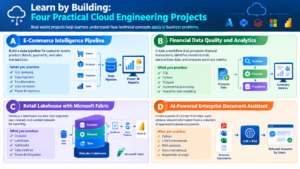
Project A: E-Commerce Intelligence Pipeline
Build a data pipeline for customer orders, product details, payments, and sales transactions.
What you practice: SQL querying, data ingestion, transformation, data validation, and Power BI reporting.
Project B: Financial Data Quality and Analytics
Create a workflow that processes financial transactions, identifies invalid records, standardizes data, and prepares summary metrics.
What you practice: SQL, Python, PySpark, incremental processing, and analytical data modeling.
Project C: Retail Lakehouse with Microsoft Fabric
Develop a lakehouse solution that organizes raw, cleaned, and curated datasets for reporting.
What you practice: OneLake, Lakehouse, notebooks, data pipelines, and Power BI integration.
Project D: AI-Powered Enterprise Document Assistant
Create a proof of concept that helps users retrieve relevant information from a collection of approved business documents.
What you practice: Python, LLM fundamentals, RAG concepts, document retrieval, and responsible AI usage.
These projects can be adapted to the learner’s experience level and the technologies available in the training environment.
Who Should Consider This Cloud Engineering Learning Path?
This learning path can benefit professionals who want to expand their technical capabilities across cloud, data, and analytics technologies.
Freshers and Graduates
Develop foundational knowledge in SQL, cloud computing, Python, and data engineering.
SQL Developers
Expand database skills into cloud data integration, distributed processing, and modern analytics platforms.
Database Administrators
Explore cloud database concepts, data migration, security, monitoring, and data platform architecture.
Data Analysts
Understand how business data is collected, transformed, and prepared for reporting and analytics.
ETL Developers
Build on traditional ETL experience by learning cloud-based pipelines and modern data processing tools.
Working IT Professionals
Explore opportunities to specialize in Azure, Databricks, Microsoft Fabric, or AI-enabled data solutions.
Beginners should generally start with SQL and cloud fundamentals before progressing to more advanced technologies.
Career Directions: Where Can These Skills Take You?
The technologies covered in this learning path can support preparation for several related technical roles.
Potential career directions include:
- Microsoft Azure Cloud Engineer
- Azure Data Engineer
- Cloud Data Engineer
- Azure Data Factory Developer
- Azure Databricks Engineer
- Microsoft Fabric Data Engineer
- SQL Developer
- Data Integration Engineer
- Cloud Database Administrator
- Data Platform Engineer
Each role has its own requirements. Infrastructure-oriented positions may require deeper networking, identity, security, and cloud administration knowledge. Data engineering positions typically place greater emphasis on SQL, Python, data pipelines, and data processing.
Building practical projects and developing problem-solving skills are important steps toward preparing for these opportunities. Training alone does not guarantee employment.
Choose a Learning Path That Builds Practical Expertise
Before enrolling in a cloud engineering course, review the curriculum and determine whether it provides a logical progression from fundamentals to applied projects.
Look for a learning experience that includes:
- Strong SQL and database fundamentals.
- Hands-on Azure services and data integration.
- Python and PySpark for data processing.
- Databricks and lakehouse concepts.
- Microsoft Fabric and analytics workflows.
- Relevant AI fundamentals.
- Practical assignments and troubleshooting exercises.
- Scenario-based projects and interview preparation.
A structured learning path should help you understand not only how to use each tool, but also when and why a particular technology is suitable for a business problem.
Frequently Asked Questions About Microsoft Cloud Engineering
What is the Microsoft Cloud Engineer Course 2026?
It is a learning path covering Microsoft cloud technologies, database systems, data engineering, analytics platforms, and relevant AI concepts.
Can beginners learn SQL, Azure, Databricks, Fabric, and AI?
Yes. Start with SQL and cloud fundamentals, then progress to data pipelines, Python, Databricks, Microsoft Fabric, and AI concepts.
Is SQL important for cloud data engineering?
Yes. SQL is widely used to retrieve, transform, validate, and analyze data. Python and cloud platform knowledge complement these skills.
What is the difference between Azure Databricks and Microsoft Fabric?
Azure Databricks specializes in data and AI workloads using technologies such as Apache Spark and lakehouse processing. Microsoft Fabric integrates data engineering, data integration, warehousing, and business intelligence capabilities into a unified analytics platform.
Do I need Python for this learning path?
Python is particularly useful for data engineering, PySpark, automation, and AI-related projects. The required depth depends on the role you want to pursue.
Does completing training guarantee a cloud engineering job?
No. Career outcomes depend on practical skills, experience, projects, interview performance, and employer requirements.
Conclusion: Shape Your Future with Microsoft Cloud Engineering
Microsoft Cloud Engineering brings together database management, cloud computing, data engineering, analytics, and artificial intelligence to solve real-world business challenges. By developing skills in SQL Server, Microsoft Azure, Azure Databricks, Microsoft Fabric, and AI, learners can build a strong technical foundation for modern cloud and data engineering projects.
The Microsoft Cloud Engineer Course 2026 offers a structured learning path for individuals who want to strengthen their technical knowledge, gain hands-on experience, and explore career opportunities across cloud and data technologies. Practicing real-world scenarios, building projects, and continuously upgrading your skills can help you prepare for the evolving technology industry.
Microsoft Cloud Engineer Training: https://sqlschool.com/microsoftcloud-engineer/
Microsoft Cloud Engineer Curriculum: https://sqlschool.com/wp-content/uploads/2026/10/Microsoft-Cloud-Engineer-Training-.pdf
Take Your Next Step with SQL School Training Institute
The future of technology increasingly connects cloud computing, data engineering, analytics, and artificial intelligence. Developing skills across these areas can help you understand modern data platforms and prepare for evolving technical responsibilities.
At SQL School Training Institute, Hyderabad, the learning approach emphasizes practical instruction, hands-on exercises, assignments, scenario-based projects, resume guidance, and interview preparation.
Ready to explore SQL, Azure, Databricks, Microsoft Fabric, and AI?
Visit https://sqlschool.com/ to enquire about course modules, upcoming batches, and training options.
Contact: +91 9666440801 | +91 9951440801
Founder & Trainer: Sai Phanindra
Build practical knowledge. Work on meaningful projects. Prepare for the next stage of your cloud and data engineering journey.
#MicrosoftCloudEngineer #MicrosoftCloudEngineering #MicrosoftCloudEngineerCourse #AzureTraining #MicrosoftAzure #SQLServer #SQLTraining #AzureDataEngineer #AzureDataFactory #AzureDatabricks #DatabricksTraining #MicrosoftFabric #FabricDataEngineering #DataEngineering #CloudComputing #CloudDataEngineer #ArtificialIntelligence #AIForDataEngineers #RealTimeProjects #HandsOnTraining #ITTraining #TechCareers #CloudEngineering2026 #SQLSchool #SaiPhanindra

