ETL Developer: Complete Guide to Skills, Tools, Technologies & Career Opportunities
Every modern organization generates data from multiple sources such as databases, applications, websites, APIs, cloud platforms, Excel files, and business applications. However, raw data cannot always be used directly for reporting or analytics.
This is where an ETL Developer plays an important role.
ETL Developers build data pipelines that collect information from different sources, clean and transform it, apply business rules, and deliver reliable data to data warehouses, data lakes, and modern analytics platforms.
In this guide, you will learn what an ETL Developer does, why ETL is important, ETL tools, key components, technologies, required skills, job roles, career opportunities, career roadmap, FAQs, and why SQL School can be a practical choice for ETL Developer training.
What Is ETL?
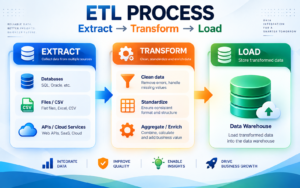
ETL stands for Extract, Transform, and Load.
It is a data integration approach used to collect information from different sources, process the data according to business requirements, and load the final data into a target system.
A simple ETL workflow can be represented as:
Data Sources → Extract → Transform → Validate → Load → Data Warehouse/Data Lake → Analytics
For example, a company may store customer details in SQL Server, sales information in an application database, product information in Excel, and marketing data in cloud storage.
An ETL pipeline can bring these different datasets together, remove duplicate records, standardize values, apply business rules, and prepare the information for reporting and analytics.
What Is an ETL Developer?
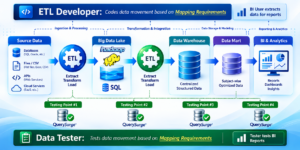
An ETL Developer is a technology professional who develops and maintains data integration pipelines.
The primary responsibility of an ETL Developer is to make data available in a structured, reliable, and usable format for applications, reporting systems, data analysts, and business intelligence teams.
An ETL Developer may work with:
- SQL and relational databases
- Data warehouses
- Data lakes
- Cloud storage
- ETL and ELT platforms
- APIs and files
- Data quality processes
- Workflow orchestration
- Pipeline monitoring
- Data transformation technologies
The role combines SQL, databases, data warehousing, programming, cloud technologies, and data engineering.
Why Is ETL Important?
Businesses rarely keep all their information in one system.
Customer data may exist in a CRM system, transaction data in a database, files may be stored in cloud storage, and analytical information may be maintained in a data warehouse.
ETL helps bring this information together.
Important benefits of ETL include:
Data Integration: Connects multiple data sources and brings information into a centralized environment.
Data Cleaning: Helps identify duplicate, missing, invalid, or inconsistent records.
Data Transformation: Converts raw information into a format suitable for business requirements.
Data Quality: Applies validation and business rules before information reaches analytical systems.
Automation: Reduces repetitive manual data processing.
Business Intelligence: Provides trusted datasets for dashboards, reports, and analytics.
Scalable Data Processing: Modern cloud-based ETL platforms can process large datasets using distributed computing technologies.
How Does an ETL Process Work?
An ETL process generally consists of three major stages.
1. Extract
The extraction stage collects data from source systems.
Common sources include:
- SQL Server
- Oracle
- PostgreSQL
- MySQL
- Excel
- CSV files
- APIs
- Cloud storage
- CRM systems
- ERP applications
The extraction process should be designed carefully so that data can be collected without unnecessarily affecting production systems.
2. Transform
The transformation stage converts raw data into meaningful information.
Common transformations include:
- Removing duplicate records
- Handling missing values
- Converting data types
- Joining datasets
- Filtering records
- Aggregating data
- Standardizing formats
- Applying business rules
- Creating calculated fields
- Validating data
For example, customer names may be standardized, dates converted into a common format, and duplicate customer records removed before loading.
3. Load
After transformation, the processed data is loaded into the target system.
Possible destinations include:
- SQL Server
- Azure SQL
- Azure Synapse Analytics
- Snowflake
- Databricks
- Data warehouses
- Data lakes
- Lakehouse platforms
Depending on the business requirement, data can be loaded as a full load, incremental load, batch process, or streaming process.
Key Components of an ETL Pipeline
A professional ETL solution contains several components that work together.
Source Systems
These are the systems where the original data is generated or stored.
Examples include databases, applications, APIs, files, and cloud services.
Extraction Layer
This layer retrieves the required information from source systems.
Staging Area
A staging area can temporarily hold extracted data before it is transformed and loaded.
Transformation Layer
This is where business rules, data cleansing, filtering, joins, calculations, and other transformations are applied.
Data Validation
Validation checks whether the processed information meets expected business and technical requirements.
Target System
The final processed data is stored in a data warehouse, data lake, lakehouse, or another analytical platform.
Orchestration
Orchestration controls the order in which different pipeline activities execute.
Monitoring
Monitoring helps identify failed pipelines, performance problems, processing delays, and other operational issues.
Error Handling
Production ETL pipelines need mechanisms for identifying failures, logging errors, retrying operations where appropriate, and troubleshooting failed processes.
Popular ETL Tools and Technologies
ETL Developers work with different technologies depending on the organization’s environment.
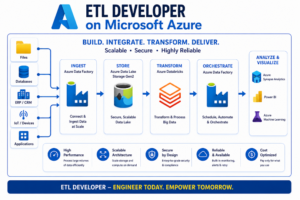
SQL Server Integration Services
SQL Server Integration Services (SSIS) is a Microsoft data integration platform commonly used for extracting, transforming, and loading data in SQL Server environments.
It provides components for working with databases, files, transformations, workflows, and data movement.
Azure Data Factory
Azure Data Factory (ADF) is a cloud-based data integration service used to create pipelines for moving and transforming data.
It can connect with databases, files, cloud storage, analytical platforms, and other services.
ADF is widely used for cloud-based data integration and orchestration.
Azure Databricks
Azure Databricks provides a data engineering environment built around Apache Spark.
It can be used for large-scale data processing and ETL using technologies such as SQL, Python, PySpark, Spark, Delta Lake, and Auto Loader.
Apache Airflow
Apache Airflow is commonly used for workflow orchestration and scheduling.
It allows data workflows to be defined as tasks with dependencies and execution schedules.
Informatica
Informatica provides enterprise data integration and data management capabilities and is used in a variety of large-scale data environments.
Talend
Talend provides tools for data integration, transformation, quality, and connectivity across different data sources.
dbt
dbt is widely used for SQL-based data transformation in modern data platforms, particularly in ELT architectures.
ETL Developer Technologies to Learn
A strong ETL Developer typically needs knowledge across several technology areas.
Database Technologies
- Microsoft SQL Server
- Oracle
- PostgreSQL
- MySQL
- Azure SQL
Programming
- SQL
- T-SQL
- Python
- PySpark
- Shell scripting
Cloud Data Technologies
- Microsoft Azure
- Azure Data Factory
- Azure Data Lake Storage
- Azure Databricks
- Azure Synapse Analytics
- Microsoft Fabric
Modern Data Technologies
- Apache Spark
- Delta Lake
- Snowflake
- dbt
- Apache Airflow
- Data Lakehouse
- Data Warehousing
DevOps and Deployment
- Git
- GitHub
- Azure DevOps
- CI/CD
- Pipeline deployment
- Monitoring
ETL vs ELT
ETL and ELT are two common approaches to data integration and transformation.
In ETL, data is extracted from the source, transformed, and then loaded into the target system.
In ELT, data is extracted and loaded into the target platform first, and transformations are performed within the target environment.
Traditional enterprise systems commonly use ETL tools such as SSIS and Informatica, while modern cloud data environments often use ELT patterns with technologies such as cloud warehouses, Databricks, SQL, and dbt.
The appropriate approach depends on factors such as data volume, platform architecture, performance requirements, transformation complexity, governance, and cost.
Skills Required for an ETL Developer
To build a successful career in ETL Development, professionals should develop both technical and practical skills.
Strong SQL Knowledge
SQL is one of the most important skills for an ETL Developer.
Important concepts include:
- Joins
- Subqueries
- CTEs
- Window functions
- Views
- Stored procedures
- Functions
- Temporary tables
- Query optimization
Data Warehousing
Understanding data warehousing is important for designing analytical solutions.
Key concepts include:
- Fact tables
- Dimension tables
- Star schema
- Snowflake schema
- Slowly Changing Dimensions
- Dimensional modeling
ETL Development
Developers should understand:
- Full load
- Incremental load
- Change data capture
- Data transformation
- Data validation
- Error handling
- Scheduling
- Pipeline monitoring
Programming
Python and PySpark can be particularly useful for modern data engineering and distributed data processing.
Cloud Computing
Knowledge of cloud storage, data integration, compute, security, and monitoring can help professionals work with modern data platforms.
Troubleshooting
ETL Developers should be able to identify data issues, pipeline failures, performance bottlenecks, connectivity problems, and transformation errors.
ETL Developer Career Technologies
The ETL career path has expanded significantly from traditional database-based ETL to modern cloud data engineering.
A practical learning path can be:
SQL → Advanced SQL/T-SQL → Data Warehousing → ETL Concepts → SSIS → Azure Data Factory → Azure Data Lake → Databricks → Python/PySpark → Cloud Data Engineering → DevOps
Professionals can then expand their knowledge into technologies such as:
- Snowflake
- dbt
- Apache Spark
- Apache Airflow
- Microsoft Fabric
- Cloud Data Warehouses
- Lakehouse Architecture
The exact technology combination depends on the target job role and organization’s technology stack.
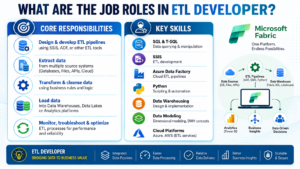
ETL Developer Job Roles
ETL skills can be applied across several data-related job roles.
ETL Developer
Develops and maintains data pipelines, transformations, mappings, workflows, and data integration processes.
Data Integration Developer
Builds integrations between databases, applications, APIs, files, and analytical systems.
Data Warehouse Developer
Works with data warehouse architecture, dimensional models, transformation logic, and analytical datasets.
Azure Data Engineer
Works with Azure-based data services such as Azure Data Factory, Azure Data Lake Storage, Azure Databricks, and analytical platforms.
ETL Administrator
Focuses on ETL environment management, scheduling, monitoring, deployments, troubleshooting, and operational support.
Data Engineer
Builds and manages broader data infrastructure, pipelines, processing systems, cloud platforms, and data platforms.
Senior Data Engineer
Works on complex data platforms, production pipelines, architecture, performance optimization, governance, and large-scale data engineering solutions.
Real-Time ETL Project Example
Consider an online retail organization that receives information from several systems.
Customer information may come from SQL Server, product information from Excel files, orders from an application database, and transaction information from APIs.
An ETL Developer can create a pipeline that:
- Extracts customer information
- Reads product information from files
- Retrieves order transactions
- Validates incoming records
- Removes duplicates
- Standardizes data
- Applies business rules
- Creates fact and dimension datasets
- Loads processed data into a warehouse or lakehouse
- Schedules the pipeline
- Monitors execution
- Handles pipeline failures
This type of project helps learners understand how ETL works in a practical business environment rather than only studying individual tools.
Why Choose SQL School for ETL Developer Training?
Learning ETL concepts theoretically is only the first step. Working on practical pipelines, real-world scenarios, databases, transformations, and troubleshooting is important for developing job-ready skills.
SQL School Training Institute focuses on practical and scenario-based learning across SQL and modern data technologies.
Training areas can include:
- SQL and T-SQL
- Microsoft SQL Server
- ETL Development
- Data Warehousing
- Azure Data Factory
- Azure Data Engineering
- Azure Databricks
- Python and PySpark
- Real-Time Projects
- Scenario-Based Training
- Interview Preparation
- Resume Guidance
SQL School also provides 100% Placement Assistance to eligible learners.
The objective is to help learners understand not only individual technologies but also how different components work together in a real-world data environment.
Frequently Asked Questions About ETL Developer
What does an ETL Developer do?
An ETL Developer builds and maintains data pipelines that extract information from source systems, transform it according to business requirements, and load it into target systems.
Is SQL important for ETL Developers?
Yes. SQL is a fundamental skill because ETL Developers frequently work with databases, data transformations, validation, data analysis, and performance optimization.
Which ETL tools should I learn?
You can begin with SSIS or Azure Data Factory and later expand into Databricks, Airflow, Informatica, dbt, or other technologies based on your career goals.
Is Python required for ETL Development?
Python is not mandatory for every traditional ETL role, but it is increasingly useful for modern data engineering, automation, Spark, and cloud data workloads.
Can a SQL Developer become an ETL Developer?
Yes. SQL Developers already have a strong foundation in databases and SQL. They can expand their skills by learning data warehousing, ETL tools, cloud technologies, and practical pipeline development.
Can freshers learn ETL Development?
Yes. Beginners can start with SQL and database fundamentals and gradually progress into data warehousing, ETL tools, cloud technologies, and real-time projects.
Conclusion
ETL Development continues to play an important role in the modern data ecosystem. Organizations need reliable processes to collect information from different sources, transform raw data, maintain data quality, and make information available for analytics and reporting.
For professionals planning a career in this field, a strong foundation in SQL, ETL, data warehousing, cloud data integration, Python, PySpark, Databricks, and data engineering can help build a broad technical skill set.
The best way to understand ETL is to combine technology learning with practical projects and real-world scenarios.
If you are planning to start your journey as an ETL Developer, Data Engineer, Azure Data Engineer, or Cloud Data Professional, practical training can help you move from individual concepts to complete data pipeline development.
Start Your ETL Developer Journey with SQL School
Ready to build practical ETL and Data Engineering skills?
Learn SQL, ETL, Data Warehousing, Azure Data Factory, Azure Data Engineering, Databricks, and related technologies through practical and scenario-based training.
Trainer: Mr. Sai Phanindra
Reach Us: +91 9666440801 | +91 9951440801
Website: www.sqlschool.com
Join a FREE Demo Session and explore the ETL Developer learning journey with SQL School.