
AWS Data Engineer Training: From SQL to Building Real-World Cloud Data Platforms
Data is no longer sitting quietly inside databases.
Every click, transaction, application event, customer interaction, and business process generates data. The real challenge for organizations is not simply collecting this data—it is building reliable systems that can move, transform, store, and deliver that data at the right time.
This is where an AWS Data Engineer plays a critical role.
With the growing adoption of cloud platforms, professionals who understand SQL, Python, ETL, AWS, data lakes, data warehouses, and big-data technologies are increasingly valuable.
If you already work with SQL, databases, ETL, BI, or analytics and want to move into cloud data engineering, AWS Data Engineer Training can be a strong next step.
What Does an AWS Data Engineer Actually Do?
Think of an organization as a large city.
Data is constantly moving through the city—from applications and databases to analytics platforms and business dashboards.
The AWS Data Engineer builds the roads, pipelines, storage systems, and processing mechanisms that allow this data to move efficiently.
A typical AWS Data Engineer may:
- Extract data from databases, applications, APIs, and files
- Build automated data pipelines
- Store large volumes of data in Amazon S3
- Transform data using AWS Glue and Spark
- Query data using Amazon Athena
- Load analytical data into Amazon Redshift
- Process large datasets using Amazon EMR
- Work with real-time streaming data
- Implement data quality and validation
- Monitor and troubleshoot production pipelines
- Optimize data processing and storage
In simple terms:
Source → Ingest → Store → Transform → Process → Analyze
That entire journey is the world of data engineering.
Why AWS Data Engineering Is Becoming Important
Organizations are moving from traditional on-premises systems toward cloud-based data platforms.
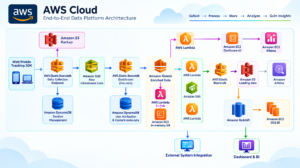
AWS provides services for almost every stage of the modern data lifecycle.
For example:
Application / Database
↓
Amazon S3
↓
AWS Glue
↓
Amazon Athena / Amazon Redshift
↓
Power BI / Tableau / Analytics Applications
This architecture allows organizations to build scalable data platforms without maintaining every component of the infrastructure themselves.
That is why learning AWS Data Engineering is not simply about learning individual AWS services.
It is about understanding how to design and build complete data solutions.
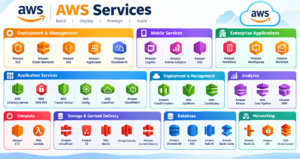
AWS Services Every Data Engineer Should Understand
Amazon S3 – The Foundation of the Data Lake
Amazon S3 is one of the most important services for AWS Data Engineers.
Organizations can use S3 to store:
- Raw data
- Processed data
- Historical data
- Application logs
- Transaction data
- Files
- Analytics datasets
A well-designed S3 data lake can become the central storage layer for an organization’s modern data platform.
AWS Glue – Building the ETL Engine
AWS Glue is a managed data integration and ETL service.
It can help data engineers discover, transform, and move data between different systems.
Practical AWS Glue Training should include:
- Glue Crawlers
- Glue Data Catalog
- Glue Jobs
- ETL transformations
- DynamicFrames
- PySpark
- Scheduling
- Workflow automation
- Error handling
The important part is understanding when and why to use Glue, not just learning the interface.
Amazon Athena – Query Data Without a Traditional Database
Imagine having terabytes of data stored in S3 and wanting to analyze it using SQL.
Amazon Athena allows you to query data directly from S3.
This makes Athena particularly useful in data lake architectures.
A Data Engineer should understand:
- External tables
- Partitions
- File formats
- SQL queries
- Performance optimization
- Data lake querying
Amazon Redshift – Turning Data Into an Analytical Warehouse
When organizations need a dedicated analytical data warehouse, Amazon Redshift becomes an important component of the architecture.
AWS Data Engineers may work with:
- Data warehouse design
- Tables
- Loading strategies
- SQL
- Data distribution
- Performance optimization
- Analytical workloads
Understanding the difference between S3 Data Lake and Redshift Data Warehouse is an important concept for AWS Data Engineers.
Amazon EMR and Apache Spark
Modern data engineering frequently involves processing very large datasets.
Amazon EMR provides a managed environment for technologies such as Apache Spark.
Learning:
Spark + PySpark + AWS
can significantly strengthen your profile as a cloud data engineer.
The Most Important Part: Real-Time Projects
Watching videos about AWS services is one thing.
Building a working data platform is completely different.
That is why practical AWS Data Engineering Projects should be an essential part of your learning journey.
Project 1: E-Commerce Data Platform
Imagine an online shopping company processing millions of customer transactions.
Data could come from:
- Customer databases
- Order systems
- Product catalogs
- Payment systems
- Website activity
A possible architecture:
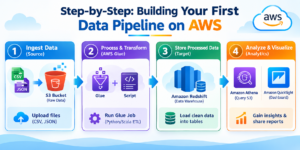
Source Systems → S3 → AWS Glue → Transformation → Redshift → BI
You could build pipelines for:
- Customer data
- Product data
- Orders
- Sales
- Revenue
- Customer behavior
This project demonstrates how AWS services work together in a realistic business scenario.
Project 2: Healthcare Data Lake
Healthcare organizations generate large amounts of structured and unstructured data.
A healthcare data engineering project can demonstrate:
- Data ingestion
- S3 data lake design
- Data transformation
- Data cataloging
- Data quality
- Data security
- Analytical queries
This type of project also introduces important concepts around sensitive data and controlled access.
Project 3: Real-Time Streaming Pipeline
Not all data arrives once per day.
Some applications generate data continuously.
Examples include:
- Website events
- IoT devices
- Financial transactions
- Application logs
- Customer activity
A real-time AWS data pipeline can introduce technologies such as Amazon Kinesis and event-driven processing.
This helps learners understand the difference between:
Batch Data Engineering
and
Real-Time Data Engineering
What Skills Do Employers Look For?
An AWS Data Engineer should ideally combine several skill areas.
Technical Skills
- SQL
- Python
- AWS
- ETL
- Data Lakes
- Data Warehousing
- PySpark
- Apache Spark
- Data Modeling
- Data Pipeline Development
- Cloud Security
- Performance Optimization
Engineering Skills
You should also understand:
- Error handling
- Logging
- Monitoring
- Scheduling
- Data validation
- Troubleshooting
- Scalability
- Cost optimization
Business Understanding
A good Data Engineer also understands the business problem behind the pipeline.
For example:
Instead of simply asking:
“How do I move this data?”
ask:
“Why does the business need this data, how frequently does it need it, and what level of reliability is required?”
That mindset separates tool users from strong data engineers.
Who Should Join AWS Data Engineer Training?
AWS Data Engineering can be a good choice for:
- SQL Developers
- Database Developers
- ETL Developers
- Data Analysts
- BI Developers
- Database Administrators
- Python Developers
- Cloud Professionals
- Software Engineers
- Freshers interested in Data Engineering
Professionals who already understand SQL and databases may find the transition particularly useful because those skills provide a strong foundation.
Career Opportunities After AWS Data Engineer Training
After developing practical skills, professionals can explore roles such as:
- AWS Data Engineer
- Cloud Data Engineer
- Data Engineer
- ETL Developer
- Big Data Engineer
- Cloud ETL Developer
- Analytics Engineer
- Data Platform Engineer
Career progression depends on experience, technical capability, project exposure, and interview performance.
Frequently Asked Questions
Is AWS Data Engineer a good career option?
AWS Data Engineering is a strong career path for professionals interested in cloud computing, databases, programming, analytics, and large-scale data processing.
Can SQL professionals become AWS Data Engineers?
Yes. SQL is one of the core skills used in data engineering. SQL professionals can build on their existing knowledge by learning AWS, Python, ETL, Spark, and cloud data architecture.
Do I need Python for AWS Data Engineering?
Python is highly useful for automation, ETL development, data processing, and PySpark-based workloads.
Is AWS Glue important for Data Engineers?
Yes. AWS Glue is an important AWS service for data integration and ETL workloads and is commonly used in modern AWS data architectures.
Should I learn Spark?
If you want to work with large-scale data processing, learning Apache Spark and PySpark can be highly valuable.
Conclusion
AWS Data Engineering offers excellent opportunities for professionals looking to build careers in cloud and data technologies.
With skills in AWS, SQL, Python, ETL, PySpark, S3, Glue, and Redshift, you can build scalable real-world data solutions.
Hands-on projects and practical training help transform technical knowledge into job-ready skills.
Start your AWS Data Engineer Training journey today and take the next step toward a successful cloud data engineering career.
AWS Data Engineering Training: https://sqlschool.com/aws%20Data%20Engineering/
Start Your AWS Data Engineering Journey
SQL School – Practical, Job-Oriented Technology Training
📞 Contact: +91 99514 40801
🌐 Website: SQL School
100% Practical Training | Real-Time Projects | Resume Guidance | Mock Interviews | Job-Oriented Learning
#AWSDataEngineer #AWSDataEngineering #AWSDataEngineerTraining #AWSDataEngineerCourse #AWSTraining #AWSCloud #CloudDataEngineering #DataEngineering #DataEngineer #AWSGlue #AmazonS3 #AmazonRedshift #AmazonAthena #PySpark #ApacheSpark #PythonForDataEngineering #SQL #ETL #DataLake #DataWarehouse #CloudComputing #BigData #RealTimeData #DataEngineeringProjects #AWSJobs #DataEngineerJobs #CloudCareer #AWSCertification #TechTraining #SQLSchool