
How to Become a Data Analyst: Step-by-Step Roadmap
In today’s business world, data is the lifeblood of the company: Sales figures, customer behavior, traffic on the website, and operational metrics all rely on someone who can transform raw numbers into decisions. So, it is no surprise that many freshers and working professionals are wondering how to become a data analyst in 2026. Fortunately, no computer science degree is required, nor are years of coding experience. Any intelligent and curious person with a bit of skill, tools, and a good plan can get into this.
This blog will guide you through an entire, helpful, and practical roadmap of skills you need, tools you can use to learn, certifications that are relevant, and career benefits of following this route.
What is a Data Analyst?
Data analysts gather, process and analyze information to enable informed decision making within organisations. They use tools such as SQL, Excel, Power BI and Python to detect trends, create reports and provide insights to business teams. So, if you are interested in how to become a Data Analyst, the first thing you need to know is that this is a cross-functional position that requires business knowledge combined with technical proficiency — you need not be a programmer, but you do need to love numbers and logic.
Why Choose a Career as a Data Analyst?
- Demand is high across all industries — whether it’s IT, banking, healthcare, retail or e-commerce, they’re all looking for data analysts.
- Rising salary levels, with a high number of experienced analysts being promoted to data or analytics-related senior positions.Growth in salaries, with well-established analysts frequently being promoted to a senior position in data or analytics.
- Faster learning curve than data science or machine learning positions
- There are plenty of remote and hybrid career opportunities available.There are numerous jobs that can be remote or hybrid.
- Evident progression to Business Analyst, Data Engineer or Data Scientist jobs
Knowing how to become a data analyst also equates to knowing that it is one of the rare tech jobs on which a commerce, statistical, or business graduate can pivot and succeed with proper training.
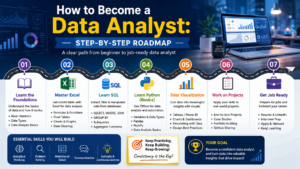
How to become a Data Analyst Step-by-Step Roadmap
step 1: The basic guideline is to establish a solid foundation in SQL.The first step is to get a strong foundation in SQL.
SQL (Structured Query Language) is the language all data analysts use. You’ll be using it every day to retrieve, select and combine information from databases. Almost all job postings for data analysts require SQL, and this is where it all begins.
Step 2: Excel for Handling Data
Get used to using Excel – pivot tables, VLOOKUP/XLOOKUP, conditional formatting, and simple formulas. One of the most popular tools for actual business reporting remains.
Step 3: Data Visualization Tool (Power BI or Tableau)
With the ability to query and clean data, the next step is to present the data visually. Today, Power BI is the most popular visualization tool in India and it is essential to master Power BI to work-ready data analyst. You will learn how to create dashboards, KPIs and interactive reports that business stakeholders can use!
Step 4: choose Basic Python or R (optional but useful).
Basic python knowledge (pandas, numpy) is helpful, but not necessarily required, and is useful for automating repetitive tasks or working with larger datasets that may be beyond the capabilities of excel.
Step 5 : Understand Statistics and Business Metrics.
A great analyst isn’t only charting, they’re analyzing! Understand some common business KPIs and basic statistics such as mean, median, standard deviation, and correlation that are relevant to the business field you are interested in.
step 6: in the series is to work on Real Projects and build a Portfolio.
Recruiters need evidence, they don’t need certificates. One of the most critical components of how to become a data analyst and get a job is to work on a real or simulated data set and create at least 2-3 projects which are solid and highly successful (for example, a sales dashboard, a customer churn analysis, an HR analytics report).
Step 7: Get Certified and Structured Training.
It is possible to be self-trained, but training is accelerated if structured. The ideal training course will include SQL, Excel, real life projects and Power BI, and also incorporate placement advice — eliminating the guesswork of how to turn into a data analyst from months of piecing together tutorials on YouTube in an organized, job-ready path.
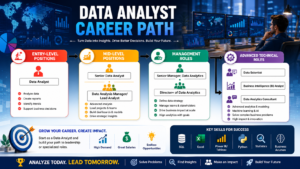
Being a data analyst, you cannot miss out on these key skills.
- SQL for data extraction, query.
- Use Excel to perform quick calculations and reports.
- To create dashboards and visualize data, use Power BI or Tableau.
- Familiarity with basic programming (Python or R) for automation and further analysis.
- Leading analytical and problem solving thinking skills
- Communicate effectively and present results to non-technical groups
Benefits of a systematic way
Trying to figure out how to become a data analyst on your own can take a lot longer than necessary. You get a roadmap that is structured with you:
- The sequence is clear and there is no jumping from tool to tool in a random sequence.
- Real world projects with hands-on activities.
- How to decipher the actual questions of the recruitment interviewer
- Rapid transition to the job, rather than that of unstructured self-study
Common mistakes to avoid.
- Attempting to use all the tools simultaneously rather than in order
- Avoid using SQL and directly go to Python or machine learning.
- Failure to develop a portfolio or to use real data sets
- Failing to take into account soft skills such as presenting data clearly to a business audience
It’s not just how to get to the technical steps of becoming a data analyst, knowing how to avoid these mistakes is crucial too — many candidates have the technical skills, but end up failing a job interview because they can’t clearly articulate their work.
How long does it take to get to be a Data Analyst?
Most learners can be job-ready within 3-6 months with consistent effort. It depends on your starting point, the time per week you can devote to the course, and whether you are self-studying or taking a structured, instructor-led course.
Final Thoughts
It’s not a secret how to become a data analyst, it’s a series: SQL, Excel, visualization tool, basic statistics, real project, practice, practice. It’s not about the tutorials, it is about consistent practice and application. This roadmap offers a practical and proven course of study into one of today’s most sought-after tech careers, whether you’re a freshman or a career change.
The following are some of our most commonly asked questions:
Is there a prerequisite for coding that I need to have to be a Data Analyst?
No, just basic logic is required to begin. You don’t need to be a master programmer, and there’s only a basic amount of Python.SQL and Excel are much simpler to learn than full scale programming and Python is only used a little.
Should I start my tutorial with SQL or should I start my tutorial with Python?
Start with SQL. It is the most used skill in job postings for data analysts and is the basis for all of the skills.
Does one need to get certified to be a data analyst?
While not required, a certification that’s known plus actual projects increase your chances to get short listed by the recruiter.
Can anyone who is not an IT graduate become a data analyst?
Yes. A lot of the successful data analysts have a commerce, statistics or business background. The important point here is that it is not the academic degree you earned; it’s about your skills.
What is the average salary of a Data Analyst in India?
Salaries are competitive depending on the city and experience level and increase rapidly as experience and tool expertise level up.
What is the difference between Data Analyst and Data Scientist?
The difference is that a data analyst interprets existing data and creates reports/dashboards, whereas a data scientist builds predictive models with machine learning, a higher level math-oriented position.