Python AI ML Course: Learn Python, Analytics, Programming, Artificial Intelligence & Machine Learning
Python has become one of the most widely used technologies for data analytics, Artificial Intelligence, Machine Learning, automation, and data-driven application development. Its simple syntax, powerful libraries, and extensive ecosystem make Python a popular choice for beginners as well as experienced technology professionals.
A well-structured Python AI ML Course can help learners progress from Python fundamentals to data analytics, Machine Learning, and Artificial Intelligence through a practical and progressive learning approach.
At SQL School, the Python AI ML learning path is organized into three major modules:
Step 1: Python Analytics
Step 2: Python Programming
Step 3: Python AI ML
This progression helps learners first understand data, then strengthen Python programming skills, and finally apply Python to Artificial Intelligence and Machine Learning.
What Is a Python AI ML Course?
A Python AI ML Course combines Python programming with data analytics, Artificial Intelligence, and Machine Learning concepts.
Instead of learning these technologies separately, learners can follow a connected journey:
Python Analytics → Python Programming → Machine Learning → Artificial Intelligence → Practical Projects
Python provides the programming foundation, analytics helps learners understand data, and Machine Learning introduces techniques for creating predictive models and intelligent solutions.
This combination is useful for students, working professionals, developers, data professionals, and job seekers who want to build skills in modern data and AI technologies.
Why Learn Python for AI and Machine Learning?
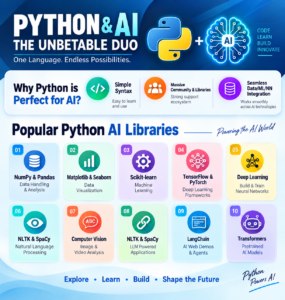
Python is widely used in the AI and Machine Learning ecosystem because developers and data professionals can access a large collection of libraries and frameworks for data processing, visualization, model development, and experimentation.
Some commonly used Python technologies include:
- NumPy
- Pandas
- Matplotlib
- Scikit-learn
- TensorFlow
- Jupyter Notebook
Python can be used across different stages of an AI/ML workflow, from preparing datasets and analyzing information to developing and evaluating Machine Learning models.
For learners, this makes Python a useful foundation for progressing from traditional programming into advanced data and AI applications.
Step 1: Python Analytics
The first module focuses on Python Analytics.
Before developing Machine Learning models, it is important to understand how to work with data. This module introduces Python-based techniques for collecting, preparing, analyzing, and visualizing datasets.
Key Areas of Python Analytics
- Python fundamentals for analytics
- Data types and data structures
- NumPy
- Pandas
- DataFrames and Series
- Data cleaning
- Data transformation
- Missing-value handling
- Data filtering
- Data aggregation
- Exploratory Data Analysis
- Statistical analysis
- Data visualization
- Working with real-world datasets
Learners can use Python libraries to explore datasets, identify patterns, understand relationships between variables, and present information through meaningful visualizations.
Typical Analytics Workflow
Load Data → Clean Data → Transform Data → Analyze Data → Visualize Insights
This foundation becomes useful when learners move into Machine Learning because high-quality data preparation is an important part of building effective ML solutions.
Step 2: Python Programming
The second module focuses on Python Programming.
Strong programming fundamentals help learners write better code, automate repetitive tasks, process information, and develop applications using Python.
Python Programming Concepts
The module can cover important programming concepts such as:
- Variables and data types
- Operators
- Strings
- Lists
- Tuples
- Sets
- Dictionaries
- Conditional statements
- Loops
- Functions
- Lambda functions
- File handling
- Exception handling
- Modules and packages
- Object-Oriented Programming
- Classes and objects
- Inheritance
- Polymorphism
- Iterators and generators
The objective is to develop programming confidence rather than simply learning Python syntax.
Learners can practice writing programs, creating reusable functions, processing files, handling errors, and organizing Python applications.
Why Python Programming Matters for AI and ML
Machine Learning applications require more than knowledge of algorithms.
A professional working with AI/ML may need to:
- Prepare datasets
- Write data-processing scripts
- Automate workflows
- Build reusable functions
- Integrate libraries
- Process large amounts of information
- Evaluate models
- Develop application logic
A strong Python programming foundation makes it easier to work with these requirements.
Step 3: Python AI ML
The third module takes learners into Artificial Intelligence and Machine Learning using Python.
At this stage, learners can apply their Python and analytics knowledge to Machine Learning concepts and practical AI/ML scenarios.
Machine Learning Fundamentals
Important areas can include:
- Introduction to Artificial Intelligence
- Machine Learning fundamentals
- Machine Learning workflow
- Supervised Learning
- Unsupervised Learning
- Regression
- Classification
- Clustering
- Data preprocessing
- Feature engineering
- Model training
- Model testing
- Model evaluation
- Prediction
- Model improvement
- Practical Machine Learning projects
Understanding the Machine Learning Process
A typical Machine Learning workflow can be represented as:
Business Problem → Data Collection → Data Cleaning → Data Analysis → Feature Preparation → Model Training → Model Evaluation → Prediction
Understanding this complete process is important because Machine Learning is not limited to selecting an algorithm. Data preparation, problem definition, evaluation, and interpretation are also important parts of the workflow.
Artificial Intelligence with Python
Artificial Intelligence is a broad field that focuses on developing systems capable of performing tasks that involve intelligent decision-making, pattern recognition, prediction, language understanding, and automation.
Python provides access to a large ecosystem that can be used for developing AI applications.
Depending on the learning path, learners can explore areas such as:
- Artificial Intelligence fundamentals
- Machine Learning
- Deep Learning
- Neural Networks
- Natural Language Processing
- Predictive Analytics
- Intelligent automation
- AI application development
The combination of Python programming, data analytics, and Machine Learning provides a strong foundation for exploring modern AI technologies.
Python AI ML Tools and Technologies
A Python AI ML learning path can introduce learners to several widely used tools.
NumPy
NumPy provides capabilities for numerical computing and working with arrays and mathematical operations.
Pandas
Pandas is commonly used for data manipulation, cleaning, transformation, and analysis.
Matplotlib
Matplotlib can be used to create charts and visualizations for exploring data and presenting analytical results.
Scikit-learn
Scikit-learn provides tools for implementing many traditional Machine Learning workflows, including classification, regression, clustering, preprocessing, and model evaluation.
TensorFlow
TensorFlow is a framework used for developing and training Machine Learning and Deep Learning models.
Jupyter Notebook
Jupyter Notebook provides an interactive environment where learners can combine Python code, data analysis, visualizations, and documentation.
Practical Projects in Python AI ML
Practical projects help learners understand how individual concepts work together to solve real-world problems.
A typical project can follow this process:
Problem Identification → Data Preparation → Exploratory Analysis → Feature Engineering → Model Development → Model Evaluation → Prediction → Project Documentation
Possible project areas include:
- Sales prediction
- Customer churn analysis
- Customer segmentation
- Fraud detection
- Recommendation systems
- Business forecasting
- Classification problems
- Predictive analytics
- Text analysis
- AI-powered applications
Projects can also help learners build a portfolio that demonstrates their ability to apply Python, analytics, and Machine Learning concepts.
Who Can Learn Python AI ML?
The course can be useful for a wide range of learners, including:
- Students interested in AI and Data Science
- Beginners learning Python
- Working professionals
- Data Analysts
- Software Developers
- SQL Professionals
- Database Professionals
- Data Engineers
- Business Intelligence Professionals
- Job seekers
- Professionals planning an AI/ML career transition
Existing programming or data experience can be helpful, but learners can begin with Python fundamentals and progressively move toward advanced topics.
Python AI ML Career Opportunities
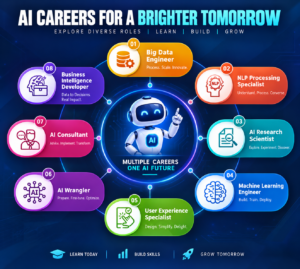
Python, Analytics, AI, and Machine Learning skills can be applied across several technology roles.
Potential career paths include:
- Python Developer
- Data Analyst
- Data Scientist
- Machine Learning Engineer
- AI Engineer
- AI/ML Developer
- Junior Machine Learning Engineer
- Data Science Associate
- AI Automation Developer
- Python Data Analyst
The actual career path depends on a person’s existing experience, technical skills, project portfolio, and level of specialization.
Why Choose SQL School for Python AI ML Training?
SQL School Training Institute – Hyderabad provides a structured learning approach designed to help learners progress from Python fundamentals to AI and Machine Learning.
The Python AI ML learning journey focuses on:
- Python Analytics
- Python Programming
- Python AI ML
- Practical learning
- Real-world scenarios
- Project-oriented training
- Interview preparation
- Resume guidance
- Career preparation
- 100% Placement Assistance
The three-module structure provides a progressive path instead of introducing advanced AI/ML concepts without first building the required Python and analytics foundation.
Frequently Asked Questions
Is Python necessary for Machine Learning?
Python is not the only language used for Machine Learning, but it is widely used because of its libraries, frameworks, community support, and applications across data and AI.
Can beginners learn Python AI ML?
Yes. Beginners can start with Python fundamentals, progress into analytics and programming, and then move toward Machine Learning and AI.
What is taught in Python Analytics?
Python Analytics focuses on working with data using Python, including data manipulation, cleaning, exploration, analysis, and visualization.
What is the purpose of the Python Programming module?
The programming module builds a strong foundation in Python concepts such as variables, functions, loops, data structures, file handling, exception handling, and Object-Oriented Programming.
Conclusion
Learning Python for Analytics, Artificial Intelligence, and Machine Learning can open the door to a wide range of modern technology applications. The right learning path should build skills progressively, starting with Python Analytics and programming before moving into Machine Learning and AI.
The Python AI ML Course at SQL School follows this three-stage approach: Python Analytics → Python Programming → Python AI ML. With practical learning, real-world scenarios, projects, and career preparation, learners can build a stronger foundation for working with Python, Data Analytics, Machine Learning, and Artificial Intelligence.
Python AI ML Training: https://sqlschool.com/python-ai-ml-training/
Start Your Python AI ML Journey
🚀 Reach SQL School for a FREE Demo and start your Python AI ML learning journey!
📞 Contact: +91 9666440801 | +91 9951440801
🌐 Website: https://sqlschool.com
👨🏫 Trainer: Mr. Sai Phanindra
🏫 SQL School Training Institute – Hyderabad
Take the next step toward building your career in Python, AI & Machine Learning!
#PythonAI #PythonML #PythonAIML #ArtificialIntelligence #MachineLearning #PythonProgramming #PythonAnalytics #DataAnalytics #DataScience #MachineLearningWithPython #AITraining #MLTraining #PythonTraining #AIMLCourse #PythonCourse #DataScienceCourse #AIEngineer #MachineLearningEngineer #PythonDeveloper #DataAnalyst #DataScientist #AITrainingHyderabad #MachineLearningTraining #PythonTrainingHyderabad