
What Is Databricks? Explaining features, Architecture & Career Advantages (2026 Guide)
Databricks has quickly become one of the most in-demand platforms in the big data and AI world. Databricks is a unified, cloud-based Data Intelligence Platform founded by the original creators of Apache Spark, which connects data engineers, data scientists, and data analysts in a unified collaborative data workspace. From creating ETL pipelines to training machine learning models, to performing SQL analytics, Databricks gives you a single platform to do it all reliably, at scale and in real time. That’s why Databricks Data Engineer Training is one of the hottest paths to search today for data professionals.
We explain what Databricks is, how it works under the hood, its fundamental capabilities, and the potential benefits of joining a structured Databricks Data Engineer training program.
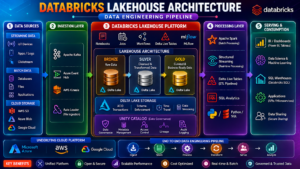
What Is Databricks?
Databricks is simply a single cloud platform that deals with data engineering, analytics, and AI. It is developed utilizing the Lakehouse Architecture, which is a new way of thinking about data storage that merges the low cost, flexibility, and storage prowess of data lakes with the reliability and performance of traditional data warehouses. This allows you to store raw files, structured tables, and unstructured data in the same repository and to execute SQL queries, as well as deep learning workloads, on top of it using the fast, distributed processing capabilities of Apache Spark. This is where all users of Databricks Data Engineer Training begin, having a strong understanding of the Lakehouse concept.
Data teams worldwide use Databricks for three main uses:
- DataEngineers leverage it to clean, transform, and load large data sets in their ETL extract, transform, load processes.
- It is used by Data Scientists for training, monitoring, and deploying machine learning and AI models.
- It can be utilized by Data Analysts to create dashboards, execute ad-hoc SQL queries, and produce business reports.
Databricks Architecture: Understanding the Lakehouse
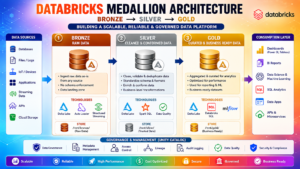
At the core of the Databricks architecture is the Medallion Architecture for organizing data as it progresses through a pipeline:
- Bronze Layer: Raw data ingestion — Raw data that is captured in the exactly same way that it comes from source systems.
- Silver Layer: Data that has been cleaned, validated and transformed for analysis.
- Gold Layer: Ready-to-use, aggregated data for reporting and decision making.
Raw data is ingested with tools such as Lakeflow Connect, then transformed in Delta Lake for reliability and version control, and orchestrated end-to-end with Databricks Workflows. This layered flow means that all datasets from source to insight are traceable, consistent, and trustworthy – a key principle explored in greater detail in any hands-on Databricks Data Engineer Training course.
Learn more about the key features of Databricks.
Let’s explore how Databricks is a Data Intelligence Platform and why these are the core components of any Data Engineer Training program:
- Distributed computing that processes huge amounts of data at high speeds is known as Apache Spark-Powered Processing.
- Ensures reliable, ACID-compliant transactions on top of data lake storage, with Delta Lake.
- Centralized data governance, security and access control across all workspaces using Unity Catalog.
- Auto Loader: Automatically and incrementally loads new files as they are received, without user action.
- Collaborative Notebooks: SQL, Python and PySpark in a single, interactive notebook.
- Jobs, Workflows & Pipelines: Orchestration built-in to automate and schedule your end-to-end data engineering jobs.
- Integrated with Power BI, Python, R and popular machine learning libraries for seamless integration and advanced analytics.
Why Databricks Matters: A Real-Time Data Flow
A typical real-time data flow in Databricks is for data to be streamed from files, websites, social media and IoT devices into an operational (OLTP) database. The data then flows through an ETL process to the data warehouse. The data can then be accessed live on Power BI for dashboards and reports, or directly into Python, R, and Jupyter tools for AI and data science for machine learning and predictive analytics, all in near real time. This end-to-end flow is a crucial part of any Databricks Data Engineer Training.
In this way, Databricks is so powerful because it eliminates silos between engineering, analytics and AI teams, enabling data to flow from the raw source to business insight without having to move between different platforms.
The benefits gained from Learning Databricks are as follows:
- Industry Demand: Databricks skills are in high demand in Data Engineering, Data Science and BI job postings today.
- Multi-Cloud Flexibility: Databricks is available on Azure, AWS, and Google Cloud Platform, so your skills cross over cloud platforms.
- One Platform, Many Roles: The same skill set is used for data engineering, analytics and AI/ML — making you more versatile.
- No Credit Card Required: Everyone can begin learning at databricks.com today with a lifetime enterprise trial.
- Certification Pathways: Certifications such as the Databricks Data Engineer Associate certification add value to your resume and are recognized worldwide. Structured Databricks Data Engineer Training is a structured
- program that aims for this certification, which is widely sought after.
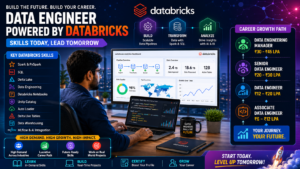
Learn about how to get started with Databricks.
Databricks is commonly implemented in two different ways, which are explored practically in SQL School’s Databricks Data Engineer Training:
- Option 1 — Open-Source Portal: Register on databricks.com with your email address (no credit card required) to use it free of charge for the rest of your life as an enterprise trial. The best way to learn about the platform and study for the Databricks Data Engineer Associate exam.
- Option 2 — Cloud Provider Integration: Deploy Databricks with Azure, AWS, or GCP for enterprise deployment and reliable support services and custom ETL techniques.
After you’ve made your account active, you just need to make sure that a Serverless Compute or SQL Warehouse is running, and you can start creating notebooks, pipelines, and workflows.
Learn Databricks with SQL School
Our Databricks Data Engineer Training is structured into 5 modules to help you learn Data Engineering skills from the ground-up and get you up to speed for your job:
- Module 1: Spark SQL & Data Warehousing
- Module 2: Python & ETL
- Module 3: PySpark & Unity Catalog
- Module 4: Create Auto Loader & Structured Data Pipelines.
- Module 5: Real-Time Projects & Resume Building
The training is delivered step-by-step, is 100% practical, and has real-time projects, job assistance, and mock interviews – all you need to be job-ready with our Databricks Data Engineer Training program.
Frequently Asked Questions
What is Databricks used for?
Databricks is the platform for data engineering, big data processing, analytics, and building and deploying models for AI/machine learning — all in one unified, cloud-based platform known as a Lakehouse.
What is Databricks Data Engineer Training?
Yes. Even for those with limited SQL or Python experience, Databricks Data Engineer Training equips you with essential skills in Spark SQL, Python, PySpark, and ETL pipeline design, all of which are highly sought-after in data engineering, analytics, and AI positions.
What are the prerequisites for Databricks Data Engineer Training?
Prior knowledge of SQL and Python is beneficial, but a solid Databricks Data Engineer Training course will cover the basics of Python and PySpark as part of the course, allowing for step-by-step learning even for users who are new to programming.
To what extent is it free to try Databricks?
Try it for free and with no credit card required at databricks.com to get started with a free, lifetime trial of the enterprise edition.
What is the next step after Databricks Data Engineer Training?
The Databricks Data Engineer Associate certification is the most widely accepted entry-level certification, demonstrating proficiency in creating ETL pipelines, working with Delta Lake tables, and orchestrating pipelines on the Databricks platform.
Conclusion
Databricks is reshaping the way organizations build, inspect and take action on data — from one cohesive Lakehouse platform. Employing powerful Apache Spark, Databricks Architecture or Medallion, and its ability to integrate with AI and BI tools, Databricks skills are soon becoming indispensable for everyone developing into a data engineer, data scientist, or analyst. From beginner to advanced, if you’re looking to get to your next role, the best way to do so is through the right Databricks Data Engineer Training course.
Looking to become job ready in Databricks? Discover SQL School’s Databricks Data Engineer Training course and embark your practical learning path now.