Data Modelling Course: Master the Art of Designing Modern Data Architectures
In the era of Artificial Intelligence, Big Data, Cloud Computing, and Business Intelligence, data has become one of the most valuable assets for every organization. However, data is only useful when it is structured, organized, and designed correctly. This is where Data Modelling plays a crucial role.
A well-designed data model acts as the blueprint of a successful database, data warehouse, analytics platform, or enterprise application. Whether you are working with SQL Server, Microsoft Fabric, Azure, Snowflake, Databricks, Oracle, or PostgreSQL, understanding Data Modelling is a fundamental skill for building scalable and high-performance solutions.
What is Data Modelling?
Data Modelling is the process of defining how data is stored, connected, accessed, and maintained within a system. It helps organizations transform business requirements into structured databases and analytics platforms.
Think of Data Modelling as the architectural plan of a building. Just as engineers create blueprints before construction begins, data professionals create data models before building databases and reporting systems.
A strong data model ensures:
- Accurate data storage
- Faster query performance
- Better reporting capabilities
- Reduced redundancy
- Improved data governance
- Scalable architecture
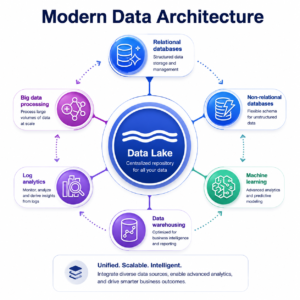
Why Data Modelling Matters in Modern Organizations
Today’s organizations rely heavily on data for decision-making. Poorly structured data often leads to:
❌ Slow reports
❌ Inconsistent information
❌ Duplicate records
❌ Difficult maintenance
❌ Poor user experience
A professionally designed data model eliminates these challenges and creates a strong foundation for enterprise systems.
Business Benefits
- Improved decision making
- Better data quality
- Faster business reporting
- Reduced operational costs
- Enhanced customer insights
Technical Benefits
- Optimized database performance
- Simplified maintenance
- Better scalability
- Easier integration across systems
- Stronger data governance
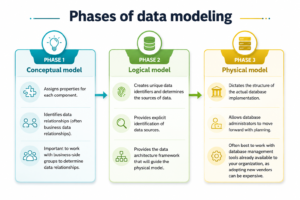
Understanding the Three Layers of Data Modelling
Conceptual Data Model
The Conceptual Model focuses on understanding business entities and their relationships without considering technical details.
Example
An E-commerce business may include:
- Customers
- Products
- Orders
- Payments
- Suppliers
This model helps business stakeholders visualize how information flows across the organization.
Logical Data Model
The Logical Model adds structure by defining:
- Attributes
- Primary Keys
- Foreign Keys
- Relationships
- Business Rules
At this stage, the model becomes more detailed and prepares the foundation for implementation.
Physical Data Model
The Physical Model translates the logical design into actual database objects such as:
- Tables
- Indexes
- Constraints
- Partitions
- Storage structures
This is the model used by database administrators and developers to create databases.
Core Concepts Covered in a Data Modelling Course
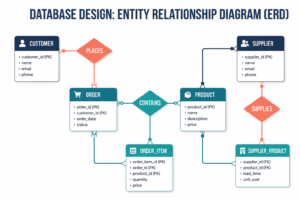
Entity Relationship Modeling (ER Modeling)
ER Modeling helps visualize relationships between business entities.
Examples include:
- Customer places Orders
- Employee works in Department
- Product belongs to Category
Understanding relationships is critical for designing reliable systems.
Data Normalization
Normalization is a technique used to reduce data redundancy and improve consistency.
Students learn:
First Normal Form (1NF)
Organize data into atomic values.
Second Normal Form (2NF)
Remove partial dependencies.
Third Normal Form (3NF)
Remove transitive dependencies.
Boyce-Codd Normal Form (BCNF)
Advanced normalization techniques.
Benefits include:
- Reduced duplication
- Better integrity
- Easier maintenance
Dimensional Modelling
Dimensional Modelling is widely used in Data Warehousing and Business Intelligence projects.
It helps businesses analyze data efficiently by organizing information into:
Fact Tables
Store measurable business data such as:
- Sales Amount
- Revenue
- Profit
- Quantity
Dimension Tables
Store descriptive information such as:
- Customer
- Product
- Region
- Date
This approach improves reporting performance significantly.
Data Modelling in Cloud and AI Platforms
Modern organizations use Data Modelling across various technologies:
| Technology | Data Modelling Usage |
|---|---|
| Microsoft Fabric | Lakehouse & Warehouse Design |
| Azure Synapse | Enterprise Data Warehousing |
| Snowflake | Analytics Architecture |
| Databricks | Medallion Data Architecture |
| SQL Server | OLTP & OLAP Solutions |
| Oracle | Enterprise Applications |
| PostgreSQL | Transactional Systems |
| Power BI | Semantic Models & Reporting |
Data Modelling is no longer limited to traditional databases. It has become an essential skill for cloud and AI-driven solutions.
Key Features of a Professional Data Modelling Course
A comprehensive Data Modelling Training program should cover:
Database Fundamentals
- Database Concepts
- Relational Databases
- Data Architecture Basics
Entity Relationship Design
- ER Diagrams
- Cardinality
- Relationship Mapping
Normalization Techniques
- 1NF
- 2NF
- 3NF
- BCNF
Dimensional Modelling
- Star Schema
- Snowflake Schema
- Fact & Dimension Design
Data Warehouse Modelling
- Kimball Methodology
- Slowly Changing Dimensions (SCD)
- Data Mart Design
Data Governance Standards
- Naming Conventions
- Documentation Standards
- Enterprise Architecture Guidelines
Real-Time Projects
- End-to-End Industry Case Studies
- Data Warehouse Design Projects
- Analytics Data Models
Advantages of Learning Data Modelling
Career Growth
Data Modelling is a high-demand skill across industries.
Popular job roles include:
- Data Modeler
- Data Engineer
- Data Architect
- Database Developer
- BI Developer
- Analytics Engineer
- Solution Architect
Who Should Learn Data Modelling?
This course is ideal for:
- SQL Developers
- Data Engineers
- Data Analysts
- ETL Developers
- Database Administrators
- Business Intelligence Professionals
- Solution Architects
- Freshers looking to build a career in Data Engineering
Future Scope of Data Modelling
As organizations continue investing in:
- Artificial Intelligence
- Machine Learning
- Cloud Computing
- Data Analytics
- Data Governance
The need for skilled Data Modelling professionals continues to grow rapidly.
Companies need experts who can design efficient, scalable, and future-ready data architectures that support modern business requirements.
Why Choose SQL School for Data Modelling Training?
✅ ISO Certified Training Institute
✅ MSME Registered Organization
✅ 20+ Years of Industry Experience
✅ Industry-Oriented Curriculum
✅ Real-Time Project Exposure
✅ Placement Assistance
✅ Resume Preparation
✅ Interview Guidance
✅ Expert Trainers from Top MNCs
Conclusion
Data Modelling is the backbone of every successful database, data warehouse, and analytics platform. Organizations can only unlock the true value of their data when it is properly structured and designed. By mastering Data Modelling, professionals gain the ability to create scalable architectures, improve business intelligence solutions, and become valuable assets in today’s data-driven world.
Whether your goal is to become a Data Engineer, Data Architect, BI Developer, or Database Professional, investing in a Data Modelling Course is one of the smartest career decisions you can make.
Data Modelling Training Course: https://sqlschool.com/data-architect/
Data Modeling Course curriculum: https://sqlschool.com/wp-content/uploads/2026/03/Latest-Data-Architect.pdf
#DataModelling #DataModelingCourse #DataArchitect #DataEngineer #DatabaseDesign #DimensionalModeling #StarSchema #SnowflakeSchema #DataWarehouse #SQLSchool #MicrosoftFabric #AzureDataEngineer #Databricks #Snowflake #BusinessIntelligence #DataAnalytics #DataArchitecture #SQLTraining #DataEngineering #DatabaseDeveloper
Trainer: Mr. Sai Phanindra
With 19+ Years of
technical expertise exclusively on SQL & Database Technologies, I assure you 100% Practical, Step by Step Classes.
Linkdin Profile: www.linkedin.com/in/saiphanindra/
Contact No: +91 9030040801 or +91 9666640801