
A Business Analyst Roadmap for 2026: Your Ultimate Guide to a Successful Career.
Whether you are interested in transitioning into business analysis or advancing current BA roles, now’s the moment to do this. The demand for proficient Business Analysts is booming, and a well-defined Business Analyst Roadmap 2026 can mean the difference between floating and sailing in this area.
What does a Business Analyst do in 2026?
A Business Analyst is the liaison between business issues and technology solutions. They listen, analyze and document and lead teams to smarter decisions. However, in 2026, the role extends well beyond writing requirements; BAs are strategic partners who shape product decisions, digital transformation initiatives, and ensure everyone is aligned.
The following characteristics are common to a modern BA:
- Good analytical and critical thinking abilities.
- Effective cross-disciplinary communication.
- Comfortable using data, tools and agile methodologies.
- The ability to think in terms of problems rather than completing tasks.
The first step is to establish a solid foundation.The first step is to create a solid base.
All great BA journeys begin with the foundations. Don’t jump it if you are a new player. This is the way it affects all subsequent projects. The Business Analyst Roadmap 2026 is about building your knowledge from ground-up instead of the tools.
Foundation skills to develop:
- Gain knowledge of scope, stakeholder and requirements, concepts of business analysis
- Understand SDLC (Software Development Life Cycle)
- Understand the principles of Agile and Scrum practices.
- Learn fundamental data literacy: interpreting data, reading reports etc.
- Work on writing clear and structured documents and emails.

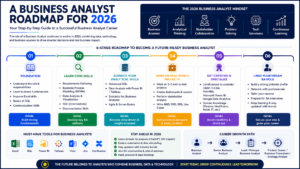
Step 2 is to start with the Core BA Tools and master them.
Information about the tools is a must-have. In 2026, employers are looking for BAs who can navigate software to facilitate current analysis workflows.
Must-know tools in 2026:
- Jira & Confluence — for agile project tracking and documentation.
- Microsoft Excel / Google Sheets (Data Analysis & Reporting)
- Whatever the case may be, these are the tools you should use for generating wireframes and UI mockups: Figma or Balsamiq.
- SQL — for accessing databases and data structures
- Tableau or Power BI — to create dashboards and visual reports
- Miro or Lucidchart — for process mapping and flowcharts
Data and Data Visualization Skills are a strong focus in the Business Analyst Roadmap 2026 as AI will make more and more data available, and it is the responsibility of the Business Analyst to get it right.
Step 3 is to get certified to stand out!
Certifications signal credibility. They inform employers that you’re dedicated and qualified. On a competitive market they create the opportunities that sometimes opportunities through experience alone cannot.
These are the highest-paying and most rewarding BA degrees to earn in 2026:
- IIBA (International Institute of Business Analysis) is an association that provides a course in ECBAs called ECBA / CCBA / CBAP.
- PMI-PBA — from Project Management Institute
- Agile BA Certification for agile related positions.
- This certificate is particularly relevant for BA positions focusing on data, such as Data Analysts at Google.
Avoid being in hurry for certifications; combine with actual practice for better value.
Step 4 — Do not be afraid of AI
AI is not taking the place of Business Analysts — it’s changing how they work. AI literacy needs to be a part of the Business Analyst Roadmap 2026. BAs with knowledge of AI tools will be able to automate repetitive tasks and concentrate on more meaningful and strategic work.
The following are some common questions related to integrating AI into your BA practice.
- Leverage AI capabilities such as ChatGPT or Copilot to create requirement documents more quickly
- Use AI-powered analytics tools to identify trends in a timely manner.
- Understand prompt engineering to get better outputs from AI tools
- Be mindful of the ethical, Bias and limitations of AI in business.
The BAs that will succeed will be those who leverage AI as a tool, and not a crutch.
Step 5 – Develop to become a specialist or senior staff member
After learning the fundamentals, it’s time to specialize. The Business Analyst Roadmap 2026 can take a wide variety of paths for your interests and business path.
Popular BA specializations in 2026:
- Product Analyst — work on product strategy and user research.
- The Data Analyst / BI Analyst will focus on metrics and dashboards to deep-dive into the data.
- IT Business Analyst — liaise closely with development teams.
- Ba roles focused on different industries and ERP systems (SAP, Salesforce)
- Business Analyst Manager (Lead Delivery) — manage a team of Business Analysts and be responsible for delivery.
Final Thoughts
But the Business Analyst Roadmap 2026 isn’t smooth sailing; it’s a voyage of discovery that is filled with challenges, opportunities, and the need for constant learning. It’s an opportunity that’s possible and available, whether you are a beginner or a transitioning career.
With your base, begin at the bottom. Learn the tools. Get certified. Embrace AI. Then develop into the 2026 market’s BA.
It’s right here, your roadmap.
Author
Trainer: Mr. Sai Phanindra
20+ Years of Industry Experience
Corporate & Porfessional Trainer
Profile: https://www.linkedin.com/in/saiphanindra
Reach me for career / resume advise: +91 9030040801
For Registrations: +91 9666440801 | +91 9666640801
www.sqlschool.com