Why Every IT Professional Should Learn DevOps in 2027
The IT industry is evolving faster than ever. Organizations are adopting cloud computing, artificial intelligence, automation, and modern software development practices to deliver applications faster and more efficiently.
In this rapidly changing technology landscape, DevOps has become one of the most valuable skills for IT professionals in 2027.
Whether you are a Software Developer, System Administrator, Database Administrator (DBA), Cloud Engineer, Data Engineer, or IT Support Professional, learning DevOps can help you expand your technical knowledge and explore new career opportunities.
DevOps is no longer limited to software development teams. It plays an important role in cloud infrastructure management, application deployment, database automation, security, monitoring, and enterprise IT operations.
In this blog, we will explore why every IT professional should learn DevOps in 2027, the essential tools to master, career opportunities, and how DevOps can help you build a successful technology career.
What Is DevOps?
DevOps is a combination of two important areas: Development (Dev) and Operations (Ops).
It is a set of practices, tools, and cultural principles that help development and IT operations teams work together to build, test, deploy, and maintain applications efficiently.
Traditionally, developers and operations teams worked separately. Developers focused on building applications, while operations teams handled deployment, servers, and infrastructure.
This separation often resulted in delays, communication gaps, and deployment issues.
DevOps solves these challenges by introducing automation, continuous integration, continuous delivery, collaboration, and continuous monitoring.
In simple words: DevOps helps organizations deliver software faster, improve application reliability, reduce manual work, and maintain stable IT environments.
Why Is DevOps Important in 2027?
The demand for faster application delivery, cloud infrastructure, automation, and secure deployments is increasing.
Organizations are moving toward modern DevOps practices to improve productivity and reduce operational complexity.
Here are the major reasons why DevOps is important in 2027.
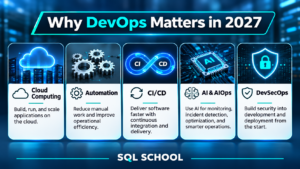
1. Increasing Demand for Cloud Computing
Cloud computing has transformed the way organizations manage their applications and infrastructure.
Companies are increasingly using cloud platforms such as:
- Microsoft Azure
- Amazon Web Services (AWS)
- Google Cloud Platform (GCP)
DevOps professionals help organizations automate cloud infrastructure, configure environments, manage deployments, and monitor applications.
Learning DevOps along with cloud platforms can create opportunities in Cloud Engineering, DevOps Engineering, and Site Reliability Engineering.
2. Automation Is Becoming Essential
Organizations want to reduce repetitive manual activities and improve operational efficiency.
DevOps introduces automation into different stages of software development and IT operations.
Examples include:
- Automated application deployment
- Infrastructure provisioning
- Automated testing
- Database deployment
- Server configuration
- Monitoring and alert management
Tools such as Jenkins, GitHub Actions, Terraform, and Ansible help automate these processes.
3. Faster Software Development and Deployment
Modern businesses cannot afford long application development and deployment cycles.
DevOps enables organizations to release software updates more frequently through Continuous Integration and Continuous Delivery (CI/CD).
With CI/CD pipelines, developers can automatically build, test, and deploy applications.
This improves development speed while helping teams identify errors earlier.
4. Growing Adoption of Artificial Intelligence
Artificial Intelligence is transforming IT operations and software delivery.
AI-powered capabilities are increasingly being used for:
- Predictive infrastructure monitoring
- Automated incident detection
- Log analysis
- Performance optimization
- Intelligent troubleshooting
- Deployment risk analysis
This evolution is contributing to practices such as AIOps and AI-assisted DevOps.
IT professionals who understand DevOps fundamentals and AI-powered automation will be better prepared for modern technology environments.
5. Better Security Through DevSecOps
Security is an essential part of modern application development.
DevSecOps integrates security practices throughout the software development and deployment lifecycle.
Instead of checking security only after development, teams introduce security testing and controls into CI/CD pipelines.
Important practices include:
- Vulnerability scanning
- Secrets management
- Access control
- Container image security
- Infrastructure security
- Compliance automation
Learning DevSecOps helps professionals understand how to build and maintain more secure applications.
Top DevOps Tools Every IT Professional Should Learn in 2027
To become a successful DevOps professional, understanding the tools used in real-time IT environments is important.
Here are some of the most widely used DevOps tools.
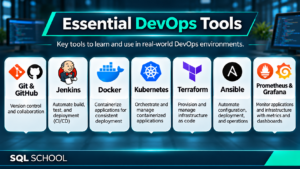
1. Git and GitHub – Version Control
Git is a distributed version control system used to track source code changes.
GitHub provides a platform for hosting repositories, managing code, collaborating with developers, and implementing automation workflows.
Important concepts:
- Git Repository
- Commit and Push
- Branching and Merging
- Pull Requests
- Conflict Resolution
- GitHub Actions
2. Jenkins – CI/CD Automation
Jenkins is an automation server widely used to build, test, and deploy applications.
It helps automate repetitive development and deployment activities.
Important concepts:
- Jenkins Installation
- Jobs and Pipelines
- Jenkinsfile
- Build Automation
- Pipeline Configuration
- Automated Deployment
3. Docker – Containerization
Docker is a containerization platform that allows applications to run consistently across different environments.
It packages applications and their dependencies into containers.
Important concepts:
- Docker Images
- Docker Containers
- Dockerfile
- Docker Volumes
- Docker Networks
- Docker Compose
4. Kubernetes – Container Orchestration
Kubernetes is an open-source container orchestration platform used to deploy, manage, and scale containerized applications.
It is especially important in modern cloud-native environments.
Important concepts:
- Pods
- Deployments
- Services
- ConfigMaps
- Secrets
- Namespaces
- Scaling and Load Balancing
5. Terraform – Infrastructure as Code
Terraform is an Infrastructure as Code (IaC) tool used to provision and manage infrastructure through configuration files.
Instead of manually creating cloud resources, engineers can automate infrastructure deployment.
Important concepts:
- Terraform Providers
- Resources
- Variables
- Outputs
- State Files
- Modules
- Infrastructure Provisioning
6. Ansible – Configuration Management
Ansible is an automation tool used for server configuration, application deployment, and infrastructure management.
It helps administrators automate repetitive infrastructure tasks.
Important concepts:
- Inventory
- Playbooks
- Modules
- Roles
- YAML Configuration
- Server Automation
7. Prometheus and Grafana – Monitoring
Monitoring is an important part of DevOps because organizations must continuously track application and infrastructure performance.
Prometheus collects and stores monitoring metrics, while Grafana helps visualize those metrics through dashboards.
Important concepts:
- Metrics Collection
- Monitoring Dashboards
- Alert Configuration
- Server Monitoring
- Application Performance
- Infrastructure Health
How DevOps Benefits Different IT Professionals
One of the biggest advantages of DevOps is that professionals from different IT backgrounds can use it to improve their existing skills.
Software Developers
Developers can learn Git, Jenkins, Docker, and CI/CD pipelines to automate application builds, testing, and deployments.
SQL Developers and Database Administrators
SQL professionals can use DevOps practices to automate database deployments, manage SQL scripts through version control, implement database CI/CD, and improve database release management.
System Administrators
System administrators can use Ansible, Terraform, and cloud automation tools to manage servers, infrastructure, and configuration.
Cloud Engineers
Cloud engineers can use DevOps tools to automate infrastructure provisioning, cloud deployments, monitoring, and resource management.
Data Engineers
Data Engineers can apply DevOps principles to data pipeline deployment, workflow automation, version control, testing, and infrastructure management.
IT Support Engineers
IT Support Engineers can expand their technical capabilities by learning scripting, automation, cloud infrastructure, monitoring, and troubleshooting.
DevOps vs Traditional IT Operations
| Traditional IT Operations | Modern DevOps |
|---|---|
| Manual deployments | Automated deployments |
| Separate development and operations teams | Collaborative teams |
| Manual infrastructure setup | Infrastructure as Code |
| Limited release frequency | Frequent releases |
| Manual testing | Automated testing |
| Reactive monitoring | Continuous monitoring |
| Manual configuration | Automated configuration management |
DevOps helps organizations move from manual and disconnected processes toward automated, collaborative, and reliable IT operations.
DevOps Career Opportunities in 2027
Learning DevOps can help IT professionals explore different career paths depending on their existing experience and technical knowledge.
Some popular career roles include:
- DevOps Engineer
- Azure DevOps Engineer
- AWS DevOps Engineer
- Cloud Engineer
- Site Reliability Engineer (SRE)
- Platform Engineer
- DevSecOps Engineer
- Infrastructure Automation Engineer
- Kubernetes Administrator
- CI/CD Engineer
The responsibilities and required skills vary across organizations. Practical experience with cloud platforms, automation, CI/CD, containers, and monitoring can help candidates prepare for these roles.
DevOps Learning Roadmap for Beginners in 2027
If you are planning to start your DevOps journey, follow a structured learning roadmap.
Step 1: Learn Linux Fundamentals
Understand Linux commands, file permissions, users, processes, services, and shell scripting.
Step 2: Learn Git and GitHub
Understand version control, repositories, branching, merging, and collaboration.
Step 3: Learn CI/CD
Practice automated builds, testing, and deployments using Jenkins or GitHub Actions.
Step 4: Learn Docker
Understand containerization, images, containers, volumes, and networking.
Step 5: Learn Kubernetes
Practice container orchestration, deployments, services, scaling, and application management.
Step 6: Learn Cloud Platforms
Choose a cloud platform such as Microsoft Azure, AWS, or Google Cloud and understand its infrastructure services.
Step 7: Learn Terraform and Ansible
Practice infrastructure provisioning and configuration management.
Step 8: Learn Monitoring and Security
Understand Prometheus, Grafana, logging, alerting, vulnerability scanning, and DevSecOps fundamentals.
Step 9: Work on Real-Time Projects
Build practical projects that combine version control, CI/CD, containers, cloud infrastructure, and monitoring.
Real-Time DevOps Projects to Build Your Skills
Practical experience is essential to understanding how DevOps works in real-world environments.
Here are some projects you can practice:
Project 1: Automated Application Deployment
Build a CI/CD pipeline using GitHub and Jenkins to automatically build and deploy a sample application.
Project 2: Docker-Based Application Deployment
Containerize an application using Docker and deploy it in a consistent environment.
Project 3: Kubernetes Application Management
Deploy a containerized application using Kubernetes and configure services, scaling, and health checks.
Is DevOps a Good Career Choice for Experienced IT Professionals?
Yes. DevOps can be a valuable skill addition for experienced IT professionals who want to expand their technical responsibilities.
For example:
- SQL DBAs can move toward database automation and DevOps practices.
- System Administrators can explore cloud and infrastructure automation.
- Developers can improve their application deployment skills.
- Cloud Engineers can specialize in CI/CD and infrastructure management.
- Data Engineers can automate data pipeline deployment and operations.
However, learning DevOps does not automatically convert existing experience into DevOps work experience. Professionals should gain practical knowledge and build relevant project experience before applying for specialized roles.
Why Choose SQL School for DevOps Learning?
At SQL School Training Institute, we focus on practical, industry-oriented technical training designed to help students and working professionals improve their IT skills.
Our training approach emphasizes:
- 100% practical and interactive training
- Step-by-step technical explanations
- Hands-on assignments and exercises
- Real-time project experience
- Scenario-based learning
- Trainer guidance and doubt clarification
- Resume guidance and interview preparation
- 100% Placement Assistance
Our goal is to help learners understand technical concepts through practical implementation and prepare for real-world IT responsibilities.
Final Thoughts: Make DevOps Your Next Career Skill in 2027
DevOps is transforming how organizations develop applications, manage cloud infrastructure, automate deployments, and maintain IT systems.
In 2027, professionals who understand cloud computing, automation, CI/CD, containerization, infrastructure as code, monitoring, and security will have valuable skills for modern technology environments.
Whether you are a fresher or an experienced IT professional, learning DevOps can help you strengthen your technical foundation and explore new career opportunities.
Don’t limit your career to traditional IT skills. Upgrade your knowledge, learn modern DevOps tools, and build practical experience to stay relevant in the evolving IT industry.
DevOps Training: https://sqlschool.com/devops/
Start Your DevOps Learning Journey with SQL School!
Want to build practical DevOps skills and prepare for modern IT career opportunities?
Join SQL School Training Institute and learn through practical sessions, assignments, and real-time projects.
📞 Contact: +91 9666440801 / +91 9951440801
🌐 Website: https://sqlschool.com/
Take the next step toward your technology career in 2027!
#DevOps2027 #DevOpsTraining #LearnDevOps #AzureDevOps #AWSDevOps #Docker #Kubernetes #CloudComputing #CICD #SQLSchool #ITCareer #DevOpsEngineer
