
SQL Server Interview Questions: The Complete Guide to Crack Your Next Interview
If you are aiming for a database position, then you’ve gone through the trouble of searching SQL Server Interview Questions more than once. These questions are used by recruiters in data engineering, jobs and DBA and analytics positions to assess theoretical knowledge as well as hands-on problem solving. For a fresher and a working professional changing their domain, having an idea about the pattern of SQL Server Interview Questions at each level can be a deciding factor between rejection and an offer letter. Here are the most frequently asked questions, why they’re being asked and how to position your responses to get your interviewers attention.
What is the reason behind the focus of interviewers on SQL Server?
SQL Server is one of the most popular relational database platforms in enterprises and is a subject of intense testing by recruiters. It’s not about syntax; it’s about knowing how to use indexing, optimize queries and how to handle transactions in real production scenarios. That’s why SQL Server Interview Questions can involve more than just SELECT statements: execution plans, deadlocks, and stored procedure design are just some of the topics covered. A candidate who’s able to convey the reasoning behind a question, rather than just the steps, makes an instant impression. That’s why structured training with a mentor is often more effective than random preparation from YouTube videos; the follow-up questions in real interview panels that go beyond what from mere videos one can get ready are what it is all about.
SQL Server Interview Questions for Beginners
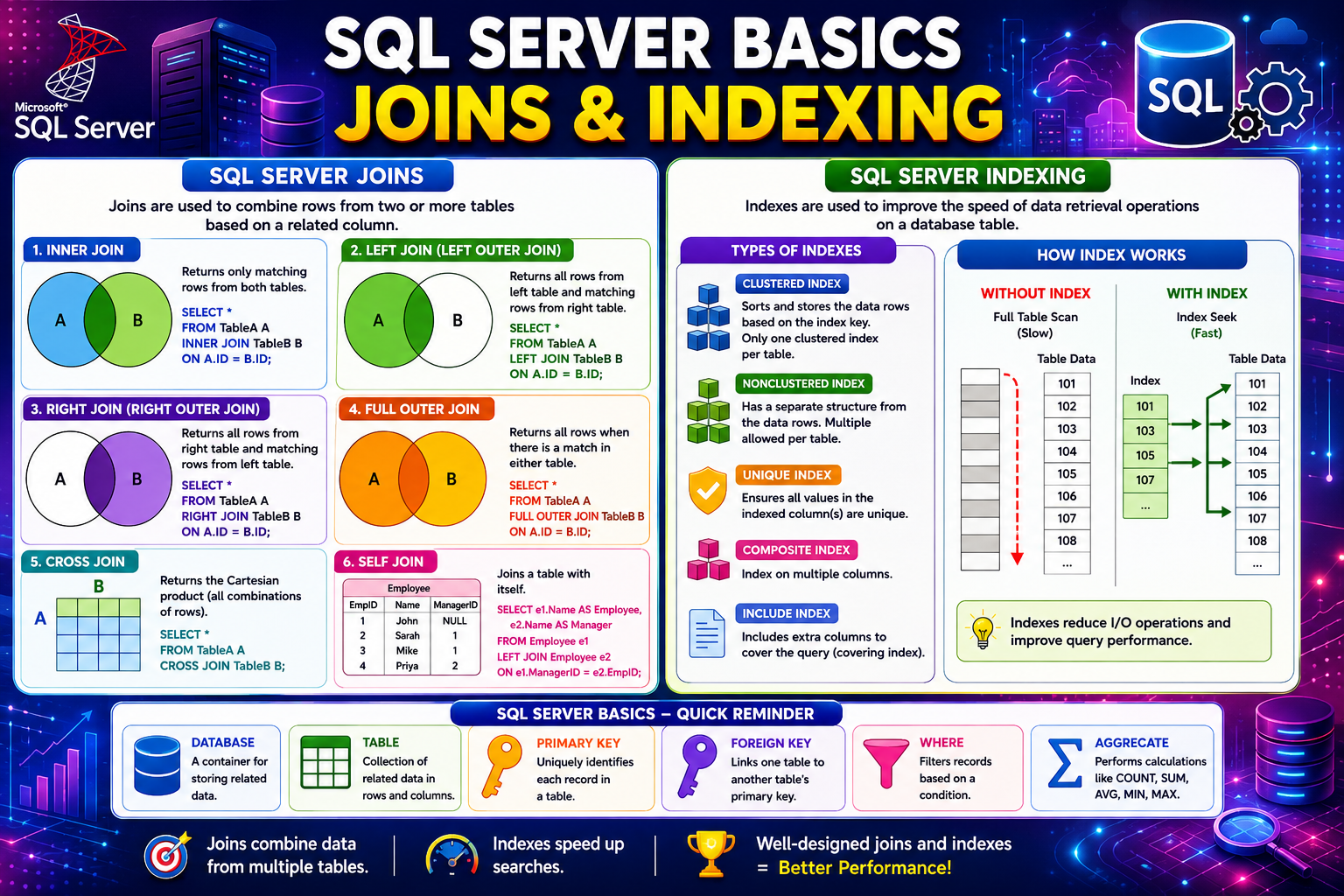
On the basic level, you should learn some of the concepts: difference between DELETE, TRUNCATE, and DROP; primary key vs unique key; clustered index vs non-clustered index; and joins (INNER, LEFT, RIGHT, FULL, self). Most interview questions asked to any fresher for SQL Server revolves around these. It would be helpful to have a basic understanding of normalization (1NF, 2NF, 3NF) as well as how to write simple subqueries. A lot of interviewers will ask you to write a query while you are being interviewed, you should prepare for this, or write it while it is happening, however it is preferable to not just be in theory learning how to write a query, you should learn to write one while using an actual SQL server instance. Frequent errors are using WHERE in place of HAVING, or omitting to check for the presence of one value but the presence of another value is zero is needed (e.g. using = in place of IS NULL).
Intermediate-Advanced Questions
After 2 or 3 years a person becomes more into SQL Server Performance and Architecture related SQL Server Interview Questions.
- Be ready to ask and answer questions, questions which involve: When a non-cluster index is improving or worsening performance;
- When a non-cluster index is impacting performance; How to read and interpret an execution plan; How to locate and resolve a deadlock;
- How to develop an efficient procedure along with proper error detection and subsequent treatment (TRY…CATCH). Also, you might be asked about isolation level, transaction locking, CTEs vs temp tables vs table variables, window functions—ROW_NUMBER(), RANK(), LEAD(), and LAG.
- Common topics for discussion at senior level involve query tuning – how would you resolve a slow-running report and what tools would you employ? (SQL Profiler, Extended Events, DMVs).
- Sometimes it’s more valuable as a frequent process rather than the definitions themselves; to be able to walk someone through a real troubleshooting scenario, step by step, is more valuable than reciting definitions.
Questions can be asked on the basis of DBA and Scenarios.
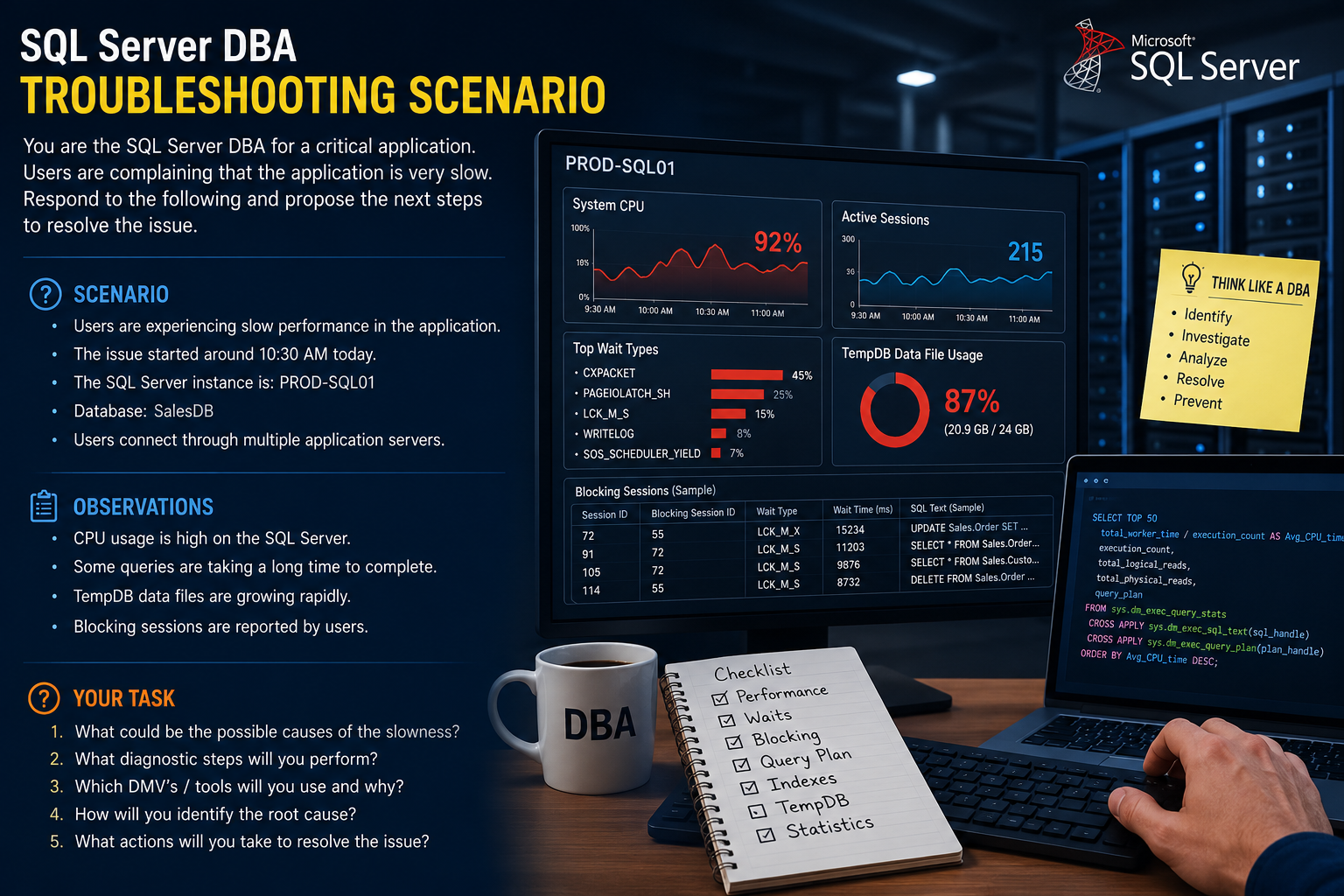
In the case of a Database Admin position the interview questions has become more inclusive of backup/recovery, replication, Always On Availability Groups, index maintenance and security (roles permissions, encryption). Common questions here are ones based on typical scenarios: “Well, a production database that may have 30,000 rows in it is filling up at 2 AM — what is the first thing you look at to figure it out?” or “You’ve got a report that takes about 5 seconds to run and now it takes 5 minutes — walk me through what you do first. These questions are about judging in circumstances much more than technical recall. It will be useful to make a help sheet of typical problems and to practice verbalizing your answer.
The Art of Being Ready: Strategies for College Writing Classes
To have a good idea about how to prepare for sql server interview questions is not the memorization but a repeated hands on practice with real dataset and real production style problems of sql server. The intuition that interviewers develop during the first few minutes of the interview practice, is developed in mock interviews, timed query-writing, and review of a server performed actual plan. While courses that mix theory and lab work like the Microsoft SQL Server, T-SQL, DBA training courses, give candidates a chance to progress from “I know the syntax” to “I can justify my design decisions. In case you’re really taking center stage on the wall in the event you want to definitely crush interview efforts with products companies or solutions firms, creating a collection of practice inquiries and trouble shooting notes will bring your resume to the forefront of examination.
SQL Server Performance Tuning Interview Questions
- What causes slow queries?
- How do indexes improve performance?
- What is Query Execution Plan?
- Explain Statistics.
- What is Parameter Sniffing?
- How do you identify blocking?
- Explain Deadlocks.
- Difference between Scan and Seek.
Real-Time SQL Server Interview Questions
- A query suddenly became slow. How would you troubleshoot it?
- How do you optimize a table with 50 million records?
- How do you find duplicate records?
- How do you delete duplicates safely?
- Explain deadlock troubleshooting.
- How do you monitor blocking?
- How would you migrate a production database?
- How do you recover deleted records?
Frequently Asked Questions
1. What are the most commonly asked SQL Server Interview Questions for freshers?
Freshers are usually asked about joins, keys, normalization, basic DML/DDL commands, and simple query writing involving GROUP BY, ORDER BY, and subqueries.
2. How do I answer SQL Server performance tuning questions?
Explain your process: check the execution plan, identify missing or unused indexes, look at statistics, and consider query rewriting before suggesting hardware or configuration changes.
3. Are SQL Server Interview Questions different for DBA versus developer roles?
Yes. Developer interviews focus more on query writing, stored procedures, and joins, while DBA interviews emphasize backup/recovery, replication, security, and server maintenance.
4. How much practice is needed before an SQL Server interview?
Most candidates benefit from at least 4–6 weeks of consistent hands-on practice, including writing queries on real datasets and reviewing common scenario-based questions.
5. Do interviewers ask about T-SQL specifically?
Yes, T-SQL (Transact-SQL) questions covering stored procedures, functions, triggers, and error handling are a standard part of most SQL Server interviews.
