Databricks Interview Questions Every Data Engineer Must Know – Complete Interview Preparation Guide (2026)
Introduction
Databricks has become one of the most in-demand technologies for modern Data Engineering. Companies such as Microsoft, Accenture, Deloitte, TCS, Infosys, Cognizant, Capgemini, Wipro, and many startups are actively hiring Azure Databricks and Databricks Data Engineers.
If you’re preparing for a Data Engineering interview, simply knowing Apache Spark isn’t enough. Interviewers expect practical knowledge of Databricks architecture, Delta Lake, data pipelines, optimization techniques, Unity Catalog, Medallion Architecture, and real-time data processing.
In this blog, we’ll cover the most important Databricks interview questions, explain each topic in detail, and help you understand what interviewers are really looking for.
YouTube Link:- https://www.youtube.com/watch?v=VFjoAE-Rang
Why Companies Prefer Databricks?
Databricks is a unified analytics platform built on Apache Spark that helps organizations process massive amounts of data efficiently.
Major advantages include:
- Faster data processing
- Unified Data Analytics
- Delta Lake support
- Machine Learning integration
- AI-powered analytics
- Collaborative notebooks
- Cloud-native platform
- Auto-scaling clusters
- High performance using Photon Engine
These capabilities make Databricks a common focus in Data Engineer interviews.
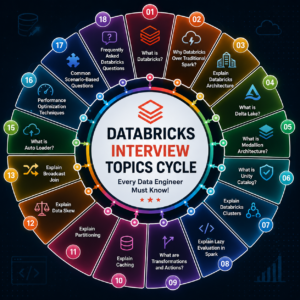
Interview Topic 1: What is Databricks?
Interview Question
Explanation
Databricks is a cloud-based unified analytics platform developed by the creators of Apache Spark.
It combines:
- Data Engineering
- Data Science
- Machine Learning
- Data Analytics
- Business Intelligence
Into one collaborative workspace.
Expected Answer
Databricks simplifies big data processing using Apache Spark while providing Delta Lake, collaborative notebooks, workflow automation, and scalable cloud computing.
Interview Topic 2: Why Databricks Over Traditional Spark?
Interview Question
Why should organizations use Databricks instead of Apache Spark?
Explanation
Apache Spark requires significant manual cluster management.
Databricks automates:
- Cluster creation
- Auto Scaling
- Job Scheduling
- Monitoring
- Optimization
- Collaboration
Interviewers often expect candidates to explain these operational advantages rather than only Spark syntax.
Interview Topic 3: Explain Databricks Architecture
The architecture generally consists of:
Control Plane
- Notebook management
- Cluster management
- User authentication
- Job scheduling
Data Plane
- Spark clusters
- Worker nodes
- Driver node
- Data processing
Cloud Storage
- Azure Data Lake
- AWS S3
- Google Cloud Storage
Interviewers usually ask candidates to explain how data flows between these components.
More details:- https://www.youtube.com/watch?v=VFjoAE-Rang
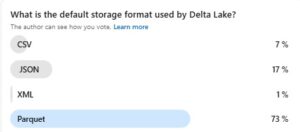
Interview Topic 4: What is Delta Lake?
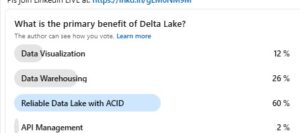
This is one of the most frequently asked Databricks interview questions.
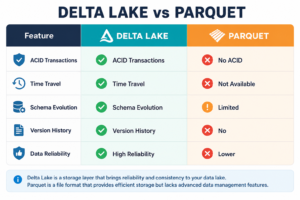
Delta Lake Features
- ACID Transactions
- Data Versioning
- Time Travel
- Schema Enforcement
- Schema Evolution
- Data Reliability
Why It Matters
Traditional data lakes often suffer from data corruption and inconsistency.
Delta Lake solves these issues while improving performance and reliability
Interview Topic 5: What is Medallion Architecture?
One of the most popular architecture questions.
Bronze Layer
Raw data
↓
Silver Layer
Cleaned and validated data
↓
Gold Layer
Business-ready analytical data
Interviewers often ask candidates to explain the purpose of each layer and when transformations occur. Community reports also show Medallion Architecture is among the most repeated Databricks topics.
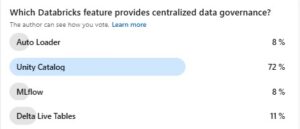
Interview Topic 6: What is Unity Catalog?
Unity Catalog provides centralized governance.
It manages:
- Users
- Permissions
- Security
- Data Lineage
- Access Control
- Metadata
Interviewers frequently ask why Unity Catalog is preferred over older access-control methods because governance has become a major enterprise requirement.
More details:- https://www.youtube.com/watch?v=VFjoAE-Rang
Interview Topic 7: Explain Databricks Clusters
Different cluster types include:
All-Purpose Cluster
Used for development
Job Cluster
Created automatically for scheduled jobs
Single Node Cluster
Best for learning
High Concurrency Cluster
Supports multiple users simultaneously
Understanding when to use each cluster type demonstrates practical experience.
Interview Topic 8: Explain Lazy Evaluation in Spark
Spark does not execute transformations immediately.
Instead:
- Transformations are recorded.
- Execution begins only when an action is triggered.
Examples:
Transformations
- select()
- filter()
- join()
- groupBy()
Actions
- show()
- collect()
- count()
- write()
Interview Topic 9: What are Transformations and Actions?
Transformations
Create a new DataFrame without executing immediately.
Examples:
- filter()
- select()
- join()
- withColumn()
Actions
Trigger execution.
Examples:
- show()
- display()
- collect()
- write()
More details:- https://www.youtube.com/watch?v=VFjoAE-Rang
Interview Topic 10: Explain Caching
Caching stores frequently used datasets in memory.
Benefits:
- Faster execution
- Reduced recomputation
- Better performance
Interviewers may ask when to use cache () versus persist ().
Interview Topic 11: Explain Partitioning
Partitioning divides large datasets into smaller chunks.
Advantages:
- Parallel processing
- Better scalability
- Faster execution
Good partitioning improves Spark performance significantly.
Interview Topic 12: Explain Data Skew
Data skew occurs when one partition contains much more data than others.
Solutions include:
- Salting
- Broadcast joins (when appropriate)
- Better partition keys
- Adaptive Query Execution (AQE)
These optimization topics appear regularly in experienced Data Engineer interviews.
More details:- https://www.youtube.com/watch?v=VFjoAE-Rang
Interview Topic 13: Broadcast Join
Broadcast Join sends a small table to all worker nodes.
Advantages:
- Faster joins
- Reduced shuffling
- Better performance
Use it when one table is significantly smaller than the other.
Interview Topic 14: What is Auto Loader?
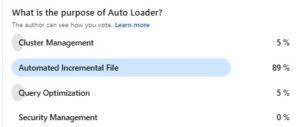
Auto Loader is used for incremental file ingestion.
Advantages:
- Detects new files automatically
- Supports streaming ingestion
- Efficient for cloud storage
- Reduces manual effort
Interview Topic 15: Difference between Delta Table and Parquet
Interview Topic 16: Performance Optimization Techniques
Interviewers often ask:
“How do you optimize Databricks jobs?”
Possible answers:
- Partitioning
- Caching
- Broadcast Join
- Z-Ordering
- Photon Engine
- Adaptive Query Execution
- Auto Optimize
- Delta Optimize
- File Compaction
Interview Topic 17: Common Scenario-Based Questions
Scenario 1
Your Spark job is running slowly.
How would you troubleshoot it?
Expected discussion:
- Review Spark UI
- Check skew
- Examine partitions
- Inspect joins
- Optimize transformations
Scenario 2
Millions of small files are affecting performance.
Possible solutions:
- OPTIMIZE
- Auto Compaction
- Delta Lake maintenance
Scenario 3
How do you load incremental data?
Possible approaches:
- Auto Loader
- Change Data Capture (CDC)
- MERGE INTO
- Delta Lake versioning
Interview Topic 18: Frequently Asked Databricks Questions
- What is Apache Spark?
- Explain Databricks Architecture.
- What is Delta Lake?
- What is Unity Catalog?
- What is Medallion Architecture?
- Difference between cache() and persist().
- Difference between repartition() and coalesce().
- What is Photon Engine?
- Explain Data Skew.
- Explain Broadcast Join.
- What is Auto Loader?
- Explain Spark DAG.
- Difference between Batch and Streaming.
- Explain Delta Tables.
- Explain MERGE INTO.
- Explain OPTIMIZE and VACUUM.
- What is Time Travel?
- Explain ACID Transactions.
- Difference between Cluster Modes.
- How do you improve Spark performance?
Databricks Interview Preparation Tips
To maximize your chances of success:
- Practice SQL coding every day.
- Strengthen your PySpark fundamentals.
- Understand Delta Lake concepts deeply.
- Learn Medallion Architecture with examples.
- Gain hands-on experience with Unity Catalog.
- Practice real-time ETL pipelines.
- Explore Spark UI and optimization techniques.
- Build projects using Azure Databricks or Databricks Community Edition.
Industry interview guides consistently emphasize practical problem-solving, architecture discussions, and performance tuning over memorizing definitions.
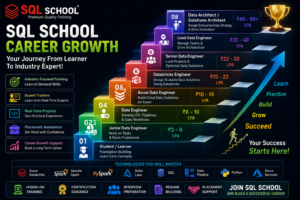
Why Choose SQL School for Databricks Training?
SQL School offers a structured Databricks learning path designed to prepare learners for real-world Data Engineering roles.
Highlights
Industry-focused curriculum
- Live instructor-led sessions
- Hands-on Databricks projects
- Apache Spark & PySpark training
- Delta Lake implementation
- Azure Databricks labs
- Performance tuning techniques
- Interview-focused preparation
- Resume building
- Mock interviews
- Placement assistance
- Lifetime learning support
Conclusion
Databricks has become one of the most valuable skills for modern Data Engineers. Interviewers increasingly evaluate practical knowledge of Spark optimization, Delta Lake, Unity Catalog, Medallion Architecture, ETL design, and production-ready data pipelines—not just theoretical definitions. By mastering these topics and practicing real-world scenarios, you’ll be well prepared for Data Engineering interviews and capable of building scalable, enterprise-grade data solutions.
Why Choose SQL School
SQL School Training Institute is committed to helping students and professionals build successful careers in Data Engineering through practical, industry-focused learning. Our Databricks training program is designed to bridge the gap between theoretical knowledge and real-world implementation, ensuring you are job-ready from day one.
Industry-Focused Curriculum
Learn the latest technologies including Azure Databricks, Apache Spark, Delta Lake, PySpark, Spark SQL, ETL pipelines, Medallion Architecture, Unity Catalog, and real-world Data Engineering concepts aligned with current industry requirements.
Experienced Industry Trainers
Learn from certified professionals with extensive real-time project experience who provide practical insights, interview strategies, and best practices used by leading organizations.
Hands-on Real-Time Projects
Work on enterprise-level projects involving data ingestion, transformation, Delta Lake implementation, workflow automation, performance optimization, and cloud-based data pipelines.
Practical Cloud Lab Experience
Gain hands-on experience using Azure Databricks, cloud storage services, notebooks, clusters, workflow automation, and modern Data Engineering tools in a live environment.
Interview Preparation
Prepare confidently with frequently asked Databricks interview questions, mock interviews, scenario-based discussions, resume-building guidance, and technical assessment practice.
Flexible Learning Options
Choose from weekday, weekend, or fast-track batches with live instructor-led sessions, recorded videos, and lifetime access to learning resources for continuous improvement.
Placement Assistance
Receive dedicated career support including resume optimization, LinkedIn profile enhancement, interview scheduling assistance, career counseling, and job referrals to help you secure your desired role.
Continuous Learning Support
Even after course completion, you’ll have access to updated study materials, new interview questions, technical sessions, and ongoing mentor support to stay current with evolving technologies.
Conclusion
Databricks has become one of the most sought-after skills in modern Data Engineering, powering scalable data pipelines, advanced analytics, and AI-driven solutions across industries. Mastering Databricks, Apache Spark, Delta Lake, and cloud-based data engineering concepts can significantly boost your career opportunities.
At SQL School Training Institute, we don’t just teach technology—we help you build practical expertise through real-time projects, hands-on labs, expert mentorship, and comprehensive interview preparation. Whether you’re a beginner or an experienced IT professional looking to advance your career, our Databricks training equips you with the skills and confidence needed to succeed in today’s competitive job market.
Learn with SQL School. Build Real Projects. Crack Interviews. Become a Successful Data Engineer.
#Databricks #AzureDatabricks #DataEngineering #DataEngineer #ApacheSpark #PySpark #SparkSQL #DeltaLake #BigData #CloudDataEngineering #DataPipeline #ETL #ELT #DataLake #Lakehouse #UnityCatalog #MedallionArchitecture #PerformanceOptimization #SQL #Python #Azure #MicrosoftAzure #CloudComputing #DataAnalytics #AnalyticsEngineering #InterviewQuestions #DatabricksInterview #DataEngineerInterview #TechInterview #CareerGrowth #JobReady #Learning #SQLSchool #SQLSchoolTrainingInstitute
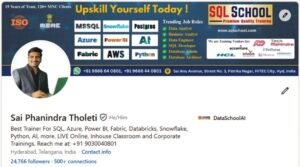
Trainer: Mr. Sai Phanindra
With 20+ Years
Follow us daily for more updates!
WhatsApp Channel: https://whatsapp.com/channel/0029VamSJLI35fLmVEvCPD3r
WhatsApp Job Updates : https://whatsapp.com/channel/0029Vb2LI8zG3R3dWqv5jS1T
Instagram : https://www.instagram.com/sqlschool__training
YouTube : www.youtube.com/sequelschool
Trainer Profile : www.linkedin.com/in/saiphanindra
Website : www.sqlschool.com
Reach Us: +919951440801 | +919666440801
