Snowflake Data Engineer Course: Learn Modern Data Warehousing in 2026
In today’s data-driven world, organizations rely on scalable and cloud-based platforms to manage massive datasets. One of the most powerful platforms leading this transformation is Snowflake—a modern cloud data platform designed for analytics, AI, and data engineering.
A Snowflake Course helps learners master cloud data warehousing, data pipelines, and analytics using real-world tools. This blog explains features, importance, tools, components, and advantages of Snowflake to help you understand why it’s a top career choice in 2026.
What is Snowflake?
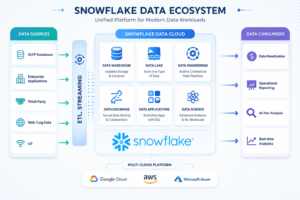
Snowflake is a cloud-native data platform that enables organizations to store, manage, analyze, and share data at scale. It combines data warehousing, data lakes, analytics, and AI workloads into a single unified system.
Unlike traditional databases, Snowflake separates compute and storage, allowing independent scaling and better performance.
Importance of Learning Snowflake
Why Snowflake is in High Demand:
- Growing Data Industry – Companies rely heavily on cloud analytics
- Multi-Cloud Support – Works on AWS, Azure, and GCP
- Real-Time Data Processing – Faster insights and decision-making
- AI & ML Integration – Supports modern AI workloads
- High-Paying Jobs – Roles like Data Engineer, Data Analyst, Cloud Engineer
Learning Snowflake opens doors to top careers in Data Engineering & Analytics
Key Features of Snowflake
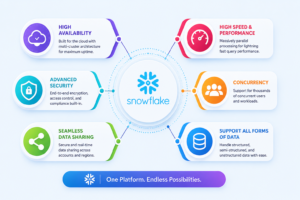
1. Separation of Compute & Storage
- Independent scaling improves performance and cost efficiency
2. Elastic Scalability
- Automatically scale resources up or down as needed
3. Secure Data Sharing
- Share live data across organizations without duplication
4. Multi-Cloud Support
- Works across AWS, Azure, and Google Cloud
5. Near-Zero Maintenance
- Fully managed platform with auto-scaling and tuning
6. Support for All Data Types
- Handles structured, semi-structured, and unstructured data
Snowflake Architecture & Components
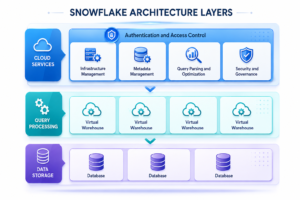
Snowflake architecture consists of three main layers:
1. Database Storage Layer
- Stores data in optimized formats
- Supports large-scale data storage
2. Query Processing Layer (Compute Layer)
- Uses Virtual Warehouses to process queries
- Enables parallel processing
3. Cloud Services Layer
- Manages authentication, metadata, optimization, and security
This architecture ensures high performance, scalability, and flexibility.
Tools & Technologies Used in Snowflake
A Snowflake course covers integration with various tools:
Data Integration Tools
- Apache Airflow
- Informatica
- Talend
BI & Visualization Tools
- Tableau
- Power BI
- Looker
Programming & Query Languages
- SQL
- Python (Snowpark)
- Java & Scala
Cloud Platforms
- AWS
- Microsoft Azure
- Google Cloud
Snowflake connects easily with external tools, making it highly flexible.
Advantages of Snowflake
1. High Performance
- Fast query execution with parallel processing
2. Cost Efficiency
- Pay only for what you use (consumption-based pricing)
3. Easy to Use
- No hardware or infrastructure management
4. Data Collaboration
- Share data securely across teams and organizations
5. Strong Security
- Built-in encryption, RBAC, and governance features
6. Supports AI & Advanced Analytics
- Enables machine learning and predictive analytics
What You Will Learn in a Snowflake Course
A complete Snowflake training typically includes:
- Introduction to Cloud & Data Warehousing
- Snowflake Architecture & Concepts
- SQL for Snowflake
- Data Loading & Transformation
- Performance Optimization
- Data Security & Governance
- Real-time Projects
Career Opportunities After Snowflake Course
After completing a Snowflake course, you can apply for roles like:
- Snowflake Data Engineer
- Data Analyst
- Cloud Data Engineer
- Business Intelligence Developer
Snowflake professionals are highly in demand across industries like finance, healthcare, e-commerce, and IT.
Frequently Asked Questions (FAQs)
What is Snowflake used for?
Snowflake is used for data warehousing, analytics, data sharing, and AI workloads.
Is Snowflake easy to learn?
Yes, especially if you have basic knowledge of SQL and cloud concepts.
Who should learn Snowflake?
Data analysts, data engineers, BI developers, and cloud professionals.
Does Snowflake require coding?
Basic SQL is required; advanced roles may use Python or Java.
Is Snowflake a good career in 2026?
Yes, it is one of the most in-demand cloud data skills with high salary potential.
Conclusion
Snowflake has revolutionized how organizations handle data by providing a fully managed, scalable, and secure cloud platform. Its ability to unify data warehousing, analytics, and AI makes it a critical skill for modern data professionals.
Enrolling in a Snowflake Course in 2026 is a smart step toward building a successful career in data engineering, analytics, and cloud computing.
#Snowflake #SnowflakeCourse #SnowflakeTraining #SnowflakeDataCloud #CloudDataWarehouse #DataEngineering #DataAnalytics #CloudComputing #BigData #DataEngineer #LearnSnowflake #DataEngineerCareer #AnalyticsCareer #TechSkills #ITCourses #OnlineLearning #CareerGrowth #FutureSkills #DataJobs #Upskill #CloudTechnology #DataArchitecture #AIData
Snowflake Training Course: https://sqlschool.com/snowflake-data-engineer-training/
Trainer: Mr. Sai Phanindra
With 20+ Years
of technical expertise exclusively on SQL & Database Technologies, I assure you 100% Practical, Step by Step Classes.
Linkdin Profile: www.linkedin.com/in/saiphanindra/
Contact No: +91 9030040801 or +91 9666640801
