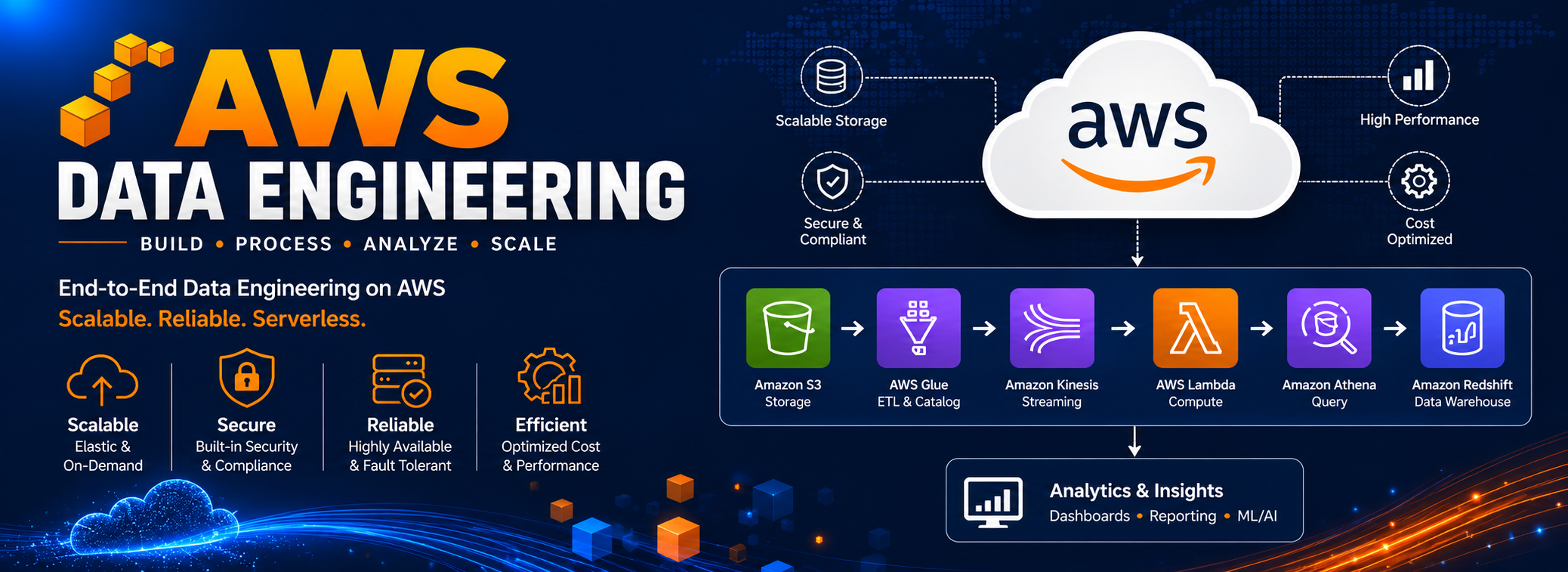
Master AWS Data Engineering skills to build scalable cloud data pipelines and modern analytics solutions.
Beyond SQL & Python: 10 AWS Data Engineering Skills That Matter
Building a successful career in cloud data engineering requires more than learning individual programming languages. It requires understanding how cloud storage, distributed computing, automation and analytics work together.
Discover the essential AWS technologies that help data engineers build scalable, reliable and business-ready data solutions.
Why AWS Data Engineering Skills Matter
Every modern organization generates information through applications, customer transactions, websites, APIs, financial systems and connected devices.
The challenge is not simply storing this information. Organizations need reliable systems to collect, transform, validate and deliver data for business intelligence, analytics and AI applications.
AWS provides a collection of cloud services that allow data engineers to build these systems without managing every component of the underlying infrastructure.
Cloud Data Platforms
Build scalable storage and analytical environments for enterprise workloads.
Automated Pipelines
Process new data using scheduled, incremental and event-driven workflows.
Business Analytics
Convert raw information into reliable datasets for reporting, analytics and decision-making.
SQL, Python & Linux – The Core Foundation
Before working with advanced AWS services, every data engineer should develop strong programming and operating system fundamentals.
SQL
Query relational databases, join datasets, apply business rules and validate analytical results.
Python
Develop ETL scripts, automate cloud operations and implement reusable processing logic.
Linux
Manage files, execute scripts, work with permissions and troubleshoot cloud environments.
- SQL joins, aggregations, CTEs and window functions.
- Python functions, collections and file processing.
- Exception handling and data validation.
- Linux commands and file permissions.
- Amazon RDS and relational database connectivity.
Amazon S3 – The Foundation of a Cloud Data Lake
Amazon Simple Storage Service (S3) is an object storage service used to store application files, transactional datasets, logs, documents and analytical data.
In data engineering, S3 commonly acts as the central storage layer for data ingestion, transformation and analytics.
Amazon S3 Data Lake Architecture
- S3 buckets, objects and prefixes.
- CSV, JSON, Parquet and compressed data formats.
- Storage classes and lifecycle policies.
- Versioning and replication.
- Partitioning strategies for analytical datasets.
- AWS CLI and Python SDK integration.
s3://company-data-lake/
    raw/
        customers/
        orders/
        payments/

    processed/
        validated_orders/
        clean_customers/

    curated/
        sales_summary/
customer_analytics/AWS Glue – Serverless ETL & Data Integration
AWS Glue is a managed data integration service that helps engineers discover, catalog and transform data for analytical workloads.
Instead of maintaining dedicated ETL servers, engineers can use Glue to execute supported transformation workloads using managed compute.
Glue Crawlers
Discover data schemas and update metadata in the Data Catalog.
Glue Data Catalog
Maintain centralized metadata about datasets, schemas and tables.
Glue ETL Jobs
Execute data cleaning, filtering, aggregation and transformation logic.
AWS Glue ETL Workflow
- Glue Crawlers and Data Catalog.
- Visual ETL and script-based transformations.
- PySpark-based Glue jobs.
- Job bookmarks and incremental processing.
- Glue triggers and workflows.
- IAM permissions and job monitoring.
Apache Spark & PySpark – Big Data Processing
Traditional processing methods may become inefficient when handling large datasets. Apache Spark provides distributed processing capabilities that allow supported workloads to run across multiple computing resources.
PySpark allows engineers to develop Spark transformations using Python. AWS Glue and Amazon EMR are examples of AWS services that support Spark workloads.
Key Skills to Learn:- Spark architecture and distributed computing.
- RDD transformations and actions.
- DataFrames and Spark SQL.
- Filtering, joins and aggregations.
- Partitioning and performance optimization.
- Structured Streaming fundamentals.
Practical PySpark Example
Read sample order data from an S3 location, calculate total sales revenue and write the result in Parquet format.
from pyspark.sql import SparkSession
from pyspark.sql.functions import col, sum

spark = SparkSession.builder \
    .appName("SalesAnalytics") \
    .getOrCreate()

orders = spark.read.csv(
    "s3://your-training-bucket/raw/orders/",
    header=True,
    inferSchema=True
)

clean_orders = orders.filter(
    (col("quantity") > 0) &
    (col("unit_price") >= 0)
)

sales = clean_orders.withColumn(
    "revenue",
    col("quantity") * col("unit_price")
)

summary = sales.groupBy("product").agg(
    sum("revenue").alias("total_revenue")
)

summary.write.mode("errorifexists").parquet(
    "s3://your-training-bucket/curated/sales-summary/"
)Amazon Athena – Query Data Without Managing Servers
Amazon Athena allows users to query supported datasets in Amazon S3 using SQL. It integrates with the AWS Glue Data Catalog to access information about registered datasets.
Athena is especially useful for exploratory analytics, data validation, log analysis and querying data lake files.
Athena queries S3 data using cataloged metadata.
Sample Athena SQL Query
SELECT
    product,
    SUM(quantity) AS units_sold,
    SUM(quantity * unit_price) AS total_sales

FROM ecommerce.orders

WHERE order_date >= DATE '2026-01-01'

GROUP BY product

ORDER BY total_sales DESC;
This query assumes that the orders table is already registered in the Data Catalog with compatible numeric and date column types.
Key Skills to Learn:- Athena databases and external tables.
- Glue Data Catalog integration.
- Partitioned tables and CTAS queries.
- Query performance and scan optimization.
- Data validation and analytical SQL.
Amazon Redshift – Enterprise Data Warehousing
Amazon Redshift is a cloud data warehouse designed for analytical SQL workloads. It helps organizations consolidate business information and perform complex analytical queries.
Data engineers use Redshift to build structured reporting environments, dimensional models and curated enterprise datasets.
Fact Tables
Store measurable business transactions, including sales amounts, quantities, payments and transaction counts.
Dimension Tables
Store descriptive business information, such as customers, products, dates and geographical locations.
Example: Retail Sales Star Schema
- Redshift architecture and deployment options.
- SQL queries and analytical operations.
- Data loading from Amazon S3.
- Distribution styles and sort keys.
- Fact tables and dimension tables.
- Performance tuning and workload monitoring.
AWS Lambda – Event-Driven Automation
AWS Lambda allows developers to execute supported code in response to events without managing application servers.
Data engineers commonly use Lambda for lightweight processing, file validation, notifications and triggering other AWS services.
Event-Driven Data Pipeline
Example: Trigger a Glue Job
import boto3

glue = boto3.client("glue")

def lambda_handler(event, context):

    response = glue.start_job_run(
        JobName="sales-etl-job"
    )

    return {
        "status": "Job Started",
        "job_run_id": response["JobRunId"]
    }
This illustrative function starts an existing Glue job. The Lambda execution role must have permission to start that specific job.
Amazon Kinesis – Real-Time Data Streaming
Not every business can wait for a daily batch-processing schedule. Some applications generate information continuously and require timely processing.
Amazon Kinesis Data Streams supports continuous ingestion of event data, while Amazon Data Firehose can deliver streaming records to supported destinations.
E-Commerce
Process customer clicks, cart activity and online transaction events.
Banking
Ingest transaction events for timely monitoring and analysis.
IoT & Applications
Collect device events, sensor readings and application activity logs.
Streaming Data Engineering Architecture
- Batch versus streaming architecture.
- Kinesis producers and consumers.
- Streaming capacity and partition keys.
- Amazon Data Firehose delivery streams.
- Streaming transformations and buffering.
- Event validation and monitoring.
Workflow Orchestration – Step Functions & Airflow
Enterprise pipelines often contain multiple dependent operations. Data ingestion must complete before transformation, and validation must succeed before publishing analytical results.
Workflow orchestration tools coordinate these dependencies, execution schedules, retries and failure-handling mechanisms.
AWS Step Functions
Coordinate AWS services using state-machine workflows, branching logic and error handling.
- Service integrations.
- Sequential and parallel execution.
- Retries and failure handling.
- Workflow execution visibility.
Apache Airflow
Define scheduled data workflows using Python-based directed acyclic graphs (DAGs).
- DAGs and task dependencies.
- Pipeline scheduling.
- Task retries and alerts.
- Integration with AWS services.
Data Pipeline Task Dependencies
Security, Monitoring & Cost Optimization
Building a working data pipeline is only one part of a data engineer's responsibility. Production systems must also be secure, observable, reliable and cost-efficient.
AWS IAM
Manage access permissions for users, roles, applications and cloud services.
- IAM roles and policies.
- Least-privilege access.
- Service permissions.
Amazon CloudWatch
Monitor supported AWS workloads, collect logs and configure alerts.
- Application logs.
- Metrics and alarms.
- Pipeline troubleshooting.
Cost Optimization
Design workloads with appropriate resource usage and operational efficiency.
- Storage lifecycle policies.
- Efficient query patterns.
- Budget alerts and resource cleanup.
- Encrypt sensitive data using appropriate controls.
- Use IAM roles rather than hardcoded credentials.
- Keep S3 buckets private unless public access is required.
- Monitor failed ETL jobs and pipeline delays.
- Validate data quality before publishing results.
- Implement retries and duplicate-processing safeguards.
- Track cloud resource consumption and costs.
Move From Learning Technologies to Building Solutions
Learn how AWS services work together through practical demonstrations, hands-on exercises and an end-to-end data engineering project.
How These Technologies Work Together
Understanding individual AWS services is important, but the ability to combine them into an end-to-end solution is what makes data engineering skills valuable.
End-to-End AWS Data Engineering Architecture
Which AWS Service Should You Use?
A common challenge for beginners is understanding when to use each cloud service. The following comparison summarizes typical use cases.
| Technology | Primary Purpose | Industry Use Case |
|---|---|---|
| Amazon S3 | Object storage | Enterprise data lake |
| AWS Glue | Data integration and ETL | Automated data transformation |
| PySpark | Distributed processing | Large-scale data transformations |
| Amazon Athena | Serverless SQL queries | Analyze cataloged S3 datasets |
| Amazon Redshift | Cloud data warehousing | Enterprise analytical workloads |
| AWS Lambda | Event-driven compute | File validation and ETL triggers |
| Amazon Kinesis | Streaming ingestion | Live application events |
| Step Functions | Workflow coordination | Multi-service pipeline execution |
| Apache Airflow | Data workflow orchestration | Scheduled data pipelines |
| CloudWatch | Logs and monitoring | Pipeline failure detection |
| AWS IAM | Identity and access management | Secure cloud service access |
Watch Practical Data Engineering Videos
Explore the following video resources to understand modern data engineering concepts and practical AWS pipeline implementation.
Building a Data Pipeline on AWS
Explore practical integration of Amazon S3, AWS Lambda, Glue and CloudWatch.
External educational resource: Learn by Doing IT.Data Engineering with AI – Industry Use Cases
Explore broader data engineering and AI concepts through Azure, Fabric, Databricks and PySpark.
SQL SCHOOL educational resource. Not an AWS-specific tutorial.Real-World Application: Retail Data Engineering on AWS
Consider an online retail organization that receives customer information, product updates and thousands of order transactions from multiple systems.
The organization needs an automated analytical platform to monitor sales, product demand, customer behavior and regional performance.
E-Commerce Sales Analytics Platform
Business Requirements
- Collect customer, product and order records.
- Store source data in Amazon S3.
- Validate and transform files using AWS Glue.
- Identify missing values and duplicate transactions.
- Calculate sales revenue and business metrics.
- Build curated reporting datasets.
- Monitor failures and pipeline execution.
Expected Business Outcomes
This illustrative project demonstrates why modern data engineering requires multiple complementary technology skills rather than expertise in only one cloud service.
What Should You Learn First?
Instead of attempting to learn every AWS service at once, follow a structured skill-development path.
Build Your Foundation
- SQL and database concepts.
- Python programming.
- Linux fundamentals.
- AWS Cloud and IAM.
Build Data Pipelines
- Amazon S3.
- AWS Glue.
- Apache Spark and PySpark.
- Amazon Athena.
Build Enterprise Solutions
- Amazon Redshift.
- Lambda and Kinesis.
- Step Functions and Airflow.
- Monitoring and real-time projects.
Career Opportunities with AWS Data Engineering Skills
AWS Data Engineering skills can complement existing experience in SQL, Python, ETL, cloud computing and business intelligence. Depending on your experience and practical proficiency, you can explore the following career opportunities.
AWS Data Engineer
Build and maintain scalable data pipelines using AWS cloud services.
Cloud ETL Developer
Develop automated data integration and transformation solutions.
PySpark Developer
Develop distributed data processing and analytical transformations.
Data Warehouse Developer
Build cloud analytical databases and enterprise data models.
Big Data Engineer
Process large datasets using distributed computing technologies.
Analytics Engineer
Build reliable and structured datasets for analytics and reporting teams.
Who Should Develop These Skills?
- Freshers interested in cloud and data careers.
- SQL and Database Developers.
- Python Developers.
- ETL and Data Warehouse Professionals.
- Data Analysts planning a career transition.
- Database Administrators exploring cloud engineering.
- Experienced Data Engineers looking to learn AWS.
Important AWS Data Engineering Interview Questions
Test your understanding of the key technologies with these commonly relevant interview concepts.
1. What is the difference between Amazon S3 and Redshift?
Amazon S3 is an object storage service, while Amazon Redshift is a cloud data warehouse designed for analytical SQL workloads.
2. What is the purpose of AWS Glue Crawlers?
Crawlers discover metadata and schemas from supported data sources and update the AWS Glue Data Catalog.
3. What is the difference between Athena and Redshift?
Athena provides serverless querying of supported datasets, commonly in S3. Redshift provides a data warehouse environment for analytical workloads.
4. Why is PySpark used in data engineering?
PySpark allows developers to perform distributed data transformations using Python and Apache Spark.
5. What is an incremental data load?
Incremental loading processes new or changed data instead of repeatedly processing the complete dataset.
6. How does Lambda support data engineering?
Lambda can respond to supported events, validate incoming files, trigger ETL jobs and perform lightweight processing operations.
7. What is the purpose of Amazon Kinesis?
Kinesis Data Streams supports continuous ingestion of streaming events from applications, devices and other producers.
8. What is a DAG in Apache Airflow?
A directed acyclic graph represents workflow tasks and their execution dependencies without cycles.
9. How can Athena query costs be optimized?
For scan-based pricing, use appropriate partitions, compressed columnar formats and selective queries to reduce the amount of data scanned.
10. How do you monitor AWS data pipelines?
Use service-specific execution information, CloudWatch logs, metrics and alarms to track failures, performance and pipeline health.
Learn AWS Data Engineering at SQL SCHOOL
SQL SCHOOL's AWS Data Engineering training focuses on developing practical cloud data engineering skills through structured technical learning and real-world implementation scenarios.
Expert-Led Training
Learn through technical demonstrations and structured practical sessions.
Hands-On Learning
Practice SQL, Python, PySpark and essential AWS services.
End-to-End Project
Understand how cloud services work together in a complete data pipeline.
Batch & Streaming
Explore scheduled and event-driven data processing architectures.
Interview Preparation
Develop technical knowledge and project explanation skills.
Career Assistance
Explore learning roadmaps, resume support and professional career resources.
Technologies Covered in the AWS Training
Frequently Asked Questions
Is coding required for AWS Data Engineering?
SQL and Python are valuable foundational skills. Engineers also benefit from PySpark, scripting and workflow automation knowledge.
Can SQL Developers become AWS Data Engineers?
Yes. SQL knowledge provides a useful foundation. Developers should extend their skills into cloud storage, ETL, Python, distributed processing and workflow orchestration.
Is AWS Glue sufficient for data engineering?
Glue is an important integration service, but complete data engineering solutions also require storage, analytics, security, monitoring and orchestration skills.
Do I need to learn both Athena and Redshift?
Learning both helps you understand serverless data lake queries and cloud data warehouse workloads. Actual requirements depend on the architecture and job role.
Which certification is relevant to AWS Data Engineers?
AWS Certified Data Engineer – Associate is specifically focused on data engineering knowledge and skills. Review the official certification page for current exam requirements.
Can freshers learn AWS Data Engineering?
Yes. Freshers can start with SQL, Python, database concepts and cloud fundamentals before progressing to advanced AWS services.
Does SQL SCHOOL provide a free demo?
Contact SQL SCHOOL to receive the latest free demo schedule, training curriculum and batch information.
Explore Related Data Engineering Courses
AWS Data Engineer
Build cloud data pipelines using S3, Glue, Python, PySpark and Redshift.
View Course Details →Azure Data Engineer
Explore Microsoft Azure data integration, cloud storage and analytical processing.
View Course Details →Databricks Data Engineer
Learn Spark, PySpark, Delta Lake and modern lakehouse architecture.
View Course Details →Snowflake Data Engineer
Explore cloud data warehousing, modern transformations and Cortex AI.
View Course Details →Microsoft Fabric Data Engineer
Develop unified data engineering and analytical platform skills.
View Course Details →Python Programming
Strengthen your programming and data processing foundation.
View Course Details →Prepare for Your Next IT Career Opportunity
SQL SCHOOL IT JOB DESK
Explore professional career development services and IT job opportunities through SQL SCHOOL's dedicated career portal.
- FREE Career Guidance.
- Professional Resume Review.
- Technical Mock Interviews.
- LinkedIn Profile Optimization.
- Real-Time Project Guidance.
- Professional Resume Services.
Conclusion: Build Skills, Not Just Cloud Knowledge
The real value of AWS Data Engineering comes from combining multiple technologies to solve practical business problems.
A strong foundation in SQL, Python and PySpark, combined with Amazon S3, Glue, Athena, Redshift, Lambda, Kinesis and orchestration tools, can help you develop a comprehensive cloud data engineering skill set.
As you prepare for your next career opportunity, focus on building practical projects, understanding architecture, explaining technical decisions and developing reliable data processing solutions.
Ready to Build Your Career in AWS Data Engineering?
Master AWS Cloud, SQL, Python, PySpark, S3, Glue, Athena, Redshift and modern data engineering technologies.
Expert-Led LIVE Training
Hands-On Practical Sessions
End-to-End Project & Career Preparation
SQL SCHOOL
Expert Training. Career Success.
