#SQL Python Snowflake

Master SQL, Python & Snowflake with SQL School’s industry-focused training program and build strong skills in T-SQL, Python Analytics, Cloud ETL, and Data Warehousing through hands-on labs and end-to-end real-time projects, preparing you for job opportunities in Data Analytics, Data Engineering, and Cloud Data Technologies.

Training Highlights

✅ 100% Practical & Hands-On Training
✅ SQL Server (MSSQL) & T-SQL
✅ Python Concepts & Data Analytics
✅ Snowflake Cloud ETL & Data Warehousing
✅ Azure Cloud Data Ingestion & Python Transformations
✅ Automated Data Pipelines & Big Data Implementations
✅ End-to-End Healthcare Real-Time Project
✅ Resume, Interview & Certification Guidance

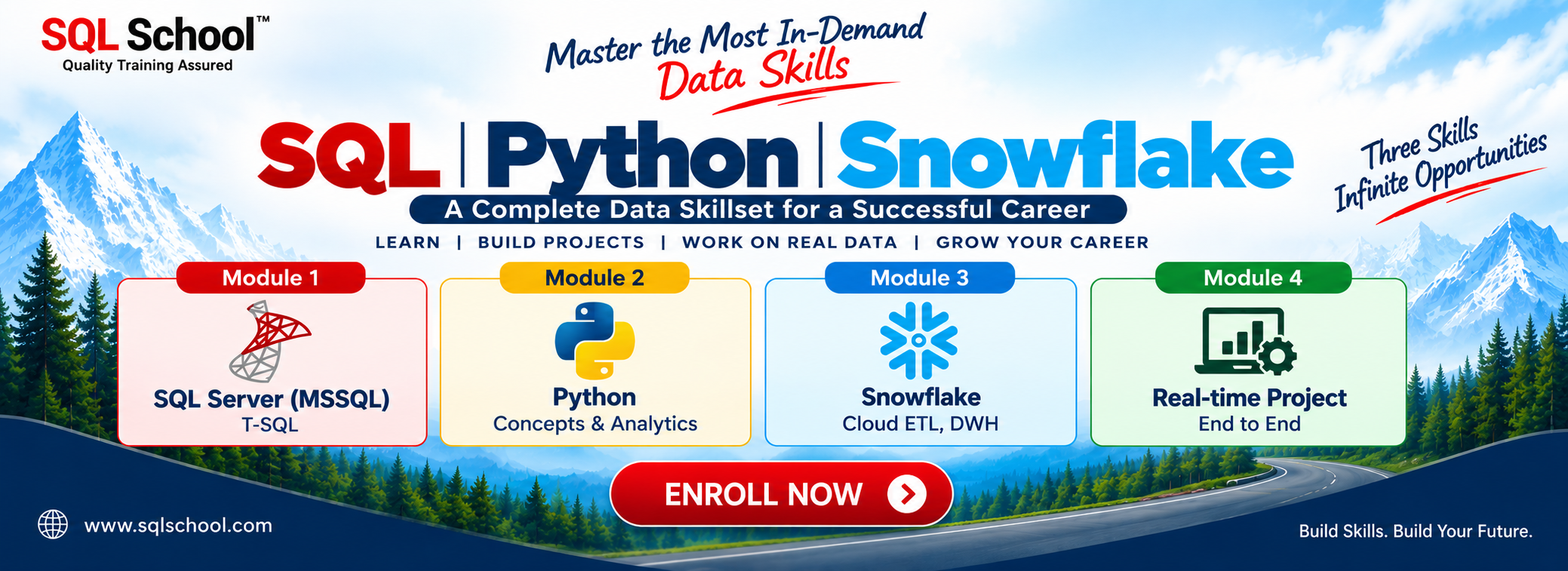
Modules We Learn:

✅ Module 1: SQL Server (MSSQL), T-SQL
✅ Module 2: Python Concepts & Analytics
✅ Module 3: Snowflake (Cloud ETL, DWH)
✅ Module 4: Real-time Project (End to End)
Snowflake Developer
Course Contents:

Module 1: Snowflake (SQL, Cloud DWH, ETL, Big Data)

Ch 1: SQL Database Job Roles

  • Introduction to Data
  • Database Intro, Types
  • OLTP, DWH, OLAP
  • DBMS Concepts
  • Data Analyst Job Roles

Ch 2: Database Intro & Installations

  • SQL Server Installations
  • Instance Concepts
  • Authentication Types
  • Authentication Modes
  • SSMS Tool Installation
  • Connections, Authentications

Ch 3: SQL Basics V1 (Commands)

  • Creating Databases (GUI)
  • Creating Tables, Columns (GUI)
  • SQL Basics (DDL, DML, etc..)
  • Creating Databases, Tables
  • Data Inserts (GUI, SQL)
  • Basic SELECT Queries

Ch 4: SQL Basics V2 (Commands, Operators)

  • DDL: Create, Alter, Drop, Add
  • DML: Insert, Update, Delete
  • DQL: Select, Fetch
  • SQL Operators
  • Special Operators

Ch 5: Data Imports, Schemas

  • Data Imports with Excel
  • Order By with WHERE
  • TOP & OFFSET
  • UNION, UNION ALL
  • Schemas: Creation, Usage
  • Real-world Banking Database
  • 2 Part, 3 Part & 4 Part Naming

Ch 6: Data Types & Variables

  • Integer Data Types
  • Character, MAX Data Types
  • Decimal & Money Data Types
  • Boolean & Binary Data Types
  • Date and Time Data Types
  • Variables in SQL

Ch 7: Constraints, Keys & RDBMS

  • Null, Not Null Constraints
  • Unique Key Constraint
  • Primary Key Constraint
  • Foreign Key & References
  • Default Constraint & Usage
  • DB Diagrams & ER Models

Ch 8: Normal Forms & ERD

  • Normal Forms: 1 NF, 2 NF
  • 3 NF, BCNF and 4 NF
  • Self Referencing Keys
  • Database Diagrams

Ch 9: Joins Queries – Level 1

  • Joins: Table Comparisons
  • Inner Join & Outer Joins
  • Cross Join & Cross Apply
  • Table & Column Aliases
  • 3 Table, 4 Table Joins

Ch 10: Joins Queries – Level 2

  • Group By & Aggregations
  • Joins with Group By
  • Join Queries with Aliases
  • WHERE & HAVING
  • Sub Queries
  • Query Execution Order

Ch 11: Views & Data Analytics

  • Views: Realtime Usage
  • Storing SELECT in Views
  • DML, SELECT with Views
  • RLS: Row Level Security
  • Important System Views

Ch 12: Stored Procedures – Level 1

  • Stored Procedures: Realtime Use
  • Procedures with SELECT
  • System Stored Procedures
  • Metadata Access with SPs
  • Stored Procedures, Tuning

Ch 13: Stored Procedures – Level 2

  • Merge Statement
  • Upsert Operations with Merge
  • Merge with OLTP & DWH
  • Matched and Not Matched
  • Merge Statement inside SPs

Ch 14: Functions in TSQL

  • Using Defined Functions (UDF)
  • Scalar Functions in Real-world
  • Table Valued Functions
  • Parameterized Queries
  • Returns and Return

Ch 15: Window Functions, CTE

  • Date & Time Functions
  • String Functions
  • Window (Rank) Functions
  • Rank, Row_Number
  • CTEs & Data Cleanisng

Ch 16: Triggers & Automations

  • Need for Triggers in Real-world
  • DDL & DML Triggers
  • For / After Triggers
  • Instead Of Triggers
  • Memory Tables with Triggers
  • Disabling DMLs & Triggers

Ch 17: Transactions & ACID

  • Transaction Concepts in OLTP
  • Auto Commit Transaction
  • Explicit Transactions
  • COMMIT, ROLLBACK
  • Lock Hints & Query Blocking
  • READPAST, LOCKHINT

Ch 18: Indexes Basics, Tuning

  • Indexes & Tuning
  • Clustered Index, Primary Key
  • Non Clustered Index & Unique
  • Composite Keys, Query Optimizer
  • Composite Indexes & Usage

Ch 19: Cursors & Temp Tables

  • IIF(), CASE Statement
  • Cube( ) and Rollup( )
  • Grouping( ) & Usage
  • Local & Global Temp Tables
  • SELECT..INTO Statement

Ch 20: Realtime Case Studies (HealthCare Datasets)

Module 2: Advanced SQL Concepts

Ch 1: Advanced Snowflake Procedures

  • Snowflake with MERGE
  • Complex Procedures, Executions
  • Return Values, Loops & JavaScript

Ch 2: Snowflake Functions

  • String, Window Functions
  • NULL Handling Functions, DECODE
  • Aggregate, Numeric, Array Functions

Ch 3: Handling Semi-Structured Data

  • JSON, ARRAY, OBJECT
  • VARIANT, FLATTEN, PARSE_JSON
  • TRY_PARSE_JSON Options

Ch 4: Data Modeling

  • Star & Snowflake Schemas
  • Dimension Tables, Fact Tables
  • Dimension Modeling, Optimizations

Ch 5: SCD Concepts

  • SCD Type 1 Implementations
  • SCD Type 2 Implementations
  • Real-Time Issues, Solutions

Ch 6: CDC Concepts

  • Change Data Capture with Snowflake
  • Version Tracking & DML Operations
  • DDL History, Incremental Loads

Ch 7: Dynamic Tables

  • Change Data Capture with Snowflake
  • Version Tracking & DML Operations
  • DDL History, Incremental Loads

Ch 8: Advanced SQL in Snowflake

  • Data Management, Data Handling
  • Query Optimizations, Query Handling
  • Query Routines & Stream Audits
  • ETL & ETL Operations, Streamlit

Ch 9: Git Integrations

  • Git Account, Projects & Branches
  • GitHub Integrations
  • Change Management with Snowflake

Module 3: Python ETL, Snowpark

Ch 1: Python Introduction, Installations

  • Python Introduction
  • Python Versions
  • Anaconda Web
  • Jupyter Notebooks, IDE

Ch 2: Python Concepts

  • print(), display()
  • Variable Declarations
  • Variable Rules
  • Common Value Variables

Ch 3: Python Operators

  • Arithmetic, String Operators
  • Bitwise, Comparison Operators
  • Binary Operators
  • Indexing Operators

Ch 4: Python Data Types

  • Integer, Float
  • String Data Types
  • Type Casting
  • Type Identification
  • Lists, Dictionaries, Tuples

Ch 5: Python Control Statements

  • if…else Conditions
  • if…elif…else, range()
  • Shorthand if
  • in & Negation Operators

Ch 6: Python Loops

  • For Loop, Range
  • While Loop
  • Exit Conditions
  • Break, Continue, Pass

Ch 7: DataFrame Transformations

  • Pandas DataFrame
  • Concat, Merge
  • dropna(), fillna() Functions

Ch 8: Snowpark Concepts

  • Snowpark Concepts
  • Architecture and Benefits
  • Connections to Snowflake

Ch 9: Snowpark Operations

  • Snowpark Python Libraries
  • Snowpark DataFrames
  • DataFrame Operations

Ch 10: Snowpark Transformations

  • Select, Filter, Sort, GroupBy
  • Joins, Aggregations, Window Functions
  • Handling NULL Values, Duplicates & Data Types
  • Read, Write Snowflake Tables

Ch 11: Snowpark Python Functions & Advanced Processing

  • Built-in Snowpark Functions and Expressions
  • Creating Python User-Defined Functions (UDFs)
  • User-Defined Table Functions (UDTFs)
  • Python Stored Procedures Using Snowpark
  • Exception Handling, Logging and Debugging

Ch 12: Building ETL Pipelines Using Snowpark

  • Extracting and Loading Data into Snowflake
  • Building ETL/ELT Pipelines with Snowpark Python
  • Incremental Data Loading and CDC Concepts
  • Automating Pipelines Using Snowflake Tasks
  • Performance Optimization and Best Practices

Module 4: Real-time Projects

Real-Time Project 1: E-Commerce Domain

  • Project Planning and ETL, ELT Requirements
  • Snowflake Deployments, Accounts & Security
  • Data Flow Artifacts, Tasks, Automations
  • Snowflake Datasets, Data Engineering Solutions
  • GitHub Integrations, Azure Integrations & Power BI
  • Resume Points, Interview FAQs and Answers

Technologies: Snowflake | Azure | Power BI

Real-Time Project 2: Finance / Accounting / Healthcare Domain

  • Defining Project and AI Requirements
  • Project Setup, Snowflake Development Concepts
  • Project Deployment & Monitoring
  • ETL, ELT with Advanced Snowflake (SnowSQL)
  • Solution Explanation, Interview FAQs and Answers

Technologies: Snowflake | Advanced SQL | Python ETL | Snowpark

Key Features of this 100% Practical Snowflake Training Course

  • Data Ingestion from Azure/AWS
  • Advanced SQL Concepts, Snowpark & Python ETL
  • SQL Optimizations and Monitoring
  • Scripting and Scheduled Data Pipelines

Learning Outcomes

Our Snowflake Developer Training is designed to take learners from core concepts to real-world, job-ready implementation.

By the end of the training, participants will be able to:

  • Design and Build End-to-End Snowflake Data Pipelines
  • Implement ETL/ELT and Data Warehousing Solutions
  • Explore Snowflake with PySpark Capabilities
  • Work Confidently on Real-Time, Industry-Oriented Projects
  • Prepare for SnowPro Certification
  • Strengthen Resume, Project Presentation and Interview Skills

BUILD REAL SKILLS. WORK ON REAL PROJECTS. BECOME JOB READY.

What will I learn in this course?

You will learn SQL Server & T-SQL, Python Concepts & Analytics, Snowflake Cloud ETL/DWH, and complete an end-to-end real-time project.

Who can join this course?

The course is suitable for Analysts, Developers, Administrators, IT Professionals, and Students.

Is this course practical or theory-based?

It is designed as 100% hands-on training, with practical implementations and real-time projects.

What real-time project will I work on?

You will work on a Healthcare Patient & Clinical Analytics Project, using SQL, Python, and Snowflake to process and analyze healthcare data.

What Python skills are covered?

The course covers Python fundamentals plus Pandas DataFrames, NumPy, SQL database access, data transformations, data cleaning, functions, and file handling.


What Snowflake concepts will I learn?

You will learn Cloud DWH, Snowflake architecture, warehouses, tables, Time Travel, cloning, security, Streams, Tasks, stages, SnowPipe, and incremental data loading.

Which job roles can I target after learning these skills?

Relevant roles include Snowflake Developer, Cloud ETL & DWH Developer, Snowflake Data Engineer, and Snowflake BI Developer.

Does the course include career and interview support?

Yes. The training includes resume guidance, interview FAQs, mock interviews, certification guidance, and career support.

Demo Videos

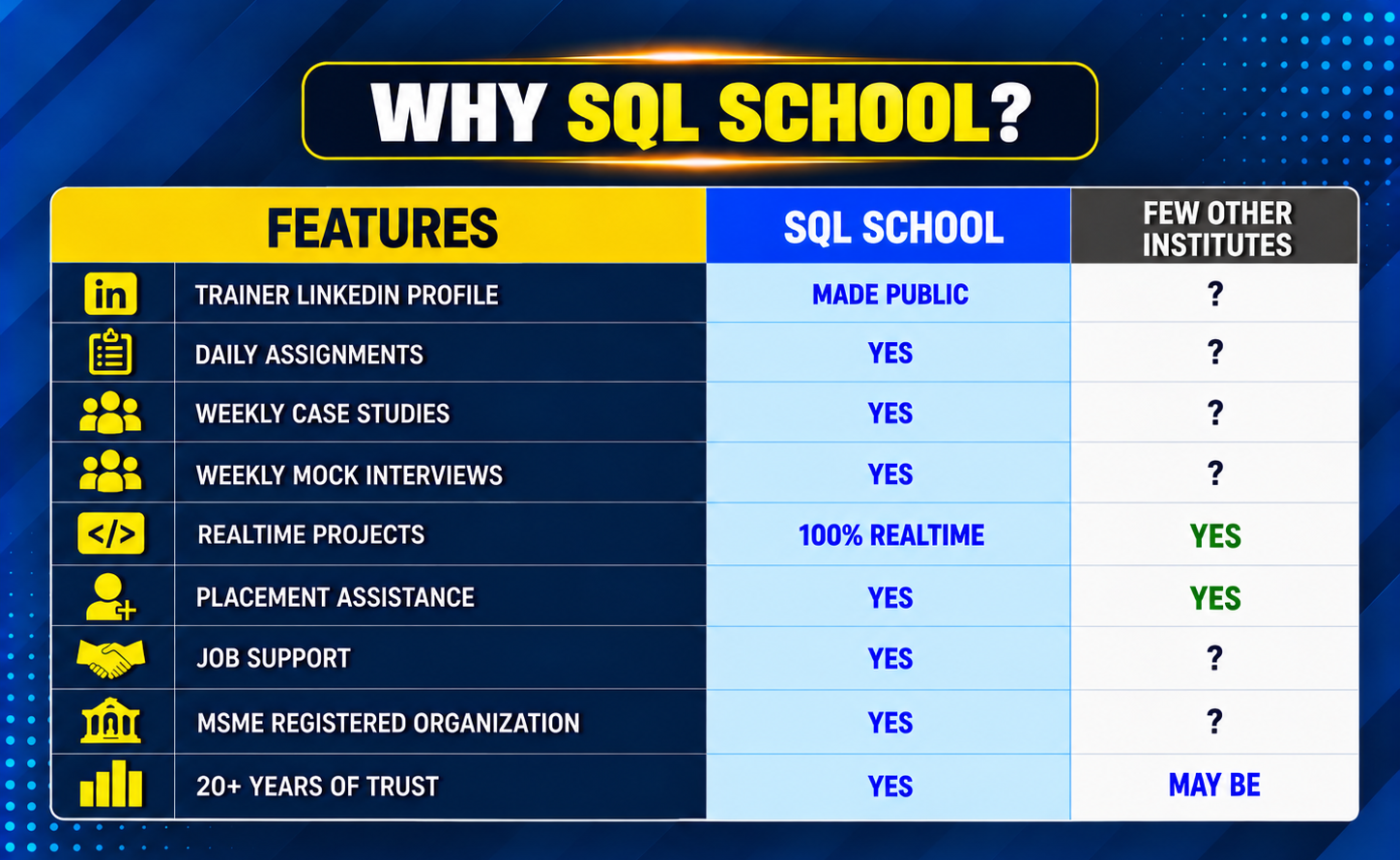
Why SQL SCHOOL?

Training Modes

Why Choose SQL School

  • 100% Real-Time and Practical
  • ISO 9001:2008 Certified
  • Concept wise FAQs
  • TWO Real-time Case Studies, One Project
  • Weekly Mock Interviews
  • 24/7 LIVE Server Access
A man smiling and giving a thumbs up while holding a notebook.
  • Realtime Project FAQs
  • Course Completion Certificate
  • Placement Assistance
  • Job Support
  • Realtime Project Solution
  • MS Certification Guidance

SQL School Fabric Data Engineer training certificate of completion issued in January 2026 with verification ID