
Azure Data Engineering with Genie AI: What You Will Learn in 2026
The data engineering industry is undergoing a significant transformation with the adoption of cloud computing, big data technologies, and Artificial Intelligence. Organizations are processing enormous amounts of information every day, creating a growing demand for professionals who can build scalable data pipelines and intelligent data platforms.
Microsoft Azure and Databricks have become important technologies in modern data engineering. With the introduction of AI-powered capabilities such as Databricks Genie and Genie Code, data professionals can explore new ways to interact with data, generate code, develop workflows, and improve productivity.
But what exactly will you learn when combining Azure Data Engineering with Genie AI?
In this comprehensive guide, we will explore the essential technologies, practical concepts, AI capabilities, data engineering architecture, and real-world projects that can help you develop the skills required for modern Data Engineering roles.
The Evolution of Data Engineering: From Traditional ETL to AI-Powered Development
Traditional data engineering involves extracting data from different sources, transforming it into meaningful information, and loading it into databases or data warehouses.
Earlier, developers performed most activities manually by writing SQL queries, Python scripts, and ETL workflows.
Today, cloud platforms and AI-powered development tools are changing how these activities are performed.
Modern data engineers work with:
- Cloud-based data storage.
- Distributed data processing.
- Automated ETL and ELT pipelines.
- Lakehouse architecture.
- AI-assisted code generation.
- Intelligent data analytics.
- Enterprise data governance.
Azure Data Engineering combined with Databricks and Genie AI provides an opportunity to understand both traditional engineering fundamentals and modern AI-assisted development.
Microsoft Azure: Building the Foundation for Cloud Data Platforms
Microsoft Azure provides cloud infrastructure and services that organizations use to store, process, integrate, and analyze data.
Before developing advanced data engineering solutions, you need to understand how Azure services work together.
Important Azure Concepts
- Azure subscriptions and resource groups.
- Azure Storage Accounts.
- Azure Data Lake Storage Gen2.
- Azure networking fundamentals.
- Identity and access management.
- Azure security and monitoring.
- Cloud-based data architecture.
Understanding these services helps you design and manage data engineering solutions in cloud environments.
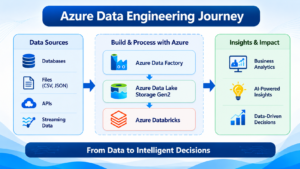
Azure Data Factory: Automating Enterprise Data Integration
Azure Data Factory (ADF) is a cloud-based data integration service used to create, schedule, and manage data movement and transformation workflows.
Imagine an organization receiving customer information from SQL Server, Excel files, APIs, and cloud storage. All this information needs to be collected and processed.
Azure Data Factory helps automate this process.
Practical Topics You Will Explore
- Creating an Azure Data Factory instance.
- Configuring Linked Services.
- Creating datasets.
- Developing pipelines.
- Working with Copy Data Activity.
- Using Lookup and ForEach activities.
- Implementing parameters and variables.
- Creating scheduled triggers.
- Monitoring pipeline execution.
- Handling pipeline failures.
Real-Time Scenario: Build an automated pipeline that extracts customer and transaction information from SQL Server and loads it into Azure Data Lake Storage.
Azure Data Lake Storage Gen2: Managing Large-Scale Data Efficiently
Data Lake Storage Gen2 provides scalable storage for structured, semi-structured, and unstructured data.
It acts as an important storage foundation for modern Azure Data Engineering solutions.
Key Areas of Learning
- Creating Storage Accounts.
- Configuring containers.
- Managing directories and files.
- Uploading CSV, JSON, and Parquet files.
- Access control and permissions.
- Integration with Azure Data Factory.
- Connecting Azure Databricks to ADLS Gen2.
- Organizing raw and processed datasets.
Practical Example: Store millions of e-commerce transactions in Azure Data Lake and process them using Azure Databricks.
Azure Databricks: Unlocking Distributed Data Processing with Apache Spark
Azure Databricks provides a collaborative platform for data engineering, analytics, and AI workloads.
It uses Apache Spark to process large datasets across distributed computing environments.
As a Data Engineer, understanding Databricks is essential for developing modern data pipelines.
Core Databricks Skills
- Databricks Workspace.
- Compute and cluster configuration.
- Notebooks.
- Apache Spark architecture.
- Spark DataFrames.
- Spark SQL.
- PySpark programming.
- DataFrame transformations.
- Reading and writing different file formats.
- Performance optimization.
Why Is PySpark Important?
PySpark allows developers to use Python for distributed data processing.
For example, an organization may receive millions of sales transactions every day. Processing this information using traditional single-machine scripts may become inefficient.
With PySpark, data engineers can distribute processing tasks and build scalable transformation workflows.
Genie AI and Genie Code: Bringing Artificial Intelligence into Data Engineering
One of the exciting developments in the Databricks ecosystem is the introduction of AI-powered assistance.
Databricks Genie and Genie Code support different but complementary workflows.
Genie provides a conversational interface for asking questions about organizational data using natural language. It can translate business questions into analytical queries using governed data and semantic context.
Genie Code assists developers with coding and development activities within Databricks.
What Can You Learn?
- Understanding Genie AI capabilities.
- Exploring natural language interactions.
- Generating SQL with AI assistance.
- Creating and improving Python and PySpark code.
- Understanding existing code.
- Debugging development issues.
- Exploring data through conversational questions.
- Improving development productivity.
- Working with governed enterprise data.
Example: Natural Language to SQL
Suppose a business analyst wants to identify the top five products based on total sales.
Instead of manually creating the entire query, the user can ask Genie a question:
“Show the top five products based on total sales.”
Genie can interpret the request and generate an SQL query based on the available data and configured business context.
The generated query should still be checked for correctness before being used for business reporting.
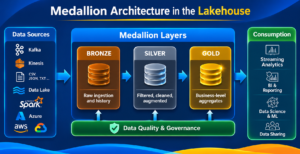
Medallion Architecture: Organizing Data Through Three Processing Layers
A well-designed data platform requires a structured approach to data ingestion and transformation.
Databricks commonly uses Medallion Architecture to organize data into Bronze, Silver, and Gold layers.
Bronze Layer – Capturing the Original Data
The Bronze Layer stores raw data from different source systems.
You will learn:
- Loading source files.
- Ingesting CSV, JSON, and Parquet data.
- Maintaining raw records.
- Handling incremental ingestion.
- Creating Delta tables.
Silver Layer – Improving Data Quality and Consistency
The Silver Layer contains cleaned and validated information.
You will explore:
- Removing duplicate records.
- Handling missing values.
- Applying data transformations.
- Standardizing data formats.
- Implementing validation rules.
- Managing data quality.
Gold Layer – Preparing Data for Business Intelligence
The Gold Layer contains aggregated and business-ready information.
You will learn:
- Business-level aggregations.
- Calculating sales metrics.
- Creating reporting tables.
- Preparing analytical datasets.
- Connecting processed data to Power BI.
This architecture helps organizations maintain reliable data pipelines and create trusted analytical datasets.
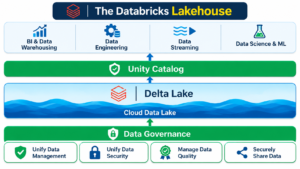
Delta Lake and Unity Catalog: Strengthening Data Reliability and Governance
Modern data engineering is not only about moving data. It also requires reliable storage, security, and governance.
Delta Lake: Reliable Data Storage
Delta Lake provides transactional capabilities on top of data lake storage.
Important concepts include:
- Delta Tables.
- ACID Transactions.
- Schema Enforcement.
- Schema Evolution.
- Time Travel.
- MERGE Operations.
- OPTIMIZE.
- VACUUM.
Unity Catalog: Centralized Data Management
Unity Catalog provides governance capabilities for data and AI assets in Databricks.
You will explore:
- Catalogs and Schemas.
- Managed and External Tables.
- Volumes.
- Access Permissions.
- Data Lineage.
- Data Discovery.
- Data Governance.
These capabilities help enterprises maintain secure and reliable data environments.
AI-Assisted Data Engineering: Automating Everyday Development Activities
AI is becoming an important productivity tool for developers.
Instead of performing every development activity manually, engineers can use AI assistance to speed up repetitive tasks and understand complex code.
Practical AI-Assisted Activities
SQL Query Development: Generate SQL queries from natural language instructions.
PySpark Development: Get assistance creating DataFrame transformations and processing scripts.
Code Explanation: Understand complex SQL and Python code.
Error Troubleshooting: Analyze error messages and identify possible solutions.
Data Transformation: Develop scripts for cleaning and restructuring datasets.
Documentation: Generate explanations and documentation for code and workflows.
Important: AI-generated solutions require technical review, testing, and validation. Understanding SQL, Python, Spark, and data architecture remains essential.
Generative AI Concepts Every Modern Data Engineer Should Understand
Beyond Genie AI, modern data engineers can benefit from understanding the fundamentals of Generative AI.
Some important concepts include:
- Artificial Intelligence and Machine Learning.
- Generative AI fundamentals.
- Large Language Models (LLMs).
- Prompt Engineering.
- Embeddings.
- Vector Databases.
- Retrieval-Augmented Generation (RAG).
- AI Agents.
- Foundation Models.
- AI-powered data applications.
These technologies help data engineers understand how enterprise data platforms can support intelligent applications and advanced analytics.
From Practical to Implementation: Real-Time Data Engineering Projects
Technical knowledge becomes more valuable when you can apply it to practical business scenarios.
Here are some project ideas that combine Azure Data Engineering, Databricks, and AI-assisted development.
Project 1: End-to-End E-Commerce Intelligence Pipeline
Business Requirement: An e-commerce company wants to analyze customer purchases, product performance, and sales trends.
Implementation:
- Extract data from different sources.
- Store raw data in Azure Data Lake.
- Ingest data using Azure Data Factory.
- Process information using PySpark.
- Create Bronze, Silver, and Gold tables.
- Use AI assistance during SQL and PySpark development.
- Prepare analytical datasets for Power BI.
Technologies: Azure Data Factory, ADLS Gen2, Azure Databricks, PySpark, Delta Lake, Genie AI, and Power BI.
Project 2: Financial Data Quality and Processing Solution
Business Requirement: A financial organization needs to process transaction information and identify inconsistent records.
Implementation:
- Ingest financial transaction files.
- Validate incoming records.
- Remove duplicate transactions.
- Apply business transformation rules.
- Implement data quality checks.
- Create reporting tables.
- Prepare financial analytics datasets.
Technologies: Azure Data Lake, Azure Databricks, Spark SQL, PySpark, Delta Lake, and AI assistance.
Project 3: Retail Lakehouse Development
Business Requirement: A retail company wants to combine sales, inventory, and customer information into a unified data platform.
Implementation:
- Collect data from multiple systems.
- Load raw information into the Bronze Layer.
- Clean and standardize data in the Silver Layer.
- Develop business-ready Gold tables.
- Configure data governance.
- Prepare datasets for reporting and analytics.
Technologies: Azure Databricks, Unity Catalog, Delta Lake, PySpark, and Power BI.
Project 4: AI-Assisted Data Pipeline Development
Business Requirement: A development team wants to improve productivity when building and maintaining data pipelines.
Implementation:
- Understand existing pipeline requirements.
- Use Genie Code to assist with notebook development.
- Generate SQL and PySpark code.
- Review and test generated code.
- Troubleshoot development errors.
- Improve pipeline documentation.
- Validate the complete workflow.
Technologies: Azure Databricks, Genie Code, PySpark, Spark SQL, and Lakeflow.
Building Your Career: Roles You Can Target After Learning These Technologies
Azure Data Engineering with AI-related skills can help you prepare for different technical career paths.
Depending on your experience and practical knowledge, you can target roles such as:
- Azure Data Engineer.
- Databricks Data Engineer.
- Cloud Data Engineer.
- PySpark Developer.
- Big Data Engineer.
- ETL Developer.
- Data Platform Engineer.
- AI Data Engineer.
Employers generally look for strong fundamentals, hands-on experience, project knowledge, troubleshooting skills, and the ability to develop production-ready data solutions.
Why Practical Training Matters in the AI-Driven Data Engineering Era
Watching tutorials and reading documentation can help you understand individual concepts. However, developing real-world technical skills requires practical implementation.
At SQL School Training Institute, our learning approach focuses on technical understanding, practical exercises, and industry-oriented projects.
What You Can Expect at SQL School
- 100% Practical and Interactive Training.
- Step-by-Step Technical Explanation.
- Experienced Trainer – Mr. Sai Phanindra.
- SQL and T-SQL Fundamentals.
- Azure Data Engineering.
- Azure Databricks and PySpark.
- Modern AI and Genie AI Concepts.
- Scenario-Based Real-Time Projects.
- Assignments and Practical Exercises.
- Weekly Feedback.
- Resume Guidance.
- One-to-One Mock Interviews.
- 100% Placement Assistance.
Our objective is to help learners understand how different technologies work together in real-world data engineering environments.
The Next Generation of Data Engineering Starts with the Right Skills
Azure Data Engineering is evolving beyond traditional ETL development. Cloud platforms, distributed processing, lakehouse architecture, and AI-powered development tools are creating new opportunities for data professionals.
Learning Azure Data Factory, Azure Data Lake Storage, Databricks, PySpark, Spark SQL, Delta Lake, Unity Catalog, and Genie AI can help you understand the complete modern data engineering ecosystem.
However, AI tools cannot replace strong technical fundamentals. The ability to understand data, write efficient code, design pipelines, troubleshoot errors, and validate business requirements remains essential.
If you want to build a career in Data Engineering, start with the fundamentals, practice real-world scenarios, and gradually explore AI-powered technologies.
Build your skills today. Develop intelligent data solutions tomorrow!
Start Your Azure Data Engineering Learning Journey with SQL School
Want to become an Azure Data Engineer?
Get practical knowledge of SQL, Azure, Databricks, PySpark, and AI-powered data engineering with SQL School Training Institute.
SQL School Training Institute – Hyderabad
- Website: https://sqlschool.com
- Contact: +91 9666440801
- Contact: +91 9951440801
- Trainer: Mr. Sai Phanindra
Learn Practically. Build Real-Time Projects. Prepare for Your Data Engineering Career.
#AzureDataEngineering #GenieAI #DatabricksGenie #GenieCode #AzureDatabricks #AzureDataEngineer #DataEngineering #PySpark #ApacheSpark #AzureDataFactory #ADLSGen2 #DeltaLake #UnityCatalog #GenerativeAI #ArtificialIntelligence
