SQL, Snowflake and Python Training: The Modern Data Career Stack in 2026
Introduction: The Data Career Has Changed
Data is no longer limited to reports and spreadsheets. Modern organizations generate massive amounts of information from applications, websites, transactions, cloud platforms, customer interactions, and business systems.
The real challenge is not simply collecting this data. Businesses need professionals who can query data, transform it, automate processes, store it efficiently, and prepare it for analytics.
This is where three technologies stand out:
SQL + Python + Snowflake
SQL provides the foundation for working with data. Python adds programming and automation capabilities. Snowflake provides a scalable cloud platform for modern data workloads.
Learning these technologies together can create a strong foundation for careers in Data Engineering, Data Analytics, Cloud Data Warehousing, Business Intelligence, and Data Development.
Why Are SQL, Python and Snowflake So Important?
The modern data environment is becoming increasingly cloud-based and automated.
Traditional database knowledge alone may not be enough for professionals who want to work with modern data platforms.
A typical organization may have:
- Transactional databases
- Cloud applications
- APIs
- CSV and Excel files
- Customer platforms
- Application logs
- Cloud storage
- Data warehouses
- Business intelligence platforms
Data professionals need to connect these different sources and turn raw information into usable business data.
This is why a combination of SQL Training, Python Training, and Snowflake Training can be particularly valuable.
SQL: The Foundation of Data
SQL is one of the most widely used technologies for interacting with structured data.
Whether data is stored in a traditional relational database or a modern cloud data warehouse, SQL remains an essential skill.
With SQL, professionals can retrieve, filter, join, aggregate, transform, and analyze data.
What Can You Learn in SQL Training?
A comprehensive SQL training program can cover:
- Relational database concepts
- Tables and schemas
- Data types
- Primary and foreign keys
- Constraints
- SELECT statements
- Filtering and sorting
- GROUP BY and HAVING
- Aggregate functions
- Joins
- Subqueries
- Common Table Expressions
- Window functions
- Views
- Stored procedures
- Functions
- Triggers
- Transactions
- Indexes
- Query optimization
- Performance tuning
The objective should not be simply to memorize SQL commands.
The real goal is to understand how to solve business problems using data.
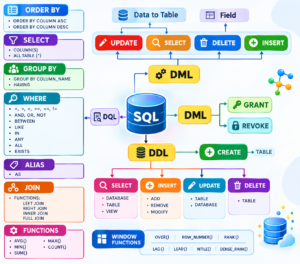
Why SQL Is Still a Must-Have Skill
Imagine a retail company with millions of sales transactions.
Management wants to know:
- Which products generate the most revenue?
- Which customers purchase most frequently?
- Which regions have declining sales?
- What are the monthly sales trends?
- Which products have low inventory?
- What is the average order value?
SQL can be used to answer these questions directly from the underlying data.
This makes SQL valuable for:
- Data Analysts
- SQL Developers
- Data Engineers
- BI Developers
- Database Developers
- Cloud Data Professionals
Python: Turning Data Knowledge Into Automation
SQL is excellent for querying and transforming data, but modern data environments often require programming.
This is where Python becomes valuable.
Python can be used to automate repetitive processes, manipulate files, connect applications, process datasets, interact with APIs, and support data pipelines.
What Does Python Training Cover?
A career-oriented Python course can include:
- Python fundamentals
- Variables
- Data types
- Operators
- Conditional statements
- Loops
- Functions
- Lists
- Tuples
- Sets
- Dictionaries
- Strings
- Exception handling
- File handling
- Modules and packages
- Object-oriented programming
- Regular expressions
- JSON
- APIs
- Database connectivity
- Pandas
- NumPy
- Data analysis
- Data processing
- Automation
Python for Data Professionals
Consider a company receiving sales files every morning from multiple locations.
Instead of manually opening and modifying every file, Python can automate the process.
A Python program can:
- Read incoming files.
- Validate the data.
- Remove unwanted records.
- Standardize column formats.
- Handle missing values.
- Transform the information.
- Generate an output file.
- Send the processed data to a database or cloud platform.
This is one of the reasons Python for Data Analytics and Data Engineering has become an important skill.
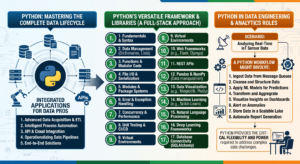
Snowflake: The Cloud Data Platform
Snowflake is designed for modern cloud-based data workloads.
It provides organizations with a platform for storing, processing, transforming, and analyzing large amounts of data.
Instead of relying only on traditional on-premises database infrastructure, organizations can use cloud data platforms to support scalable analytical workloads.
What Can You Learn in Snowflake Training?
A structured Snowflake Training Course can cover:
- Snowflake architecture
- Databases
- Schemas
- Tables
- Views
- Virtual warehouses
- Data loading
- Stages
- File formats
- COPY INTO
- Snowpipe
- Streams
- Tasks
- Time Travel
- Zero-copy cloning
- Semi-structured data
- JSON
- Security
- Roles and privileges
- Data sharing
- Performance optimization
- Monitoring
Why Learn Snowflake?
Organizations are generating more data than ever before.
They need platforms that can support:
- Large datasets
- Analytical workloads
- Multiple users
- Data integration
- Cloud-based processing
- Business intelligence
- Data engineering
- Historical analysis
Snowflake skills can therefore be useful for professionals targeting modern cloud data engineering and analytics roles.
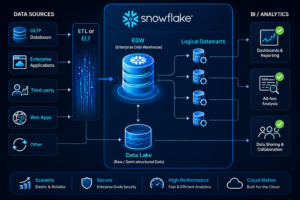
The Real Power Is in Combining SQL, Python and Snowflake
Learning these technologies individually is useful.
Learning how they work together is even more valuable.
Consider a simple business data pipeline:
Business Applications
↓
SQL Databases
↓
Python Processing
↓
Snowflake
↓
Data Transformation
↓
BI & Analytics
Each technology has a different responsibility.
SQL
Used to access and transform database information.
Python
Used for programming, automation, validation, processing, and integration.
Snowflake
Used as the scalable cloud data platform.
This creates a complete data workflow rather than isolated technical knowledge.
A Real-World Example: E-Commerce Data Pipeline
Consider an online shopping company.
Every day, the company generates:
- Customer data
- Product data
- Orders
- Payments
- Returns
- Shipment information
- Website activity
The organization needs to bring this information together for analytics.
Step 1: Extract Data
SQL can retrieve customer, order, product, and payment information from operational databases.
Step 2: Process Data
Python can validate files, clean records, transform information, and automate data-processing tasks.
Step 3: Load Data
The processed data can be loaded into Snowflake.
Step 4: Transform Data
SQL can be used inside the cloud data platform to create analytical datasets.
Step 5: Analyze Data
Business teams can use the prepared data for:
- Revenue analysis
- Customer segmentation
- Product performance
- Regional sales
- Return analysis
- Inventory reporting
This is the type of end-to-end thinking that modern data professionals should develop.
SQL vs Python vs Snowflake: What Does Each Technology Do?
| Technology | Main Role | Typical Applications |
|---|---|---|
| SQL | Data querying and transformation | Databases, analytics, reporting |
| Python | Programming and automation | Data processing, APIs, automation |
| Snowflake | Cloud data platform | Data warehousing, analytics, engineering |
These technologies are not competing technologies.
They solve different parts of the same data problem.
What Should You Learn First?
One of the biggest questions beginners ask is:
Should I learn SQL, Python, or Snowflake first?
A practical approach is:
First: SQL
Build a strong foundation in databases and data querying.
Second: Python
Learn programming, automation, and data processing.
Third: Data Warehousing
Understand concepts such as ETL, ELT, fact tables, dimensions, data pipelines, and analytical workloads.
Fourth: Snowflake
Learn how modern cloud data platforms work.
Fifth: Projects
Combine all three technologies to build complete data solutions.
This approach creates a stronger foundation than attempting to learn all three technologies simultaneously.
Career Opportunities After Learning SQL, Python and Snowflake
A combination of these technologies can support several career paths.
SQL Developer
Focuses on database development, SQL programming, stored procedures, performance, and data management.
Data Analyst
Uses SQL and Python to extract, clean, analyze, and interpret business data.
Data Engineer
Builds data pipelines and prepares data for analytics and business intelligence.
Snowflake Data Engineer
Works with cloud data warehousing, data loading, transformations, pipelines, performance, and Snowflake architecture.
BI Developer
Works with databases, data warehouses, reporting platforms, semantic models, and business intelligence solutions.
Python Data Professional
Uses Python for automation, data processing, analytics, and application integration.
Skills Employers Look for Beyond the Tools
Knowing technology names is not enough.
Employers also value professionals who can:
- Understand business requirements
- Troubleshoot data issues
- Write optimized SQL
- Understand data quality
- Explain technical concepts clearly
- Work with large datasets
- Build reliable pipelines
- Understand data modeling
- Analyze project requirements
- Communicate findings
- Explain project architecture during interviews
The difference between knowing a technology and being job-ready is often the ability to apply that technology to a business problem.
Common Mistakes Made by Beginners
Learning Only Syntax
Memorizing commands without understanding when to use them makes it difficult to solve real problems.
Ignoring SQL
Some learners immediately jump into cloud technologies without developing database fundamentals.
Avoiding Projects
Tutorials can teach concepts, but projects demonstrate how those concepts work together.
Learning Python Without Data
For data careers, Python should eventually be connected to datasets, databases, APIs, and automation.
Learning Snowflake Without Warehousing Concepts
Understanding data warehousing fundamentals makes Snowflake concepts much easier to understand.
Preparing Only for Theory-Based Interviews
Modern interviews can involve scenarios where candidates must explain how they would solve a data problem.
Who Should Learn SQL, Python and Snowflake?
This combination can be useful for:
- Fresh graduates
- IT professionals
- SQL Developers
- Database Developers
- Data Analysts
- Data Engineers
- BI Developers
- Software Developers
- Cloud professionals
- Professionals moving into data careers
Even if you are starting from the beginning, the technologies can be learned progressively.
Frequently Asked Questions
Can I learn Snowflake without SQL?
Snowflake can be explored without advanced SQL knowledge, but SQL is extremely important for working effectively with Snowflake data.
Should I learn Python after SQL?
For many data-focused career paths, learning Python after SQL is a practical progression because it adds programming and automation capabilities.
Is Snowflake useful for Data Engineers?
Yes. Snowflake is widely used as a cloud data platform, making Snowflake knowledge relevant to modern data engineering and analytics environments.
Is Python necessary for Data Engineers?
Python is highly useful for many Data Engineering tasks, including automation, data processing, integrations, and pipeline development.
How long does it take to learn SQL, Python and Snowflake?
The time depends on your existing technical knowledge, learning schedule, practice time, and career objective. Consistent hands-on practice is more important than simply completing lessons quickly.
Can beginners learn these technologies?
Yes. Beginners can start with SQL fundamentals, progress to Python, learn data warehousing concepts, and then move into Snowflake.
Conclusion
The future of data is not about mastering one tool.
It is about understanding how different technologies work together.
SQL provides the foundation.
Python provides flexibility and automation.
Snowflake provides a modern cloud environment for storing and processing data.
When these skills are combined with data warehousing knowledge, projects, and strong problem-solving abilities, they can create a powerful foundation for a career in the data industry.
For anyone planning to enter Data Engineering, Data Analytics, SQL Development, Cloud Data Warehousing, or Snowflake, learning this technology stack can be a practical way to build modern data skills.
Course Curriculum: Click Here
Trainer: Mr. Sai Phanindra
With 20+ Years of
technical expertise exclusively on SQL & Database Technologies, I assure you 100% Practical, Step by Step Classes.
Linkdin Profile: www.linkedin.com/in/saiphanindra/
Contact No: +91 9030040801 or +91 9666640801
#SQLTraining #SQLCourse #SQLTutorial #SQLDeveloper #AdvancedSQL #PythonTraining #PythonCourse #PythonForDataAnalytics #PythonProgramming #SnowflakeTraining #SnowflakeCourse #SnowflakeDataEngineer #SnowflakeTutorial #DataEngineering #DataEngineer #DataEngineeringTraining #DataAnalytics #DataAnalyst #CloudData #CloudDataEngineering