
Why Every Data Professional Should Learn ETL in 2026
ETL Developer
Data is increasing at a rate like never before and businesses need individuals who can move, clean, and organize data at the right speed. That’s where ETL (Extract, Transform, Load) comes in. ETL is no longer a luxury in 2026, particularly if you’re pursuing a career in data, such as a Data Analyst, Data Engineer, or Database Administrator. It’s an essential skill which determines your growth.
In this blog, we’ll explain what ETL is, why it’s relevant in today’s world and why it should be on every data professionals’ list of skills to acquire this year.
What is ETL?
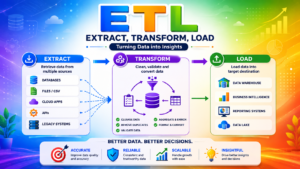
ETL stands for:
- Extract – retrieving raw information from multiple information sources (databases, API, files, cloud applications)
- Transform – Transforming, structuring and transforming that data to make it usable
- Load – Copying the last, cleaned data to a data warehouse or target system
All data pipelines, dashboards and business intelligence reports are built around this process in use by companies today.
Why ETL is more critical than ever in 2026.
Businesses are all now “data companies.”
From retail to healthcare, banking to logistics, decisions are made across all industries, and data pipelines are essential for this. The key for businesses is to have professionals who can build and handle ETL pipelines that maintain that data flow accurately and on time.
Cloud Data Platforms: Exploding.
Many tools, such as Azure Data Factory, Databricks, Snowflake, and Microsoft Fabric, are dependent on the use of ETL and ELT concepts. Without basic knowledge of ETL, these modern cloud platforms can become a lot more difficult to utilize.
High Demand, High Salary Roles
Job titles like:
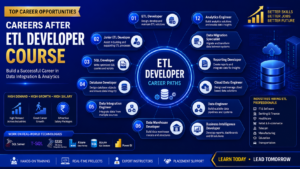
- ETL Developer
- Data Engineer
- BI Developer
- Data Warehouse Analyst
These positions are always among the highest-paid and most popular data roles for 2026. ETL experience is a key qualification for recruiters.
The key to data engineering is ETL.
It is impossible to be a good Data Engineer without knowing ETL. It is the basic skill that brings database, cloud and analytics technologies together as a cohesive system.
Clean data is essential for AI and Automation.
The data that power AI models and machine learning systems is what they are made from. ETL skills are even more valuable in the age of AI, as ETL processes guarantee the accuracy, consistency, and readiness of data for AI-driven analysis.
In 2026, who should learn ETL?
ETL is not the only tool of the engineers. It’s valuable for:
- Data Analysts aspiring to transition to Data Engineering.Data Analysts looking to shift their career towards Data Engineering.
- Database Administrators (DBAs) seeking to broaden their expertise in their role.Database Administrators (DBAs) who want to know more about their role.
- SQL Developers looking to advance their careers.SQL Developers who want to seek a better paying position.
Business Intelligence (BI) Professionals working with Power BI / Tableau - People who are freshers entering the data field or people who are career switchers are entering the data field.
A list of essential ETL skills that need to be taken care of:
If you are beginning your ETL learning road, consider these following areas of focus:
- SQL is an essential language for programming databases and managing the transformation and retrieval of the data.SQL is the core language used to query and alter the data.
- ETL tools are used to transform, load, move, and copy data.ETL tools include Azure Data Factory, SSIS, Talend, Informatica.
- Based on the processing of cloud data, there are platforms like Cloud Data Platforms (such as Databricks, Snowflake and the Microsoft Fabric).
- Understanding of concepts of data warehousing like Fact table, Dimension table and Star schema
Transform data with Python – Automate and script ETL workflows - Data quality and validation techniques.
Why is it important for students to learn ETL?
- Better salary packages than traditional database jobs
- A more rapid career trajectory towards Data Engineering and Cloud Architecture positions.
- Job security – nearly all companies require ETL workers
- Able to move between sectors, such as banking, health, retail, IT etc.
- Excellent base knowledge of advanced tools such as Databricks and Snowflake.
Here are some of the most popular items.
- Understand SQL first – It is the basis of all ETL operations
- Recognize basic data warehousing concepts.
- Involve at least one ETL tool – Azure Data Factory is a good place to start.
- Apply to real-time projects – Practice realtime use with sample datasets and pipelines
- Learn directly from industry professionals – Courses are structured to help you learn more quickly than you would by studying on your own.
Final Thoughts
In 2026, ETL is no longer a “nice to have” skill; it is a “must have” skill for all data professionals. With the increasing trend of migrating more data to the cloud, companies increasingly automating their data processes, and relying on AI to analyze their data, the need for ETL professionals continues to rise.
Don’t wait for the competition to get to you, if you want to build a strong career in data now is the time to learn ETL.
Looking to learn how to utilize ETL and cloud data engineering tools such as Azure Data Factory, Databricks, and Snowflake? Begin your training journey now with hands-on, expert-led training.