#DP 750

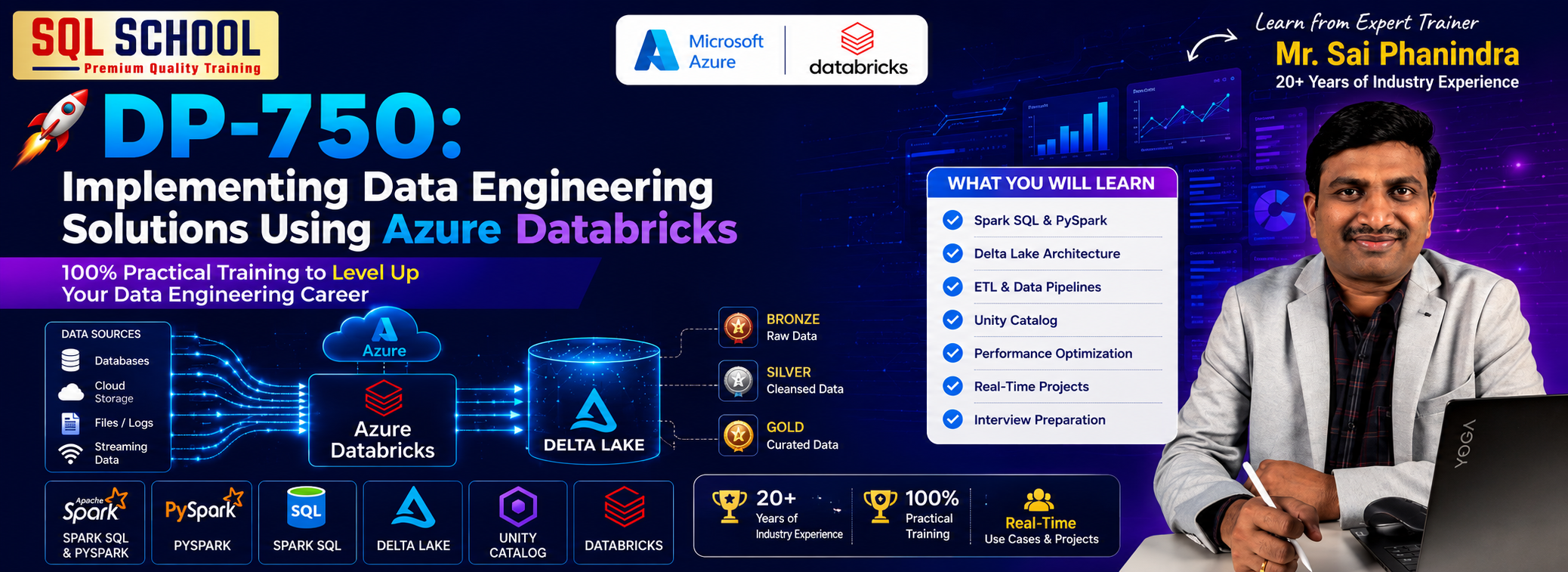
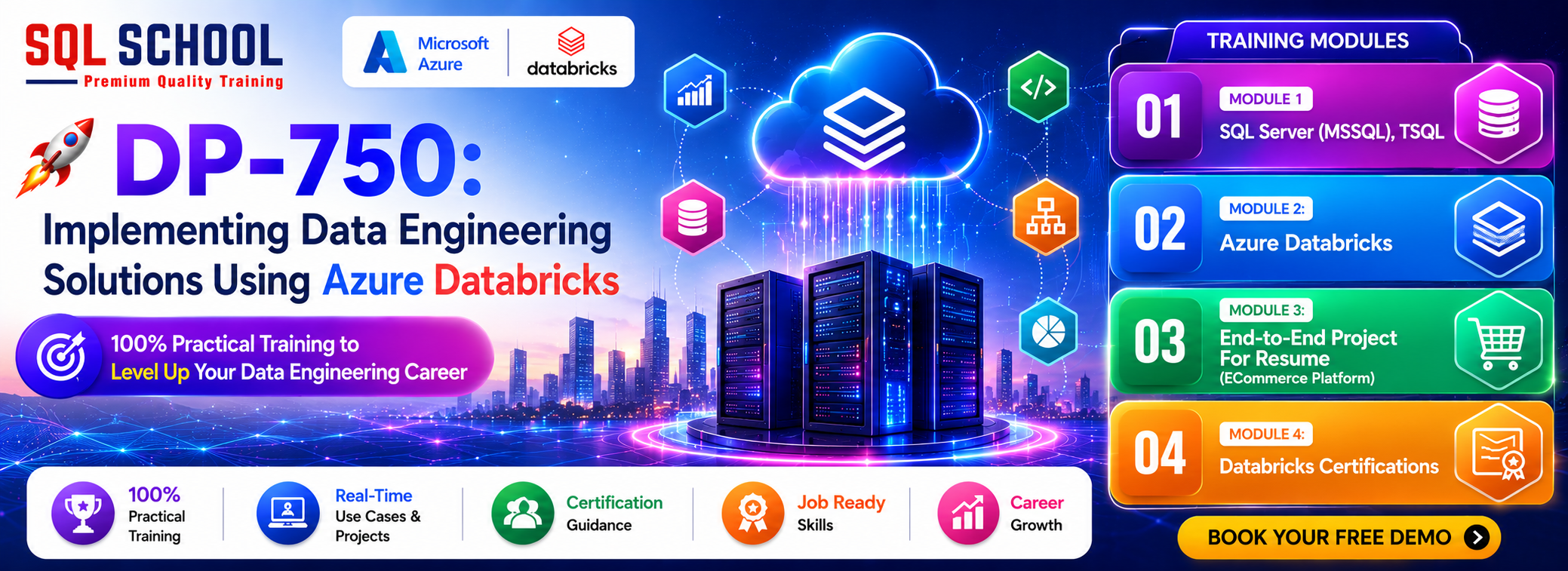
SQL School’s DP-750 Course covers Azure Databricks fundamentals, Unity Catalog, data ingestion and transformation with SQL & Python, Lakeflow orchestration, Git & CI/CD practices, and performance tuning. Gain hands-on experience with real-world data engineering workflows and prepare confidently for the Microsoft DP-750 certification exam.

Work on industry-focused projects that simulate real business scenarios and strengthen your practical skills. Learn from experienced trainers and build the expertise needed for in-demand Azure Data Engineering roles.

Training Highlights

✅ Cloud ETL, DWH with Big Data Analytics
✅ OneLake & Lakehouse for Unified Storage
✅ Dataflows Gen2, Self-Service Data Prep
✅ Delta Lake, Delta Tables with Big Data
✅ ETL Notebooks with PySpark, TSQL
✅ Realtme IoT with Eventstreams
✅ CI/CD with Fabric Git Integrations
✅ End-to-End Capstone Project on Banking

DP 750 Course Content

DP 750 Detailed Course Curriculum

Ch 1: Databricks Introduction

  • Cloud ETL, DWH
  • Cloud Computing
  • Databricks Concepts
  • Big Data in Cloud

Ch 2: Databricks Architecture

  • Unity Catalog, Volume
  • Spark Clusters
  • Apache Spark and Databricks
  • Apache Spark Ecosystem
  • Compute Operations
  • Hadoop, MapReduce, Apache Spark

Ch 3: Unity Catalog

  • Unity Catalog Concepts
  • Workspace Objects
  • Databricks Notebooks
  • Databricks Workspace UI
  • Organizing Workspace Objects
  • Creating Volumes
  • Spark Table Creations
  • UI Limitations

Ch 4: Unity Catalog Operations, Spark SQL – 1

  • Spark SQL Notebooks
  • Creating Catalog
  • Creating Schemas, Tables
  • Spark Data Types
  • Data Partitioning
  • Managed Tables
  • SQL Queries with the PySpark API
  • Union, Views in Spark
  • Dropping Objects
  • External Tables, External Volumes
  • SQL Notebooks: Exports, Clone

Ch 5: Spark SQL Notebooks – 2

  • Math, Sort Functions
  • String, Date Time Functions
  • Conditional Statements
  • SQL Expressions with expr()
  • Volume for our Data Assets
  • File Formats, Schema Inference
  • Spark SQL Aggregations

Ch 6: Python Concepts – 1

  •  Python Introduction
  • Python Versions
  • Python Implementations
  • Python in Spark (PySpark)
  • Python Print ()
  • Single, Multiline Statements

Ch 7: Python Concepts – 2

  • Python Data Types
  • Integer / Int Data Types
  • Float, String Data Types
  • Arithmetic, Assignment Ops
  • Comparison Operators
  • Operator Precedence
  • If … Else Statement
  • Shorthand If, OR, AND
  • ELIF and ELSE IF Statements

Ch 8: Python Concepts – 3

  • Python Lists
  • List Items, Indexes
  • Python Dictionaries
  • Tables Versus Dictionaries
  • Python Modules & Pandas
  • Import pandas DataFrame
  • Pandas Series, arrays
  • Indexes, Indexed Lists

Ch 9: PySpark – 1

  • DataFrames with SQL DB
  • Pandas DataFrame
  • Dataframe()
  • List Values, Mixed Values
  • spark.read.csv()
  • spark.read.format()
  • Filtering DataFrames
  • Grouping your DataFrame

Ch 10: PySpark – 2

  • DataFrameReader
  • DataFrameWriter Methods
  • CSV Data into a DataFrame
  • Reading Single Files
  • Reading Multiple Files
  • Schema with an SQL String
  • Schema Programmatically

Ch 11: PySpark Transformations – 1

  • Data Preparation
  • Selecting Columns
  • Column Transformations
  • Renaming Columns
  • Changing Data Types
  • select() and selectExpr()
  • Column Transformations
  • withColumn()

Ch 12: PySpark Transformations – 2

  • String Functions
  • Datetime Conversions
  • Date and Time Functions
  • Joining DataFrames
  • Union DataFrames
  • Joining DataFrames

Ch 13: PySpark Transformations – 3

  • Filtering DataFrame Records
  • Removing Duplicate Records
  • Sorting and Limiting Records
  • Filtering Null Values
  • Grouping and Aggregating
  • Pivoting and Unpivoting
  • Conditional Expressions

Ch 14: Medallion Architecture

  • Medallion Architecture
  • Aggregated Data Loads
  • Broze, Silver and Gold
  • Temp Views
  • Spark Tables (Parquet)
  • Work with File, Table Sources

Ch 15: Delta Lake – 1

  • Storage Layer
  • Delta Table API
  • Deleting Records
  • Updating Records
  • Merging Records
  • History & Time Travel

Ch 16: Delta Lake – 2 (SCD)

  • Schema Evolution
  • Delta Lake Data Files
  • Deleting and Updating Records
  • Merge Into
  • Incremental Loads
  • Old History Retention
  • Delta Transaction Log

Ch 17: Widgets

  • Text Widgets
  • User Parameters
  • Manual Executions
  • Lake Bridge
  • Databricks Bridge One

Ch 18: Lake Flow Jobs

  • Worksflows & CRON
  • Job Compute, Running Tasks
  • Python Script Tasks
  • Parameters
  • Concurrent Executions
  • Dependencies
  • Branching Control

Ch 19: Databricks Tuning

  • Lazy Evaluation
  • Explain Plan
  • Caching, Data Shuffling
  • Broadcast Joins
  • When to Partition
  • Data Skipping
  • Z Ordering
  • Liquid Clustering
  • Spark Configurations

Ch 20: Version Control & GitHub

  • Local Development
  • Runtime Compatibility
  • Git and GitHub Pre-requisites
  • Git and GitHub Basics
  • Linking to GitHub, Databricks
  • Databricks Git Folders
  • Project Code to GitHub
  • Databricks Job Updates, Runs

Ch 21: Spark Structured Streaming

  • Streaming Simulator Notebook
  • Micro-batch Size
  • Schema Inference and Evolution
  • Time Aggregations, Watermarking
  • Writing Streams
  • Trigger Intervals
  • Delta Table Stream Reads, Writes

Ch 22: Auto Loader

  • Reading Streams with Auto Loader
  • Reading a Data Stream
  • Manually Cancel your Data Streams
  • Writing to a Data Stream
  • Workspace Modules

Ch 23: Lake Flow Declarative Pipelines

  • Delta LIVE Tables
  • Data Generator Notebook
  • Pipeline Clusters
  • Databricks CLI
  • Data Quality Checks
  • Streaming Dataset “Simulator”
  • Streaming Live Tables

Ch 24: Security: ACLs

  • Overview of ACLs
  • Workspace Users, Groups
  • Workspace Access Control
  • Cluster Access Control
  • Groups & LakeBridge

Ch 25: Azure Databricks – 1

  • Azure Account
  • Azure Subscription
  • Azure Resource Group
  • Azure Databricks
  • Azure Regions
  • Azure IAM & Microsoft Entra
  • Azure Databricks Deployment

Ch 26: Azure Databricks – 2

  • Classic Compute
  • Serverless Compute
  • Notebooks & Jobs
  • DBFS & Alternatives
  • External Tables
  • Photon Acceleration
  • DBU & Pricing
  • Unity Catalog Features

Ch 27: Realtime Project Ecommerce / Banking / Sales

  • Detailed Project Requirements
  • Project Solutions
  • Project FAQs
  • Project Flow
  • Interview Questions & Answers
  • Resume Guidance (1:1)

DP-750: Implementing Data Engineering Solutions Using Azure Databricks

  • Certification Dumps
  • Sample Certifications
Empty section. Edit page to add content here.

What prerequisites do I need before attempting DP-750?

There are no formal prerequisites, but you should have hands-on experience with Azure Databricks, solid proficiency in SQL and Python, familiarity with Unity Catalog, and working knowledge of Git and SDLC practices. Experience with Azure Data Factory, Microsoft Entra, and Azure Monitor is also beneficial.

What is the passing score for DP-750?

A minimum score of 700 out of 1000 is required to pass the exam. Score reports are provided immediately upon completion at a Pearson VUE testing centre or via online proctoring.

How long is the certification valid, and how do I renew it?

Microsoft associate certifications are valid for one year. You can renew for free by passing an online renewal assessment on Microsoft Learn before the expiry date — no need to retake the full proctored exam.

Which Azure services appear in the exam?

The exam primarily covers Azure Databricks and Unity Catalog. Supporting services include Azure Data Factory (for ingestion), Microsoft Entra (for authentication and identity), Azure Event Hubs (for streaming ingestion), and Azure Monitor with Log Analytics (for observability and alerting).
Is there a free practice assessment available?

Yes. Microsoft provides a free practice assessment on Microsoft Learn that mirrors the exam format. It is a great way to identify knowledge gaps before sitting the real exam. You can access it from the official DP-750 certification page.

What topics carry the most weight in the exam?

The two heaviest domains — each at 30–35% — are “Prepare and process data” and “Deploy and maintain data pipelines and workloads”. Together they account for up to 70% of the exam. Focus especially on Lakeflow Jobs, Lakeflow Spark Declarative Pipelines, Delta Lake optimisation, and workload monitoring.

Training Modes

LIVE Online Training

Instructor Led

Self Paced Videos

 On-Demand

Corporate Training

With 100% Hands-On

Placement Partners

SQL School Fabric Data Engineer training certificate of completion issued in January 2026 with verification ID