
MSSQL vs Oracle: The Ultimate Database Showdown for Modern Enterprises
In today’s digital economy, data powers everything—from banking transactions and healthcare records to e-commerce platforms and AI-driven applications. Behind these systems are robust database technologies that ensure data remains secure, available, and performant.
When discussing enterprise databases, two names dominate the conversation: Microsoft SQL Server (MSSQL) and Oracle Database. Both are industry-leading relational database management systems (RDBMS), trusted by Fortune 500 companies and government organizations worldwide. However, they differ in architecture, cost, scalability, administration, cloud strategy, and career opportunities.
This guide explores MSSQL and Oracle from a practical, real-world perspective to help developers, DBAs, data engineers, and business leaders make informed decisions. The comparison is based on key concepts, syntax differences, advantages, and industry practices outlined in the SQL School reference guide.
What is Microsoft SQL Server (MSSQL)?
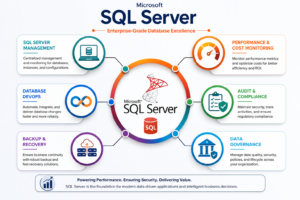
Microsoft SQL Server is Microsoft’s flagship enterprise database platform designed to store, process, and analyze data efficiently. It is widely adopted because of its seamless integration with the Microsoft ecosystem, including Azure, Power BI, Microsoft Fabric, .NET applications, and Active Directory.
Why Organizations Choose MSSQL
- User-friendly administration through SQL Server Management Studio (SSMS)
- Strong Azure cloud integration
- Faster application development lifecycle
- Powerful reporting and analytics ecosystem
- Cost-effective licensing compared to many enterprise alternatives
- Excellent support for BI and Data Engineering workloads
Industries Using MSSQL
- Retail
- Healthcare
- Education
- Manufacturing
- Financial Services
- Software Development Companies
What is Oracle Database?
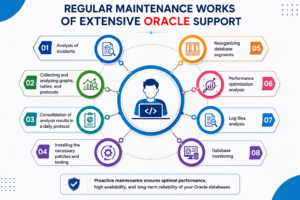
Oracle Database is one of the most advanced enterprise-grade database systems available today. It is designed to handle massive workloads, mission-critical applications, and highly available environments where downtime can cost millions.
Oracle is particularly dominant in sectors requiring maximum reliability, scalability, and security.
Why Organizations Choose Oracle
- Enterprise-grade architecture
- Advanced security capabilities
- Oracle RAC for high availability
- Superior scalability for large workloads
- Powerful disaster recovery solutions
- Strong support for global enterprise deployments
Industries Using Oracle
- Banking
- Telecommunications
- Insurance
- Government
- Healthcare
- Large Enterprise ERP Systems
MSSQL vs Oracle: Understanding the Core Philosophy
Although both databases solve similar problems, their design philosophies are different.
MSSQL Focuses On
✔ Simplicity
✔ Faster Development
✔ Microsoft Integration
✔ Cloud-Native Azure Solutions
✔ Ease of Administration
Oracle Focuses On
✔ Enterprise Scale
✔ Maximum Availability
✔ High-End Security
✔ Massive Data Volumes
✔ Global Business Operations
Think of MSSQL as a powerful, business-friendly platform, while Oracle is engineered for organizations operating at enormous scale.
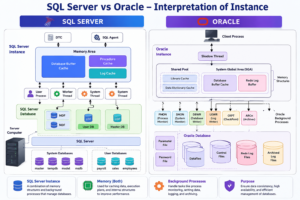
MSSQL vs Oracle Architecture Comparison
MSSQL Architecture Highlights
- Database Engine
- SQL Server Agent
- SSIS (Integration Services)
- SSRS (Reporting Services)
- SSAS (Analysis Services)
- Azure SQL Services
The architecture is straightforward and easier for administrators to manage.
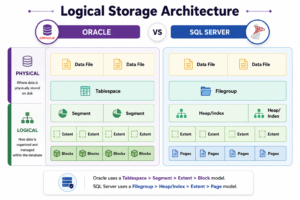
Oracle Architecture Highlights
- Oracle Instance
- SGA and PGA Memory Structures
- Background Processes
- ASM Storage Management
- RAC Clustering
- Data Guard Disaster Recovery
Oracle’s architecture is more sophisticated and designed for extremely large-scale deployments.
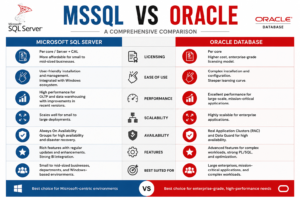
Feature-by-Feature Comparison
| Category | MSSQL | Oracle |
|---|---|---|
| Vendor | Microsoft | Oracle Corporation |
| Language | T-SQL | PL/SQL |
| Management Tool | SSMS | SQL Developer |
| High Availability | Always On AG | RAC |
| Disaster Recovery | Log Shipping | Data Guard |
| Cloud Platform | Azure SQL | Oracle Cloud |
| Ease of Learning | Easy | Moderate |
| Licensing Cost | Lower | Higher |
| Enterprise Scalability | High | Very High |
| Security Features | Strong | Advanced |
Performance: Which Database is Faster?
Performance depends largely on workload and architecture.
MSSQL Excels In
- Small and medium-sized businesses
- Reporting applications
- BI workloads
- Azure cloud environments
- Fast development projects
Oracle Excels In
- Multi-terabyte databases
- Banking systems
- Telecom platforms
- High-concurrency applications
- Enterprise ERP systems
For most organizations, both databases provide excellent performance when properly optimized.
Security Comparison
Data security is no longer optional—it’s mandatory.
MSSQL Security Features
- Row-Level Security
- Dynamic Data Masking
- Transparent Data Encryption
- Always Encrypted
- Azure Security Integration
Oracle Security Features
- Database Vault
- Data Redaction
- Advanced Auditing
- Label Security
- Transparent Data Encryption
Oracle generally offers more advanced enterprise security options, while MSSQL provides easier deployment and administration.
Cloud Strategy: Azure vs Oracle Cloud
Cloud adoption is transforming database administration.
MSSQL Ecosystem
- Azure SQL Database
- Azure Managed Instance
- Azure Synapse Analytics
- Microsoft Fabric
- Power BI
Oracle Ecosystem
- Oracle Cloud Infrastructure (OCI)
- Autonomous Database
- Exadata Cloud Services
- Oracle Analytics Cloud
Organizations heavily invested in Microsoft technologies often choose MSSQL, while enterprises already using Oracle products typically remain within the Oracle ecosystem.
Career Opportunities: MSSQL vs Oracle
Choosing a database technology can significantly influence your career path.
MSSQL Career Paths
- SQL Developer
- SQL DBA
- Azure SQL DBA
- Data Engineer
- Power BI Developer
- Data Analyst
- Fabric Data Engineer
- Data Architect
Oracle Career Paths
- Oracle Developer
- Oracle DBA
- RAC Administrator
- Oracle Cloud Engineer
- Database Architect
- ODI Developer
Current market trends indicate growing demand for MSSQL professionals due to the rise of Azure, Microsoft Fabric, AI-powered analytics, and cloud data engineering.
MSSQL vs Oracle: Which One Should You Learn in 2026?
Learn MSSQL If You Want To Become
- SQL Developer
- Azure Data Engineer
- Fabric Data Engineer
- Power BI Developer
- SQL DBA
- Data Analyst
Learn Oracle If You Want To Become
- Oracle DBA
- Oracle Developer
- Oracle Cloud Engineer
- Enterprise Database Architect
For professionals targeting modern cloud, analytics, AI, and data engineering careers, MSSQL combined with Azure and Microsoft Fabric offers tremendous growth opportunities.
Click HERE To Know More About MSSQL vs ORACLE
Final conclusion: MSSQL or Oracle?
The answer depends on your goals.
Choose MSSQL if you need ease of use, Azure integration, lower costs, faster development, and strong analytics capabilities.
Choose Oracle if your organization demands enterprise-grade scalability, advanced security, mission-critical uptime, and massive transaction processing.
The reality is that both databases remain among the most respected and valuable technologies in the IT industry. Learning either—or both—can open doors to high-paying careers in database administration, cloud computing, and data engineering.
SQL Server Training: https://sqlschool.com/sql-server-training/
SQL Server (MSSQL) Course Curriculum: https://sqlschool.com/wp-content/uploads/2026/05/MSSQL-TSQL-Training.pdf
Oracle PL SQL Training: https://sqlschool.com/plsql-training/
Oracle PL SQL Course curriculum: https://sqlschool.com/wp-content/uploads/2025/12/Oracle-SQL-Training.pdf
#MSSQL#Oracle#SQLServer#OracleDatabase#Database#DatabaseAdministrator#SQLDeveloper#OracleDBA#SQLDBA#DataEngineering#DataEngineer#CloudComputing
#AzureSQL#OracleCloud#DatabaseManagement#TSQL#PLSQL#BusinessIntelligence#DataAnalytics#DataArchitecture#SQLInterviewQuestions#DatabaseComparison
#TechCareers#LearnSQL#SQLSchool
Trainer: Mr. Sai Phanindra
With 19+ Years of
technical expertise exclusively on SQL & Database Technologies, I assure you 100% Practical, Step by Step Classes.
Linkdin Profile: www.linkedin.com/in/saiphanindra/
Contact No: +91 9030040801 or +91 9666640801
