What is OneLake? A Unified Data Lake for Microsoft Fabric.
You may have heard about OneLake if you’ve been investigating about modern data platforms. With the shift away from a disconnected data landscape, Microsoft announced OneLake as the data foundation of Microsoft Fabric, which will enable every team, every workload, and every dataset to come together into a single, governed home. Let’s explore what is OneLake , its key capabilities, its significance, and the benefits it offers to contemporary data engineering and analytics teams.
What is OneLake?
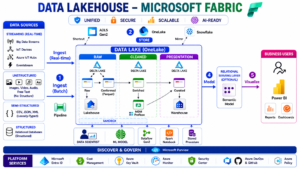
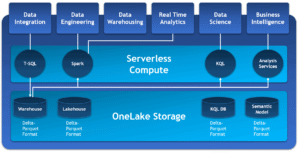
OneLake is a single, unified, SaaS-managed data lake that is prebuilt in each and every Microsoft Fabric tenant. Imagine a “OneDrive for data” – where every team, department or tool stores its own isolated storage account, you get one logical lake for an entire organization with OneLake. OneLake stores all Fabric workloads’ data in an open format known as Delta Parquet format, which is automatically created.Information stored in all Fabric workloads—Data Engineering, Data Warehousing, Data Science, Power BI, and Real-Time Analytics—is automatically stored in OneLake in an open format called Delta Parquet format.
This will eliminate the need to copy and move data from one service to another in order to use it in another tool. Storing data once, accessed by many.
Key features of OneLake include:OneLake highlights:
Let’s take a closer look at the key differentiators between OneLake and conventional data lake architectures:
- One Lake location for all workspaces in Microsoft Fabric – All workspaces in Microsoft Fabric are automatically provided with a OneLake location, rather than multiple, disjoint storage accounts.
- Made with Open Data Formats – Data is stored by default as Delta Parquet, which is open and widely adopted and can be easily consumed by Spark, SQL and Power BI.
- Shortcuts (Virtualization Without Duplication) – OneLake makes it possible to create “shortcuts” that point to data that is stored in Azure Data Lake Storage (ADLS) Gen2, Amazon S3, or another Fabric workspace – without a copy.
- Like a File System – OneLake structures data in workspaces, items and folders to make navigating easy.
- Consistent Security and Governance – Access control, sensitivity labels and compliance policies are consistent across the entire lake and not tool-specific.
- Automatic Provisioning – No manual provisioning – OneLake is available as soon as a Fabric tenant is created.
The reasons why OneLake is important.
Traditional analytics environments typically are characterized by data silos: BI teams have their own data stores, data engineers have their own data stores, and data scientists have their own data stores. This results in data duplication, increased storage expenses and inconsistencies in reporting.
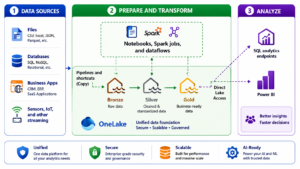
At OneLake, this is a problem that is solved by making OneLake the single source of truth. As all Fabric workloads access the same underlying storage, teams need not create custom pipelines for moving data from one system to another. This directly contributes to quick decision making, reduced storage expenses, and easier data governance — priorities that are of significant concern to almost every data-driven organization these days.
If businesses are already utilizing Power BI or Azure Synapse or Azure Data Factory, then it is important to know about OneLake as it is the foundation for the way Microsoft Fabric will integrate these tools moving forward.
OneLake benefits include:
- Avoids Data Duplication – All Fabric services access/consume the same lake, so no need to have multiple copies of the same data.
- Lowers costs – When redundant copies are eliminated between the BI, data warehouse, and data science environments, storage costs are reduced.
- Enhances Collaboration – Data engineers, analysts, and data scientists can collaborate on the same data without needing to wait for exports or manual data transfer.
- Fewer moving parts – Simplifies Architecture.
- Open Format Compatibility – OneLake will seamlessly integrate with native Fabric services, plus other open-source tools such as Apache Spark.
- Organizations don’t have to move all the data from their existing Azure Data Lake Storage Gen2 to OneLake at once, as they can directly reference it within OneLake.Organizations can shorten the time to market by not having to move all the data from their existing Azure Data Lake Storage Gen2 to OneLake at once; they can simply reference the data directly in OneLake.
OneLake vs Traditional Data Lakes
OneLake is pre-provisioned and fully managed as part of Microsoft Fabric, whereas the Azure Data Lake Storage account is manually provisioned and managed. There’s no need to select a region, create access tiers, or set up storage accounts independently; it’s available, tenant-wide, at the moment that Fabric is enabled. This SaaS business model is what is truly different from the traditional “build it yourself” data lake model that most organizations have used for years now.
Final Thoughts
OneLake is a transformation in thinking about data storage — from data lakes that are siloed by tools to a single, governed, open data foundation for all analytics workloads. As more organizations become aware of Microsoft Fabric, it is becoming an important topic to understand, whether you’re a data engineer, a BI developer, or a data science professional.
SQL School’s training courses for Microsoft Fabric and Azure Databricks provide hands-on experience and project-based learning into the concepts of Microsoft Fabric and Azure Databricks and how they fit into real-world data engineering pipelines.