#Solution Architect

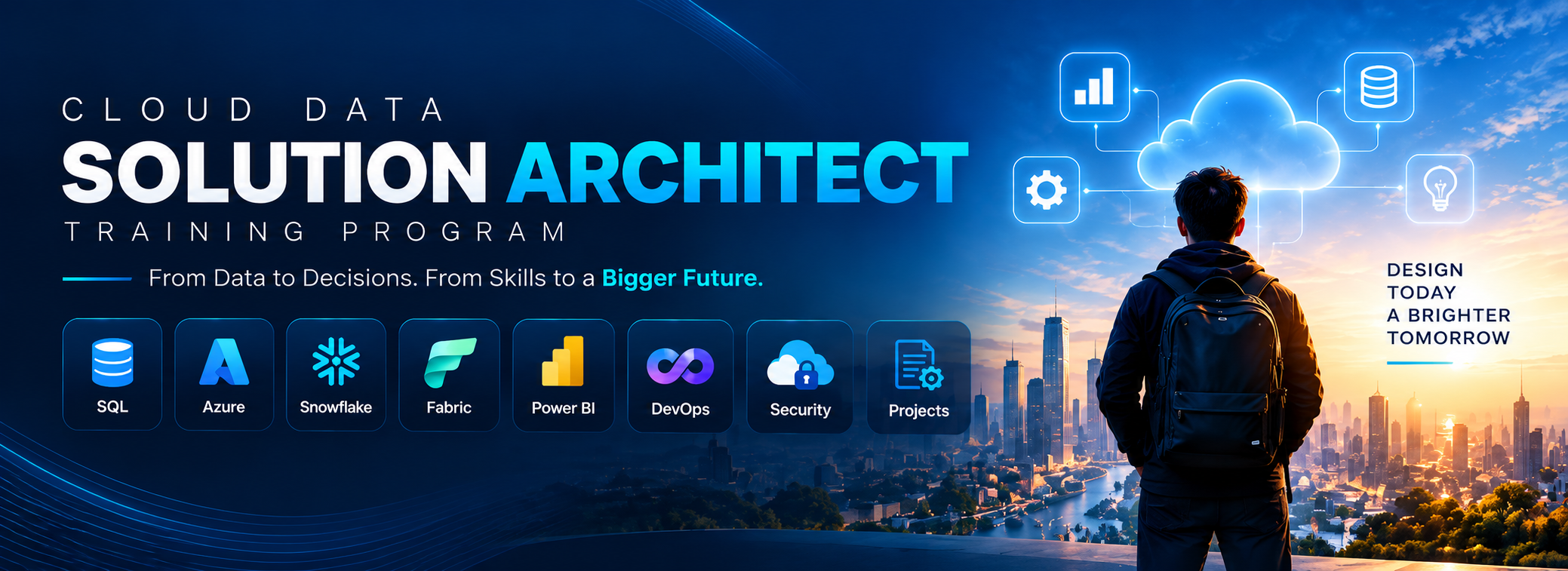
The Cloud Data Solution Architect Training is a practical, project-driven program covering SQL, Azure Data Engineering, Snowflake, Microsoft Fabric, Power BI, AI, DevOps, Security & Governance. It helps professionals move from individual technical skills to end-to-end solution architecture, with hands-on labs, real-world projects, and architecture-focused learning.

Training Highlights

MSSQL & T-SQL + Query Performance Tuning
✅ Azure Data Engineering with AI
✅ Snowflake Engineering with DBT & Cortex AI
✅ Microsoft Fabric Data Engineering
✅ Power BI with AI & Copilot
✅ DevOps & CI/CD Integrations
✅ Cloud Architecture, Security & Governance
✅ End-to-End Enterprise Projects

Modules We Learn

✅ Module 1: MSSQL & TSQL
✅ Module 2: SQL Query Tuning
✅ Module 3: Azure Data Engineering, AI
✅ Module 4: Snowflake Engineering, DBT, Cortex AI
✅ Module 5: Fabric Data Engineering
✅ Module 6: Power BI with AI, Co-Pilot
✅ Module 7: DevOps Integrations
✅ Module 8: Cloud Architecture, Security & Governance
✅ Module 9: End to End Projects

Course Duration: 8 Months
Solution Architect
Course Contents:

Module 1: MSSQL & T-SQL

  • Build the database and SQL foundation required to understand transactional
    systems, data models, data extraction and downstream data platforms.
  • Key topics
  • SQL Server architecture and database fundamentals
  • Tables, constraints, keys and relationships
  • SELECT queries, filtering, sorting and aggregations
  • Joins, subqueries, CTEs and set operators
  • Views, stored procedures and functions
  • Transactions and error handling
  • Window functions and advanced T-SQL
  • Data modeling fundamentals and OLTP vs analytical workloads
  • Module outcome
  • Participants can work confidently with SQL Server and create reliable SQL
    logic for operational and analytical data workloads.

Module 2: SQL Query & Database Performance Tuning

  • Develop the performance mindset required of architects when designing
    scalable database and analytics solutions.
  • Key topics
  • Query execution plans
  • Indexes and indexing strategies
  • Statistics and cardinality concepts
  • SARGability and query rewrites
  • Blocking, locking and concurrency fundamentals
  • Waits and performance troubleshooting
  • Stored procedure performance
  • Identifying expensive queries
  • Database performance baselining and optimization approaches
  • Module outcome
  • Participants can identify common SQL performance problems and incorporate
    performance considerations into solution design.

Module 3: Azure Data Engineering with AI

  • Design and implement modern data engineering solutions using the Microsoft
    Azure data ecosystem.
  • Key topics
  • Azure data platform architecture
  • Azure SQL Database and related data services
  • Azure Data Lake Storage Gen2
  • Azure Data Factory pipelines and orchestration
  • Azure Databricks, Spark and PySpark
  • Delta Lake and Medallion Architecture
  • Data warehouse and lakehouse patterns
  • Batch and streaming concepts
  • Monitoring, error handling and operationalization
  • AI-assisted engineering and productivity scenarios
  • End-to-end Azure data pipelines
  • Module outcome
  • Participants can build and explain an Azure-based data platform from
    ingestion through transformation, storage and consumption.

Module 4: Snowflake Data Engineering, DBT & Cortex AI

  • Learn how to engineer and architect scalable cloud data warehouse and
    transformation solutions on Snowflake.
  • Key topics
  • Snowflake architecture and core objects
  • Databases, schemas, tables and virtual warehouses
  • Stages and data loading
  • Snowpipe and automated ingestion
  • Streams, Tasks and Dynamic Tables
  • Semi-structured data handling
  • Secure data sharing concepts
  • Performance and warehouse optimization
  • DBT models, tests, documentation and transformations
  • DBT deployment workflow concepts
  • Snowflake Cortex AI capabilities and use cases
  • Snowflake security, governance and cost considerations
  • Module outcome
  • Participants can design modern Snowflake data pipelines, transformation
    workflows and AI-enabled analytics patterns.

Module 5: Microsoft Fabric Data Engineering

  • Build unified analytics solutions using Microsoft Fabric and OneLake.
  • Key topics
  • Microsoft Fabric architecture
  • OneLake and workspaces
  • Lakehouse and Warehouse
  • Data Factory pipelines
  • Dataflow Gen2
  • Notebooks, Spark and data engineering
  • Delta tables and Medallion Architecture
  • Shortcuts and data virtualization concepts
  • Mirroring concepts
  • Real-time analytics concepts
  • Semantic model integration
  • Security, governance and monitoring
  • Fabric capacity and performance considerations
  • Module outcome
  • Participants can design and implement a Fabric-based data engineering
    platform and integrate it with enterprise analytics.

Module 6: Power BI with AI & Copilot

  • Connect engineered data platforms to business analytics and decision-making
    experiences.
  • Key topics
  • Power BI architecture and ecosystem
  • Data modeling and star schema
  • Power Query transformation concepts
  • DAX fundamentals and measures
  • Reports, dashboards and visualization design
  • Import, DirectQuery and Direct Lake concepts
  • Power BI with Microsoft Fabric
  • Row-level security and governance
  • Performance optimization fundamentals
  • AI features and Copilot-assisted analytics
  • Enterprise deployment and sharing concepts
  • Module outcome
  • Participants understand how architecture decisions upstream affect semantic
    models, reporting performance, governance and business consumption.

Module 7: DevOps & CI/CD Integrations

  • Introduce repeatable development, version control, testing and deployment
    practices for enterprise data solutions.
  • Key topics
  • Git and source-control fundamentals
  • Branching and collaboration strategies
  • Azure DevOps / GitHub integration concepts
  • CI/CD for database and data engineering workloads
  • Environment separation: development, test and production
  • Deployment pipelines
  • Configuration and secrets management
  • Automated testing concepts
  • Infrastructure-as-Code awareness
  • Release, rollback and operational practices
  • Module outcome
  • Participants can incorporate DevOps principles into cloud data platform
    delivery and architecture.

Module 8: Cloud Architecture, Security & Governance

  • Develop the architecture-level skills that connect the individual technologies
    into secure, scalable and governable enterprise solutions.
  • Key topics
  • Business and technical requirement analysis
  • High-Level Design (HLD) and Low-Level Design (LLD)
  • OLTP, Data Warehouse, Data Lake and Lakehouse architecture
  • Medallion Architecture and data platform design patterns
  • Batch vs streaming architecture
  • Azure identity, Microsoft Entra ID and RBAC concepts
  • Managed identities and secrets management
  • Azure Key Vault
  • Networking, private connectivity and security concepts
  • Microsoft Purview and data governance
  • Data lineage, cataloging and access control
  • Snowflake and Fabric security/governance patterns
  • High availability and disaster recovery concepts
  • RTO and RPO
  • Monitoring and observability
  • Scalability and performance design
  • Cost optimization and FinOps fundamentals
  • Technology evaluation: when to use Azure, Snowflake or Fabric
  • Architecture documentation and stakeholder presentation
  • Module outcome
  • Participants can convert a business requirement into an architecture proposal
    and defend their choices across security, governance, performance,
    scalability and cost.

Module 9: End-to-End Enterprise Projects

  • Apply the complete curriculum through architect-level projects where
    participants design, build, document and present solutions.
  • Key topics
  • Requirement analysis and architecture selection
  • Source-to-target design
  • Data ingestion and orchestration
  • Transformation and data quality
  • Lake / Lakehouse / Warehouse implementation
  • Security and governance design
  • BI and analytics integration
  • DevOps and deployment approach
  • Monitoring and performance considerations
  • Architecture diagrams and project documentation
  • Solution presentation and design justification
  • Module outcome
  • Participants graduate with practical projects they can explain from both an
    engineering and solution-architecture perspective.

Who should enroll in this Cloud Data Solution Architect Training?

The program is suitable for SQL Developers, DBAs, ETL/DWH professionals, Azure and Snowflake Data Engineers, Fabric Engineers, Power BI professionals, Cloud Engineers, Technical Leads, Consultants and experienced IT professionals planning to move toward architecture responsibilities.

Do I need experience in all the technologies before joining?

No. Strong prior knowledge of every platform is not required. The learning path starts with SQL foundations and progresses toward advanced cloud and solution architecture. Basic database/IT knowledge and willingness to participate in hands-on labs and projects are recommended.

What technologies are covered in the program?

The curriculum covers MSSQL & T-SQL, SQL Query Tuning, Azure Data Engineering with AI, Snowflake with DBT & Cortex AI, Microsoft Fabric, Power BI with AI & Copilot, DevOps, Cloud Architecture, Security & Governance, and End-to-End Projects.

Is this training hands-on or theory-based?

It is designed as a practical program combining concept sessions, hands-on labs, scenario-based assignments, platform projects, architecture reviews and interview preparation.

Does the course include real-time projects?

Yes. The curriculum recommends an Azure Enterprise Data Platform, Snowflake Modern Data Platform, Microsoft Fabric Unified Analytics Platform, and Multi-Platform Solution Architecture Capstone.

Will I learn Cloud Architecture, Security and Governance?

Yes. The architecture module includes HLD/LLD, architecture patterns, identity and RBAC, Key Vault, networking, Purview, lineage, governance, HA/DR, monitoring, scalability, cost optimization and technology evaluation.

How is this different from a regular Data Engineering course?

The program goes beyond implementing pipelines or learning individual tools. Its differentiator is the connected learning path across database, engineering, analytics, AI, DevOps and architecture, with emphasis on why a design should be selected, cross-platform decision making and enterprise architecture documentation.

What career roles can I target after completing the training?

The curriculum is aligned toward roles such as Cloud Data Solution Architect, Data Solution Architect, Azure Data Architect, Cloud Data Architect, Senior/Lead Data Engineer, Microsoft Fabric Data Engineer/Architect, Snowflake Data Engineer/Architect, Data Platform Consultant, Analytics Solution Architect and Technical Lead – Data & Analytics.

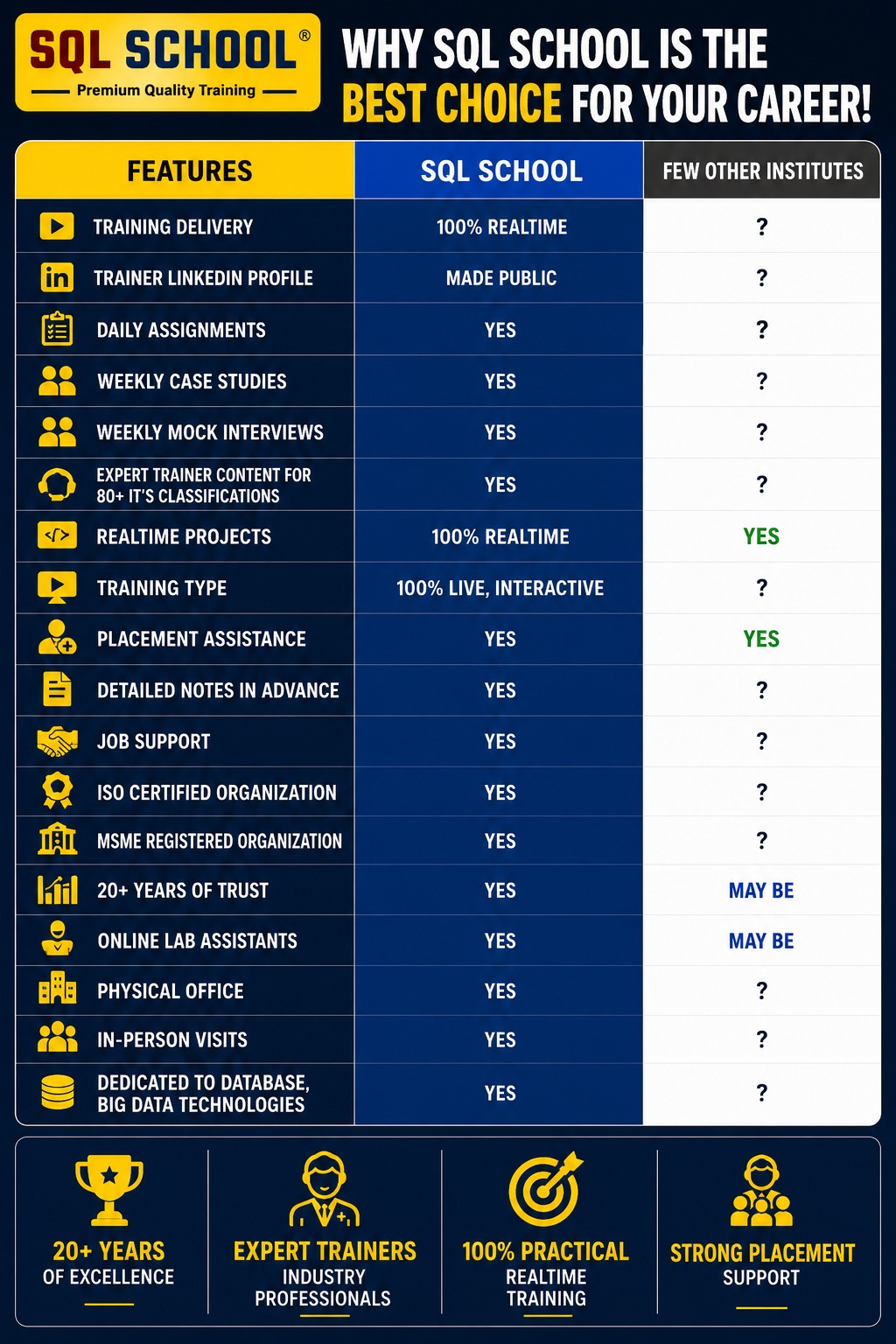
SQL SCHOOL vs Other Institutes

SQL SCHOOL vs Other Institute Comparistion image
SQL Server Training

Training Modes

LIVE Online Training

Instructor Led

Self Paced Videos

 On-Demand

Corporate Training

With 100% Hands-On

Why Choose SQL School

  • 100% Real-Time and Practical
  • ISO 9001:2008 Certified
  • Concept wise FAQs
  • TWO Real-time Case Studies, One Project
  • Weekly Mock Interviews
  • 24/7 LIVE Server Access
A man smiling and giving a thumbs up while holding a notebook.
  • Realtime Project FAQs
  • Course Completion Certificate
  • Placement Assistance
  • Job Support
  • Realtime Project Solution
  • MS Certification Guidance

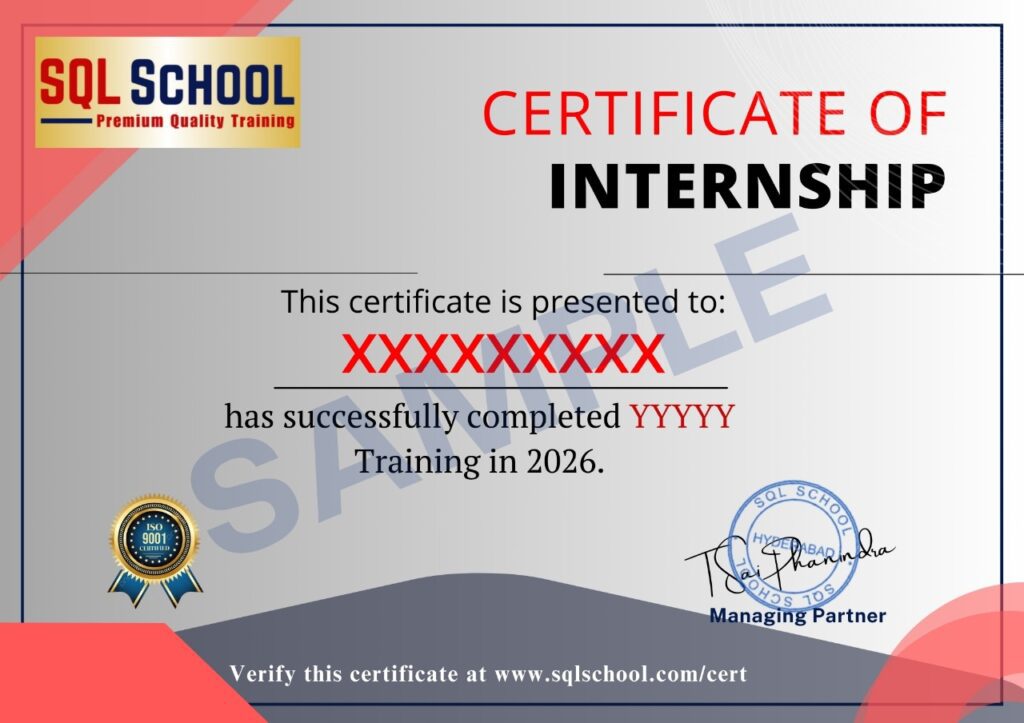
SQL School Azure Data Engineer training certificate of completion issued in January 2026 with verification ID
Verified by MonsterInsights