Snowflake with Databricks Training 2026: Build Your Data Engineering Career with Real-Time Projects
Introduction: Master Two Powerful Data Platforms in 2026
Data is at the center of modern business decisions. From banking and retail to healthcare and e-commerce, organizations need reliable data pipelines to collect, process, transform, and analyze information efficiently.
As data volumes grow, traditional data processing approaches may not be sufficient for every workload. Modern cloud platforms such as Snowflake and Databricks help organizations build scalable data solutions that support analytics, reporting, and advanced data processing.
Snowflake with Databricks Training 2026 is a valuable learning path for professionals who want to understand cloud data warehousing and modern data engineering together.
At SQL School Training Institute, learners can develop practical skills in SQL, Python, PySpark, data transformations, cloud data platforms, and real-time project development.
Whether you are a SQL Developer, ETL Developer, Data Analyst, or aspiring Data Engineer, understanding these technologies can help you expand your technical capabilities.
Why Modern Data Engineers Are Learning Snowflake and Databricks
Data engineering involves much more than writing SQL queries. Data Engineers must understand how to ingest data, clean inconsistent records, transform large datasets, maintain data quality, and prepare information for business analytics.
Snowflake and Databricks address different but complementary requirements in this process.
Snowflake provides cloud data warehousing and analytical capabilities, while Databricks supports distributed data processing, data engineering, and lakehouse workloads.
Learning both platforms helps you understand how different components of a modern data architecture work together.
Key learning benefits include:
- Develop strong cloud data engineering fundamentals.
- Process structured and semi-structured data.
- Build ETL and ELT pipelines.
- Work with SQL, Python, and PySpark.
- Understand incremental data processing.
- Implement data quality and validation checks.
- Prepare analytics-ready datasets for reporting.
- Practice realistic business scenarios through projects.
Snowflake Explained: From Raw Data to Business Insights
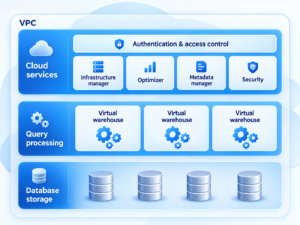
Snowflake is a cloud-based data platform that enables organizations to store, process, query, and share data.
Its architecture separates storage and compute, helping organizations manage resources for different analytical workloads.
Essential Snowflake Skills for Data Engineers
Cloud Data Warehouse Architecture
Understand databases, schemas, tables, views, and virtual warehouses.
Advanced SQL Development
Practice joins, common table expressions, subqueries, window functions, aggregations, and query optimization techniques.
Data Loading and Transformation
Learn how to load files and transform data using SQL and supported ingestion methods.
Incremental Data Processing
Understand approaches for processing new and changed records while handling duplicates and updates.
Snowflake Streams and Tasks
Explore change tracking and scheduled SQL operations for supported automation scenarios.
Data Security and Recovery
Understand role-based access control, permissions, and Time Travel.
These skills help Data Engineers build and maintain analytical data structures that support business reporting and decision-making.
Databricks Explained: Process Large Datasets with Modern Data Engineering
Databricks is a data and AI platform that supports data engineering, distributed processing, analytics, and machine learning.
It enables teams to develop pipelines that process data from multiple sources and prepare it for downstream applications.
Databricks Technologies Worth Learning
Apache Spark and PySpark
Learn distributed data processing and use Python APIs to transform large datasets.
DataFrames and Spark SQL
Read, filter, join, aggregate, and manipulate datasets using DataFrames and SQL.
Delta Lake
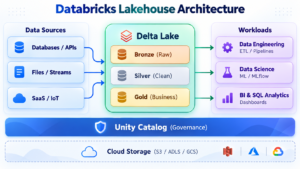
Understand reliable data storage, transaction support, and table versioning.
Medallion Architecture
Organize data into Bronze, Silver, and Gold layers for ingestion, cleansing, and business-ready transformations.
Auto Loader
Explore incremental file ingestion patterns for supported cloud storage sources.
Lakeflow and Workflow Orchestration
Understand how supported pipeline and workflow features help automate data ingestion, transformations, and scheduled jobs.
Unity Catalog
Learn data governance, permissions, and centralized management of supported data assets.
Together, these technologies provide a foundation for developing scalable and maintainable data pipelines.
Snowflake vs. Databricks: Choose the Right Tool for the Right Workload
Snowflake and Databricks are not simply competing technologies. Their capabilities overlap, and organizations may use one or both depending on their requirements.
| Area | Snowflake | Databricks |
|---|---|---|
| Core strengths | Cloud data warehousing and SQL analytics | Data engineering, distributed processing, and lakehouse workloads |
| Common languages | SQL, with additional supported development options | Python, PySpark, SQL, and other supported languages |
| Data transformation | SQL-based transformations and supported pipeline features | Spark-based transformations and supported pipeline features |
| Automation | Tasks and other supported automation features | Workflows and pipeline orchestration |
| Analytics | Analytical tables, queries, and data sharing | Lakehouse analytics and data processing |
| Common learning focus | SQL, warehouse concepts, loading, and optimization | Spark, PySpark, Delta Lake, and pipeline development |
Understanding the strengths of each platform helps you design appropriate solutions rather than relying on a single tool for every requirement.
Build a Modern Data Pipeline: How Snowflake and Databricks Work Together
Consider a business that receives sales information from online transactions, retail stores, customer applications, and operational databases.
The company needs to combine this information, validate it, calculate business metrics, and make it available for reporting.
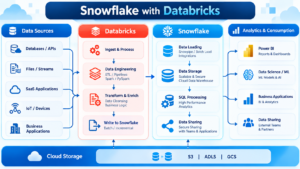
A possible architecture is:
Data Sources → Databricks Processing → Curated Data → Snowflake Analytics → Power BI Dashboard
The exact implementation depends on the organization’s cloud environment, integration methods, data volumes, and architecture requirements.
Step 1: Collect Data from Multiple Sources
Data may arrive through CSV files, databases, APIs, or cloud storage.
The first step is to understand the source structure, data formats, refresh frequency, and quality requirements.
Step 2: Transform Data in Databricks
Use Python or PySpark to standardize column names, handle missing values, remove duplicates, apply business rules, and join datasets.
Step 3: Organize Data into Processing Layers
Use the Medallion Architecture to separate raw data, cleansed data, and analytics-ready datasets.
Step 4: Load Curated Data into Snowflake
Transfer the prepared datasets through an appropriate integration or loading mechanism. Organize the target data into suitable Snowflake databases, schemas, and tables.
Step 5: Create Analytical Models
Use Snowflake SQL to create views, aggregate business metrics, and prepare datasets for reporting.
Step 6: Automate and Monitor the Pipeline
Schedule supported workflows, validate data quality, track failures, and implement recovery procedures.
Step 7: Deliver Business Insights
Connect Power BI or another business intelligence tool to the curated datasets to create dashboards and reports.
This workflow demonstrates how data engineering connects source systems with business decision-making.
Real-Time Project Spotlight: Retail Sales Intelligence Platform
A practical project helps learners move beyond individual commands and understand how data engineering concepts fit together.
Business Challenge
Imagine a retail organization operating physical stores and an e-commerce website. Sales records arrive throughout the day, but the management team struggles to obtain consistent information about revenue, product performance, and regional sales.
The company needs a data pipeline that prepares reliable sales information for analytical reporting.
Project Implementation
Phase 1: Data Ingestion
Collect sample sales transactions, customer records, product details, and store information.
Phase 2: Data Processing
Use Databricks and PySpark to validate records, standardize data types, remove duplicates, and apply business rules.
Phase 3: Data Lake Organization
Store raw, cleansed, and refined data in appropriate processing layers.
Phase 4: Snowflake Integration
Load curated data into Snowflake and organize it for analytical queries.
Phase 5: Incremental Loading
Process new or changed records and handle duplicate transactions, updated orders, and late-arriving data.
Phase 6: Business Analytics
Calculate total revenue, monthly sales, top-performing products, customer purchasing patterns, and regional performance.
Phase 7: Dashboard Development
Create Power BI dashboards that help stakeholders monitor business performance.
Expected Learning Outcomes
Through this project, learners can practice:
- Building an end-to-end data processing workflow.
- Writing PySpark transformations.
- Working with Delta Lake and Medallion Architecture.
- Loading and querying data in Snowflake.
- Designing incremental processing strategies.
- Validating data quality.
- Troubleshooting pipeline failures.
- Preparing analytical datasets for reporting.
The project is designed as a realistic learning scenario. Actual business implementations may require additional security, monitoring, testing, and performance optimization.
Career Paths After Snowflake and Databricks Training
Learning Snowflake and Databricks can support your preparation for several data-related career paths.
Data Engineer: Develop and maintain data pipelines that deliver reliable information to downstream systems.
Snowflake Developer: Build SQL transformations, analytical tables, and data warehouse solutions.
Databricks Data Engineer: Develop data processing pipelines using Spark, Python, SQL, and supported Databricks features.
ETL Developer: Extract, transform, and load data from multiple systems.
Cloud Data Engineer: Build and maintain data solutions on cloud platforms.
Analytics Engineer: Transform raw data into reliable, reusable datasets for analytics and reporting.
Your eligibility for these roles depends on your technical skills, practical experience, project portfolio, and employer requirements. Knowledge of SQL, Python, cloud services, data modeling, and pipeline orchestration can strengthen your preparation.
Who Should Consider This Data Engineering Learning Path?
This learning path can be useful for:
- Freshers who want to explore Data Engineering.
- SQL Developers looking to expand into cloud platforms.
- ETL Developers interested in distributed data processing.
- Data Analysts who want to understand how analytical datasets are built.
- Azure Data Engineers who want to broaden their Snowflake and Databricks knowledge.
- Working professionals preparing for data engineering interviews.
Basic SQL knowledge is helpful. Python familiarity is beneficial for Databricks-based development, although the required prerequisites depend on the selected course.
Learn with SQL School Training Institute
SQL School Training Institute, Hyderabad, focuses on practical technical education designed to help learners strengthen their understanding of data technologies.
The learning experience emphasizes:
- Hands-on training and practical exercises.
- Step-by-step technical explanations.
- Assignments and scenario-based learning.
- Real-time project practice.
- Resume preparation guidance.
- One-to-one mock interview preparation.
- Class recordings and notes according to the applicable course access policy.
- Placement assistance.
Learners should confirm the latest course syllabus, batch schedule, fees, and available project modules with the institute before enrolling.
Your 2026 Data Engineering Roadmap
If your goal is to become a Data Engineering professional, follow a structured approach:
- Strengthen SQL: Practice joins, subqueries, window functions, and analytical queries.
- Learn Python: Understand data structures, functions, file handling, and data processing.
- Explore PySpark: Practice DataFrames, transformations, joins, and aggregations.
- Understand Delta Lake: Learn table management and reliable data processing.
- Master Snowflake Fundamentals: Practice loading, querying, modeling, and managing analytical data.
- Build a Complete Project: Integrate ingestion, transformation, validation, and analytics.
- Prepare for Interviews: Explain your architecture, technical decisions, troubleshooting approach, and project outcomes.
A consistent combination of technical learning and project practice can help you build confidence in modern data engineering concepts.
Frequently Asked Questions
1. What is Snowflake with Databricks Training?
It is a learning path covering cloud data warehousing, distributed data processing, data transformations, pipeline development, and practical integration scenarios.
2. Can beginners learn Snowflake and Databricks?
Yes. Beginners can start with SQL and basic data concepts before progressing to Snowflake, Python, PySpark, and data pipeline development.
3. Why should I learn both platforms?
Learning both helps you understand cloud data warehousing and distributed data processing, including how they can work together in a modern data architecture.
4. Is Python necessary for Databricks?
Python and PySpark are widely used for Databricks data engineering. SQL is also important, and the language requirements depend on the tasks and course content.
5. What projects can I build?
You can practice retail sales analytics, banking transaction processing, e-commerce reporting, customer analytics, and other data pipeline scenarios.
6. What are the career opportunities?
Possible roles include Data Engineer, Snowflake Developer, Databricks Data Engineer, ETL Developer, Cloud Data Engineer, and Analytics Engineer.
7. Does SQL School guarantee a job after training?
No training can guarantee employment. SQL School provides placement assistance, while employment outcomes depend on individual skills, experience, interview performance, and employer requirements.
Conclusion: Turn Data Engineering Knowledge into Practical Skills
Snowflake and Databricks provide important capabilities for modern data engineering, from cloud data warehousing and SQL analytics to distributed data processing and pipeline development.
By learning SQL, Python, PySpark, Delta Lake, incremental loading, and analytical data modeling, you can develop a stronger foundation for working with modern data platforms.
A real-time project can help connect these concepts into a complete workflow and provide practical experience to discuss during technical interviews.
Snowflake with Databricks Training Course: https://sqlschool.com/snowflake-databricks-training/
Snoflake with Databricks Curriculum: https://sqlschool.com/wp-content/uploads/2026/09/SnowflakeWithDatabricks.pdf
Ready to explore Snowflake with Databricks Training in 2026?
Connect with SQL School Training Institute to learn about available batches, course modules, practical projects, and placement assistance.
SQL School Training Institute – Hyderabad
Contact: +91 9666440801 | +91 9951440801
Website: https://sqlschool.com/
Founder & Trainer: Sai Phanindra
#SnowflakeTraining #DatabricksTraining #DataEngineering #DataEngineerTraining #SnowflakeWithDatabricks #PySpark #ApacheSpark #DeltaLake #CloudDataEngineering #RealTimeProjects #SQLSchool #DataEngineering2026