# AWS Data Engineering

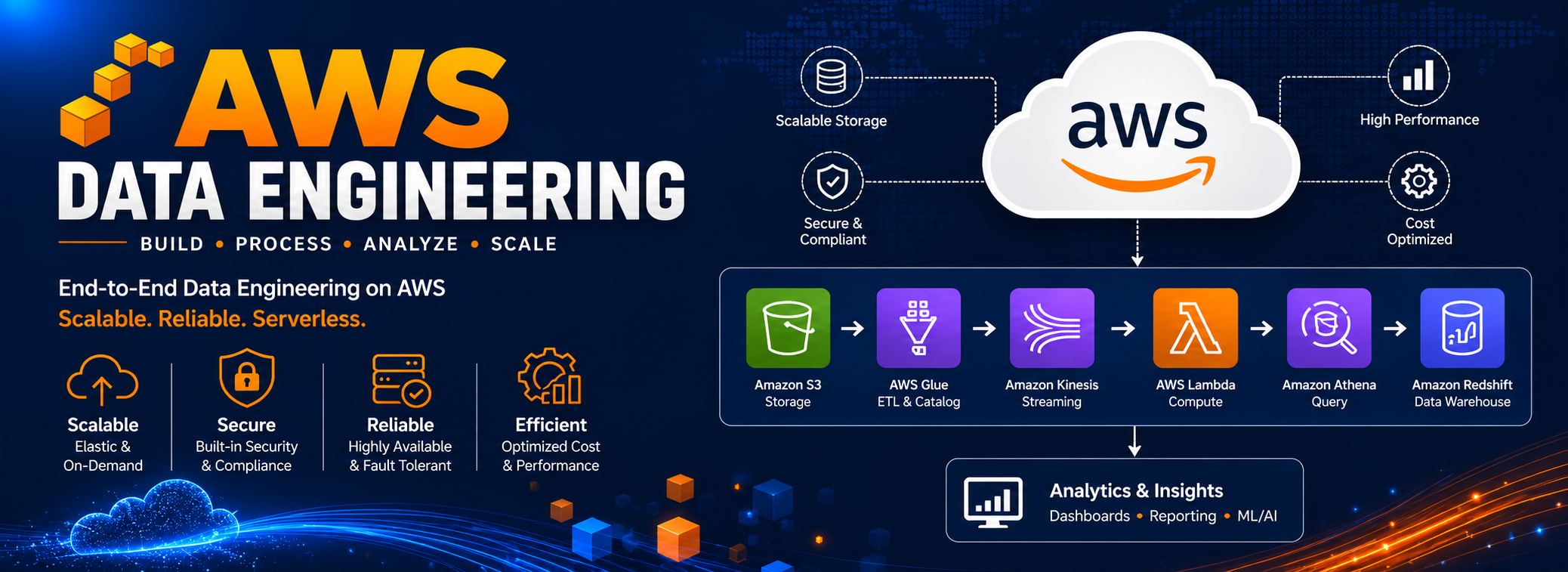
Build job-ready AWS Data Engineering skills through practical, hands-on training focused on building scalable data pipelines. Learn Amazon S3, AWS Glue, Lambda, Kinesis, Athena, Redshift, SQL, Python, and PySpark, along with workflow orchestration and monitoring.

Training Highlights

✅ 100% Hands-On Practical Training
✅ S3 • Glue • Lambda • Kinesis • Redshift
✅ SQL • Python • PySpark
✅ Batch + Real-Time Data Pipelines
✅ End-to-End Real-Time Project
✅ Interview & Career Preparation

Modules We Learn:

✅ Module 1: AWS Data Engineering Introduction
✅ Module 2: AWS Fundamentals for Data Engineering
✅ Module 3: Linux for AWS Data Engineering
✅ Module 4: SQL for AWS Data Engineering
✅ Module 5: Python for AWS Data Engineering
✅ Module 6: PySpark for AWS Data Engineering
✅ Module 7: Storage with Amazon S3
✅ Module 8: Data Processing with AWS Glue
✅ Module 9: Querying with Amazon Athena
✅ Module 10: Real-Time Data Processing with Amazon Kinesis
✅ Module 11: Serverless Compute with AWS Lambda
✅ Module 12: Data Warehousing with Amazon Redshift
✅ Module 13: Logging & Observability with Amazon CloudWatch
✅ Module 14: Workflow Orchestration with AWS Step Functions
✅ Module 15: Apache Airflow for AWS Data Engineering
✅ Module 16: End-to-End Real-Time Project
What is AWS Data Engineering?

AWS Data Engineering focuses on designing, building, managing, and optimizing cloud-based data pipelines and data warehouses using AWS services such as S3, Redshift, Glue, Lambda, EMR, Kinesis, and Athena.

Who should join the AWS Data Engineer course?

Anyone aspiring to become a Data Engineer, Cloud Engineer, ETL Developer, Big Data Engineer, Python ETL Developer, or professionals wanting to shift into Cloud & Big Data roles can join.

What are the job roles for AWS Data Engineers?

AWS Data Engineers work on data extraction, transformations, loads (ETL/ELT), big data processing, DWH design, security, pipelines, notebooks, and end-to-end enterprise workflows.

Is it mandatory to know programming before starting the course?

No. Basic understanding of computers is enough. Linux, AWS console, and ETL tools are taught step-by-step from basics.

How long is the AWS Data Engineer course?

The course duration is approximately 2 months with hands-on practical sessions, real-time scenarios, and a complete end-to-end project.

What modules are covered in this AWS Data Engineering program?

Linux, AWS Fundamentals, Data Streaming (Kinesis), RDS, Redshift, Lambda, Glue, CloudFormation, EMR, Spark, and Athena.

What Linux skills will I learn as part of the training?

You will learn CLI navigation, file system hierarchy, file management, user management, authentication, permissions, variables, and Linux usage inside AWS EC2 environments.

What AWS fundamentals are included in the course?

AWS account setup, global infrastructure, compute (EC2), VPC, security groups, IAM, EBS, S3, cost management, CloudWatch, and networking concepts.

Will I learn how to work with AWS S3?

Yes. You learn buckets, objects, security, versioning, policies, storage classes, website hosting, automation, and integration with other AWS tools.

Does the training cover AWS IAM & Security?

Yes. Users, groups, policies, IAM roles, access control, authentication mechanisms, encryption, CloudShell, and real-time IAM best practices are included.

Does the course include AWS Kinesis for Data Streaming?

Yes. You learn Kinesis Streams, Firehose, enhanced fan-out, producers/consumers, transformations with Lambda, and real-time ETL streaming pipelines.

Do we learn AWS RDS in detail?

Yes. You will learn RDS setup, subnet groups, backups, snapshots, restores, encryption, replication, parameter groups, proxies, and multi-AZ configurations.

Are we taught Amazon Redshift for Data Warehousing?

Yes. You will learn RDS setup, subnet groups, backups, snapshots, restores, encryption, replication, parameter groups, proxies, and multi-AZ configurations.

Is AWS Lambda a part of the AWS Data Engineer curriculum?

Yes. Lambda fundamentals, layers, Python & Java usage, S3 automation, event notifications, API Gateway, and serverless ETL patterns are included.

Do we learn AWS Glue for ETL/ELT?

Yes. Glue crawlers, ETL scripts, transformations, workflows, triggers, classifiers, data quality, budgets, and fully automated pipelines are covered.

Does the course cover CloudFormation?

Yes. You learn infrastructure-as-code concepts to automate AWS resource creation and run Glue pipelines using CloudFormation templates.

Will I learn Big Data processing with EMR & Spark?

Yes. EMR concepts, PySpark, ETL transformations, DWH integrations, and real-time data workflow implementations are included.

What is taught about AWS Athena?

Athena querying, federated queries, performance tuning, cost optimization, workgroups, and hands-on analytics operations are included.

Does the training include a real-time project?

Yes. An end-to-end enterprise project combining data ingestion, streaming, ETL, DWH loads, analytics, automation, and big data processing is implemented practically.

What training modes are available for AWS Data Engineer?

Live Online Training, Self-Paced Videos, Classroom Training (where available), Corporate Batches, and Free Demo Sessions with the trainer.

AWS Data Engineer
Course Contents:

Module 1: AWS Data Engineering Introduction

Learning outcome: Understand the role of a data engineer and how AWS services fit into modern data
platforms.

  • What is Data Engineering and common data engineering technologies
  • AWS Data Engineering overview
  • Role of SQL, Linux, Python, and PySpark in data engineering
  • Batch vs. streaming data pipeline concepts

Hands-on: Map a sample business requirement to a simple AWS data pipeline.

Module 2: AWS Fundamentals for Data Engineering

Learning outcome: Build the AWS foundation required to work safely with data services.

  • AWS Cloud Computing introduction, AWS account sign-in, Free Tier and service overview
  • AWS Global Infrastructure: Regions and Availability Zones
  • EC2, IAM and default VPC fundamentals
  • Basic cost-awareness and resource cleanup practices

Hands-on: Create/access an AWS environment and identify the services used in the course.

Module 3: Linux for AWS Data Engineering

Learning outcome: Use Linux confidently for cloud data engineering tasks.

  • Linux filesystem architecture
  • Linux installation/use on an EC2 instance
  • Connecting to a Linux machine
  • Basic commands, filters, files/directories and permissions

Hands-on: Connect to an EC2 Linux host and perform common file and permission operations.

Module 9: Querying with Amazon Athena

Learning outcome: Query S3 data efficiently using serverless SQL.

  • Athena and Glue Catalog integration
  • Query Editor and database/table creation
  • CTAS and data population
  • Athena architecture and relationship with Hive
  • Partitioned tables and partition-aware queries
  • Insert into partitions and validate partitioning
  • Drop tables and manage related data files

Hands-on: Create a partitioned Athena table and compare partition-aware queries.

Module 8: Data Processing with AWS Glue

Learning outcome: Build metadata-driven ETL pipelines with AWS Glue.

  • AWS Glue components
  • Crawlers, Catalog databases and tables
  • Create and run Glue jobs and triggers
  • Glue workflows and validation
  • Spark History Server / Spark UI setup concepts
  • IAM permissions required for Glue
  • Managing the Glue Data Catalog and crawling multiple folders

Hands-on: Catalog S3 data, run a Glue ETL job and validate transformed output.

Module 7: Storage with Amazon S3

Learning outcome: Design and manage a durable data-lake storage layer.

  • S3 buckets and objects using AWS Console
  • Upload local datasets and manage objects
  • Versioning and cross-Region replication
  • Storage classes and Glacier overview
  • S3 management using AWS CLI
  • S3 integration with PySpark, Glue, Lambda and Athena

Hands-on: Create a structured S3 data lake area and load versioned source data.

Module 6: PySpark for AWS Data Engineering

Learning outcome: Process distributed datasets using Spark concepts relevant to AWS workloads.

  • PySpark foundation
  • RDD programming: transformations and actions
  • Spark SQL: DataFrames, tables, DSL and native SQL
  • PySpark Streaming concepts
  • Database integration and Amazon S3 integration

Hands-on: Transform a dataset from S3 using DataFrames and Spark SQL.

Module 5: Python for AWS Data Engineering

Learning outcome: Use Python as the scripting foundation for AWS automation and data processing.

  • Python installation, interactive mode and script mode
  • Editors/IDEs including Jupyter, PyCharm and VS Code
  • Language fundamentals, indentation and data types
  • Flow control, collections, modules, packages and libraries
  • Functions, lambda functions, classes and objects

Hands-on: Write a Python script that reads, validates and transforms a sample dataset.

Module 4: SQL for AWS Data Engineering

Learning outcome: Query and manipulate relational data used by pipelines and analytics workloads.

  • SQL basics: DDL, DML, DQL, TCL and DCL
  • Filtering, sorting and joins
  • MySQL setup concepts
  • Provisioning MySQL using Amazon RDS

Hands-on: Create a small relational dataset in RDS/MySQL and query it with joins and filters.

Module 10: Real-Time Data Processing with Amazon Kinesis

Learning outcome: Understand and implement streaming ingestion patterns.

  • Building a streaming pipeline using Kinesis
  • Rotating logs and Firehose agent setup
  • Create a Firehose delivery stream
  • Pipeline planning and IAM permissions
  • Configure, start and validate the agent
  • Integrating streaming data with PySpark concepts

Hands-on: Stream sample events into an AWS destination and validate delivery.

Module 11: Serverless Compute with AWS Lambda

Learning outcome: Build event-driven data processing without managing servers.

  • Lambda Hello World and local development setup
  • Deploy a project to AWS Lambda
  • Using third-party Python libraries
  • S3 download/upload integration
  • Incremental file validation
  • Bookmarks/state maintained in S3
  • Deployment and scheduling with Amazon EventBridge

Hands-on: Build an incremental S3 processing Lambda and schedule it with EventBridge.

Module 12: Data Warehousing with Amazon Redshift

Learning outcome: Load, query and manage analytical data in Amazon Redshift.

  • Redshift introduction and cluster creation concepts
  • Query Editor, information schema and saved queries
  • Tables and CRUD operations
  • COPY data from S3 to Redshift
  • Load JSON data using an IAM role
  • Redshift architecture and multi-node cluster concepts
  • Databases, users and schemas
  • PySpark integration with Redshift

Hands-on: Load curated S3 data into Redshift and run analytical SQL queries.

Module 13: Logging & Observability with Amazon CloudWatch

Learning outcome: Monitor pipeline health and troubleshoot AWS data workloads.

  • CloudWatch role in data engineering observability
  • Logs, metrics and alarms for pipeline components
  • Monitoring failures and operational events
  • Basic troubleshooting workflow for data pipelines

Hands-on: Define monitoring checkpoints and alerts for the capstone pipeline.

Module 14: Workflow Orchestration with AWS Step Functions

Learning outcome: Coordinate multi-step data workflows with retries and error handling.

  • Step Functions introduction and setup
  • States, tasks and state machines
  • Integrating with AWS services
  • Developing and deploying workflows
  • Monitoring, logging and error handling
  • Workflow design best practices
  • Scaling, optimization and cost management

Hands-on: Orchestrate a serverless ETL workflow with failure handling.

Module 15: Apache Airflow for AWS Data Engineering

Learning outcome: Understand DAG-based orchestration for scheduled data workflows.

  • Airflow role in data engineering orchestration
  • DAGs, tasks, dependencies and scheduling
  • Coordinating AWS-oriented pipeline steps
  • Operational considerations for workflow monitoring

Hands-on: Design an Airflow DAG for a multi-stage AWS data pipeline.

Module 16: End-to-End Real-Time Project

Learning outcome: Combine the course services into a portfolio-ready AWS data engineering solution.

  • Project requirements and pipeline planning
  • Source ingestion to S3 / streaming layer
  • Cataloging and ETL processing
  • Query and warehouse serving layer
  • Workflow orchestration and monitoring
  • Validation, troubleshooting and project documentation
  • Resume guidance, interview FAQs and mock interview support

Hands-on: Build and present an end-to-end AWS data engineering project with architecture,
implementation flow and validation.

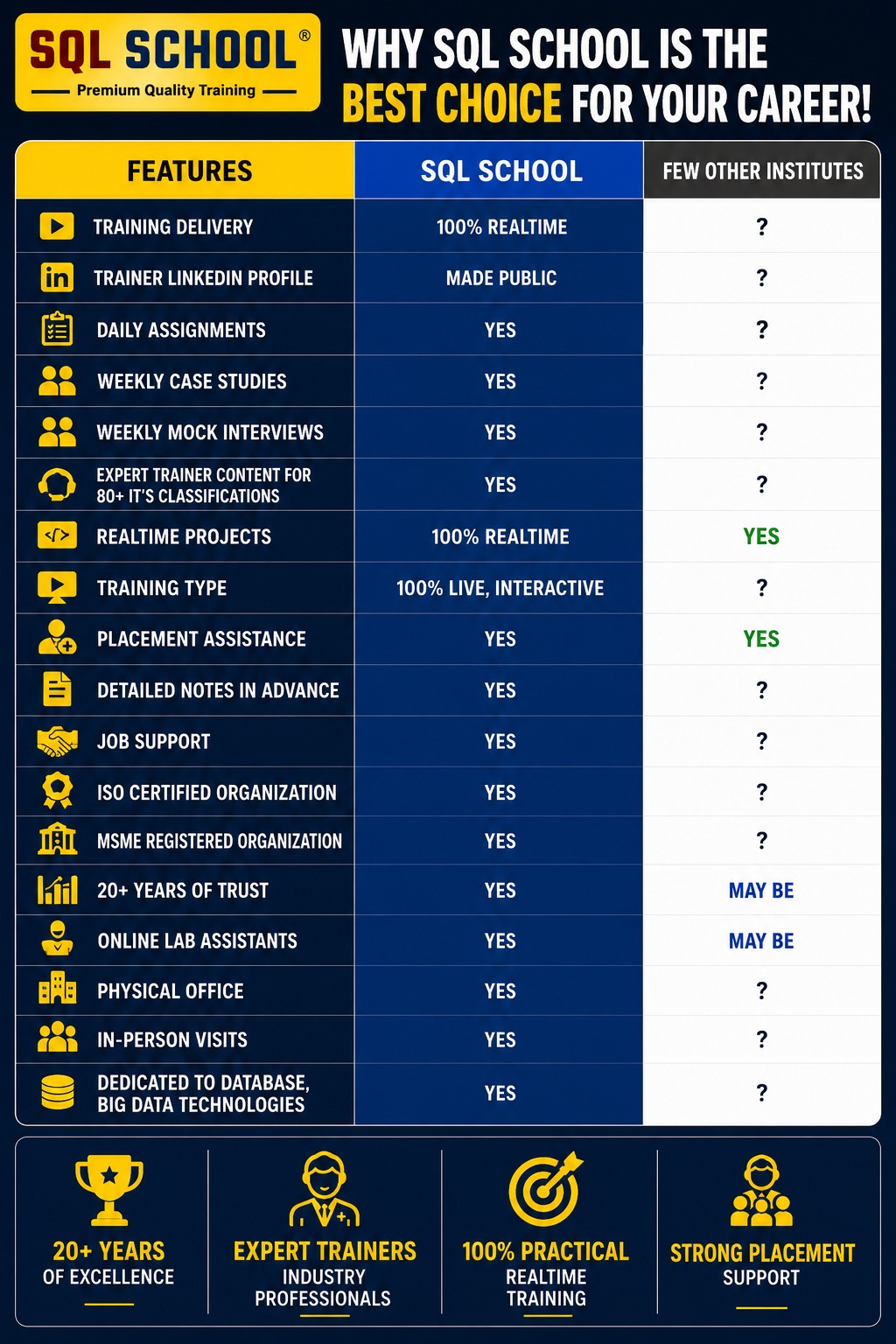
SQL SCHOOL vs Other Institutes

SQL SCHOOL vs Other Institute Comparistion image
SQL Server Training

Training Modes

LIVE Online Training

Instructor Led

Self Paced Videos

 On-Demand

Corporate Training

With 100% Hands-On

Our Recent Success Stories

Why Choose SQL School

  • 100% Real-Time and Practical
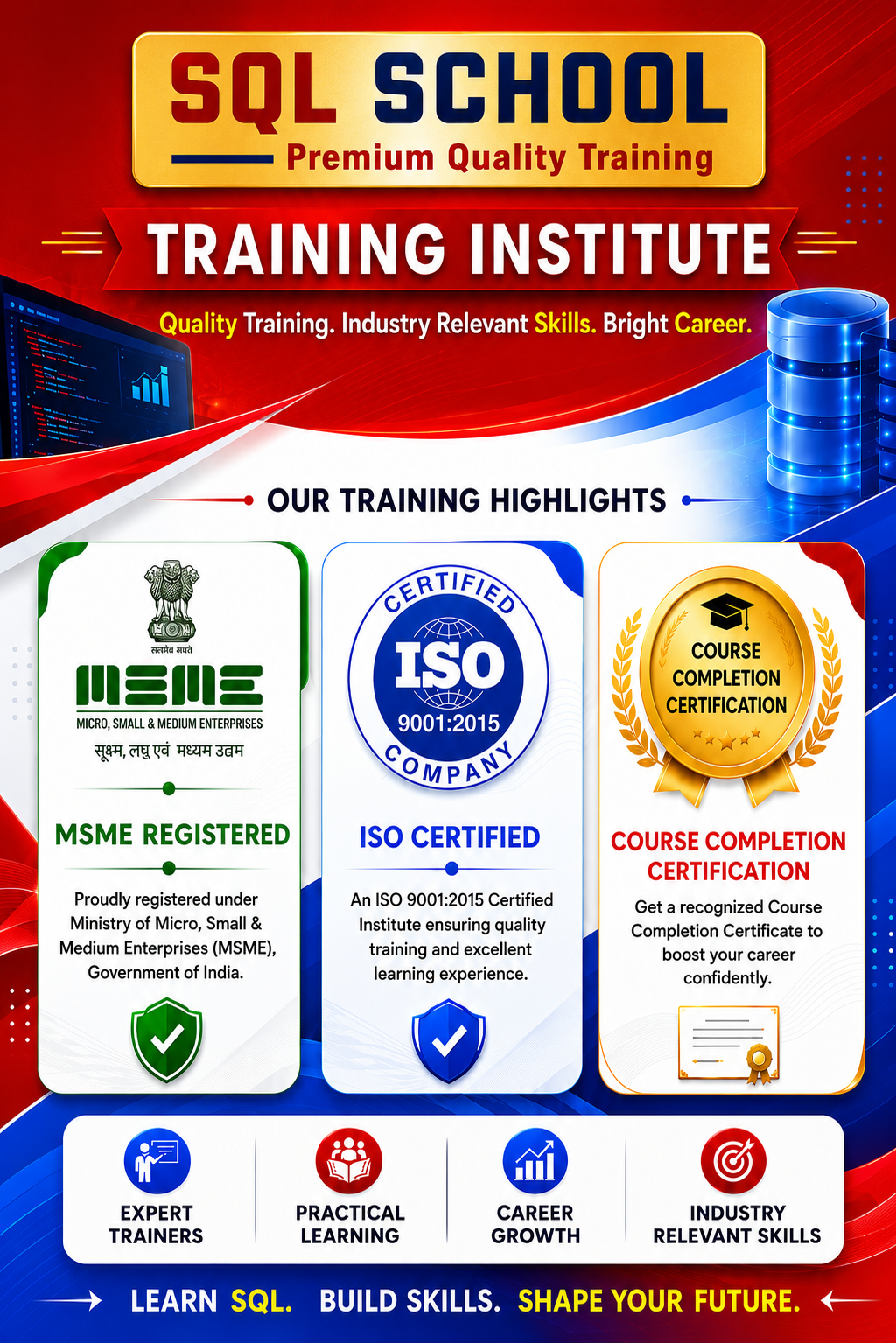
  • ISO 9001:2008 Certified
  • Concept wise FAQs
  • TWO Real-time Case Studies, One Project
  • Weekly Mock Interviews
  • 24/7 LIVE Server Access
A man smiling and giving a thumbs up while holding a notebook.
  • Realtime Project FAQs
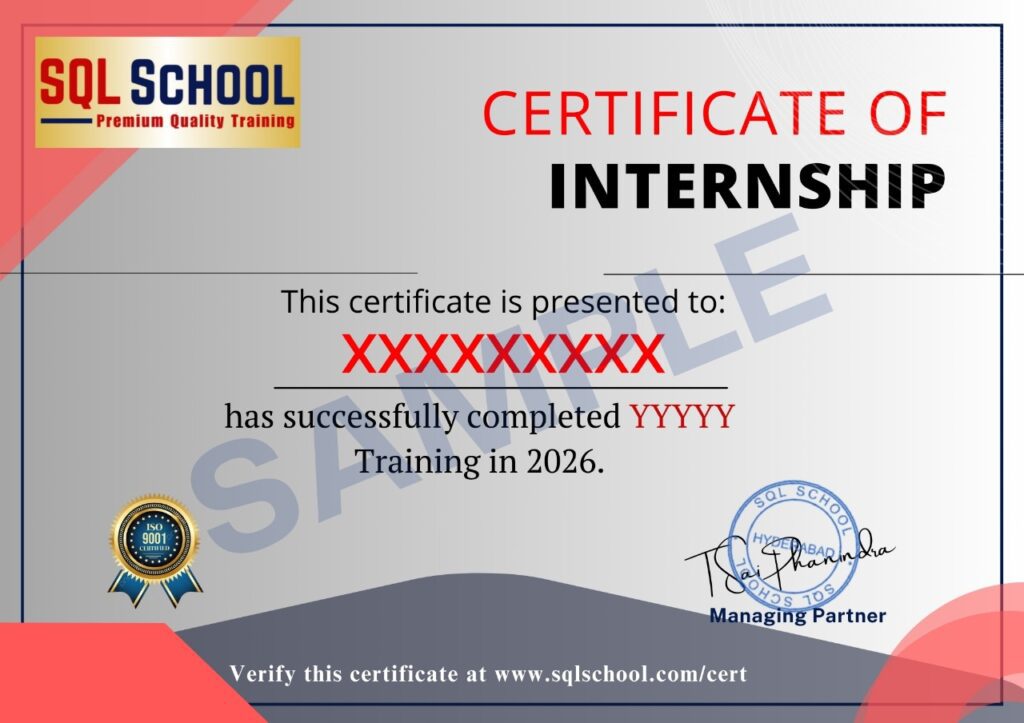
  • Course Completion Certificate
  • Placement Assistance
  • Job Support
  • Realtime Project Solution
  • MS Certification Guidance

SQL School Fabric Data Engineer training certificate of completion issued in January 2026 with verification ID
Verified by MonsterInsights