Databricks Interview Questions Series 2 – Top 10 Interview Questions and Answers
If you are preparing for a Data Engineering role, this Databricks Interview Questions Series 2 is built exactly for you. This is the second part of our popular interview preparation series from SQL School, and it picks up right where Level 1 left off — moving from the fundamentals into the concepts that real interviewers actually probe when they want to check whether a candidate can work with Delta Lake and Databricks in a production environment.
In this Databricks Interview Questions Series 2, our trainer walks through ten commonly asked Databricks interview questions, one at a time, with a clear explanation and a short, practical answer for each. These are not textbook definitions — they are the kind of answers that reflect how Managed Tables, Delta Lake, Auto Loader, Unity Catalog, and performance-tuning commands like OPTIMIZE and VACUUM actually behave in day-to-day data engineering work. Whether you are a fresher trying to break into Azure Data Engineering or an experienced professional brushing up before a Databricks-focused interview, this set of questions covers the concepts that recruiters expect you to know cold.
Below, you’ll find all ten questions from the video along with the answers, presented together with the reference slides from the session so you can revise visually as well as textually. Let’s get started with Question 11.
11. What is the difference between a Managed Table and an External Table in Databricks?
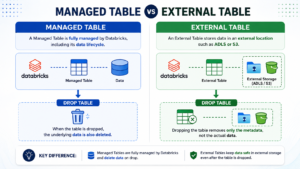
A Managed Table is fully managed by Databricks, including its data lifecycle. When the table is dropped, the underlying data is also deleted.
An External Table stores data in an external location such as ADLS or S3. Dropping the table removes only the metadata, not the actual data.
12. What is Delta Lake and why is it preferred over Parquet?
Delta Lake adds a transaction layer on top of Parquet. It provides ACID transactions, schema enforcement, time travel, reliable updates/deletes, and better support for production data pipelines.
13. What is the Delta Transaction Log?
The _delta_log folder maintains the transaction history and current state of a Delta table. It records operations such as inserts, updates, deletes, schema changes, and file additions/removals.
This is one of the most important concepts to know well in this Databricks Interview Questions Series 2, since almost every follow-up question about Time Travel, MERGE, or OPTIMIZE eventually traces back to how the transaction log tracks table versions.
14. What is Time Travel in Delta Lake?
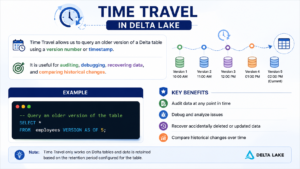
Time Travel allows us to query an older version of a Delta table using a version number or timestamp. It is useful for auditing, debugging, recovering data, and comparing historical changes.
Example:
sql
SELECT *
FROM employees VERSION AS OF 5;
15. What is the purpose of the MERGE command?
MERGE is used to perform UPSERT operations. It can update existing records and insert new records in a single operation. It is commonly used for incremental loads and CDC (Change Data Capture) pipelines.
16. What is Auto Loader in Databricks?
Auto Loader incrementally processes new files arriving in cloud storage. It efficiently handles large numbers of files and supports schema inference and schema evolution. It commonly uses format(“cloudFiles”).
17. What is the Medallion Architecture?
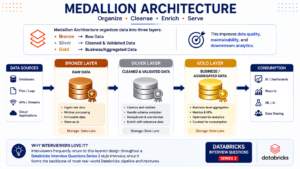
Medallion Architecture organizes data into three layers:
- Bronze → Raw Data
- Silver → Cleaned & Validated Data
- Gold → Business/Aggregated Data
This improves data quality, maintainability, and downstream analytics. Interviewers frequently return to this layered design throughout a Databricks Interview Questions Series 2 style interview, since it forms the backbone of most real-world Databricks pipeline architectures.
18. What is Unity Catalog?
Unity Catalog provides centralized data governance across Databricks workspaces. It manages permissions, discovery, auditing, lineage, tables, views, volumes, models, and other data/AI assets.
19. What does OPTIMIZE do in Databricks?
OPTIMIZE is a Delta Lake command used to improve the performance of queries by compacting many small data files into fewer, larger files. In data engineering pipelines, frequent INSERT, UPDATE, MERGE, or streaming operations can create many small files. These small files increase file-opening and metadata overhead when Databricks reads the table.
20. What is VACUUM in Delta Lake?
VACUUM is a Delta Lake command used to remove old data files that are no longer referenced by the current version of a Delta table and are older than the configured retention period.
When a Delta table is updated, deleted, or overwritten, the old Parquet files are not immediately deleted. They may still be required for Time Travel or by previous table versions. Over time, these unused files can consume a significant amount of storage.
Wrapping Up
That brings us to the end of this Databricks Interview Questions Series 2. These ten questions — from Managed vs External Tables all the way to VACUUM — represent the core Delta Lake and Databricks concepts that show up again and again in real interviews for Azure Data Engineer, Cloud Data Engineer, and Databricks Developer roles.
If you found this useful, go back through each answer once more and try explaining it in your own words — that’s the best way to make sure the concepts stick before your next interview. And if you’re serious about building a strong foundation in Databricks, Azure Data Engineering, and modern data platforms, check out the complete courses at SQL School, where sessions like this one are part of a much larger, hands-on curriculum designed to take you from fundamentals to job-ready skills.
Continue Your Databricks Interview Preparation
Don’t stop with Series 2. Strengthen your preparation using these resources:
Previous Interview Questions
Databricks Interview Questions – Series 1
Complete Interview Video Series
Watch the Databricks Interview Questions Playlist
Want Complete Databricks Training?
Go beyond interview questions with practical training covering Databricks, Spark, PySpark, Delta Lake, real-time projects, performance optimization, and interview preparation.
Explore Databricks Data Engineer Training at SQL School
Ready to Build Your Databricks Career?
Learn with Industry Experts • Work on Real-Time Projects • Get Interview Ready
Whether you’re preparing for your first Databricks role or an experienced Data Engineering position, consistent hands-on practice combined with scenario-based interview preparation can help you approach technical interviews with greater confidence.
Book Your FREE Demo Today!
📞 +91 99514 40801
Visit SQL School
Keep Learning. Keep Practicing. Get Databricks Interview Ready!
Author: Mr. Sai Phanindra
With 20+ Years of technical expertise
exclusively on SQL & Database Technologies, I assure you 100% Practical, Step by Step Classes.
Linkdin Profile: www.linkedin.com/in/saiphanindra/
Contact No: +91 9030040801 (or) +91 9666440801