What is Azure Serverless? A Full Technical Handbook for developers.
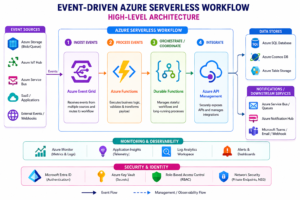
If you’re looking into modern cloud architecture, you likely have wondered: What is Azure Serverless? Azure Serverless, in its simplest form, is Microsoft’s cloud execution model that allows you to run application code, without provisioning, patching, or managing any underlying servers. You write code, Azure takes care of the infrastructure, scaling and availability. Despite all that, there are servers out there somewhere in Microsoft’s data centers, but they’re invisible to you as a developer. This change enables companies to deliver features more rapidly, reduce over-provisioned infrastructure expenses, and develop entire applications that rely solely on business logic, rather than on server operation. This is why it’s critical for every cloud developer and data professional today to understand what Azure Serverless is.
What is Azure Serverless Computing, Technically?
Technically, Azure Serverless is the execution model where compute resources are dynamically provisioned based on events to the system: HTTP request, message from a queue, new file in Blob Storage, or a scheduled timer. No virtual machine always running; Azure only starts an execution environment when your code needs to run, and when demand goes away, it scales down (sometimes all the way to zero). Billing is based on a similar model: consumption-based pricing involves paying for execution and compute time (not reserved capacity). From an architectural perspective, this is the gist of Azure Serverless — pay-as-you-go, elastic, and event-driven compute.
Core Azure Serverless Services
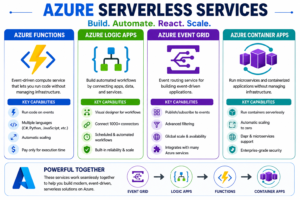
The serverless ecosystem offered by Microsoft extends beyond just one product. To grasp the concept of Azure Serverless in practice, you should be familiar with these components:
- Azure Functions – the flagship offering of a Function-as-a-Service (FaaS) platform. Deploys small pieces of code (C#, Python, JavaScript, Java, PowerShell) triggered by HTTP calls, queue messages, timers and database updates, automatically scaling elastically as the load changes.
- Azure Logic Apps – a low-code, visual workflow engine for orchestrating integrations between hundreds of connectors (Office 365, SAP, SQL, Salesforce) without having to write custom code for each step.
- Azure Event Grid – A fully managed event-routing service that enables you to scale to vast numbers of events linking event sources (such as Blob Storage or IoT Hub) to event handlers (such as Functions or Logic Apps).
- Azure Container Apps – execute microservices and APIs on containers serverlessly with built-in autoscaling using KEDA including scale-to-zero.
- Azure SQL Database Serverless – Compute service that scales up and down with workload and pauses while idle, charges based on actual compute time used, per single database.
Let’s dive into the inner workings of Azure Serverless.
Azure’s event infrastructure detects an event — such as a file landing in Blob Storage and initiates the bound Function or Logic App immediately. Azure’s scale controller then launches the appropriate number of execution instances based on the load, runs your code on an isolated environment and shuts down the environment once the code has been processed. This is what Azure Serverless is unique from the traditional IaaS or even the conventional PaaS hosting, where you still have to scale the compute capacity and execute it yourself.
Azure Serverless has several key benefits.Here are some of the benefits of Azure Serverless.
- No infrastructure management – no VMs, OS patching, or capacity planning.
- Automatic elastic scaling – from zero to thousands of concurrent executions.
- Consumption-based billing – only pay for time used, not time wasted.
- Time to market reduced – developers can concentrate on business logic only.
- Built-in HA – redundancy managed by Microsoft.
Common Use Cases
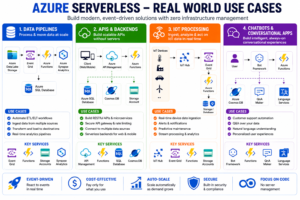
Knowing what Azure Serverless is best for aids in real project planning. Typical examples are event-driven ETL, data pipelines into Azure Data Factory or Databricks, REST API backends for Web and mobile applications, IoT telemetry processing in large-scale, short-lived, bursty fashion, scheduled batch jobs, and, as increasingly happens in 2026, AI inference endpoints and agent orchestration steps that are similarly bursty and short-lived.
Things to be mindful of when reviewing the challenges.
Serverless is no magic bullet. Latency of starting a new execution environment (known as cold starts) can impact latency sensitive applications. Processes whose execution semantics are long-running or highly stateful are not well suited to Functions’ execution limits. But observability demands discipline, too: When you start building up more functions, you are going to need to have structured logs, distributed tracing, or Application Insights/OpenTelemetry metrics per function. Although serverless can reduce costs on workloads that are bursty, high utilization workloads can sometimes be more expensive than a reserved VM.
Conclusion
So, what is Azure Serverless in one sentence? It’s Microsoft’s execution model for the cloud that is event-driven, auto-scaling, and consumption-billed, from Azure Functions, Logic Apps, Event Grid, Container Apps and serverless databases. Event-driven and AI-based architectures have become the standard for many businesses, making serverless skills on Azure a must-have for both cloud engineers and data engineers and architects.
For hands-on experience and to gain certification aligned skills in serverless and Azure data engineering, SQL School offers training for Azure Databricks (DP-900) and Azure Data Engineering (DP-800), providing real projects and content rich in Azure serverless ecosystem.