
In order to become a data analyst in 2026, learn SQL, Python and data visualization software such as Power BI or tableau, create a portfolio of real-world projects, get a recognized certification, and apply to an entry-level position or a freelance project to gain practical experience.
Curious about how to be a data analyst in 2026? You’re not alone. As companies are drowning in data and AI changes the landscape of all industries, the need to hire skilled data analysts has never been greater. The good news? Four-year degree is not required to break in, you need the right skills, the right tools, and a good plan.
Why Data Analytics Will Be the Career of Choice in 2026.
The new oil is data and the refinery is the analysts. All businesses, big and small, including startups and Fortune 500s, require individuals capable of transforming raw data into clear decisions. Not only is the time of the year perfect how to become a data analyst in 2026, but the timing could not be any better. Jobs in analytics have increased by 28 per cent annually, and wages are also competitive across the industries.
Guide: How to be a Data Analyst by 2026.
It is not one way, but there is an established pattern. These six steps will help you become a data analyst more quickly than you might have thought:
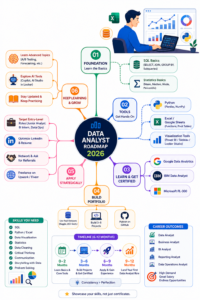
STEP 01
Learn SQL first
SQL is used in their day-to-day activities by every data analyst. Learn to select, join, group by, and subqueries within 4-6 weeks.
STEP 02
Choose Python or Excel.
The industry standard is Python (Pandas, NumPy). Excel/Sheets continue to be important with business-side positions.
STEP 03
Master a viz tool
Tableau and Power BI are taking over the job listings. Looker Studio is free, and good to start with.
STEP 04
Get certified
Google Data Analytics, IBM Data Analyst or Microsoft PL-300 is an instant addition to your resume.
STEP 05
Build a portfolio
Publish 3-5 projects on GitHub. Make use of actual datasets on Kaggle, UCI or government open data portals.
STEP 06
Apply strategically
First apply as a Target junior analyst, a BI intern, or data operations. On Upwork, become a freelance writer to gain experience quickly.
What Are the Skills Data Analysts Will Require in 2026?
The set of skills that will transform one into a data analyst has changed. Employers are not only seeking more than Excel. How to Become a Data Analyst in 2026. You require good storytelling with data, basic statistical knowledge, and (increasingly) familiarity with AI-assisted analytics systems like Copilot in Power BI or AI Studio in Looker. Coding is not as important as critical thinking and communication. Analysts capable of communicating insights to non-technical stakeholders, are worth their weight in gold.
Do You Need a Degree?
No. A high number of working analysts nowadays did not even learn data science as a form of study. In 6-12 months to get you job-ready, bootcamps, self-paced courses (Coursera, DataCamp, LinkedIn Learning) and regular practice can all get you job-ready. To be a data analyst without a degree, you would have to become obsessed with your portfolio and certifications, however, since hiring managers actually look at these factors, you will need to become obsessive about your portfolio and certifications.
What Is the Time Frame?
Practically, 6-12 months of rigorous training suffice to find your first job. You can do so within 3 months in case you already know how to operate spreadsheets. Consistency is the key, spending 1-2 hours a day is much more efficient than crraming on the weekend. When you keep on track, you can achieve the objective of becoming a data analyst in a year. Herein lies How to Become a Data Analyst in 2026 with an intelligent and well-planned approach.
The path how to becoming a data analyst in 2026 is more important—and more clearly defined—than ever before. Begin with SQL today, develop your skills in a systematical manner, present your work in a portfolio, and work before you consider yourself ready. The industry requires inquisitive, communicative and committed analysts, not idealists. This is a trip that begins with just one question.
Frequently asked questions
1. Is it possible to become a data analyst without any experience?
Yes. Construct projects on Kaggle, become certified (Google or IBM), and seek internships or freelance work. Portfolio is more important than paper experience.
2. Which tool should I learn initially python or SQL?
SQL first, always. SQL is needed in almost all the analyst positions. Python is an excellent programming language that ranks second in the majority of job descriptions.
3. Will data analytics be a good career in 2026?
Absolutely. AI has not killed analysts – it has multiplied their efforts. Humans are required in companies to pose the correct questions and make meaning out of AI-producing insights.
4. In 2026, what will be the salary of a data analyst in India?
Entry-level: ₹4–8 LPA. Mid-level: ₹10–18 LPA. Top positions with BI systems or knowledge of the domain may transverse 25 LPA in the metropolis.
5. Which are the most suitable certifications of data analysts in 2026?
Best courses: Google Data Analytics (Coursera), IBM Data Analyst Professional, Microsoft PL-300 (Power BI), and the Data Analyst track on DataCamp.
6. What is the impact of AI on the work of data analysts?
AI deals with the data cleaning and simple reporting that is repetitive. The role is now more valuable, not obsolete, as analysts are now looking at the role in terms of strategy, storytelling, and posing smarter questions.
Author
Trainer: Mr. Sai Phanindra
With 20+ Years of
Corporate & Porfessional Trainer
technical expertise exclusively on SQL & Database Technologies, I assure you 100% Practical, Step by Step Classes.
Linkdin Profile: www.linkedin.com/in/saiphanindra/
Contact No: +91 9030040801 or +91 9666440801