
Tableau vs Power BI: Which BI Tool is Best in 2026?
So, in 2026, data is not only the power thing, it’s the survival thing. From startup founders to Fortune 500 analysts, selecting between Tableau vs Power BI may impact your team’s speed in converting raw data into real decisions.
The importance of this comparison in 2026.
The debate of Tableau vs Power BI: Which BI Tool is Best in 2026 is not new — it’s more relevant than ever. The explosion of data, cloud-first approaches and AI-driven analytics are compelling businesses to rethink their tools.
Both have expanded by a tremendous amount. Tableau (which is owned by Salesforce) doubled down on AI-native features. Power BI (Microsoft) enhanced its connection with Copilot and Fabric. There’s no clear winner here, though one of them may be the more obvious fit in some contexts.
Tableau: The Visual Storyteller
Tableau has been the artist of the BI world from the beginning. Its drag and drop canvas provides analysts and business users with a canvas to create advanced and beautiful dashboards without coding a single line of code.
Key Strengths of Tableau in 2026
- Predictive Analytics in Tableau dashboards – Einstein’s AI layer allows you to directly use predictive analytics in your Tableau dashboards.
- Advanced data visualization – Unmatched flexibility of custom chart types, maps and layout design.
- Tableau Pulse — AI-generated data digests that make things discoverable for users instead of being found through a search query.
- Cross-platform connectivity — Natively integrates with 100+ data sources, such as Snowflake, BigQuery, and Redshift
- There are a number of great tools and resources available to communities and Tableau Public — Millions of published vizzes for inspiration and learning.
Tableau excels in scenarios where teams value visual depth, intricate analytics, and data storytelling, particularly within enterprise settings outside the Microsoft context, in comparison to Power BI.In comparison to Power BI, Tableau is a clear choice for those where visual depth, complex analytics, and data storytelling are paramount, especially in enterprise settings that are not part of the Microsoft ecosystem.
Power BI: The Microsoft Powerhouse
Power BI is the champion of accessibility and integration. If you are a business that already uses Microsoft Teams, SharePoint, Azure, Excel, then power BI is a no-brainer.
Key Strengths of Power BI in 2026
- Integrate Microsoft Fabric — One place for all your analytics needs from ingestion to reporting.
- Copilot for Power BI — Ask Questions in Natural Language and receive auto-generated reports and DAX formulas.
- Cost efficiency — Available with many Microsoft 365 licenses, and a small percentage of Tableau’s licensing fee
- DAX & Power Query — powerful calculation engine and data transformation, right there!
- Paginated reports — Ideal for operational reports, invoices, and compliance documents where it’s imperative to get the pictures right.
The actual benefit of Power BI? Tableau vs Power BI: 2026 indeed, it’s the Power BI. A non-tech business user can get a dashboard up and running in less than an hour. This is the game-changing for small teams.
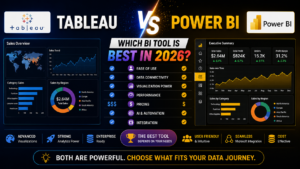
Head-to-Head: Feature Comparison
Tableau
- Best-in-class visualizations
- Flexible, canvas-based UX
- Salesforce & Einstein AI
- Ideal for data scientists
- Tableau Pulse (proactive AI)
- This results in an increase in the cost per seat.
Power BI
- Deep Microsoft 365 synergy
- Natural language queries (Copilot)
- Microsoft Fabric platform
- Cost-effective licensing
- Easy for users of Excel to use
- The book is limited to the outside of the MS
In 2026 both are AI enhanced, albeit with different philosophies. Tableau is an exploratory tool. Power BI is designed to be fast and scalable in enterprise environments.
Which tool is best for you?
The honest answer when asking Tableau vs Power BI: Which BI Tool is Best in 2026? is — it depends. The following is a quick guide:
Choose Tableau If…
- You can expect your team to appreciate custom-made, publish-ready visualizations.
- You’re in a Salesforce rich environment
- You have advanced analytics requirements and you’re ready to invest in licenses
- Your analysts are technically skilled data professionals
Choose Power BI If…
- You already have an organization using Microsoft 365 or Azure.You already have an organization that uses Microsoft 365 or Azure.
- You are required to deploy quickly without a lot of training.
- Sustainability is a key factor and cost efficiency is paramount.
- You and your users are familiar with Excel and Teams
conclusion
By 2026, both tools are of equal performance. Power BI can be the value champion, the integration, and the easy-to-use business solution — particularly for Microsoft-native companies. Tableau has a lot to offer companies that consider dashboards a product in their data-driven work – depth of analysis, visual sophistication and design flexibility.
In 2026, the smartest companies are not asking which is better, but rather which one fits our stack, our team, and our goals?
Author
Trainer: Mr. Sai Phanindra
20+ Years of Industry Experience
Corporate & Porfessional Trainer
Profile: https://www.linkedin.com/in/saiphanindra
Reach me for career / resume advise: +91 9030040801
For Registrations: +91 9666440801 | +91 9666640801
www.sqlschool.com
