PostgreSQL Cheat Sheet: Complete Beginner’s Guide to Database Management
In today’s data-driven world, the ability to manage and analyze data efficiently is a critical skill. One of the most powerful and widely used database systems is PostgreSQL, an open-source relational database known for its reliability, performance, and scalability. If you are starting your journey in databases or aiming for a career in data analytics, data engineering, or software development, a quick reference guide like this PostgreSQL Cheat Sheet can make learning faster and more practical.
Getting Started with PostgreSQL
The first step in working with PostgreSQL is setting up the database and connecting to it using tools like pgAdmin or SQL Shell (psql). Once connected, you can start executing SQL queries to interact with your data.
At the core of PostgreSQL is SQL (Structured Query Language), which allows you to communicate with the database. Whether you are retrieving data, inserting records, or updating information, SQL provides a standardized and easy-to-learn approach.
Working with Tables and Data
In PostgreSQL, data is stored in tables made up of rows and columns. Each column has a specific data type such as INTEGER, TEXT, DATE, or BOOLEAN. Before working with data, you typically create tables and define their structure.
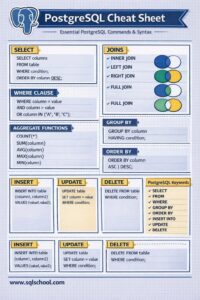
Once your table is ready, you can start performing operations using SQL commands. The most commonly used command is the SELECT statement, which allows you to retrieve data from a table. You can specify columns, apply conditions, and sort results, making it essential for data exploration.
Filtering and Sorting Data
To extract meaningful information, you often need to filter data. This is done using the WHERE clause, which allows you to apply conditions such as equality, comparison, and logical operations like AND, OR, and IN.
Sorting results is equally important, and PostgreSQL makes it simple with the ORDER BY clause. You can sort data in ascending (ASC) or descending (DESC) order, helping you organize results for better analysis and reporting.
Joins for Combining Data
In real-world scenarios, data is usually spread across multiple tables. PostgreSQL provides JOIN operations to combine this data efficiently.
Some commonly used joins include:
- INNER JOIN, which returns matching records from both tables
- LEFT JOIN, which returns all records from the left table and matched ones from the right
- RIGHT JOIN, which does the opposite
- FULL JOIN, which returns all records when there is a match in either table
Understanding joins is crucial for working with relational databases and performing complex queries.
Aggregations for Data Insights
PostgreSQL offers powerful aggregate functions such as COUNT(), SUM(), AVG(), MAX(), and MIN(). These functions help you perform calculations on large datasets.
When combined with the GROUP BY clause, you can group rows based on a column and apply aggregate functions to each group. Additionally, the HAVING clause allows you to filter grouped data, making it extremely useful for business analytics and reporting.
Data Manipulation Made Simple
PostgreSQL supports essential data manipulation operations that allow you to manage your database effectively:
- INSERT to add new records
- UPDATE to modify existing data
- DELETE to remove records
These commands are widely used in real-time applications where data is continuously updated and maintained.
Useful Commands for Daily Practice
Beyond basic queries, PostgreSQL provides several features that enhance productivity:
- DISTINCT to remove duplicate records
- LIMIT to restrict the number of rows returned
- Aliases for better readability
- Importing data from CSV or external sources
- Exporting query results for reporting
These commands help streamline workflows and improve efficiency when working with databases.
Why Learn PostgreSQL?
PostgreSQL is widely used across industries due to its advanced features, open-source nature, and strong community support. It is a must-have skill for anyone looking to work with data, whether in analytics, engineering, or backend development.
Its compatibility with modern tools and cloud platforms makes it highly relevant in today’s data ecosystem.
Conclusion
This PostgreSQL Cheat Sheet serves as a quick reference to help you understand and apply essential database concepts in real-world scenarios. Whether you are preparing for interviews, practicing SQL, or building projects, mastering these fundamentals will give you a strong foundation.
Consistent practice is key. Start with simple queries, explore real datasets, and gradually move toward complex operations.
For hands-on training, real-time projects, and expert guidance, structured learning programs can help accelerate your growth and take your database skills to the next level.
Ready to Master PostgreSQL and Build a Powerful Database Career?
Join SQL School — India’s most trusted platform for real-time PostgreSQL Training with hands-on projects.
✅ Learn PostgreSQL from basics to advanced concepts
✅ Master SQL queries, joins, indexing, functions, and performance tuning
✅ Gain practical experience with real-time databases and live projects
✅ Understand database design, optimization, and administration
✅ Perfect for Developers, DBAs, and Data Professionals
🚀 Upgrade your skills with one of the world’s most popular open-source databases!
📞 Call now at +91 9666640801
🌐 Visit 👉 www.sqlschool.com for a FREE demo session!
SQL School – Your Real-Time Path to PostgreSQL Expertise & Career Growth.