#Microsoft Cloud Engineer

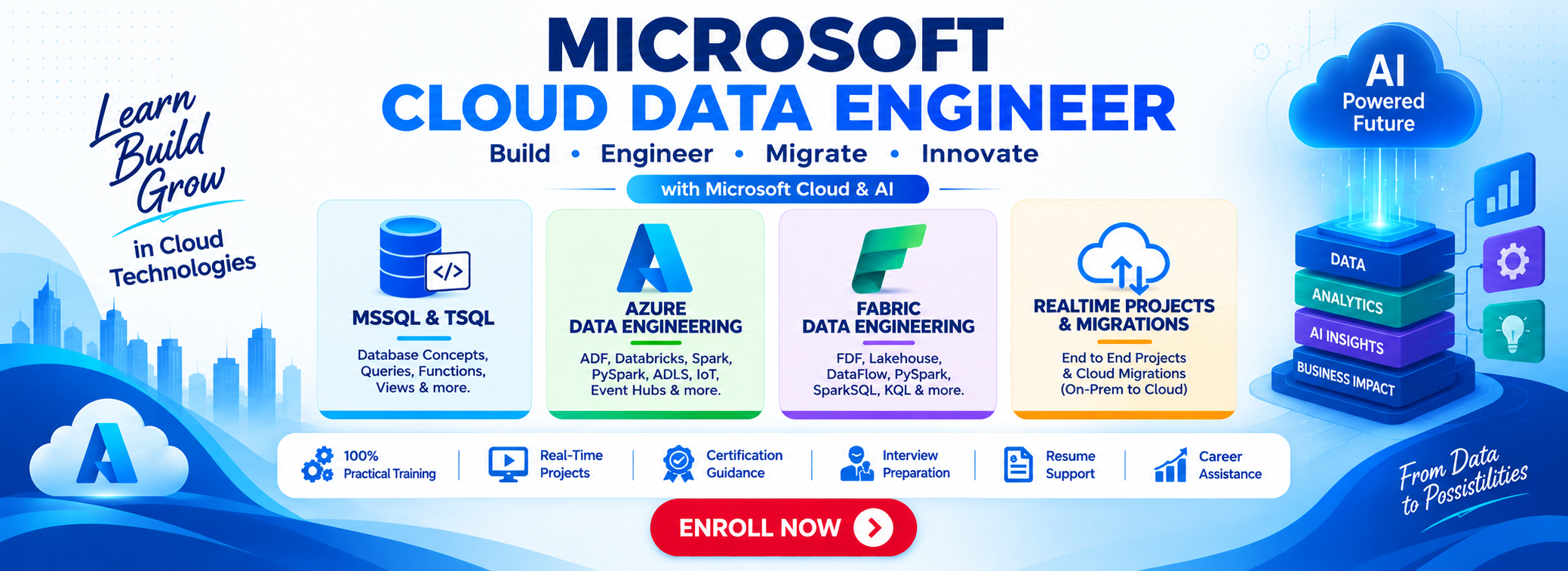
Microsoft Cloud Engineer is a stable and high-demand job role responsible for designing, deploying, and managing scalable cloud-based data and application platforms using Microsoft Azure. This promising career stream involves integrating data and services from multiple sources, building secure cloud architectures, and managing modern data environments.

✅ Module 1: MSSQL & TSQL, Tuning
✅ Module 2: Azure Data Engineer
✅ Module 3: Fabric Data Engineer
✅ Module 4: Realtime Projects, Cerifications
⏳ Duration: 3.5 – 4 Months

Module 1: SQL Server TSQL (MS SQL) Queries

Ch 1: Data Engineer Job Roles

  • Introduction to Data
  • Data Engineer Job Roles
  • Data Engineer Challenges
  • Data and Databases Intro

Ch 2: Database Intro & Installations

  • Database Types (OLTP, DWH, ..)
  • DBMS: Basics
  • SQL Server 2025 Installations
  • SSMS Tool Installation
  • Server Connections, Authentications

Ch 3: SQL Basics V1 (Commands)

  • Creating Databases (GUI)
  • Creating Tables, Columns (GUI)
  • SQL Basics (DDL, DML, etc..)
  • Creating Databases, Tables
  • Data Inserts (GUI, SQL)
  • Basic SELECT Queries

Ch 4: SQL Basics V2 (Commands, Operators)

  • DDL: Create, Alter, Drop, Add, modify, etc..
  • DML: Insert, Update, Delete, select into, etc..
  • DQL: Fetch, Insert… Select, etc..
  • SQL Operations: LIKE, BETWEEN, IN, etc..
  • Special Operators

Ch 5: Data Types

  • Integer Data Types
  • Character, MAX Data Types
  • Decimal & Money Data Types
  • Boolean & Binary Data Types
  • Date and Time Data Types
  • SQL_Variant Type, Variables

Ch 6: Excel Data Imports

  • Data Imports with Excel
  • SQL Native Client
  • Order By: Asc, Desc
  • Order By with WHERE
  • TOP & OFFSET
  • UNION, UNION ALL

Ch 7: Schemas & Batches

  • Schemas: Creation, Usage
  • Schemas & Table Grouping
  • Real-world Banking Database
  • 2 Part, 3 Part & 4 Part Naming
  • Batch Concept & “Go” Command

Ch 8: Constraints, Keys & RDBMS – Level 1

  • Null, Not Null Constraints
  • Unique Key Constraint
  • Primary Key Constraint
  • Foreign Key & References
  • Default Constraint & Usage
  • DB Diagrams & ER Models

Ch 9: Normal Forms & RDBMS – Level 2

  • Normal Forms: 1 NF, 2 NF
  • 3 NF, BCNF and 4 NF
  • Adding Keys to Tables
  • Cascading Keys
  • Self Referencing Keys
  • Database Diagrams

Ch 10: Joins & Queries

  • Joins: Table Comparisons
  • Inner Joins & Matching Data
  • Outer Joins: LEFT, RIGHT
  • Full Outer Joins & Aliases
  • Cross Join & Table Combination
  • Joining more than 2 tables

Ch 11: Views & RLS

  • Views: Realtime Usage
  • Storing SELECT in Views
  • DML, SELECT with Views
  • RLS: Row Level Security
  • WITH CHECK OPTION
  • Important System Views

Ch 12: Stored Procedures

  • Stored Procedures: Realtime Use
  • Parameters Concept with SPs
  • Procedures with SELECT
  • System Stored Procedures
  • Metadata Access with SPs
  • SP Recompilations

Ch 13: User Defined Functions

  • Using Functions in MSSQL
  • Scalar Functions in Real-world
  • Inline & Multiline Functions
  • Parameterized Queries
  • Date & Time Functions
  • String Functions & Queries
  • Aggregated Functions & Usage

Ch 14: Triggers & Automations

  • Need for Triggers in Real-world
  • DDL & DML Triggers
  • For / After Triggers
  • Instead Of Triggers
  • Memory Tables with Triggers
  • Disabling DMLs & Triggers

Ch 15: Transactions & ACID

  • Transaction Concepts in OLTP
  • Auto Commit Transaction
  • Explicit Transactions
  • COMMIT, ROLLBACK
  • Checkpoint & Logging
  • Lock Hints & Query Blocking
  • READPAST, LOCKHINT

Ch 16: CTEs & Tuning

  • Common Table Expression
  • Creating and Using CTEs
  • CTEs, In-Memory Processing
  • Using CTEs for DML Operations
  • Using CTEs for Tuning
  • CTEs: Duplicate Row Deletion

Ch 17: Indexes Basics, Tuning

  • Indexes & Tuning
  • Clustered Index, Primary Key
  • Non Clustered Index & Unique
  • Creating Indexes Manually
  • Composite Keys, Query Optimizer
  • Composite Indexes & Usage

Ch 18: Group By Queries

  • Group By, Distinct Keywords
  • GROUP BY, HAVING
  • Cube( ) and Rollup( )
  • Sub Totals & Grand Totals
  • Grouping( ) & Usage
  • Group By with UNION
  • Group By with UNION ALL

Ch 19: Joins with Group By

  • Joins with Group By
  • 3 Table, 4 Table Joins
  • Join Queries with Aliases
  • Join Queries & WHERE, Group By
  • Joins with Sub Queries
  • Query Execution Order

Ch 20: Sub Queries

  • Sub Queries Concept
  • Sub Queries & Aggregations
  • Joins with Sub Queries
  • Sub Queries with Aliases
  • Sub Queries, Joins, Where
  • Correlated Queries

Ch 21: Cursors & Fetch

  • Cursors: Realtime Usage
  • Local & Global Cursors
  • Scroll & Forward Only Cursors
  • Static & Dynamic Cursors
  • Fetch, Absolute Cursors

Ch 22: Window Functions, CASE

  • IIF Function and Usage
  • CASE Statement Usage
  • Window Functions (Rank)
  • Row_Number( )
  • Rank( ), DenseRank( )
  • Partition By & Order By

Ch 23: Merge(Upsert) & CASE, IIF

  • Merge Statement
  • Upsert Operations with Merge
  • Matched and Not Matched
  • IIF & CASE Statements
  • Merge Statement inside SPs
  • Merge with OLTP & DWH

Ch 24: Key Take-Aways from Module 1

  • Case Study 1: Medicare Scenario
  • Case Study 2: Ecommerce Scenario

Module 2: Azure Data Engineer (ADF, Synapse)

Ch 1: Azure ETL, DWH Introduction

  • Data Warehouse (DWH)
  • Cloud Concepts: IaaS, PaaS
  • SaaS & Azure Cloud Concepts
  • Azure Resources & Groups
  • Storage, ETL, IoT Resources

Ch 2: Azure Intro, Azure SQL

  • Azure SQL Server, SQL DB
  • Azure SQL Database (OLTP)
  • Azure SQL Pool (DWH)
  • Connections from SSMS Tool
  • Connections from ADS Tool
  • Pause / Resume SQL Pool
  • Source Data Configurations

Ch 3: Azure Synapse (DWH)

  • Synapse Pool Architecture
  • Control Node, Compute Node
  • DMS & Partitioned Tables
  • Creating Tables with TSQL
  • Distributions: RR, Hash, Repl
  • Big Data Loads with TQL
  • Important DMFs & DMVs

Ch 4: Azure Data Factory (ADF)

  • Need for ADF & Pipelines
  • Data Orchestration with IR
  • Integration Runtime Engine
  • Linked Services, Datasets
  • Pipelines: Copy Data Activity
  • Data Flow Activity with IR

Ch 5: Azure SQL DB Loads

  • ADF: Author
  • Azure SQL Database Reads
  • Azure SQL Pool Writes
  • Synapse Analytics with IR
  • Pipeline Design, Validation
  • Pipeline Runs, Monitoring

Ch 6: BLOB Data Loads

  • Azure Storage Account
  • Azure BLOB Containers
  • BLOB Storage in ADF
  • Synapse Analytics with IR
  • ADF Pipeline Edits
  • Pipeline Runs, Monitoring

Ch 7: Pipeline Settings

  • ADF Pipeline Settings
  • Staging : Advantages
  • Reliable Logging
  • Best Effort Logging
  • DIU & DOCP with IR
  • Compressions, Health Check

Ch 8: File Incremental Loads

  • File Incremental Loads
  • Storage Account, Data Lake
  • Binary Copy, Schema Drift
  • Staging Concept in ADF
  • Initial, Incremental Loads
  • Schema & Data Changes

Ch 9: Table Incremental Loads

  • Implement SCD with ADF
  • Self Hosted IR: Realtime Use
  • On-premise Data: Incr Loads
  • Copy Method: Upsert, Keys
  • Staging & ADF Optimizations
  • Pipeline Runs, Activity IDs

Ch 10: ADF Data Flow – 1

  • Data Flow Transformations
  • Spark Clusters for Debugging
  • Optimized Clusters, Preview
  • Conditional Split, SELECT
  • Sort, Union Transformations
  • Pipelines with Data Flow

Ch 11: ADF Data Flow – 2

  • Working with Multiple Tables
  • Join Transform, Broadcast
  • Row Filters, Column Filters
  • Surrogate Keys, Derived Cols
  • ETL Loads Dates, Sink Options
  • Aggregated Data Loads

Ch 12: ADF Data Flow – 3

  • Pivot Transformation
  • Group By & Pivot Keys
  • Column Pattern, Deduplicate
  • Lookup, Cached Lookup
  • Tuning Transformations
  • Tuning Data Flow, Spark

Ch 13: ADF Data Flow – 4

  • Lookup Transformation
  • Cache Lookup
  • Inline Datasets
  • Data Validations
  • Lookup Versus Joins
  • Broadcast Options

Ch 14: ADF Metrics, Alerts

  • Azure Insights
  • Azure Metrics for ADF
  • Azure Metrics for Synapse
  • CPU, Memory Metrics
  • Alerts and Notifications
  • Action Groups, Tuning Options

Ch 15: ADF Parameters, Security

  • Linked Service Parameters
  • Creating Logins
  • Users and ETL Permissions
  • Parameterize Logins
  • Parameterize Users
  • Dynamic Linked Services

Ch 16: Parameters, SCD & ETL

  • ADF Templates in Realtime
  • Implementing ADF SCD
  • Table Incremental Loads
  • Control Tables, Watermarks
  • Pipeline Parameters, SPs
  • Dynamic Data Sets, SCD

Ch 17: Synapse Analytics

  • Azure Synapse Analytics
  • Dedicated SQL Pools
  • TSQL: Stored Procedures
  • Synapse Pipelines, Tuning
  • SP Activity in Pipelines, Jobs
  • Comparing ADF & Synapse

Ch 18: CI CD with GitHub

  • Creating Github Account
  • GIT: Main, Branches
  • Connecting with ADF
  • Version Changes
  • Builds and Deployments
  • CI-CD Integrations

Module 3: Azure Migrations, IoT & Key Vaults

Ch 1: Azure Storage Security, IAM

  • Access Keys & Admin Access
  • SAS Keys Generation, Ips
  • Azure AD Users, Groups
  • IAM & RBAC with Entra Users
  • ACLs and ADLS Security
  • ADF with Azure Storage Security

Ch 2: Azure SQL DB Migrations

  • On-Premise SQL DB bacpac
  • Azure SQL Deployment
  • Azure Storage from SSMS
  • Azure SQL DB Migration
  • Migration Verifications
  • Testing Migrations in SQL

Ch 3: Azure Tables & ADF

  • Azure Tables
  • Entities and Properties
  • Storage Service Operations
  • OData Queries & Filters
  • Data Loads with ADF

Ch 4: Azure Stream Analytics

  • Azure IoT Hubs & Devices
  • APIs with Connection Strings
  • Azure Steam Analytic Jobs
  • Inputs, Outputs, SAQL Query
  • LIVE Feed: JSON, AVRO Files
  • Watermark & LIVE Streams

Ch 5: Azure Key Vaults

  • Azure Encryptions at REST
  • SMK & CMK Encryptions
  • Azure Key Vaults & Keys
  • Key Access Policies
  • Rest, Transit Encryptions
  • Realtime Considerations

Ch 6: Azure Logic Apps

  • Azure Logic Apps
  • Consumption Logic
  • Standard Logic
  • Logic App Connectors
  • Triggers & Parallel Branches
  • Schedules & Automations

Module 4: Databricks with Auto Loader, DLT, PySpark

Ch 1: Databricks Introduction

  • Cloud ETL, DWH
  • Cloud Computing
  • Databricks Concepts
  • Big Data in Cloud

Ch 2: Databricks Architecture

  • Unity Catalog, Volume
  • Spark Clusters
  • Apache Spark and Databricks
  • Apache Spark Ecosystem
  • Compute Operations
  • Hadoop, MapReduce, Apache Spark

Ch 3: Unity Catalog

  • Unity Catalog Concepts
  • Workspace Objects
  • Databricks Notebooks
  • Databricks Workspace UI
  • Organizing Workspace Objects
  • Creating Volumes
  • Spark Table Creations
  • UI : Limitations

Ch 4: Unity Catalog Operations, Spark SQL – 1

  • Spark SQL Notebooks
  • Creating Catalog
  • Creating Schemas, Tables
  • Spark Data Types
  • Data Partitioning
  • Managed Tables
  • SQL Queries with the PySpark API
  • Union, Views in Spark
  • Dropping Objects
  • External Tables, External Volumes
  • Spark SQL Notebooks: Exports, Clone

Ch 5: Spark SQL Notebooks – 2

  • Math, Sort Functions
  • String, DateTime Functions
  • Conditional Statements
  • SQL Expressions with expr()
  • Volume for our Data Assets
  • File Formats, Schema Inference
  • Spark SQL Aggregations

Ch 6: Python Concepts – 1

  • Python Introduction
  • Python Versions
  • Python Implementations
  • Python in Spark (PySpark)
  • Python Print()
  • Single, Multiline Statements

Ch 7: Python Concepts – 2

  • Python Data Types
  • Integer / Int Data Types
  • Float, String Data Types
  • Arithmetic, Assignment Ops
  • Comparison Operators
  • Operator Precedence
  • If … Else Statement
  • Short Hand If, OR, AND
  • ELIF and ELSE IF Statements

Ch 8: Python Concepts – 3

  • Python Lists
  • List Items, Indexes
  • Python Dictionaries
  • Tables Versus Dictionaries
  • Python Modules & Pandas
  • import pandas.DataFrame
  • Pandas Series, arrays
  • Indexes, Indexed Lists

Ch 9: PySpark – 1

  • Dataframes with SQL DB
  • Pandas Dataframes
  • Dataframe()
  • List Values, Mixed Values
  • spark.read.csv()
  • spark.read.format()
  • Filtering DataFrames
  • Grouping your DataFrame
  • Pivot your DataFrame

Ch 10: PySpark – 2

  • DataFrameReader
  • DataFrameWriter Methods
  • CSV Data into a DataFrame
  • Reading Single Files
  • Reading Multiple Files
  • Schema with an SQL String
  • Schema Programmatically

Ch 11: PySpark – 3

  • Writing DataFrames to CSV
  • Working with JSON
  • Working with ORC
  • Working with Parquet
  • Working with Delta Lake
  • Rendering your DataFrame
  • Creating DataFrames from Python Data Structures

Ch 12: PySpark Transformations – 1

  • Data Preparation
  • Selecting Columns
  • Column Transformations
  • Renaming Columns
  • Changing Data Types
  • select() and selectExpr()
  • Column Transformations
  • withColumn()

Ch 13: PySpark Transformations – 2

  • Basic Arithmetic and Math Functions
  • String Functions
  • Datetime Conversions
  • Date and Time Functions
  • Joining DataFrames
  • Unioning DataFrames
  • Joining DataFrames

Ch 14: PySpark Transformations – 3

  • Filtering DataFrame Records
  • Removing Duplicate Records
  • Sorting and Limiting Records
  • Filtering Null Values
  • Grouping and Aggregating
  • Pivoting and Unpivoting
  • Conditional Expressions

Ch 15: Medallion Architecture

  • Medallion Architecture
  • Aggregated Data Loads
  • Broze, Silver and Gold
  • Temp Views
  • Spark Tables (Parquet)
  • Work with File, Table Sources

Ch 16: Delta Lake – 1

  • Storage Layer
  • Delta Table API
  • Deleting Records
  • Updating Records
  • Merging Records
  • History and Time Travel

Ch 17: Delta Lake – 2 (SCD)

  • Schema Evolution
  • Delta Lake Data Files
  • Deleting and Updating Records
  • Merge Into
  • Table Utility Commands
  • Exploratory Data Analysis
  • Incremental Loads
  • Old History Retention
  • Delta Transaction Log

Ch 18: Widgets

  • Text Widgets
  • User Parameters
  • Manual Executions
  • Lake Bridge
  • Databricks BridgeOne

Ch 19: Lake Flow Jobs

  • Worksflows & CRON
  • Job Compute, Running Tasks
  • Python Script Tasks
  • Parameters into Notebook Tasks
  • Parameters into Python Script Tasks
  • Concurrent Executions, Dependencies
  • Branching Control with the If-Else Task

Ch 20: Databricks Tuning

  • How Spark Optimizes your Code
  • Lazy Evaluation
  • Explain Plan
  • Inspecting Query Performance
  • Caching, Data Shuffling
  • Broadcast Joins
  • When to Partition
  • Data Skipping
  • Z Ordering
  • Liquid Clustering
  • Spark Configurations

Ch 21: Version Control & GitHub

  • Local Development
  • Runtime Compatibility
  • Git and GitHub Pre-requisites
  • Git and GitHub Basics
  • Linking GitHub and Databricks
  • Databricks Git Folders
  • Project Code to GitHub
  • Adding Modules to the Project Code
  • Databricks Job Updates, Runs

Ch 22: Spark Structured Streaming

  • Streaming Simulator Notebook
  • Micro-batch Size
  • Schema Inference and Evolution
  • Time Based Aggregations and Watermarking
  • Writing Streams
  • Trigger Intervals
  • Delta Table Streaming Reads and Writes

Ch 23: Auto Loader

  • Reading Streams with Auto Loader
  • Reading a Data Stream
  • Manually Cancel your Data Streams
  • Writing to a Data Stream
  • Workspace Modules

Ch 24: Lake Flow Declarative Pipelines

  • Delta LIVE Tables
  • Data Generator Notebook
  • Pipeline Clusters
  • Databricks CLI
  • Data Quality Checks
  • Streaming Dataset “Simulator”
  • Streaming Live Tables

Ch 25: Security: ACLs

  • Overview of ACLs
  • Adding a New User to our Workspace
  • Workspace Access Control
  • Cluster Access Control
  • Groups & LakeBridge

Ch 26: Realtime Project 2 @ Ecommerce / Banking / Sales

  • Detailed Project Requirements
  • Project Solutions
  • Project FAQs
  • Project Flow
  • Interview Questions & Answers
  • Resume Guidance (1:1)

Module 5: Fabric Concepts, DWH, Data Factory

Ch 1: Fabric Introduction

  • Need for Fabric, Big Data
  • Fabric Data Engineering Model
  • Fabric Components (Items)
  • Microsoft Fabric: Advantages
  • Cloud Warehouse & AI
  • AI with CoPilot
  • Azure Versus Fabric DWH

Ch 2: Fabric Account, Workspace

  • Need for Fabric Workspace
  • Workspace Creation Process
  • Pins and New Items
  • Item Categorization
  • ETL, Storage, Analytical
  • Streaming, Monitoring
  • Compute & Separation

Ch 3: Fabric Architecture

  • Intelligent Data Foundation
  • Polaris Distributed Engine
  • Stateless & Stateful
  • Cache, Metadata, Xact & Data
  • Fabric Tasks, Inputs & DAG
  • State Machine & Statistics
  • Hot Spot Recovery

Ch 4: Fabric Warehouse

  • Fabric Warehouse Creation
  • Fabric Warehouse Features
  • Fabric Warehouse Properties
  • Fabric Warehouse Limitations
  • DWH Internal Operations
  • Default Schemas & Objects

Ch 5: Fabric Data Types

  • Realtime use of Fabric Houses
  • Exact, Approximate Numbers
  • Date and Time Data Types
  • Fixed & Variable Length
  • Binary & String Data Types
  • Fabric Type Limitations

Ch 6: SSMS Connections

  • Warehouse SQL Connection
  • Database Engine Server
  • Multi Factor Authentication
  • Warehouse Artifacts
  • Executing .SQL Scripts
  • Testing Fabric Artifacts

Ch 7: Fabric Caching

  • Fabric Caching Process
  • In-memory Cache, Disk Cache
  • Cache Types: LRU /MRU
  • Cold Cache / Cold Run
  • Realtime use of Caching
  • Performance Advantages
  • Warehouse Optimizations

Ch 8: Fabric Statistics

  • Query Engine Options
  • Statistics Types
  • Leverage Statistics
  • Auto, Manual Statistics
  • Update Statistics
  • Statistics Consistency
  • Statistics Lists & Reports

Ch 9: Time Travel

  • Continuous Data Protection
  • Data Storage, Retention
  • FOR TIMESTAMP AS OF
  • Time Travel Scenarios
  • Time Travel Implementation
  • Time Travel on Queries
  • Time Travel Limitations

Ch 10: Aggregated Data Store

  • Options for Data Aggregations
  • Save As table, Save As View
  • Single Table Aggregations
  • Multi Table Aggregations
  • Dynamic Conditions
  • Parameterized Aggregations

Ch 11: Zero Copy Cloning

  • User Layer, Storage Layer
  • Cloning & Parquet Files
  • Synapse Data Warehouse
  • Data History Retention
  • Point In Time , Schema Level
  • Zero Copy Cloning Limitations

Ch 12: Fabric Security

  • Workspace Security
  • Warehouse Security
  • Item Security & Roles
  • Adding AD Users
  • Item Security Limitations
  • MFA & Client Security

Ch 13: Fabric Data Factory

  • ETL Implementation Options
  • Need for Fabric Data Factory
  • ETL Operations in FDF
  • Data Sources, Transformations
  • Data Destinations (Sinks)
  • Creating Pipelines

Ch 14: Fabric Pipelines

  • Activities and Connections
  • Gateways & OnPrem Access
  • Data Sets & Activity Sets
  • Data Activator & Alerts
  • Run ID & Monitoring
  • Pipeline Creation, Verification

Ch 15: Fabric Pipelines Design

  • Creation Options for Pipelines
  • Azure SQL DB Data Loads
  • Creating Data Sets
  • RRR Transformations
  • Copy Command Usage
  •  Internal Staging (Workspace)

Ch 16: Fabric Aggr Data Loads

  • Aggregation Scenarios
  • Creating Views in TSQL
  • Using Views in FDF Pipelines
  • Using Pipeline Editor
  • Data Loads to Warehouse
  • Pipeline Verifications

Ch 17: ETL Staging

  • Staging : Advantages
  • Caching & Storing Concept
  •  Staging Types in Fabric
  • Workspace & External
  • External Stages in Pipelines
  • Compressions & Advantages
  • Pipeline Trigger, Monitor

Ch 18: OnPrem Gateways

  • Need for On_Premi Gateway
  • Installing & Configuring
  • Authentication, Usage
  • OnPremises Connections
  • Pipelines for Data Loads
  • Warehouse Data Storage
  • Data Refresh with Gateways

Ch 19: Fabric Lakehouse

  • Fabric Lakehouse, AI
  • Files and Tables Storage
  • Data Sources: Parquet Files
  • Transformation Options
  • Direct Lake & AI
  • Lakehouse with AI
  • Lakehouse Real time Use

Ch 20: Lakehouse File Loads

  • Creating Lakehouse
  • Copy Data Wizard
  • Azure SQL Database Source
  • File Data Loads in Lakehouse
  • Concurrency & Batch Count
  • Pipeline Execution Tests
  • Pipeline Monitor Check

Ch 21: Aggregated Data Loads

  • Aggregated Data Store
  • Plan & Design Aggregations
  • Testing Aggregations
  • Pipelines for Data Compute
  • Data Copy Options
  • Pipeline Optimizations
  • Data Loads and Verification

Ch 22: MultiTable Loads in LH

  • Table Loads Connections
  • Data Load in Lakehouse
  • Using Copy Data Wizard
  • Data Store in Lakehouse
  • View Run History, Executions
  • SQL End Points & Access
  • Lakehouse Schemas

Ch 23: Data Factory Pipeline Tuning

  • Intelligent Throughput
  • DOCP & Optimizations
  • Staging & In-Memory
  • Reliable Logging
  • Spark Compute Options
  • Concurrent Connections
  • ETL Partitions in Real-world

Module 6: Data Flow, KQL, Models

Ch 1: Lakehouse Visual Queries

  • Visual Query Interface
  • Visual Editor & Tables / Views
  • Merge, Remove, Sort Tfns
  • Data Preview, Save As Table
  • Save As View : Advantages
  • Using Schemas, Identifiers
  • TDS Packets & Transfer Units

Ch 2: Power Query Level 1

  • Power Query Concept
  • Need for Power Query
  • Data Flow Gen 1
  • Data Flow Gen 2, AI
  • Power Query Items
  • Differences with Copy Activity
  • ETL, ELT Process with AI

Ch 3: Power Query Level 2

  • Data Flow Gen2 Operations
  • PQ Online Editor
  • Working with Binary Content
  • Detailed Data Options
  • Data Cleansing & CoPilot
  • Step Names, Aggregations
  • Warehouse Data Loads

Ch 4: Power Query Level 3

  • Binding Power Query Steps
  • Edit / Delete Steps
  • Optimizing Power Query
  • ETL & ELT with Power Query
  • Advanced Editor
  • M Language Expressions
  • Duplicate / Reference Queries

Ch 5: Stream House, KQL

  • Need for Stream House
  • Auto creation of KQL
  • Manual KQL Databases
  • Verification & Usage
  • Differences with Warehouse
  • Differences with Lakehouse

Ch 6: KQL Query Sets

  • KQL Database Extraction
  • File Imports – on Premises
  • Metadata Edit Options
  • Query Analytics
  • Exports, Visualizations
  • Query Sets Versus Notebooks

Ch 7: Fabric Data Activator

  • Need for Alerts, Notifications
  • Fabric Data Activator Options
  • Alert Conditions, Thresholds
  • Email Notifications
  • Events & Notifications
  • Edit / Enable / Disable

Ch 8: Model Layouts

  • Need for Layouts with AI
  • Creating Model Layouts
  • Adding Refences, Keys
  • Power BI Semantic Models
  • Report Items, CoPilot
  • Using Power BI Desktop

Module 7: Python, Spark, PySpark, DWH

Ch 1: Fabric Notebooks

  • Need for Notebooks
  • Fabric Notebook Types
  • Get / Prep / Analyze
  • Sessions, Markdown Folding
  • Standard, High Concurrency
  • Magic Command
  • Freeze Cells

Ch 2: Spark SQL Notebooks

  • Creating Environment
  • Creating Spark Clusters
  • Spark Cluster Compute
  • SQL Analytics in Notebooks
  • Visual Query Vs SQL
  • Cell Execution Options
  • Magic Command Usage

Ch 3: Spark SQL – 1

  • Spark SQL Notebooks
  • Creating Schemas, Tables
  • Spark Data Types
  • Data Partitioning
  • SQL Queries with the PySpark API
  • Union, Views in Spark
  • Dropping Objects

Ch 4: Spark SQL – 2

  • Spark Joins
  • Aggregations
  • Math, Sort Functions
  • String, DateTime Functions
  • Conditional Statements
  • SQL Expressions with expr()
  • Spark SQL Aggregations

Ch 5: Spark SQL – 3

  • Spark Time Travel
  • Data Recovery & Undo
  • Version Number
  • Describe
  • Describe Extended
  • Timestamp As Of Concept

Ch 6: Python Dataframes

  • Pandas Module (Python)
  • Dataframes from Lists
  • Dataframe from Dict
  • Pandas Dataframes
  • Dataframe print, display
  • Dataframe from Files
  • spark.read.csv()
  • spark.read.format()

Ch 7: Medallion Architecture

  • Medallion Concepts
  • Bronze, Gold and Silver
  • Raw Data
  • Data Preparation (Prepping)
  • Temporary Views
  • Aggregated Data Flow
  • Big Data Analytics

Ch 8: PySpark: Medallion Loads – 1

  • Reading from Volumes
  • Dataframes, Temp Views
  • Data Prep (Silver)
  • Filtering DataFrame Records
  • Removing Duplicate Records
  • Sorting and Limiting Records
  • Spark SQL Dataframes
  • Gold Layer Implementation
  • Testing Aggregated Loads

Ch 9: PySpark: Medallion Loads – 2

  • Azure SQL DB Connections
  • SQL Queries in PySpark
  • Data Prep (Silver)
  • Filtering Null Values
  • Grouping and Aggregating
  • Spark SQL Dataframe
  • Gold Layer Implementation
  • Testing Aggregated Loads

Ch 10: PySpark: SCD

  • Slowly Changing Dimension
  • Parquet Versus Delta
  • Deleting and Updating Records
  • Table Utility Commands
  • Merge Into Statement
  • Incremental Loads, Temp Views
  • Merge with OLTP Data Sources

Ch 11: PySpark: Widgets

  • Text Widgets
  • User Parameters
  • Manual Executions
  • Parameters & JSON

Module 8: Realtime Project with AI, CoPilot

👉 Azure Synapse Migrations

👉 DP 700 Exam Guidance

👉 Databricks Data Engineer Associate Exam Guidance

👉 End to End Realtime Project with Power BI Integrations

Cloud Engineer

Cloud Engineer Training FAQ's

What is Cloud Engineer Job Role?

A Cloud Engineer is responsible for designing, deploying, managing, and supporting cloud infrastructure and services across platforms like Azure, AWS, GCP, and hybrid clouds. The role involves working on cloud architecture, security, automation, monitoring, migration, and optimization. Cloud Engineers ensure that organizations’ applications and data operate securely, reliably, and cost-effectively in the cloud.

What are the Job Roles of a Cloud Engineer?

💼 Top Job Roles:


  • 1️⃣ Design and deploy scalable cloud infrastructure and solutions
  • 2️⃣ Manage and automate cloud resources using tools like Terraform, ARM, CloudFormation
  • 3️⃣ Configure security controls, identity management, and network settings
  • 4️⃣ Monitor, troubleshoot, and optimize cloud workloads
  • 5️⃣ Migrate on-premises systems to the cloud
  • 6️⃣ Ensure cloud compliance, backup, and disaster recovery and more..!

What does our Cloud Engineer Training course contains?

The course is carefully curated with below module:
👉🏻Module 1: Azure Data Engineer
👉🏻Module 2: Fabric Data Engineer
👉🏻Module 3: AWS Data Engineer
👉🏻Module 4: Snowflake Data Engineer

Who can join this course?

  • Freshers looking to start a career in cloud computing

  • System administrators transitioning to cloud infrastructure roles

  • Developers and DevOps engineers aiming to master cloud platforms

  • IT professionals seeking multi-cloud skills (Azure, AWS, GCP)

  • Anyone passionate about cloud technologies and modern IT solutions

No prior coding experience is required. All concepts are taught from scratch

What training modes are available?

Option 1:        LIVE Online Training  (100% Interactive, step by step, assignments)

Option 2:        Self Paced Videos (100% practical, step by step with concept wise assignments)

You may choose any one of these options, same curriculum!

I (Trainer) shall be available for doubts and clarifications, assignment check and review.

Why should I choose SQL School for Cloud Engineer training?

👉🏻 Every session is Practical, Step by Step with Concept wise FAQs !!

👉🏻 100% results with on-time practice.  Daily Tasks for every session.

👉🏻 Concept wise tasks be submitted before next class for Job Waiters / Starters.

👉🏻 Concept wise tasks due for submission by Weekends for Working Professionals.

Training Modes

LIVE Online Training

Instructor Led

Self Paced Videos

 On-Demand

Corporate Training

With 100% Hands-On

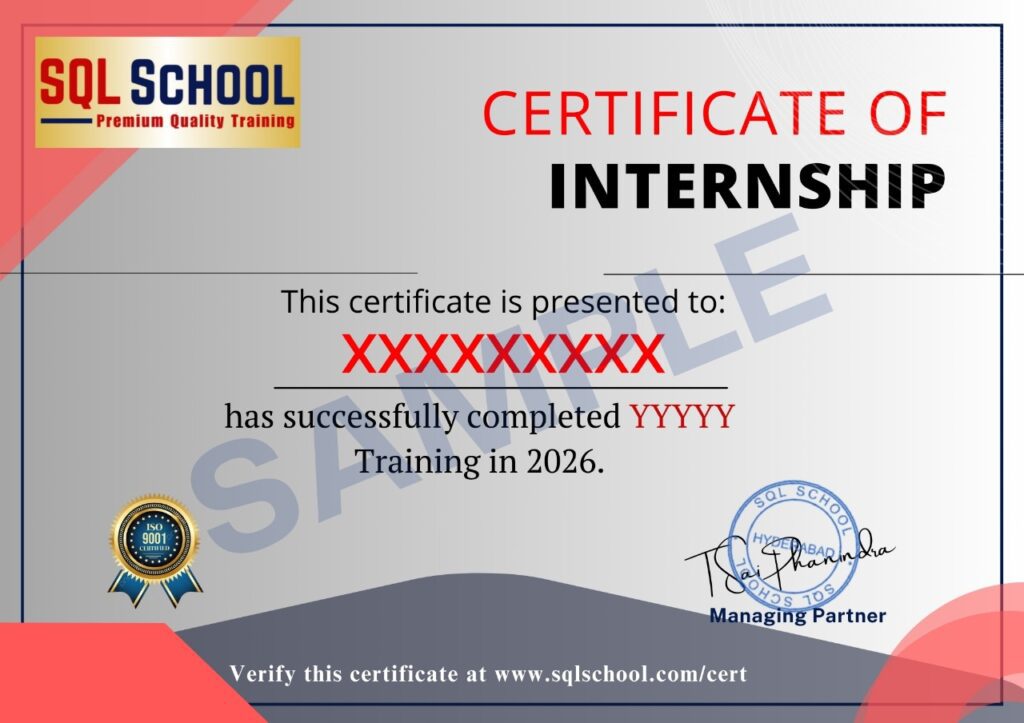
SQL School Azure Data Engineer training certificate of completion issued in January 2026 with verification ID

SQL SCHOOL

24x7 LIVE Online Server (Lab) with Real-time Databases.
Course includes ONE Real-time Project.

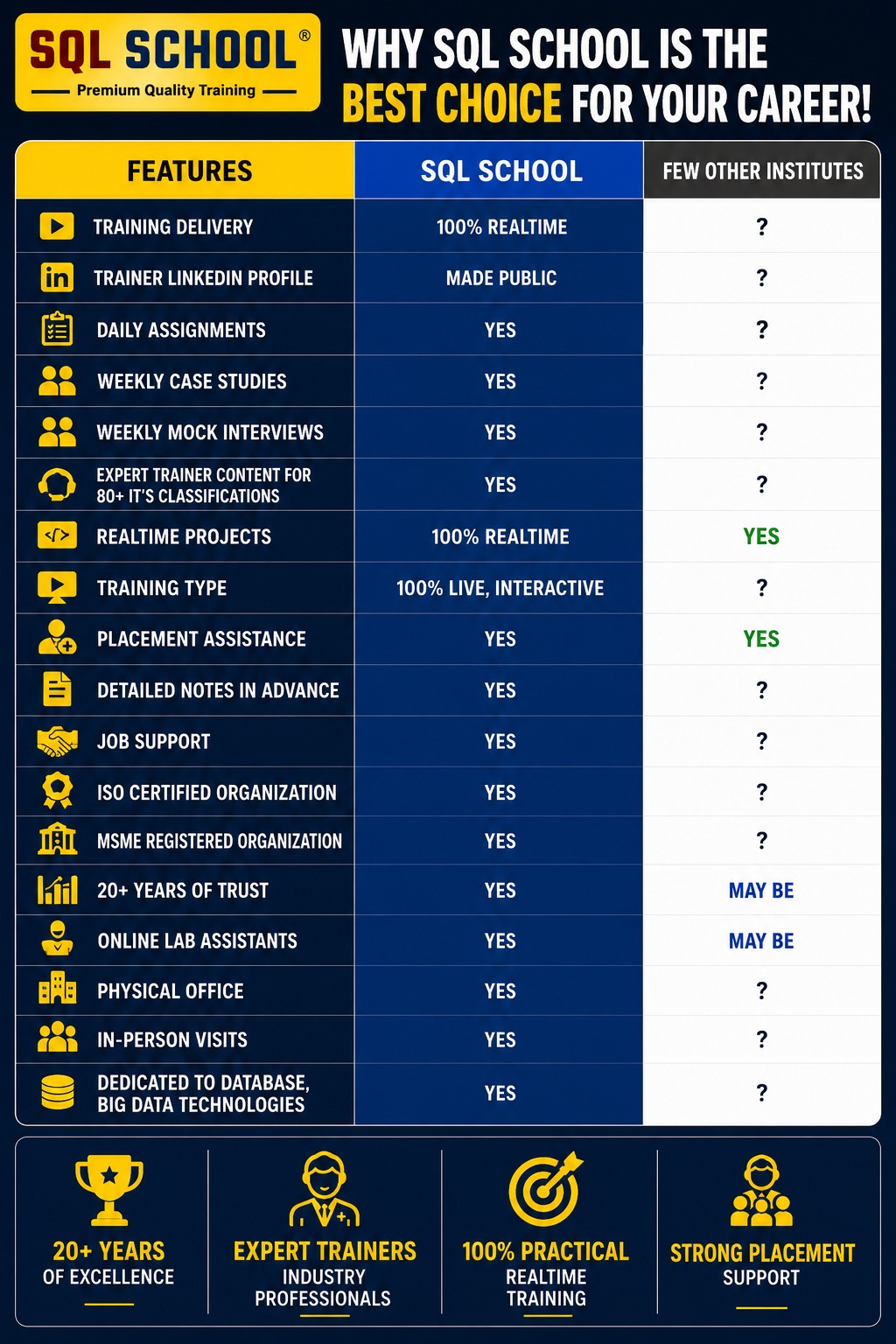
Why Choose SQL School

  • 100% Real-Time and Practical
  • ISO 9001:2008 Certified
  • Weekly Mock Interviews
  • 24/7 LIVE Server Access
  • Realtime Project FAQs
  • Course Completion Certificate
  • Placement Assistance
  • Job Support