Master PostgreSQL DBA: Build High-Demand Database Administration Skills
In today’s data-driven world, organizations rely on powerful and secure databases to manage critical business information. PostgreSQL is one of the most trusted open-source relational database systems used globally. A PostgreSQL DBA Course helps you master database administration, performance tuning, security, and high availability, opening doors to high-paying IT careers.
Whether you are a fresher, IT professional, or system administrator, learning PostgreSQL DBA skills can significantly boost your career growth.
What is PostgreSQL and Why It Is Important
PostgreSQL, also known as Postgres, is an advanced open-source relational database management system (RDBMS) known for its reliability, scalability, and performance. It supports ACID transactions, advanced indexing, JSON, replication, and enterprise-level security features.
PostgreSQL is widely used in:
Banking and finance
Healthcare systems
E-commerce platforms
SaaS applications
Data analytics solutions
Government and enterprise systems
With growing data volumes, companies need skilled PostgreSQL Database Administrators (DBAs) to ensure databases run smoothly, securely, and efficiently.
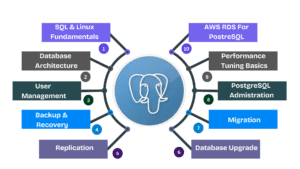
Features of a PostgreSQL DBA Course
A professional PostgreSQL DBA Course is designed to provide real-world, job-ready skills.
Installation & Configuration
Learn to install PostgreSQL on Windows and Linux, configure memory, storage, connections, and optimize server settings.
Database Administration
Manage users, roles, permissions, schemas, tables, and database objects efficiently.
Security Management
Implement authentication, encryption, role-based access, auditing, and security best practices.
Backup & Recovery
Perform logical and physical backups, point-in-time recovery (PITR), and disaster recovery planning.
High Availability & Replication
Set up streaming replication, failover systems, clustering, and load balancing.
Performance Tuning
Optimize queries using indexes, execution plans, vacuum, partitioning, and configuration tuning.
Monitoring & Troubleshooting
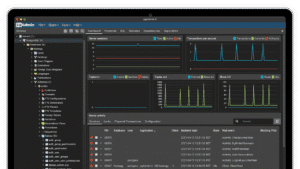
Track performance using pgAdmin, system views, logs, and monitoring tools like Grafana.
Cloud PostgreSQL
Work with PostgreSQL on AWS RDS, Azure PostgreSQL, and Google Cloud SQL.
Automation & Maintenance
Schedule jobs, automate backups, upgrades, and routine maintenance.
Why Learn PostgreSQL DBA
PostgreSQL DBA skills are in high demand because businesses depend on stable, fast, and secure databases.
Key reasons to learn PostgreSQL DBA:
Strong demand in IT industry
Open-source and enterprise-ready
High salary potential
Used across multiple industries
Excellent cloud integration
Strong community support
Long-term career stability
A PostgreSQL DBA ensures business continuity by managing performance, security, and availability of critical systems.
Advantages of a PostgreSQL DBA Course
Open-Source with Enterprise Power
PostgreSQL is free, reliable, and scalable for enterprise workloads.
High Career Growth
DBAs are essential for data-driven companies and earn attractive salaries.
Real-Time Project Experience
Courses include real-world scenarios for backups, failures, and performance tuning.
Global Job Opportunities
PostgreSQL is used worldwide, creating international career options.
Cloud & DevOps Integration
PostgreSQL works seamlessly with modern cloud platforms and DevOps tools.
Who Should Learn PostgreSQL DBA
This course is ideal for:
IT Professionals & System Administrators
Aspiring Database Administrators
Software Developers
Cloud & DevOps Engineers
Data Engineers & Analysts
Freshers & Final-Year Students
Career Switchers
No matter your background, PostgreSQL DBA training helps you build job-ready database skills.
Key Concepts in PostgreSQL DBA
A PostgreSQL DBA (Database Administrator) is responsible for managing, securing, optimizing, and maintaining PostgreSQL databases in production environments. A professional PostgreSQL DBA Course covers the following core concepts in depth.
PostgreSQL Architecture
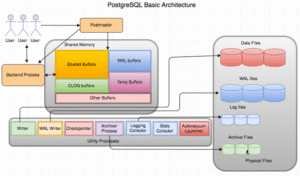
Understanding PostgreSQL’s internal architecture is essential for effective administration. This includes background processes like the Postmaster, WAL Writer, Checkpointer, Autovacuum, memory structures such as shared buffers, work memory, and how Write-Ahead Logging (WAL) ensures data consistency and crash recovery.
Installation & Server Configuration
DBAs learn how to install PostgreSQL on Linux and Windows, configure postgresql.conf and pg_hba.conf files, manage ports, connections, memory allocation, and tune system-level parameters for optimal performance.
User, Role & Access Management
Security starts with proper user management. DBAs create roles, assign privileges, manage authentication methods, implement role-based access control (RBAC), and ensure only authorized users can access sensitive data.
Backup & Recovery (PITR)
Backup strategies include logical backups (pg_dump), physical backups (pg_basebackup), and Point-in-Time Recovery (PITR). DBAs must ensure business continuity by restoring databases quickly after failures or data corruption.
Replication & High Availability
PostgreSQL supports streaming replication, logical replication, and failover systems. DBAs configure standby servers, manage failover mechanisms, and ensure high availability for mission-critical applications.
Performance Tuning & Optimization
Performance tuning involves analyzing slow queries, using indexes effectively, understanding execution plans, vacuuming tables, partitioning large datasets, and tuning parameters like work_mem and shared_buffers.
Monitoring & Troubleshooting
DBAs use pgAdmin, system views (pg_stat_activity), logs, and monitoring tools like Grafana to track database health, detect bottlenecks, and resolve performance or stability issues.
Storage & Tablespace Management
PostgreSQL DBAs manage disk usage, tablespaces, data growth, large objects, and ensure efficient storage allocation to prevent downtime caused by space issues.
Career Opportunities After PostgreSQL DBA Course
After completing PostgreSQL DBA training, you can apply for:
PostgreSQL Database Administrator
Database Engineer
Cloud Database Administrator
Database Architect
DevOps Database Engineer
Data Platform Engineer
These roles offer strong salary packages and long-term career growth.
How Students Can Learn PostgreSQL DBA Effectively
To master PostgreSQL DBA:
Practice on live servers
Work on real-time projects
Perform backups and recovery
Configure replication
Tune performance
Monitor production databases
Learn cloud deployments
Prepare for interviews
Hands-on training makes you job-ready faster.
Conclusion
A PostgreSQL DBA Course is a smart investment for anyone aiming for a stable, high-paying IT career. With skills in database administration, performance tuning, security, and high availability, you become a valuable asset to any organization.
Start your PostgreSQL DBA journey today and build a future-proof career in database administration.
#PostgreSQLDBA #PostgreSQLCourse #DBATraining #DatabaseAdmin #ITCareers #TechSkills #SQL #CloudDatabase #CareerGrowth #SQLSchool