Top 100 Python Interview Questions
Level 2
Q51. What is break, continue, and pass in Python?
A51. break terminates the loop entirely. continue skips the current loop iteration and moves to the next. pass is a null operation used as a placeholder in empty blocks.
Q52. What is the use of self in Python?
A52. self represents the instance of the class. It is used within class methods to access the attributes and methods of the specific object instance.
Q53. What are global, protected, and private attributes in Python?
A53. Global variables are public. Protected attributes are conventionally prefixed with a single underscore (_). Private attributes are prefixed with a double underscore (__) and cannot be accessed or modified from outside the class directly.
Q54. What are the common built-in data types in Python?
A54. None Type (None), Numeric (int, float, complex, bool), Sequence (list, tuple, range, str), Mapping (dict), and Set (set, frozenset).
Q55. What is Scope in Python?
A55. Scope is a block of code where an object in Python remains relevant. Examples are Local, Global, Module-level, and Outermost (built-in) scopes.
Q56. What is an Interpreted language?
A56. An interpreted language executes its statements line by line directly from the source code, with no intermediary compilation step.
Q57. What is a dynamically typed language?
A57. A dynamically typed language (like Python) performs type-checking on the fly, during code execution, meaning data types are checked during execution.
Q58. What are *args and **kwargs?
A58. *args passes a variable number of positional arguments (packed as a tuple). **kwargs passes a variable number of keyword arguments (packed as a dictionary).
Q59. What is the difference between a Set and Dictionary?
A59. A Set is an unordered, mutable collection of unique elements. A Dictionary is an ordered (since Py 3.7) collection of key:value pairs.
Q60. What is inheritance in Python?
A60. Inheritance is a feature of OOPs that allows a new class (subclass) to inherit features from an existing class (superclass), supporting code reuse.
Q61. What is encapsulation in Python?
A61. Encapsulation is a feature of OOPs that hides the internal details of a class and protects data from outside access, often achieved using single or double underscores on variables.
Q62. What is polymorphism in Python?
A62. Polymorphism means “many forms”. It allows different classes to have methods with the same name but different behavior (e.g., method overriding).
Q63. What is abstraction in Python?
A63. Abstraction means showing only essential features and hiding unnecessary details. It is often implemented using abstract classes and methods from the abc module.

Q64. What is the use of the if __name__ == “__main__”: statement?
A64. It ensures that the code inside the block is only executed if the script is run directly, and not when it is imported as a module.
Q65. What is a defaultdict in Python?
A65. A defaultdict is a subclass of dict that provides a default value for non-existent keys, preventing KeyError exceptions. It requires a factory function (like int or list) for the default value.
Q66. What is the best way to debug a Python program?
A66. The command python -m pdb Python-script.py can be used to debug a Python program using the built-in PDB (Python Debugger)
Q67.What is the GIL in Python?
A67: Global Interpreter Lock — prevents multiple native threads from executing Python
bytecode simultaneously.
Q68. What is Tkinter used for?
A68: To build GUI-based applications.
Q69: What is a package in Python?
A69: A collection of modules in a directory with __init__.py.
Q70: What is NumPy?
A70: A library for numerical and matrix computations.
Q71: What is machine learning?
A71: It’s the process of training systems to learn patterns and make predictions.
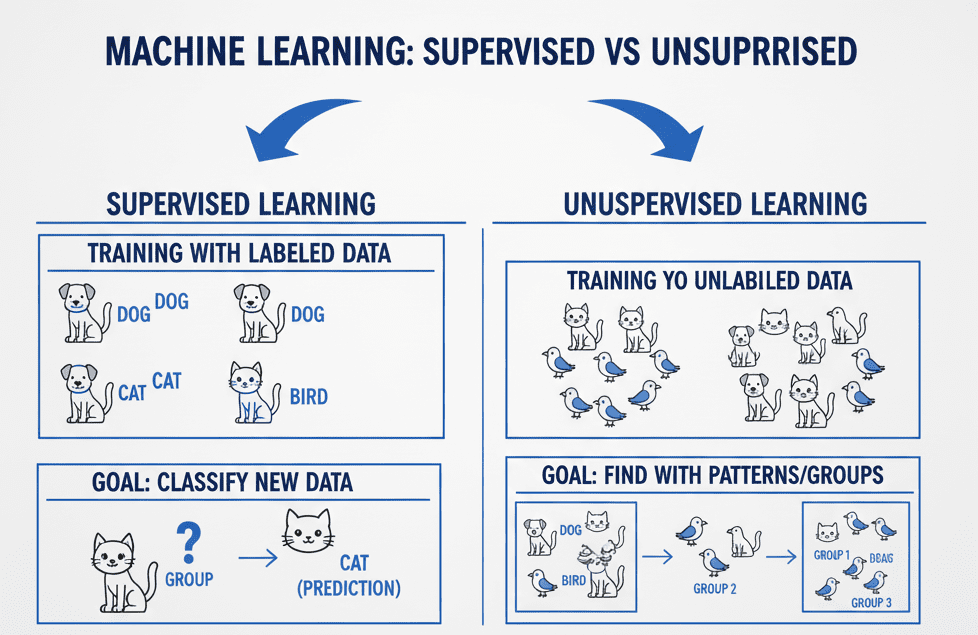
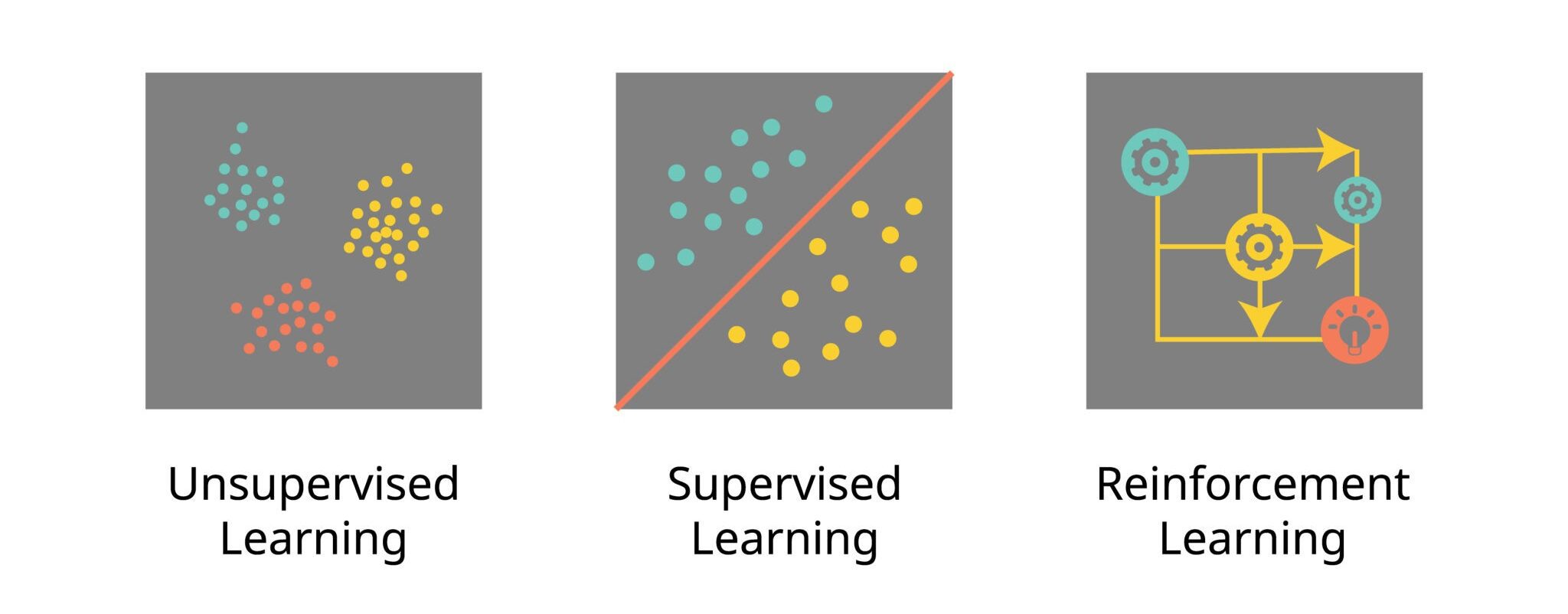
Q72: Difference between supervised and unsupervised learning.
A72: Supervised uses labeled data; unsupervised uses unlabeled data.
Q73: What is Scikit-Learn?
A73: A Python library for machine learning algorithms.
Q74: What is Linear Regression?
A74: A supervised algorithm for predicting continuous values.
Q75: What is Logistic Regression used for?
A75: Binary classification problems.
Q76: What is Decision Tree?
A76: A model that splits data into branches to make decisions.
Q77: What is Random Forest?
A77: An ensemble of multiple decision trees.
Q78: What is PCA (Principal Component Analysis)?
A78: A dimensionality reduction technique.
Q79: What is DBSCAN?
A79: A clustering algorithm that groups points based on density.
Q80: What is the purpose of Neural Networks?
A80: To model complex relationships between inputs and outputs.
Q81:What is Artificial Intelligence?
A81: Simulation of human intelligence by machines.
Q82: What is NLP?
A82: Natural Language Processing — processing human language using AI.
Q83: How is NLP different from ML?
A83: NLP focuses on language understanding; ML is a broader learning process
Q84: What are common Python NLP libraries?
A84: NLTK, spaCy, and TextBlob.
Q85: What is tokenization?
A85: Splitting text into words or sentences.
Q86: What is stemming?
A86: Reducing words to their root form.
Q87: How is AI used in chatbots?
A87:For intent detection, context retention, and generating responses.
Q88: What is Flask used for in AI projects?
A88:To deploy ML models as web applications.
Q89: What is FastAPI?
A89: A fast Python web framework for API-based AI deployment.
Q90: What is Streamlit used for?
A90: Building interactive AI dashboards and data apps easily.
Q91: How does Python interact with Big Data?
A91: Using PySpark and Hadoop integrations.
Q92: What is Spark MLlib?
A92: A library in Apache Spark for scalable machine learning.
Q93: What is dimensionality reduction?
A93: Reducing the number of features while retaining essential information.
Q94: What are GLM models?
A94: Generalized Linear Models — statistical models for regression.
Q95: What is K-Means clustering?
A95: A method to group data into K clusters.
Q96: What is t-SNE used for?
A96: Visualizing high-dimensional data.
Q97: What is Python’s role in IoT?
A97: Connecting sensors and devices through libraries like MQTT, Flask, and JSON.
Q98: What are Python frameworks for web development?
A98: Django, Flask, Pyramid, Falcon, etc.
Q99: What is an AI ethical consideration?
A99: Ensuring fairness, privacy, and transparency in AI systems.
Q100: How can Python help in career growth?
A100: By enabling data analytics, automation, AI-ML, and application development
skills, making it one of the most in-demand tech skills.