



Yes. SQL is taught from basics to advanced level, including joins, subqueries, indexing, window functions, merge (upsert), and full real-time case studies in Medicare & E-Commerce.
An Excel Data Analyst cleans, organizes, and analyzes data using formulas, pivot tables, and dashboards. They uncover trends, automate reports, and create clear insights that help teams make faster, data-driven decisions. With strong Excel and basic SQL skills, they turn raw data into meaningful business outcomes.
✅ Data Cleaning & Transformation
✅ Advanced Excel Functions
✅ Pivot Tables, Pivot Charts & Interactive Dashboards
✅ Automating Tasks with Macros & VBA
✅ Exploratory Data Analysis (EDA) using Excel & Python
✅ Data Modeling, Schema Understanding & KPI Design
✅ Handling Large Datasets & Performance Optimization
✅ Excel Integrations with SQL, Power BI & Cloud Sources
✅ AI & CoPilot for Smart Analytics & Automation
✅ Real-Time Business Dashboards + 1:1 Interview Support
Module 1: SQL Server TSQL (MS SQL) Queries
Ch 1: Data Analyst Job Roles
- Introduction to Data
- Data Analyst Job Roles
- Data Analyst Challenges
- Data and Databases Intro
Ch 2: Database Intro & Installations
- Database Types (OLTP, DWH, ..)
- DBMS: Basics
- SQL Server 2025 Installations
- SSMS Tool Installation
- Server Connections, Authentications
Ch 3: SQL Basics V1 (Commands)
- Creating Databases (GUI)
- Creating Tables, Columns (GUI)
- SQL Basics (DDL, DML, etc..)
- Creating Databases, Tables
- Data Inserts (GUI, SQL)
- Basic SELECT Queries
Ch 4: SQL Basics V2 (Commands, Operators)
- DDL : Create, Alter, Drop, Add, modify, etc..
- DML: Insert, Update, Delete, select into, etc..
- DQL: Fetch, Insert… Select, etc..
- SQL Operations: LIKE, BETWEEN, IN, etc..
- Special Operators
Ch 5: Data Types
- Integer Data Types
- Character, MAX Data Types
- Decimal & Money Data Types
- Boolean & Binary Data Types
- Date and Time Data Types
- SQL_Variant Type, Variables
Ch 6: Excel Data Imports
- Data Imports with Excel
- SQL Native Client
- Order By: Asc, Desc
- Order By with WHERE
- TOP & OFFSET
- UNION, UNION ALL
Ch 7: Schemas & Batches
- Schemas: Creation, Usage
- Schemas & Table Grouping
- Real-world Banking Database
2 Part, 3 Part & 4 Part Naming
Batch Concept & “Go” Command
Ch 8: Constraints, Keys & RDBMS – Level 1
- Null, Not Null Constraints
- Unique Key Constraint
- Primary Key Constraint
- Foreign Key & References
- Default Constraint & Usage
- DB Diagrams & ER Models
Ch 9: Normal Forms & RDBMS – Level 2
- Normal Forms: 1 NF, 2 NF
- 3 NF, BCNF and 4 NF
- Adding PK to Tables
- Adding FK to Tables
- Cascading Keys
- Self Referencing Keys
- Database Diagrams
Ch 10: Joins & Queries
- Joins: Table Comparisons
- Inner Joins & Matching Data
- Outer Joins: LEFT, RIGHT
- Full Outer Joins & Aliases
- Cross Join & Table Combination
- Joining more than 2 tables
Ch 11: Views & RLS
- Views: Realtime Usage
- Storing SELECT in Views
- DML, SELECT with Views
- RLS: Row Level Security
- WITH CHECK OPTION
- Important System Views
Ch 12: Stored Procedures
- Stored Procedures: Realtime Use
- Parameters Concept with SPs
- Procedures with SELECT
- System Stored Procedures
- Metadata Access with SPs
- SP Recompilations
- Stored Procedures, Tuning
Ch 13: User Defined Functions
- Using Functions in MSSQL
- Scalar Functions in Real-world
- Inline & Multiline Functions
- Parameterized Queries
- Date & Time Functions
- String Functions & Queries
- Aggregated Functions & Usage
Ch 14: Triggers & Automations
- Need for Triggers in Real-world
- DDL & DML Triggers
- For / After Triggers
- Instead Of Triggers
- Memory Tables with Triggers
- Disabling DMLs & Triggers
Ch 15: Transactions & ACID
- Transaction Concepts in OLTP
- Auto Commit Transaction
- Explicit Transactions
- COMMIT, ROLLBACK
- Checkpoint & Logging
- Lock Hints & Query Blockin
- READPAST, LOCKHINT
Ch 16: CTEs & Tuning
- Common Table Expression
- Creating and Using CTEs
- CTEs, In-Memory Processing
- Using CTEs for DML Operations
- Using CTEs for Tuning
- CTEs: Duplicate Row Deletion
Ch 17: Indexes Basics, Tuning
- Indexes & Tuning
- Clustered Index, Primary Key
- Non Clustered Index & Unique
- Creating Indexes Manually
- Composite Keys, Query Optimizer
- Composite Indexes & Usage
Ch 18: Group By Queries
- Group By, Distinct Keywords
- GROUP BY, HAVING
- Cube( ) and Rollup( )
- Sub Totals & Grand Totals
- Grouping( ) & Usage
- Group By with UNION
- Group By with UNION ALL
Ch 19: Joins with Group By
- Joins with Group By
- 3 Table, 4 Table Joins
- Join Queries with Aliases
- Join Queries & WHERE
- Join Queries & Group By
- Joins with Sub Queries
- Query Execution Order
Ch 20: Sub Queries
- Sub Queries Concept
- Sub Queries & Aggregations
- Joins with Sub Queries
- Sub Queries with Aliases
- Sub Queries, Joins, Where
- Correlated Queries
Ch 21: Cursors & Fetch
- Cursors: Realtime Usage
- Local & Global Cursors
- Scroll & Forward Only Cursors
- Static & Dynamic Cursors
- Fetch, Absolute Cursors
Ch 22: Window Functions, CASE
- IIF Function and Usage
- CASE Statement Usage
- Window Functions (Rank)
- Row_Number( )
- Rank( ), DenseRank( )
- Partition By & Order By
Ch 23: Merge(Upsert) & CASE, IIF
- Merge Statement
- Upsert Operations with Merge
- Matched and Not Matched
- IIF & CASE Statements
- Merge Statement inside SPs
- Merge with OLTP & DWH
Ch 24: Key Take-Aways from Module 1
- Case Study 1: Medicare: Tasks, Solutions
- Case Study 2: ECommerce: Task, Solutions
- Chapter Wise Assignments: Solutions
- Dailly Assignments: Review (Feedback)
- Weekly Mock Interview: Feedbacks
Module 2: Excel & Advanced Excel, CoPilot
Ch 1: Basic Functions
- SUM, AVERAGE, MAX, MIN, COUNT, COUNTA
- Absolute, Mixed
- Relative Referencing
Ch 2: Formatting and Proofing
- Currency Format
- Format Painter
- Formatting Dates
- Custom and Special Formats
- Formatting Cells
Ch 3: Functions
- SUMIF, SUMIFS, COUNTIF
- COUNTIFS, AVERAGEIF
- AVERAGEIFS, NESTED IF
- IFERROR STATEMENT
- AND, OR, NOT
Ch 4: Protecting Excel
- File Level Protection
- Workbook
- Worksheet Protection
- Security Concepts
- Realtime Issues, Solutions
Ch 5: Text Functions
- Upper, Lower, Proper
- Left, Mid, Right
- Trim, Len, Exact
- Concatenate
- Find, Substitute
Ch 6: Date & Time Functions
- Today, Now
- Day, Month, Year
- Date, Date if, Date Add
- EOMONTH
- Weekday Functions
Ch 7: Adv. Techniques
- Paste Formulas
- Paste Formats
- Paste Validations
- Transpose Tables
Ch 8: New in Excel & 365
- Charts – Tree map & Waterfall
- Sunburst, Box and whisker Charts
- Combo Charts – Secondary Axis
- Adding Slicers Tool in Pivot & Tables
- Using Power Map and Power View
- Forecast Sheet, park lines
Ch 9: New in Excel & 365
- Using 3-D Map
- New Controls in Pivot Table
- Various Time Lines
- Auto complete a data range
- Quick Analysis Tool
- Smart Lookup manage Store
Ch 10: Printing Workbooks
- Setting Up Print Area
- Customizing Headers
- Templates
- Print Titles –Repeat Rows
Ch 11: Sorting and Filtering
- Filtering on Text
- Numbers & Colors
- Sorting Options
- Advanced Filters
- Filter Criteria
Part 2: Advanced Excel
Ch 12: What If Analysis
- Goal Seek
- Scenario Analysis
- Data Tables (PMT Function)
- Solver Tool
Ch 13: Logical Functions
- If Function
- How to Fix Errors – if error
- Nested If
- Complex if and or functions
Ch 14: Data Validation
- Number, Date & Time
- Text and List Validation
- Custom validations formulas
- Dynamic Dropdowns
Ch 15: Lookup Functions
- V lookup / H Lookup
- Index and Match
- Smooth User Interface
- Nested V Lookup
- Reverse Lookup
- Worksheet linking
- V lookup with Helper Column
Ch 16: Pivot Tables – 1
- Creating Simple Pivot Tables
- Classic Pivot table
- Choosing Field
- Filtering PivotTables
- Modifying PivotTable Data
- Grouping
- Calculated Fields
Ch 17: Pivot Tables – 2
- Array with IF, LEN
- MID function
- Array with Lookup
- Various Charts
- SLICERS, Filter data
- Manage Primary Axis
- Manage Secondary Axis
Ch 18: Excel Dashboard
- Planning a Dashboard
- Adding Tables and Charts to Dashboard
- Adding Dynamic Contents to Dashboard
Ch 19: VBA Macro – Level 1
- Using Outlook Namespace
- Send automated mail
- Outlook Configurations, MAPI
- Worksheet Operations
- Workbook Operations
Ch 20: VBA Macro – Level 2
- Merge Worksheets using Macro
- Merge multiple excel files into one sheet
- Split worksheets using VBA
- Worksheet copiers
Module 3: Python (For Data Analysts)
Ch 1: Python in Data Analyst
- Database Types
- Role of Python in Analysis
- Databricks & Data Analyst with Python
Ch 2: Python Introduction
- Python Introduction
- Python Versions
- Python Implementations
- Python Installations
- Python IDE & Usage
- Jupyter Notebooks
Ch 3: Python Operations
- Basic Operations in Python
- Python Scripts, Print()
- Single, Multiline Statements
- Python: Internal Architecture
- Compiler Versus Interpreter
Ch 4: Data Types & Variables
- Integer / Int Data Types
- Float, String Data Types
- Sequence Types: List, Tuple
- Range, Complex & memview
- Retrieving Data Type: type()
Ch 5: Python Operators
- Arithmetic, Assignment Ops
- Comparison Operators
- Operator Precedence
- If … Else Statement, Pass
- Short Hand If, OR, AND
- ELIF and ELSE IF Statements
Ch 6: Python Loops, Iterations
- Python Loop & Realtime Use
- Python While Loop Statement
- Break and Continue Statement
- Iterations & Conditions
- Exit Conditions & For Loops
- iter() and Looping Options
Ch 7: Python Functions
- Python Functions & Usage
- Function Parameters
- Default & List Parameters
- Python Lambda Functions
- Recursive Functions, Usage
- Return & Print @ Lamdba
Ch 8: Python Modules
- Import Python Modules
- Built In Modules & dir
- datetime module in Python
- Date Objections Creation
- strftime Method & Usage
- imports & datetime.now()
Ch 9: Python User Inputs & TRY
- Try Except, Exception Handling
- Raise an exception method
- TypeError, Scripting in Python
- Python User Inputs
- Python Index Numbers
- input() & raw_input()
Ch 10: Python File Handling
- File Handling, Activities
- Loop, Write, Close Files
- Appending, Overwriting
- import os, path.exists
- f.open, f.write
- f.read, f.close
Ch 11: Pandas DataFrames 1
- Installation of Pandas
- Python Modules & Pandas
- Pandas Codebase & Usage
- import pandas.DataFrame
- Pandas Series, arrays
Ch 12: Pandas DataFrames 2
- Indexes & Named Options
- Locate Row and Load Rows
- Row Index & Index Lists
- Load Files Into a DataFrame
- df.to_string() Function
- tail() & null() Function
Ch 13: Pandas Transformations
- Pandas – Cleaning Data
- Replace, Transform Columns
- Data Discovery & Column Fill
- Identify & Remove Duplicates
- dropna(), fillna() Functions
- Data Plotting & matlib Lib
Ch 14: Key Take-Aways from Module 2
- Case Study @ ECommerce: Task, Solutions
- Chapter Wise Assignments: Solutions
- Dailly Assignments: Review (Feedback)
- Weekly Mock Interview: Feedbacks
What is the Excel Data Analyst course?
This program trains you in SQL Server TSQL, Excel, Advanced Excel, CoPilot, Power BI, Python for Analytics, dashboards, and real-time analytics workflows. It includes daily assignments, projects, and job-oriented tasks.
Who can join the Excel Data Analyst training?
Anyone — freshers, non-IT students, working professionals, or career switchers. The course starts from the basics of data, SQL, Excel, and moves into advanced analytics.
What are the modules in this training program?
Module 1: SQL Server TSQL (3 Weeks, 2 Case Studies)
Module 2: Excel, Advanced Excel & CoPilot
Module 3: Python for Data Analysts
Module 4: Realtime Projects + Resume + Mock Interviews
Includes PL-300 Exam Guidance.
What SQL topics will I learn before Excel?
Database concepts, DDL/DML/DQL operations, data types, schemas, constraints, normalization, joins, views, stored procedures, triggers, transactions, CTEs, indexes, group-by, subqueries, window functions, and tuning.
Do I need prior knowledge of Excel to join?
No. Excel is taught from basic formulas to advanced analytics. All tools, functions, and dashboards are covered step by step.
What basic Excel skills will I learn?
SUM, AVERAGE, COUNT, MAX/MIN, referencing, formatting, text functions, date/time functions, conditional functions, workbook protection, and data imports.
What advanced Excel concepts are covered?
VLOOKUP, HLOOKUP, INDEX/MATCH, nested functions, dynamic dropdowns, pivot tables, dashboards, slicers, solver, goal seek, array formulas, and Excel 365 new charts.
Is CoPilot included in this Excel training?
Yes. Excel CoPilot tasks, AI-driven analytics, predictions, automation, quick formatting, smart lookups, storytelling insights, and cloud integrations are taught.
Do we learn Excel dashboards?
Yes. Dashboard planning, charts, pivot charts, dynamic visuals, slicers, interactive layouts, and KPI-based reporting are covered in the Advanced Excel module.
Will I learn Excel automation (Macros & VBA)?
Yes. VBA macros to automate Excel sheets, merge files, split worksheets, send automated emails via Outlook, and perform repetitive tasks efficiently are included.
Does this course include Power BI?
Yes. Power BI basics, visualizations, modelling, DAX, cloud publishing, dashboards, RLS, and Excel-to-PowerBI workflows are covered.
Do we learn Python for Data Analytics?
Yes. Python basics, loops, conditions, functions, modules, exceptions, file handling, Pandas, cleaning, transformations, duplicates, plotting, and a real-time analytics project are included.
Are real-time projects included?
Yes. Medicare, E-Commerce, and Banking/Finance projects using SQL, Excel, Power BI, and Python are part of the end-to-end training.
Do you provide daily assignments and weekly mock interviews?
Yes. Each chapter includes hands-on tasks, solution reviews, weekly mock interviews, and personalized feedback sessions.
Is this course suitable for non-IT background students?
Yes. The syllabus starts from fundamentals of data and gradually builds expertise in Excel, SQL, BI, and Python analytics — ideal for beginners.
What job roles can I apply for after completing this training?
Excel Data Analyst, Junior Data Analyst, MIS Analyst, Reporting Analyst, Business Analyst, Power BI Analyst, SQL Analyst, Python Analyst.
Is PL-300 (Power BI) exam guidance included?
Yes. PL-300 certification strategy, exam preparation, practice questions, and real-world scenario training are provided.
Do you provide resume and interview preparation?
Yes. 1:1 resume building, project explanation tips, mock interviews, and job-oriented scenario discussions are included.
What training modes are available?
LIVE Online Classes, Self-Paced Videos, Corporate Training, and Free Demo Sessions with the trainer.
Placement Partners






















SQL SCHOOL
24x7 LIVE Online Server (Lab) with Real-time Databases.
Course includes ONE Real-time Project.
#Top Technologies



Why Choose SQL School

- 100% Real-Time and Practical
- ISO 9001:2008 Certified
- Weekly Mock Interviews
- 24/7 LIVE Server Access
- Realtime Project FAQs
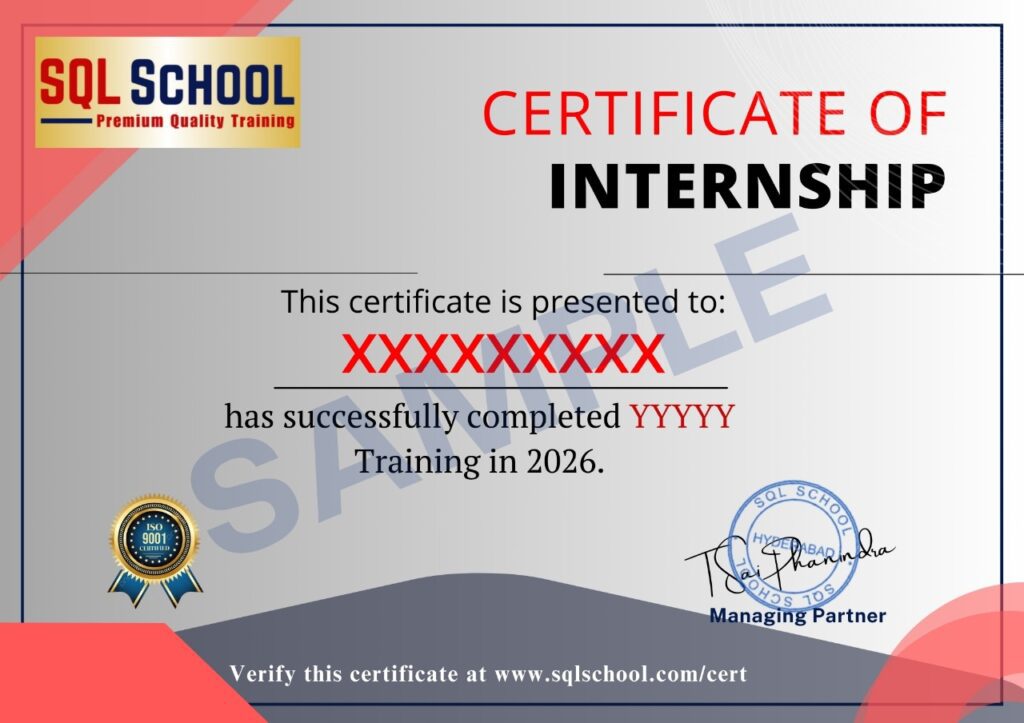
- Course Completion Certificate
- Placement Assistance
- Job Support