
Module 1: Ethical Hacking
Module 2: Defensive Security (SOC / SIEM / EDR)
Module 3: GRC (Governance, Risk & Compliance)
Cyber Security focuses on protecting systems, networks, and data from cyber threats using offensive and defensive security techniques. It equips you with skills in ethical hacking, SOC operations, SIEM, threat detection, incident response, cloud security, and compliance, preparing you for roles like Cyber Security Analyst, SOC Analyst, Ethical Hacker, SIEM Engineer, and Information Security Specialist.
- ✅Ethical Hacking & Offensive Security
- ✅Advanced Ethical Hacking Tools
- ✅ Networking for Cyber Security
- ✅Cryptography & Data Protection
- ✅Web Application & Vulnerability Attacks
- ✅Cloud Security (AWS, Azure, GCP)
- ✅SOC Operations & Blue Team Skills
- ✅SIEM, EDR & Threat Hunting
- ✅Malware Analysis & Email Security
- ✅GRC, Risk, Compliance & Audits
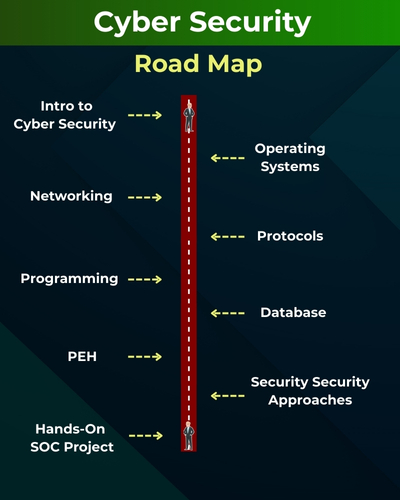
Module 1: Cyber Security – Ethical Hacking
Ch 1: Introduction to Cybersecurity
- The evolution of Cybersecurity
- What is Information Security & Cybersecurity
- Cybersecurity objectives
- Cybersecurity Roles
- Domain of cyber security
- Cybersecurity objectives
- The Cybersecurity skills gap
- Cybersecurity & situational awareness
Ch 2: Operating Systems in Cyber Security
- Intro to operating systems
- Different types of Operating Systems
- What is Virtual Machine
- What is Virtualization
- Intro to Kali Linux
Ch 3: Ethical Hacking in Cyber Security
- Introduction to Ethical hacking
- What is hacking
- Types of Hackers
- World Top 10 hackers and their HATs
- 5 Phases of Hacking
- FootPrint/Information Gathering
Ch 4: Ethical Hacking Tools
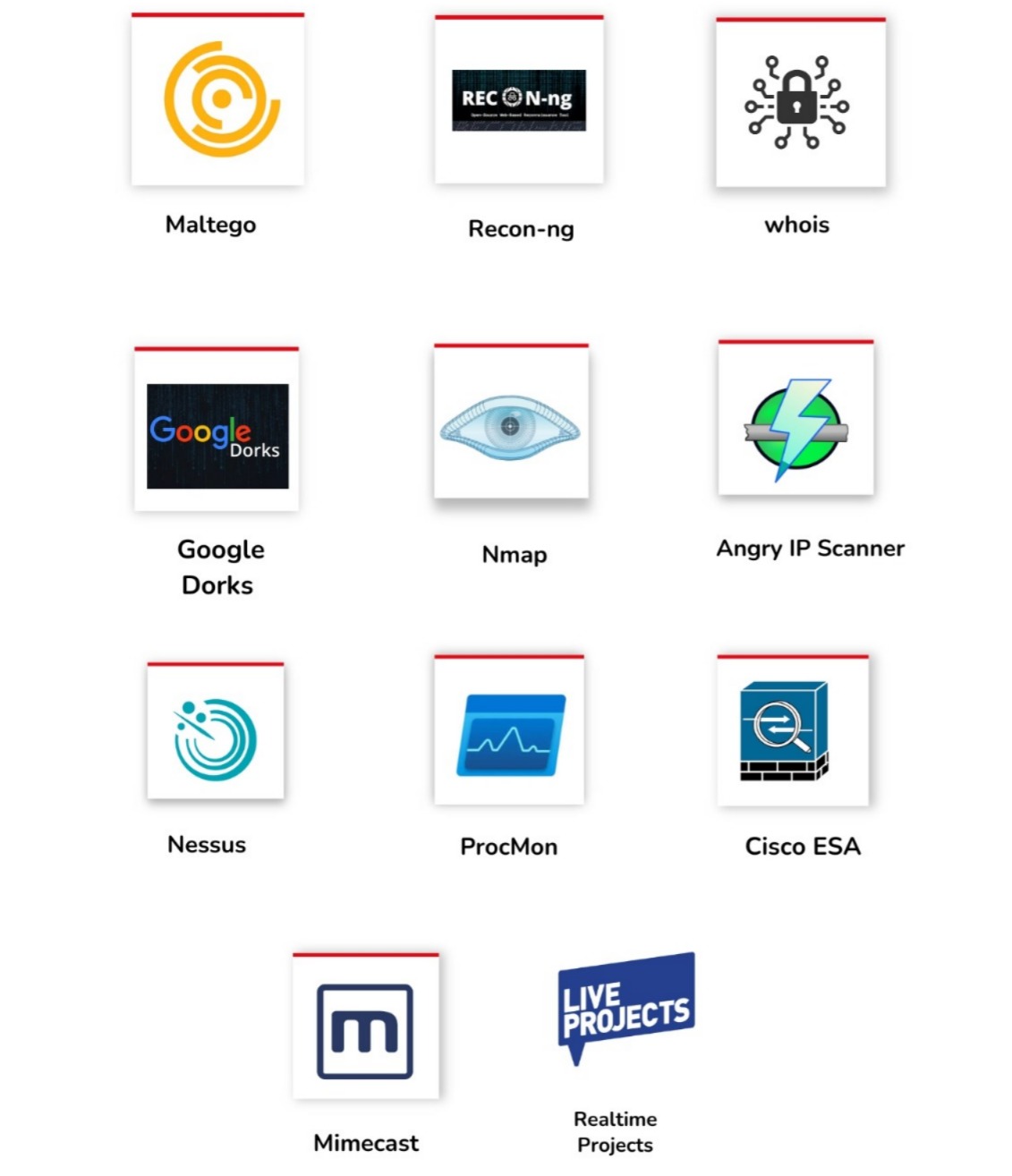
- Tools: Maltego, Recon-ng, whois, Shodan, Google
- Scanning
- Tools: Nmap, Angry IP Scanner, Nessus
Ch 5: Ethical Hacking Access
- Gaining Access
- Maintaining Access
- Clearing Tracks
- Types of Attacks – Active / Passive Attacks
- Penetration Testing
- Offensive and defensive security
- Teams in cyber security – Red/Blue/Purple
Ch 6: Networking Essentials in Cyber Security – 1
- Infrastructure Terminology
- Designing with Security in Mind
- Network Diagrams
- Network Topology
- OSI Layers & TCP/IP Model
- IPv4 & Ipv6
- Ports & protocols
- Port numbers
Ch 7: Networking Essentials in Cyber Security – 2
- Wireless Attacks
- Firewalls
- IDS/IPS
- Honeypots
- Cloud Computing
- VPNs and VPN Concentrators
Ch 8: Networking Essentials in Cyber Security – 3
- Intrusion Detection Systems
- Router
- Switch
- Proxy
- Network Access Control (NAC)
- Different Types of networks
Ch 9: Cryptography & Data Protection – 1
- Introduction to Cryptography
- Purpose and role in cybersecurity
- Key terminology (plaintext, ciphertext, key, algorithm)
- Types of Cryptography
- Symmetric Encryption (AES, DES, 3DES, Blowfish)
- Asymmetric Encryption (RSA, ECC)
- Hybrid encryption models
Ch 10: Cryptography & Data Protection – 2
- Hashing & Integrity
- Hash functions (MD5, SHA-1, SHA-256, SHA-3)
- Digital fingerprints and integrity verification
- Common hashing use cases (password storage, file verification)
- Digital Signatures & Certificates
- Signing process and verification
- Role of PKI (Public Key Infrastructure)
- 509 certificates
- Key Management
- Key generation, distribution, storage, and rotation
- Hardware Security Modules (HSMs)
- Key escrow and recovery procedures
Ch 11: Data Protection & Encryption – 1
- Cryptographic Protocols
- SSL/TLS basics
- IPsec and VPN encryption
- Secure Email protocols (S/MIME, PGP)
- Common Cryptographic Attacks
- Brute force & dictionary attacks
- Hash collision attacks
- Data Encryption at Rest & In Transit
- Disk encryption (BitLocker, VeraCrypt)
- Database encryption methods
Ch 12: Data Protection & Encryption – 2
- Network encryption (HTTPS, SSH, VPN)
- Compliance & Best Practices
- Cryptography in ISO 27001, PCI DSS, HIPAA
- Strong encryption standards & key length recommendations
- Avoiding deprecated algorithms
- Tools for Cryptography
- OpenSSL
- hashcat
Ch 13: Advanced Pentesting in Cyber Security
- Introduction to Bug Bounty
- Basic Terminology on Bug Bounty
- Bug Bounty Platforms
- Lab setup for Pentesting
- Installation of Burp Suite Tool
- Bug Bounty Platforms
- Reporting of the bugs
- Vulnerability Scanner Tools
- Web Application Vulnerabilities
- Cross Site Scripting
- Host Header Injection
- URL Redirection Attack
- Parameter Tampering
- SQL Injection
- Bypass Authentication
- Sensitive Information
Ch 14: Vulnerability Attacks in Cyber Security
- File Upload Vulnerability
- Disclosure Vulnerability
- CSRF Attack Vulnerability
- information disclosure
- XML Vulnerability
- Missing SPF Records vulnerability
- OTP Bypass Technique Vulnerability
- IDOR Vulnerability
- No rate Limit Vulnerability
- Session Hijacking Vulnerability
- Long Password Attack Vulnerability
Ch 15: Cloud Security – 1
- Cloud Security Fundamentals
- Shared Responsibility Model
- Cloud Infrastructure Threats
- AWS Cloud Security fundamentals
- AWS Cloud Security Tools and usages
- Azure Cloud Security fundamentals
- Azure Cloud Security Tools and usages
- GCP Cloud Security fundamentals
Ch 16: Cloud Security – 2
- Cloud Resource Exploitation
- Unmonitored API Calls and Access Keys
- Credential Theft from Repositories
- Cloud Identity Attacks
- Lateral Movement in Cloud Environments
- Lack of Visibility and Logging
Module 2: Defensive Security (Blue Team) @ SOC / SIEM / EDR
Ch 17: SOC Fundamentals
- SOC Overview
- SOC Team Structure
- Tier 1 Responsibilities
- Tier 2 Responsibilities
- Tier 3 Responsibilities
- SOC Workflow and Escalation Path
Ch 18: Alert System
- Alert Lifecycle Stages
- Incident Response Phases
- Types of Alerts Handled in SOC
- Daily SOC Monitoring Activities
- KPIs and Metrics for SOC
- Incident Response Phases
- Types of Alerts Handled in SOC
- Daily SOC Monitoring Activities
- KPIs and Metrics for SOC
Ch 19: Log Mechanism & Audits
- Log Collection Strategy
- Log Parsing and Normalization
- Key SOC Log Sources
- Firewall Logs
- IDS/IPS Logs
- DNS Logs
- Endpoint Logs (Sysmon/EDR)
- Active Directory Logs
- Cloud Logs (CloudTrail, Azure Activity)
Ch 20: Cyber Security : SIEM (Splunk)
- Introduction to SIEM
- Use Case Design in SIEM
- Overview of Splunk Architecture
Ch 21: Splunk Operations
- Splunk Ingestion and Indexing
- Writing SPL Queries
- Splunk Dashboards and Alerts
- QRadar Architecture and Flow Collection
- QRadar Rule Creation using CRE
- Rule Writing – SPL (Splunk), AQL (Qradar)
Ch 22: Threat Hunting & Splunk
- Threat Hunting Basics
- Alert Enrichment Techniques
- Alert Suppression & False Positive Handling
- Ticketing Systems (ServiceNow, JIRA) Integration
- Shift Handover Protocols
Ch 23: QRadar
- AQL Querying in Qradar
- Introduction to EDR
- SentinelOne Architecture
- SentinelOne Agent Capabilities
- Remote Response Actions
- (Kill, Quarantine, Rollback)
Ch 24: Mobile Security
- Introduction to Mobile Security
- Threats via Malicious Applications
- App Cloning and Impersonation
- Jailbreaking and Rooting Risks
- Insecure App Communication
- Phishing via SMS or Messaging Apps
- Wi-Fi-based Attacks (MITM)
- Mobile Email Account Compromise
- Keylogging via Spyware Apps
- Mobile Device as
- Entry Point into Corporate Networks
Ch 25: Malware Analysis
- Introduction to Malware Analysis
- Malware Categories
- Virus
- Worm
- Trojan
- Ransomware
- Spyware
- Rootkit
- Fileless Malware
- Malware Behavior and Infection Chain
- Static Analysis Fundamentals
Ch 26: Metadata Security
- File Header and Metadata Check
- String Extraction (strings, FLOSS)
- PE Header Inspection
- Hashing (MD5, SHA256) and Use Cases
- Dynamic Analysis Overview
- Sandbox Analysis (Any.run, Cuckoo)
- Tools for Monitoring Behavior
- ProcMon
- RegShot
- Wireshark
- TCPView
Ch 27: IOC & Cyber Security
- Reverse Engineering Introduction
- Disassemblers (Ghidra, IDA Free)
- Debuggers (x64dbg, OllyDbg)
- Packers and Obfuscation
- IOC Extraction Process
- Types of IOCs
- File Hashes
- Registry Keys
- IPs and Domains
- Filenames
Ch 28: Cyber Security – Emails
- Overview of Email-Based Threats
- Anatomy of a Phishing Email
- Spear Phishing vs Generic Phishing
- Business Email Compromise (BEC)
- Malware Delivery via Email
- Email Header Components
- SPF Record Validation
- DKIM Signature Verification
- DMARC Policy Enforcement
- Email Flow and Received Headers
- Tools for Email Security
- Microsoft Defender for O365
- Cisco ESA
- Proofpoint
- Mimecast
- IOC Search in Mailboxes
- Quarantining and Purging Emails
Ch 29: Data Security ( DLP)
- Intro to Data Security
- Intro to DLP
- DLP for Emails
- DLP for Files
- Writing and applying rules in DLP
- Proofpoint DLP
- User Awareness and Reporting Channels
Ch 30: Threat Intelligence & Incident Response
- Threat Intelligence Fundamentals
- Intelligence Lifecycle Stages
- Strategic vs Tactical vs
- Operational vs Technical TI
- IOC Formats (IP, Hash, URL, Domain)
- TI Sources and Feeds
- VirusTotal
- AlienVault OTX
- Recorded Future
- Shodan
- io
MITRE ATT&CK Overview
Ch 31: IOC & SIEM
- IOC Enrichment in SIEM
- Incident Response and Threat Factors
- Types Incident need to reported
- Management of incidents
- Reporting and remediating Incidents
- Learning from Past Incidents
Module 3: GRC
Ch 32: Governance & Information Security Frameworks
- Overview of Governance in Cybersecurity
- Role of governance in InfoSec
- Key governance principles and policies
- Information Security Management Systems (ISMS)
- Purpose and structure of ISMS
- PDCA (Plan–Do–Check–Act) cycle
Ch 33: Governance & CIS
- ISO 27001/27002 Overview
- NIST Cybersecurity Framework (CSF)
- CIS Controls
- COBIT for Information Security Governance
- Security Policies & Standards
- Policy hierarchy (Policies → Standards → Procedures → Guidelines)
- Writing effective security policies
- Roles & Responsibilities in GRC
- Board, CISO, risk managers, compliance officers
- RACI matrix in security governance
Ch 34: Risk Management & Assessment
- Risk Management Fundamentals
- Risk terms (Threat, Vulnerability, Impact, Likelihood)
- Risk appetite & tolerance
- Risk Assessment Methodologies
- Qualitative vs Quantitative
- Common methods: ISO 27005, NIST SP 800-30
- Risk Identification
Ch 35: Risk Management & Assessment
- Asset identification & classification
- Threat and vulnerability mapping
- Risk Analysis & Evaluation
- Risk scoring & prioritization (Heatmaps, Risk Matrix)
- Business Impact Analysis (BIA)
- Risk Treatment Strategies
- Accept, Avoid, Transfer, Mitigate
- Residual risk management
- Risk Register Management
- Structure and maintenance of a risk register
Ch 36: Compliance & Audit Management
- Compliance Fundamentals
- Legal, regulatory, and contractual requirements
- Sector-specific regulations (GDPR, HIPAA, PCI DSS, SOX, )
- Security Control Mapping
- Cross-mapping controls between frameworks (ISO, NIST, CIS)
- Maintaining a controls library
- Internal & External Audits
- Audit lifecycle (Planning → Fieldwork → Reporting → Follow-up)
- Evidence gathering and validation
Ch 37: Cyber Security Tools
- Tools for compliance tracking (Archer, ServiceNow GRC, OneTrust)
- Key compliance metrics & dashboards
- Remediation & Gap Closure
- Corrective Action Plans (CAPs)
- Post-audit follow-up process
Ch 38: Security Awareness, Exception
- Security Awareness Programs
- Designing GRC-focused awareness campaigns
- Measuring awareness effectiveness
- Exception Management
- Types of security exceptions
- Approval workflow & documentation
- Monitoring and tracking approved exceptions
Ch 39: Policy Management
- Policy Lifecycle Management
- Drafting, reviewing, approving, and publishing policies
- Version control & review timelines
- GRC Reporting & Metrics
- Executive dashboards & board-level reporting
- Key Risk Indicators (KRIs) & Key Performance Indicators (KPIs)
- Integration with Incident Response
- Using GRC data in IR investigations
- Lessons learned & continuous improvement in governance
Module 4: Databricks Data Engineer Associate
Databricks Data Engineer Associate Exam Guidance
Exam Samples
Mock Exams
What is this Cyber Security Training about?
This program covers Ethical Hacking, Defensive Security (SOC/SIEM/EDR), and GRC. It is a highly practical, job-oriented training handled by real-time on-job experts.
Who can join this Cyber Security course?
Freshers, IT professionals, SOC aspirants, system engineers, developers, admins, and anyone who wants to build a career in Cyber Security.
What job roles can I get after completing this course?
Cyber Security Professional, Cyber Security Specialist, SOC Analyst, and SIEM Analyst.
What Ethical Hacking topics will I learn?
Cybersecurity evolution, roles, Kali Linux, virtualization, footprinting, scanning, hacking phases, attacks, penetration testing, and red/blue/purple team concepts.
Does the course include networking foundations?
Yes. OSI model, TCP/IP, subnets, IPv4/IPv6, ports, firewalls, IDS/IPS, honeypots, Wi-Fi attacks, VPNs, routers, switches, proxies, NAC, and network types.
Will I learn Cryptography and Data Protection?
Yes. Symmetric/asymmetric encryption, hashing, certificates, PKI, SSL/TLS, IPsec, email security, key management, HSM, secure storage, cryptographic attacks, and compliance standards.
Is Pentesting covered in detail?
Yes. Bug bounty basics, Burp Suite, vulnerability scanners, web vulnerabilities, SQL injection, CSRF, IDOR, URL redirection, authentication bypass, and reporting.
Does the course include Cloud Security?
Yes. AWS, Azure, and GCP security fundamentals, shared responsibility model, cloud threats, API exploitation, identity attacks, privileging issues, and logging.
What SOC concepts will I learn?
SOC structure, Tier 1/2/3 roles, workflows, escalations, alert management, metrics, incident response phases, monitoring, and daily SOC operations.
Is SIEM taught in the training?
Yes. SIEM concepts, Splunk architecture, use case design, AQL/SPL queries, dashboards, alert rules, QRadar architecture, and MITRE ATT&CK mapping.
Will I learn Threat Hunting?
Yes. Alert enrichment, suppression, false positive handling, ticketing (ServiceNow, JIRA), and shift handover practices.
Is EDR included in the course?
Yes. SentinelOne architecture, agent capabilities, remote response actions like kill, quarantine, rollback, and endpoint threat detection workflows.
Will I learn Malware Analysis?
Yes. Malware types, infection behavior, static analysis, dynamic analysis, sandboxing tools (Any.run, Cuckoo), ProcMon, RegShot, TCPView, and forensic basics.
Does the course include IOC identification and analysis?
Yes. IOC extraction, reverse engineering introduction, disassemblers (Ghidra, IDA), debuggers, hash analysis, registry keys, malicious domains, and IOC mapping.
Will I learn Email Security?
Yes. Phishing, spear phishing, BEC, SPF, DKIM, DMARC, email flow, analysis tools (Defender, Cisco ESA, Proofpoint), and mailbox IOC checks.
Is Data Security & DLP included?
Yes. DLP for emails/files, rule writing, DLP tools (Proofpoint), reporting, and user awareness strategies.
Do you teach Threat Intelligence?
Yes. TI lifecycle, IOC formats, TI feeds (VirusTotal, OTX, Recorded Future, Shodan), MITRE ATT&CK usage, and incident reporting workflows.
Is GRC (Governance, Risk & Compliance) part of the syllabus?
Yes. Governance frameworks, ISMS, ISO 27001, NIST CSF, CIS controls, COBIT, risk assessment, BIA, risk treatment, audits, compliance management, policies, exceptions, and GRC reporting.
What is the duration of this Cyber Security course?
Each module is 30 hours. Total duration is 3 months as mentioned at the end of the PDF.
Placement Partners






















SQL SCHOOL
24x7 LIVE Online Server (Lab) with Real-time Databases.
Course includes ONE Real-time Project.
Who is SQL School? How far you have been in the training services ?
SQL School is a registered training institute, established in February 2008 at Hyderabad, India. We offer Real-time trainings and projects including Job Support exclusively on Microsoft SQL Server, T-SQL, SQL Server DBA and MSBI (SSIS, SSAS, SSRS) Courses. All our training services are completely practical and real-time. CREDITS of SQL School Training Center
- We are Microsoft Partner. ID# 4338151
- ISO Certified Training Center
- Completely dedicated to Microsoft SQL Server
- All trainings delivered by our Certified Trainers only
- One of the few institutes consistently delivering the trainings for more than 20+ Years online as inhouse
- Real-time projects in
- Healthcare
- Banking
- Insurance
- Retail Sales
- Telecom
- ECommerce
I registered for the Demo but did not get any response?
Make sure you provide all the required information. Upon Approval, you should be receiving an email containing the information on how to join for the demo session. Approval process usually takes minutes to few hours. Please do monitor your spam emails also.
Why you need our Contact Number and Full Name for Demo/Training Registration?
This is to make sure we are connected to the authenticated / trusted attendees as we need to share our Bank Details / Other Payment Information once you are happy with our Training Procedure and demo session. Your contact information is maintained completely confidential as per our Privacy Policy. Payment Receipt(s) and Course Completion Certificate(s) would be furnished with the same details.
What is the Training Registration & Confirmation Process?
Upon submitting demo registration form and attending LIVE demo session, we need to receive your email confirmation on joining for the training. Only then, payment details would be sent and slot would be allocated subject to availability of seats. We have the required tools for ensuring interactivity and quality of our services.
Please Note: Slot Confirmation Subject to Availability Of Seats.
Will you provide the Software required for the Training and Practice?
Yes, during the free demo session itself.
How am I assured quality of the services?
We have been providing the Trainings – Online, Video and Classroom for the last 20+ years – effectively and efficiently for more than 100000 (1 lakh) students and professionals across USA, India, UK, Australia and other countries. We are dedicated to offer realtime and practical project oriented trainings exclusively on SQL Server and related technologies. We do provide 24×7 Lab and Assistance with Job Support – even after the course! To make sure you are gaining confidence on our trainings, participans are requested to attend for a free LIVE demo based on the schedules posted @ Register. Alternatively, participants may request for video demo by mailing us to contact@sqlschool.com Registration process to take place once you are happy with the demo session. Further, payments accepted in installments (via Paypal / Online Banking) to ensure trusted services from SQL School™
YES, We use Enterprise Edition Evaluation Editions (Full Version with complete feature support valid for SIX months) for our trainings. Software and Installation Guidance would be provided for T-SQL, SQL DBA and MSBI / DW courses.
Why Choose SQL School

- 100% Real-Time and Practical
- ISO 9001:2008 Certified
- Weekly Mock Interviews
- 24/7 LIVE Server Access
- Realtime Project FAQs
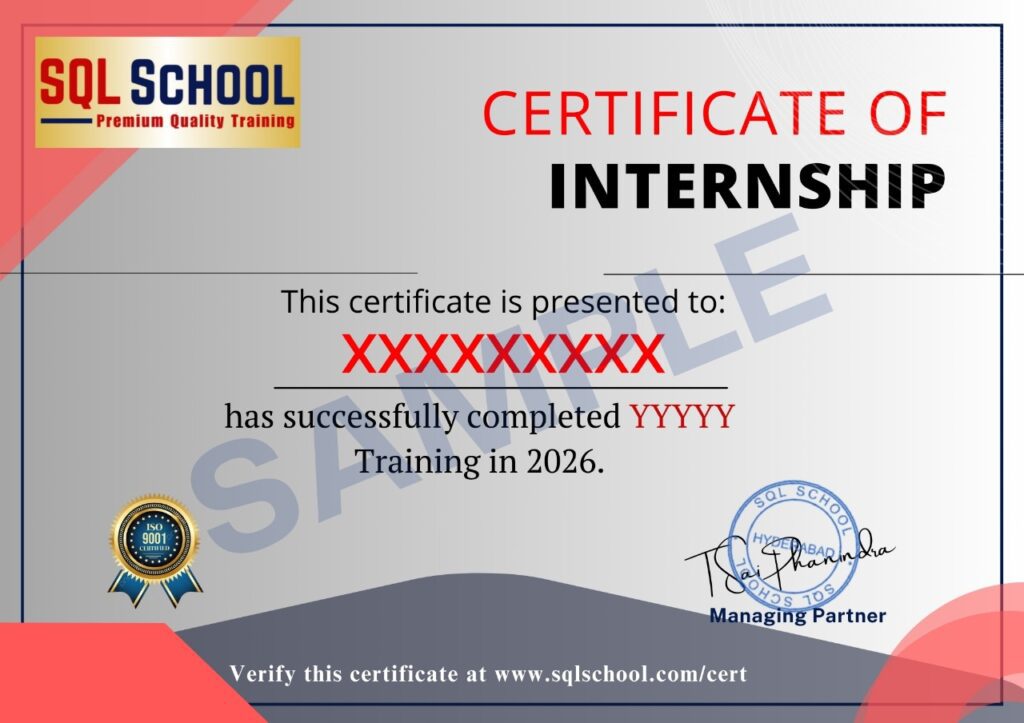
- Course Completion Certificate
- Placement Assistance
- Job Support