PySpark Cheat Sheet: Complete Beginner’s Guide to Data Engineering
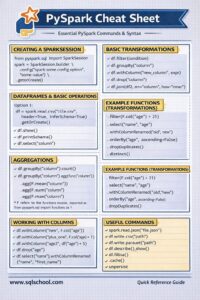
In today’s data-driven world, the demand for skilled Data Engineers is rapidly increasing. One of the most powerful tools in this domain is PySpark, a Python-based API for Apache Spark that enables large-scale data processing with speed and efficiency. If you are starting your journey in data engineering, having a quick reference guide can make learning faster and more practical. This PySpark Cheat Sheet is designed to simplify core concepts and help you get hands-on with real-time data processing.
Getting Started with PySpark
The first step in working with PySpark is creating a SparkSession. It acts as the entry point for all Spark functionalities. With just a few lines of code, you can initialize a session and start processing data. This makes PySpark highly accessible for beginners who are familiar with Python.
Once your Spark session is ready, you can begin working with DataFrames, which are the backbone of PySpark. DataFrames allow you to handle structured data efficiently, similar to tables in SQL.
Working with DataFrames
PySpark makes it easy to load and manipulate data from various sources such as CSV, JSON, and Parquet files. For example, reading a CSV file with inferred schema and headers takes just a single command. After loading the data, you can quickly explore it using functions like:
- show() to preview data
- printSchema() to understand structure
- select() to fetch specific columns
These operations are essential for data exploration and initial analysis.
Transformations in PySpark
Transformations are operations that create a new DataFrame from an existing one. They are lazy, meaning they are not executed until an action is triggered. Some commonly used transformations include:
- filter() to apply conditions
- groupBy() to group data
- withColumn() to create or modify columns
- drop() to remove columns
- join() to combine multiple datasets
These transformations allow you to clean, reshape, and prepare data for analysis or machine learning.
Aggregations for Insights
Aggregation functions are used to summarize data. With PySpark, you can easily calculate metrics such as count, sum, mean, and maximum values. Using groupBy along with aggregation functions helps you derive meaningful insights from large datasets.
For example, you can group data by a column and calculate averages or totals, which is commonly used in business analytics and reporting.
Column Operations Made Simple
Handling columns is a crucial part of data engineering. PySpark provides flexible methods to:
- Create new columns
- Modify existing ones
- Rename columns
- Drop unnecessary fields
You can also perform arithmetic operations on columns, making it easy to derive new features from existing data.
Useful Commands for Real-Time Processing
Beyond transformations and aggregations, PySpark offers several utility functions that improve performance and usability:
- Reading JSON files for semi-structured data
- Writing data into CSV or Parquet formats
- Using describe() for statistical summaries
- Handling missing values with fillna()
- Improving performance with cache() and unpersist()
These commands are especially useful when working on real-time data pipelines and big data applications.
Why Learn PySpark?
PySpark is widely used in industries for handling massive datasets efficiently. It is a must-have skill for aspiring Data Engineers, Data Analysts, and Developers. Its integration with big data tools and cloud platforms makes it highly valuable in modern data ecosystems.
Conclusion
This PySpark Cheat Sheet serves as a quick reference to help you understand and apply essential concepts in real-world scenarios. Whether you are preparing for interviews, working on projects, or building a career in data engineering, mastering these basics will give you a strong foundation.
Consistent practice and hands-on projects are key to becoming proficient in PySpark. Start small, experiment with datasets, and gradually move toward building scalable data pipelines.
For hands-on training, real-time projects, and expert guidance, you can explore structured learning programs and take your data engineering skills to the next level.
Ready to Master Databricks and Become a Job-Ready Data Engineer?
Join SQL School — India’s most trusted platform for real-time Databricks Data Engineering training.
✅ Learn Databricks, Apache Spark, PySpark, and Delta Lake step-by-step
✅ Build real-time ETL pipelines and big data processing solutions
✅ Work on cloud platforms (Azure/AWS) with hands-on labs
✅ Master data transformation, optimization, and performance tuning
✅ Perfect for Data Engineers, Developers, and Cloud Professionals
🎯 Gain in-demand skills used by top companies for big data and analytics!
📞 Call now at +91 9666640801
🌐 Visit 👉 www.sqlschool.com for a FREE demo session!
SQL School – Your Real-Time Launchpad to Databricks Data Engineering Success.
#PySpark #BigData #DataEngineering #ApacheSpark #LearnPySpark #DataAnalytics #SQLSchool #CareerGrowth
