
Cloud Architect Job Role: Skills, Responsibilities and Career Path
Cloud computing has transformed the way organizations build, deploy, and manage applications. Businesses are rapidly moving their infrastructure to cloud platforms to improve scalability, security, and efficiency. Because of this shift, the demand for skilled Cloud Architects has increased dramatically across industries.
A Cloud Architect is responsible for creating scalable, secure, and cost-efficient cloud infrastructures while ensuring that applications run smoothly in the cloud environment. Companies rely on cloud architects to make critical decisions about cloud platforms, architecture design, and long-term cloud strategies.
Who is a Cloud Architect?
A Cloud Architect is an IT professional who designs, implements, and manages cloud computing solutions. They act as the bridge between business needs and cloud technology.
Cloud architects plan how applications, databases, networking, and security components will work together in a cloud environment. They ensure that cloud solutions are reliable, scalable, and optimized for performance.
Most modern organizations use major cloud platforms such as
- Amazon Web Services
- Microsoft Azure
- Google Cloud
A Cloud Architect must understand how to design solutions using these platforms while following best practices for cost optimization, security, and performance.
Key Responsibilities of a Cloud Architect
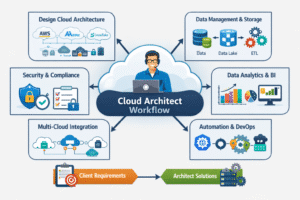
1. Designing Cloud Architecture
The primary responsibility of a cloud architect is designing the overall cloud architecture for an organization. This includes selecting the right cloud services, designing infrastructure layouts, and defining how applications will run in the cloud. They also decide whether the organization should use a public cloud, private cloud, or hybrid cloud architecture.
2. Cloud Migration Planning
Many organizations move their applications from on-premises infrastructure to the cloud. A cloud architect designs migration strategies to ensure a smooth transition. This involves analyzing existing systems, identifying dependencies, and planning the migration process without disrupting business operations.
3. Ensuring Cloud Security
Security is one of the most important responsibilities of a cloud architect. They design secure cloud environments that protect sensitive data and prevent unauthorized access.
This includes implementing identity management, encryption, network security policies, and compliance frameworks.
4. Cost Optimization
Cloud platforms operate on a pay-as-you-go model. Without proper management, cloud costs can increase rapidly. Cloud architects monitor resource usage and implement strategies such as auto-scaling, resource optimization, and storage management to reduce costs.
5. Performance and Scalability
Modern applications must handle increasing user demand. Cloud architects design systems that automatically scale resources based on traffic. This ensures that applications remain fast and reliable even during peak usage.
6. Collaboration with Development Teams
Cloud architects work closely with developers, DevOps engineers, and data engineers. They guide development teams on how to build applications that follow cloud architecture best practices.
They also help implement CI/CD pipelines and automation tools to improve development workflows.
Essential Skills Required for a Cloud Architect
To become a successful cloud architect, professionals need a combination of technical knowledge and strategic thinking.
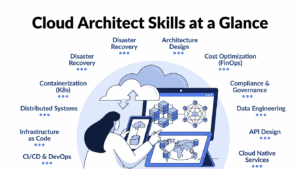
1. Cloud Platform Expertise
A cloud architect must have deep knowledge of cloud platforms such as:
- Amazon Web Services
- Microsoft Azure
- Google Cloud
Understanding services related to computing, networking, storage, and databases is essential.
2. Networking Knowledge
Cloud environments rely heavily on networking concepts such as virtual networks, load balancers, firewalls, and VPN connections. A strong understanding of networking is crucial for designing secure and reliable systems.
3. DevOps and Automation
Cloud architects often work with DevOps practices. Knowledge of tools such as Docker, Kubernetes, and CI/CD pipelines helps in automating application deployment and infrastructure provisioning.
4. Database and Data Management
Cloud architects should understand both relational and non-relational databases. This helps them design scalable data architectures that support analytics, transactions, and real-time applications.
Certifications for Cloud Architects
Certifications help professionals validate their cloud architecture skills and increase their career opportunities. Some of the most popular certifications include:
- AWS Certified Solutions Architect
- Microsoft Certified: Azure Solutions Architect Expert
- Google Professional Cloud Architect
These certifications focus on cloud design principles, security, infrastructure management, and cost optimization.
Cloud Architect Salary and Demand
The demand for cloud architects is growing rapidly as companies continue to adopt cloud computing. Organizations across industries including finance, healthcare, retail, and technology require cloud experts who can design secure and scalable cloud infrastructures.
In India, experienced cloud architects can earn salaries ranging from ₹25 LPA to ₹60 LPA depending on experience and certifications. Globally, cloud architects are among the highest-paid IT professionals.
Frequently Asked Questions:
1. What is the difference between a Cloud Architect and a Cloud Engineer?
Architects are the strategic “planners” who design the high-level infrastructure blueprint and select cloud vendors to meet business goals. Engineers are the “builders” who handle the hands-on implementation, coding, and day-to-day management of those designs. The architect focuses on the “what” and “why,” while the engineer focuses on the “how” and the technical execution.
2. Is coding required for a Cloud Architect?
While you may not build applications, you must be proficient in Infrastructure as Code (IaC) to automate environment deployments. Knowledge of tools like Terraform or Pulumi is essential for defining infrastructure through code rather than manual configuration. A strong grasp of scripting languages like Python or Bash is also necessary for automating architectural patterns and workflows.
3. How do Cloud Architects handle “Cloud Sprawl” and high costs?
Architects combat sprawl by implementing strict tagging policies and governance to track and account for every resource used. They utilize automated scaling and right-sizing to ensure the organization only pays for the computing power it actually needs. Continuous monitoring and “Well-Architected Reviews” are used to identify and eliminate wasted resources or inefficient configurations.
4. What role does Artificial Intelligence play in modern Cloud Architecture?
Architects now design “AI-ready” infrastructures by selecting specialized compute instances (GPUs) and managing high-speed data pipelines for model training. They integrate native AI services, like Amazon SageMaker or Azure AI, directly into the application workflow to enhance functionality. Security and cost become even more critical here, as AI workloads can be incredibly resource-intensive and expensive if unmonitored.
5. How has the “DevOps” movement changed the Cloud Architect’s job?
The line between architecture and operations has blurred, requiring architects to design for continuous integration and continuous deployment (CI/CD) pipelines. They must ensure the infrastructure is modular and compatible with automated testing and deployment tools like Jenkins or GitHub Actions. This shift means architects spend less time on static diagrams and more time on dynamic, automated system lifecycles.
Conclusion
The Cloud Architect role is one of the most important positions in modern IT infrastructure. These professionals design the foundation on which cloud applications run. Their expertise ensures that organizations can build scalable, secure, and cost-effective systems in the cloud.
With the growing adoption of cloud platforms worldwide, the demand for skilled cloud architects will continue to rise. For IT professionals looking to advance their careers, learning cloud architecture and gaining hands-on experience with platforms like Azure, AWS, or Google Cloud can open the door to exciting opportunities in the technology industry.
Ready to Become a Certified Cloud Architect and Design Scalable Cloud Solutions?
Join SQL School — India’s trusted platform for real-time Cloud Architect training with hands-on cloud projects.
✅ Learn Azure , AWS & Fabric cloud architecture fundamentals
✅ Master cloud networking, security, storage, and scalability
✅ Design enterprise-level cloud infrastructures and solutions
✅ Work on real-time case studies and architecture scenarios
✅ Perfect for IT professionals, developers, and DevOps engineers
🚀 Build the skills needed to architect modern, secure, and scalable cloud platforms.
📞 Call now at +91 9666640801
🌐 Visit 👉 www.sqlschool.com for a FREE demo session!
SQL School – Your Real-Time Guide to Cloud Architecture Excellence.
#CloudArchitect#CloudArchitecture#CloudComputing#CloudTechnology#CloudEngineering#CloudInfrastructure#CloudSolutions#Azure #CloudSecurity#CloudMigration#CloudStrategy#AWS#GoogleCloud#AWSArchitecture#AzureCloud#GCP
Trainer: Mr. Sai Phanindra
With 19+ Years of
technical expertise exclusively on SQL & Database Technologies, I assure you 100% Practical, Step by Step Classes.
Linkdin Profile: www.linkedin.com/in/saiphanindra/
Contact No: +91 9030040801 or +91 9666640801
